India’s quiet reaction to Ayatollah Khamenei’s death can be explained in simple language using ideas from realism in International Relations, which says countries mainly act to protect their national interest and power.
A leader who often criticised India
Ayatollah Khamenei was important for Iran, but his words on India were often negative.
-
In 2017, he asked the Muslim world to support “oppressed Muslims of Kashmir,” echoing Pakistan’s stand on a very sensitive issue for India.
-
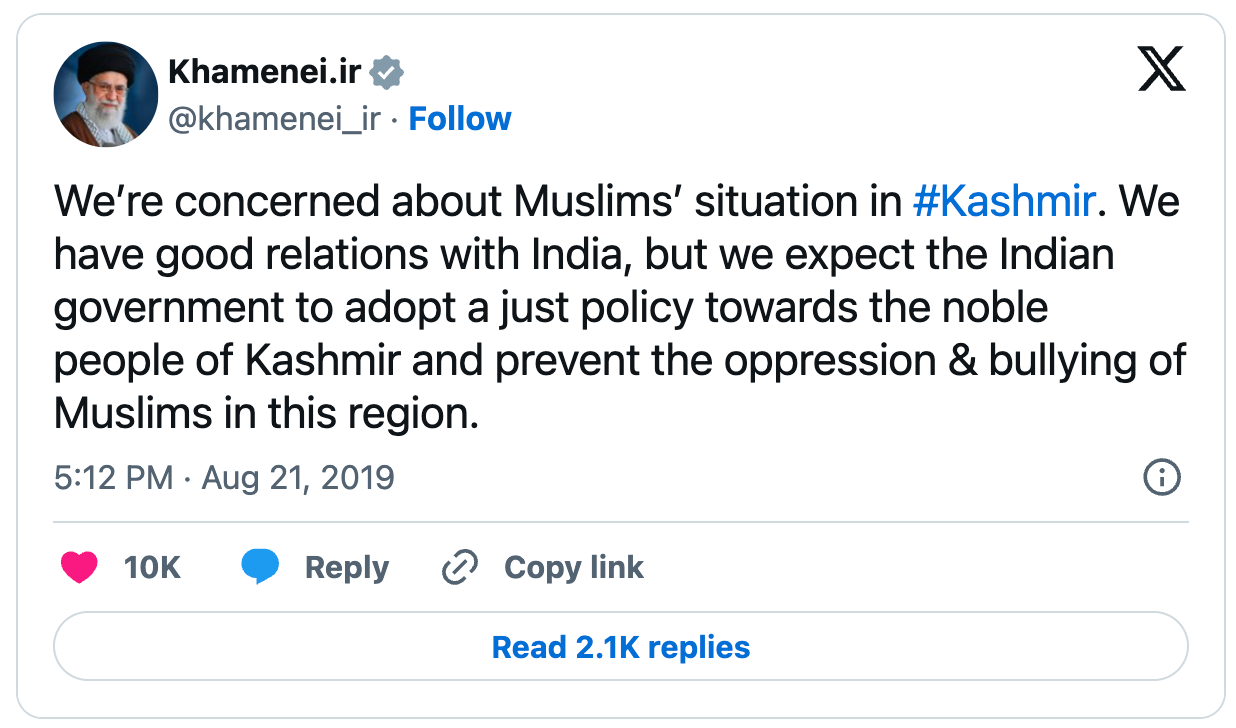
After Article 370 was removed in 2019, he again spoke about Kashmir and demanded a “just policy,” which India saw as interference.
-
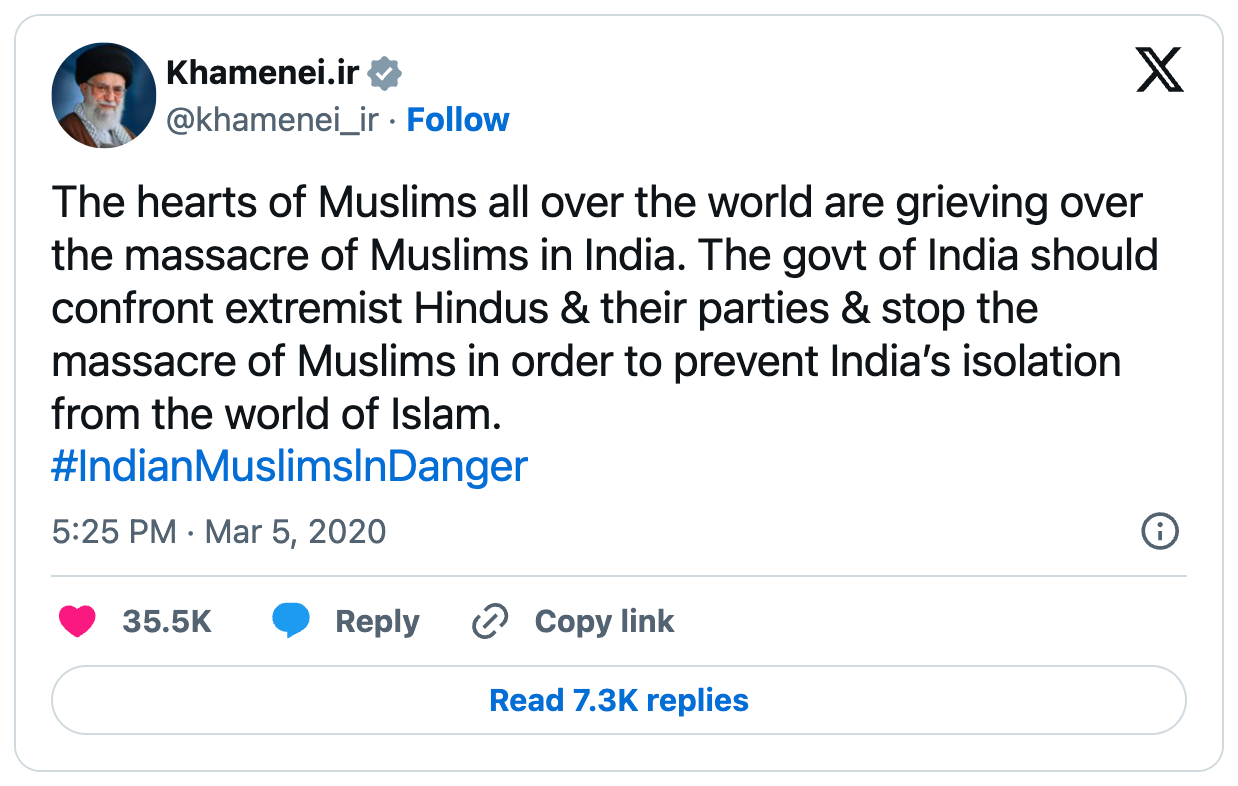
During the CAA protests and Delhi riots in 2020, he accused India of a “massacre” of Muslims and attacked “extremist Hindus.”
So, even though India and Iran had ties based on culture, energy, and geography, Khamenei’s repeated public criticism made him a controversial figure inside India.
How India balanced protest and cooperation
Each time Khamenei commented on Kashmir or CAA, India called in the Iranian ambassador and clearly said that Kashmir and citizenship laws are internal matters. At the same time, India did not break ties with Iran. It continued to work on:
-
Oil trade when sanctions allowed.
-
The Chabahar port, which gives India access to Afghanistan and Central Asia without going through Pakistan.
This is a classic example of realism: India defended its sovereignty in public, but kept cooperation where it served national interest. Realist theory says states can disagree on values or statements but still work together when interests match.
Silence as a deliberate signal
When Khamenei died, the Indian government did not issue a big public condolence message. Opposition leaders like Sonia Gandhi criticised this as going against India’s tradition of honouring major world leaders. But in realist terms, the government seems to have calculated three things:
-
A warm tribute to a leader who repeatedly criticised India on Kashmir and CAA would look inconsistent and could upset many Indians.
-
Any strong statement—whether very positive or very negative—could be read by the US, Israel, Gulf states, and Iran as India taking sides in a tense West Asia situation.]
-
Silence avoids sending the wrong signal abroad while also avoiding domestic controversy.
Realism helps explain this: states often use silence or very careful words as tools of foreign policy. The goal is to protect security, economic interests, and room for manoeuvre, not to express emotion.
Domestic politics and international image
Inside India, Khamenei’s remarks were used by both sides in domestic politics.
-
Critics of the government cited his words on Muslims and Kashmir as outside “proof” of their concerns.
-
Supporters saw his statements as foreign interference that lined up with Pakistan’s narrative.
The government’s silence fits its broader line that India will not accept “lectures” on internal matters from Western countries or from religious leaders in the Muslim world. Opposition, on the other hand, argues that such silence damages India’s image as a bridge between different regions.
Here, another political science idea appears: two-level games. This theory says governments always juggle two tables at once—global diplomacy and domestic politics. India’s leaders had to think about:
-
How Iran, the US, Gulf countries, and others would read any message.
-
How Indian voters, especially on sensitive issues like Kashmir and CAA, would react.
A realist reset in India–Iran ties
Looking ahead, India and Iran still need each other for energy, regional stability, and connectivity through Chabahar. But India is less willing to overlook public criticism from Tehran’s top leadership. Under realism, states try to separate the state-to-state relationship from the personal legacy of one leader when it suits their interest.
India’s quiet reaction, seen through realist theory, is not just avoidance; it is a calculated reset. India is signalling that:
-
It respects Iran as a state and a people.
-
It will protect its core interests and dignity when leaders speak against it.
-
Future relations will be based more on clear interests than on emotional or ideological language.
Recent Posts
- In the Large States category (overall), Chhattisgarh ranks 1st, followed by Odisha and Telangana, whereas, towards the bottom are Maharashtra at 16th, Assam at 17th and Gujarat at 18th. Gujarat is one State that has seen startling performance ranking 5th in the PAI 2021 Index outperforming traditionally good performing States like Andhra Pradesh and Karnataka, but ranks last in terms of Delta
- In the Small States category (overall), Nagaland tops, followed by Mizoram and Tripura. Towards the tail end of the overall Delta ranking is Uttarakhand (9th), Arunachal Pradesh (10th) and Meghalaya (11th). Nagaland despite being a poor performer in the PAI 2021 Index has come out to be the top performer in Delta, similarly, Mizoram’s performance in Delta is also reflected in it’s ranking in the PAI 2021 Index
- In terms of Equity, in the Large States category, Chhattisgarh has the best Delta rate on Equity indicators, this is also reflected in the performance of Chhattisgarh in the Equity Pillar where it ranks 4th. Following Chhattisgarh is Odisha ranking 2nd in Delta-Equity ranking, but ranks 17th in the Equity Pillar of PAI 2021. Telangana ranks 3rd in Delta-Equity ranking even though it is not a top performer in this Pillar in the overall PAI 2021 Index. Jharkhand (16th), Uttar Pradesh (17th) and Assam (18th) rank at the bottom with Uttar Pradesh’s performance in line with the PAI 2021 Index
- Odisha and Nagaland have shown the best year-on-year improvement under 12 Key Development indicators.
- In the 60:40 division States, the top three performers are Kerala, Goa and Tamil Nadu and, the bottom three performers are Uttar Pradesh, Jharkhand and Bihar.
- In the 90:10 division States, the top three performers were Himachal Pradesh, Sikkim and Mizoram; and, the bottom three performers are Manipur, Assam and Meghalaya.
- Among the 60:40 division States, Orissa, Chhattisgarh and Madhya Pradesh are the top three performers and Tamil Nadu, Telangana and Delhi appear as the bottom three performers.
- Among the 90:10 division States, the top three performers are Manipur, Arunachal Pradesh and Nagaland; and, the bottom three performers are Jammu and Kashmir, Uttarakhand and Himachal Pradesh
- Among the 60:40 division States, Goa, West Bengal and Delhi appear as the top three performers and Andhra Pradesh, Telangana and Bihar appear as the bottom three performers.
- Among the 90:10 division States, Mizoram, Himachal Pradesh and Tripura were the top three performers and Jammu & Kashmir, Nagaland and Arunachal Pradesh were the bottom three performers
- West Bengal, Bihar and Tamil Nadu were the top three States amongst the 60:40 division States; while Haryana, Punjab and Rajasthan appeared as the bottom three performers
- In the case of 90:10 division States, Mizoram, Assam and Tripura were the top three performers and Nagaland, Jammu & Kashmir and Uttarakhand featured as the bottom three
- Among the 60:40 division States, the top three performers are Kerala, Andhra Pradesh and Orissa and the bottom three performers are Madhya Pradesh, Jharkhand and Goa
- In the 90:10 division States, the top three performers are Mizoram, Sikkim and Nagaland and the bottom three performers are Manipur and Assam
In a diverse country like India, where each State is socially, culturally, economically, and politically distinct, measuring Governance becomes increasingly tricky. The Public Affairs Index (PAI 2021) is a scientifically rigorous, data-based framework that measures the quality of governance at the Sub-national level and ranks the States and Union Territories (UTs) of India on a Composite Index (CI).
States are classified into two categories – Large and Small – using population as the criteria.
In PAI 2021, PAC defined three significant pillars that embody Governance – Growth, Equity, and Sustainability. Each of the three Pillars is circumscribed by five governance praxis Themes.
The themes include – Voice and Accountability, Government Effectiveness, Rule of Law, Regulatory Quality and Control of Corruption.
At the bottom of the pyramid, 43 component indicators are mapped to 14 Sustainable Development Goals (SDGs) that are relevant to the States and UTs.
This forms the foundation of the conceptual framework of PAI 2021. The choice of the 43 indicators that go into the calculation of the CI were dictated by the objective of uncovering the complexity and multidimensional character of development governance

The Equity Principle
The Equity Pillar of the PAI 2021 Index analyses the inclusiveness impact at the Sub-national level in the country; inclusiveness in terms of the welfare of a society that depends primarily on establishing that all people feel that they have a say in the governance and are not excluded from the mainstream policy framework.
This requires all individuals and communities, but particularly the most vulnerable, to have an opportunity to improve or maintain their wellbeing. This chapter of PAI 2021 reflects the performance of States and UTs during the pandemic and questions the governance infrastructure in the country, analysing the effectiveness of schemes and the general livelihood of the people in terms of Equity.


Growth and its Discontents
Growth in its multidimensional form encompasses the essence of access to and the availability and optimal utilisation of resources. By resources, PAI 2021 refer to human resources, infrastructure and the budgetary allocations. Capacity building of an economy cannot take place if all the key players of growth do not drive development. The multiplier effects of better health care, improved educational outcomes, increased capital accumulation and lower unemployment levels contribute magnificently in the growth and development of the States.


The Pursuit Of Sustainability
The Sustainability Pillar analyses the access to and usage of resources that has an impact on environment, economy and humankind. The Pillar subsumes two themes and uses seven indicators to measure the effectiveness of government efforts with regards to Sustainability.


The Curious Case Of The Delta
The Delta Analysis presents the results on the State performance on year-on-year improvement. The rankings are measured as the Delta value over the last five to 10 years of data available for 12 Key Development Indicators (KDI). In PAI 2021, 12 indicators across the three Pillars of Equity (five indicators), Growth (five indicators) and Sustainability (two indicators). These KDIs are the outcome indicators crucial to assess Human Development. The Performance in the Delta Analysis is then compared to the Overall PAI 2021 Index.
Key Findings:-
In the Scheme of Things
The Scheme Analysis adds an additional dimension to ranking of the States on their governance. It attempts to complement the Governance Model by trying to understand the developmental activities undertaken by State Governments in the form of schemes. It also tries to understand whether better performance of States in schemes reflect in better governance.
The Centrally Sponsored schemes that were analysed are National Health Mission (NHM), Umbrella Integrated Child Development Services scheme (ICDS), Mahatma Gandh National Rural Employment Guarantee Scheme (MGNREGS), Samagra Shiksha Abhiyan (SmSA) and MidDay Meal Scheme (MDMS).
National Health Mission (NHM)
INTEGRATED CHILD DEVELOPMENT SERVICES (ICDS)
MID- DAY MEAL SCHEME (MDMS)
SAMAGRA SHIKSHA ABHIYAN (SMSA)
MAHATMA GANDHI NATIONAL RURAL EMPLOYMENT GUARANTEE SCHEME (MGNREGS)