


Background:-
After the infamous 2012 gang rape of a student on a bus in Delhi, the number of rape cases reported to police in India rose sharply. But one survey concluded that in Delhi, in 2013-14, more than half of these reports were “false” – fuelling claims by male activists that women are alleging rape in order to extort money from men.
The Story:-
Yogesh Gupta always knew he had evidence that could prove, indisputably, he was not a rapist, but getting the police to recognise his innocence was another matter.
The 44-year-old Delhi estate agent’s troubles began after he caught an employee embezzling money and threatened to go to the police.
The employee reacted by coercing a woman to pose as a potential house buyer who, after viewing a property, asked Gupta for a lift to the local metro station. She later accused him of driving her to an empty fourth floor apartment and raping her.
“Thankfully I had CCTV installed in my office,” he says.
“The whole process of taking the stairs to the fourth floor, opening the flat, taking her inside, then getting out and dropping her at the metro station would have taken at least 37 – 40 minutes.
“I could prove I was back in my office within 11 minutes.”
But when the woman registered her complaint to the police, Gupta found himself caught up in a system that seemed to care little about the evidence and a lot about branding him a criminal.
“Nobody listened to what I had to say,” he says. “The police didn’t even consult me. I tried everything, but I didn’t get justice.”
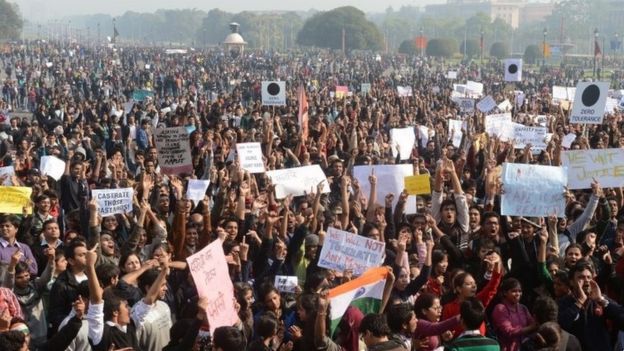
The gang-rape and murder of a student in Delhi in 2012 provoked mass protests
For the next eight months as the police investigation continued, Gupta had to endure the public disgrace of being accused of rape.
“I can’t even begin to explain the ordeal that my wife, kids, my father and brother had to go through,” he says.
“My children have had the toughest time. My daughter, who is just six years old, would write letters to god pleading to spare her father.”
When the case finally went to court, the woman confessed she had made up the accusation and Gupta was acquitted, but much damage had already been done.
Gupta sees himself as a victim of what men’s rights campaigners say is a growing problem – the false allegations of rape – and it’s one that some argue stems directly from the 2012 Delhi gang rape.
As graphic details of the brutal attack were made public, protesters took to the streets to demand changes to India’s deeply patriarchal society which they said ignores or even encourages violence against women.
The media responded with a spike in reports of sexual assault, particularly violent assaults by strangers, and the government widened the definition of rape, made it mandatory for police to register all complaints and introduced special fast-track courts.
This in turn encouraged more women to report sexual violence, with the number of cases registered in Delhi rising by more than 100% in the year after the 2012 gang-rape
All these developments were widely welcomed as positive steps to tackle sexual violence.
The Report:-
But when a body called the Delhi Commission for Women published a report in 2014 describing 53% of rapes reported in the city the previous year as “false” this was seized upon by men’s rights activists as evidence that the legal changes and noisy public debate had ended up making victims out of men.
Today the definition of rape has changed so much and anything and everything is reported as rape.”Of all the rape cases that are registered, only 1% is genuine,” says Gupta’s lawyer, Vinay Sharma, who regularly defends men accused of rape in Delhi.
“The rest are either registered to take revenge or to take advantage of the person in some financial matter,” he says.
Men’s rights activist Partha Sadhukhan takes a similar view.
“The reality at that point in time was that India had enough stringent laws to curb rape and punish the offenders,” he says.
“Today the definition of rape has changed so much and anything and everything is reported as rape.”
But are they right?
The evidence from the Commission for Women is in fact far from conclusive. It classes as “false” all reports of rape that were dropped before they reached court, without analysing the reasons why.
So it doesn’t distinguish between cases dropped because it was clear the woman was lying and those where a woman was put under pressure to withdraw her claim – or where there was simply insufficient evidence to build a strong case. Forensic evidence is rarely used in Indian rape cases, so it’s often just his word against hers.
The Reporter:-
One person who decided to do her own investigation was data journalist Rukmini Shrivanasan.
When she moved to Delhi from Mumbai to take up a post at The Hindu newspaper, she wanted to know whether Delhi’s reputation as the rape capital of India was justified.
Instead of counting dropped rape cases, she looked at the 460 cases that went to a full trial in Delhi district courts in 2013 and compared the initial complaint made to police with what happened in court.
Her first discovery was that the media’s alarm about stranger rape was overblown.Families are more willing to have the stigma of rape rather than having the stigma of their daughter choosing her own sex or life partner.
“Stranger rape, the thing that gets most highly reported in India, was an absolutely tiny category,” she says. It accounted for just 12 of the 460 cases.
On the question of false rape, her findings were mixed.
More than one third of the 460 cases involved young people who had engaged in consensual sex outside marriage until their parents found out and used the criminal justice system to end the relationship.
“Families are more willing to have the stigma of rape rather than having the stigma of their daughter choosing her own sex or life partner,” she says.
Shrivanasan found that many of these cases dealt with inter-caste or mixed-religion relationships which are considered taboo in conservative society. There was often a typical script that was used when parents filed the case with the police.
“I was repeatedly seeing stories of women being picked up in moving cars, being given a cold drink laced with sedatives which would render them unconscious, and then they would be raped,” she said.
“But when I started reading more and more cases I realised that there are patterns to how complaints are filed. So this sedative-laced drink becomes important because it is necessary to show that consent was not given.”
Another large category – nearly a quarter of the total – were cases where the man had broken his promise to marry the woman.
Although this would not be considered rape in many countries, in India a man can be charged with falsely obtaining consent for sex if he promises to marry a woman and then changes his mind.
Although there has been a jump in rape reporting since the Delhi gang-rape, there are still many cases that go unreported
What she did not find was any cases like Yogesh Gupta’s, where a woman had filed a case maliciously or to extort money.
“In some cases it would be the argument of the defence that the woman was trying to abstract money,” she says. “But I cannot think of a case where this was proven.”
While Shrivanasan’s study would appear to indicate that the proportion of false rape cases in Delhi is high by international standards – in more than one country, researchers have put the proportion of false rape claims at about 8% of the total – academic Nithya Nagarathinam argues that this is a distraction from a more pressing issue, the under-reporting of rape.
“Although there has been a jump in rape reporting since the Delhi gang-rape, there are still many cases that go unreported and there are so many reasons for that,” she says, pointing to traditional patriarchal structures that mean violence against women is consistently downplayed.
“That is a more serious issue to me than a few cases where the parents have probably wrongly accused the man.”
Nagarathinam cites a 2014 study using data from the Indian National Crime Records Bureau and the National Family Health Surveys that suggests only 6% of incidents of sexual violence against women are reported to the police.
She insists India needs better data, to understand the scale and nature of the problem.
“If you don’t have hard data to base your arguments on, the result is the emotion-driven men’s rights versus women’s rights arguments that are going on now,” she says.
However big Delhi’s false rape problem may be, Yogesh Gupta can attest to the powerful stigma of being falsely identified as sexual predator.
“The allegation of rape has affected my social status,” he says.
“Even if one is acquitted, one cannot regain that status. You can’t prove your innocence to each and every person. People are quick to judge in a rape case without even knowing whether the person is guilty or not.”