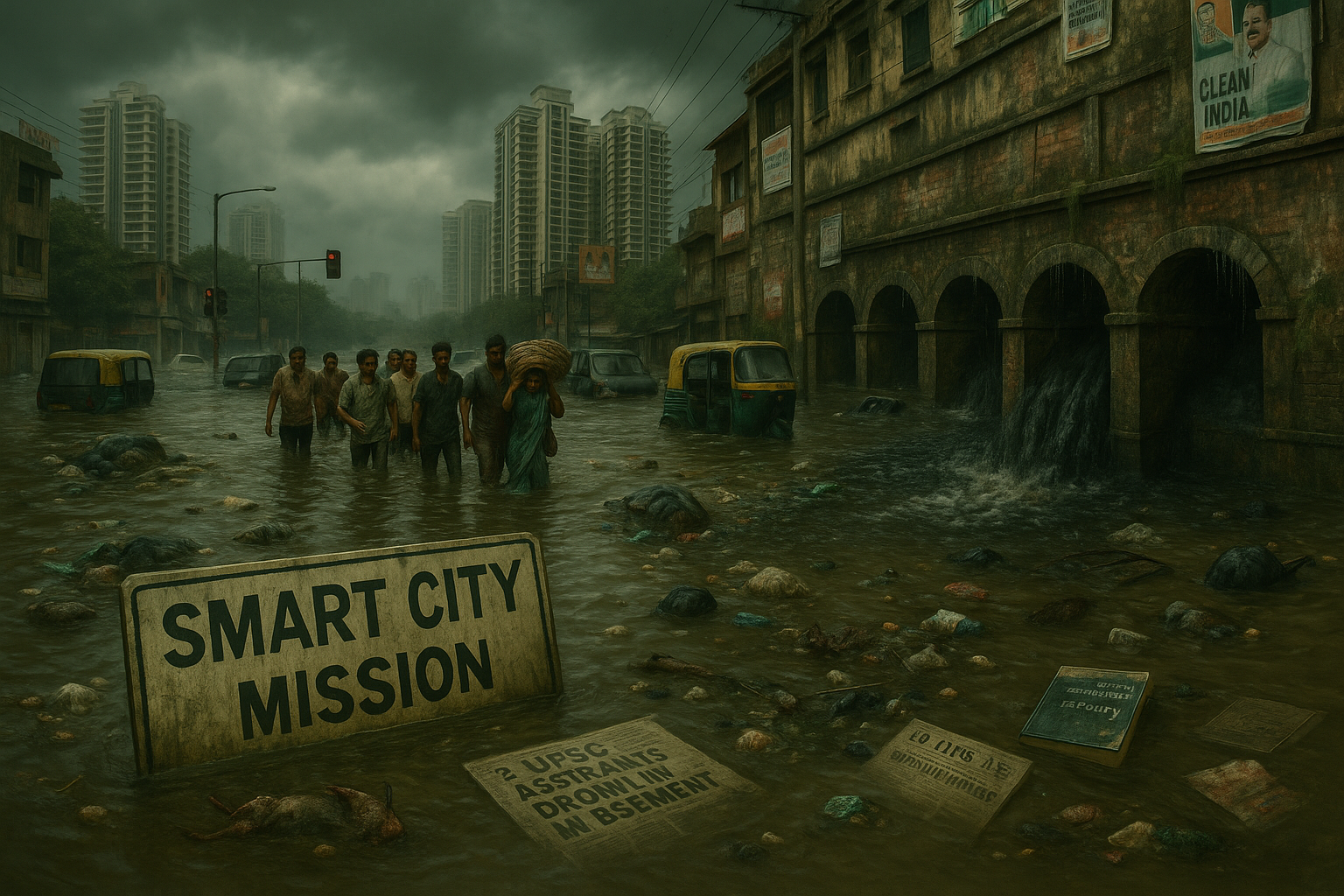
💧 A Nation Sinking in Its Own Waste

Even after 75 years of independence, over 70% of Indian cities lack basic sewage and garbage disposal systems. Cities with billion-dollar valuations, skyscrapers, and “smart city” tags cannot move water off their streets during rains.

Why? Because India doesn’t just have a drainage crisis—it has a governance catastrophe.

Delhi’s drains, meant for 38 million people, serve only half that number. Bengaluru, which generates 1,800 million litres of sewage daily, treats just 30%. The rest flows into streets and lakes.

Mumbai’s 160-year-old British-era drainage system gasps under 22 million bodies and billions in real estate greed. And when disaster strikes—as it did in Old Rajendra Nagar in July 2024—it kills not just bodies, but dreams.

Three young aspirants, preparing for the civil services, drowned in a flooded basement. The country never noticed.

🌪️ When the System Itself Is the Killer

Let’s be clear: this is not just poor planning—it’s systemic betrayal. Cities have turned rivers into sewage dumps. The Yamuna carries 2.9 billion litres of untreated waste daily.

Mumbai’s Mithi River has been narrowed by over 50% due to slums and encroachments.

Bengaluru’s Vrishabhawathi is now a black river of corporate sewage. Of India’s 603 assessed rivers, 46% are severely polluted, as per a 2025 report.

Floodplains have been devoured by highways, malls, and luxury apartments. Wetlands, nature’s own flood buffers, have been erased.

Since 1990, India has lost 40% of its wetlands. Chennai’s Pallikaranai marsh, once 5,500 hectares, is now a tenth of that, sacrificed for airport expansions. And when the rains come, the water has nowhere to go—except into people’s homes, lungs, and coffins.

💸 The Price of Progress? Blood and Bribes

Corruption is the rot that drowns us. Desilting contracts worth ₹1,500 crore in Mumbai went to shell companies. Delhi’s ₹3,000 crore sewerage plan is stalled, its funds leaking like the city’s pipes.

Bengaluru’s AMRUT scheme met only 20% of its sewage targets—allegedly due to kickbacks and contractor-politician nexuses. The Namami Gange project, with ₹32,000 crore pumped in since 2014, has 68% of its sewage treatment plants non-functional.

While the elite race across global cities, the poor in India wade through filth and disease. In slums, where only 5% have piped water, life is reduced to a slow death.

🚨 Lessons from the World—and from Ourselves

Cities like Tokyo, Singapore, and New York have built systems to capture, clean, and reuse water. India, meanwhile, captures headlines—of avoidable death. Tokyo’s underground flood tanks can store 13 million gallons. New York’s drainage network is 10,600 km long and smart-monitored. Singapore’s green roofs and swales mimic nature. India builds expressways through floodplains and calls it development.

But hope glimmers: Indore’s waste model and Meghalaya’s Umngot River protection show transformation is possible. It demands rage. It demands reform. It demands accountability.

🔥 This is Not Climate Change. This Is Civic Collapse.

Each death in the floods is a murder by neglect. Each overflowing drain is an indictment of the state. Each lost dream is a reminder that urban India is not drowning—it’s being drowned.

So here’s what we must demand—today, not tomorrow:

  • Separate stormwater and sewage networks.
  • Enforce river reserve zones.
  • Restore wetlands like Pallikaranai and the Ganga’s floodplains.
  • Jail corrupt officials and contractors.
  • Upgrade infrastructure with citizen oversight, not just cement.

When the rains return, will we still pretend this is fate? Or will we rise—with fists, with votes, with voices—to ensure this flood is the last?


Share is Caring, Choose Your Platform!

Receive Daily Updates

Stay updated with current events, tests, material and UPSC related news

Recent Posts

  • Steve Ovett, the famous British middle-distance athlete, won the 800-metres gold medal at the Moscow Olympics of 1980. Just a few days later, he was about to win a 5,000-metres race at London’s Crystal Palace. Known for his burst of acceleration on the home stretch, he had supreme confidence in his ability to out-sprint rivals. With the final 100 metres remaining,

    [wptelegram-join-channel link=”https://t.me/s/upsctree” text=”Join @upsctree on Telegram”]

    Ovett waved to the crowd and raised a hand in triumph. But he had celebrated a bit too early. At the finishing line, Ireland’s John Treacy edged past Ovett. For those few moments, Ovett had lost his sense of reality and ignored the possibility of a negative event.

    This analogy works well for the India story and our policy failures , including during the ongoing covid pandemic. While we have never been as well prepared or had significant successes in terms of growth stability as Ovett did in his illustrious running career, we tend to celebrate too early. Indeed, we have done so many times before.

    It is as if we’re convinced that India is destined for greater heights, come what may, and so we never run through the finish line. Do we and our policymakers suffer from a collective optimism bias, which, as the Nobel Prize winner Daniel Kahneman once wrote, “may well be the most significant of the cognitive biases”? The optimism bias arises from mistaken beliefs which form expectations that are better than the reality. It makes us underestimate chances of a negative outcome and ignore warnings repeatedly.

    The Indian economy had a dream run for five years from 2003-04 to 2007-08, with an average annual growth rate of around 9%. Many believed that India was on its way to clocking consistent double-digit growth and comparisons with China were rife. It was conveniently overlooked that this output expansion had come mainly came from a few sectors: automobiles, telecom and business services.

    Indians were made to believe that we could sprint without high-quality education, healthcare, infrastructure or banking sectors, which form the backbone of any stable economy. The plan was to build them as we went along, but then in the euphoria of short-term success, it got lost.

    India’s exports of goods grew from $20 billion in 1990-91 to over $310 billion in 2019-20. Looking at these absolute figures it would seem as if India has arrived on the world stage. However, India’s share of global trade has moved up only marginally. Even now, the country accounts for less than 2% of the world’s goods exports.

    More importantly, hidden behind this performance was the role played by one sector that should have never made it to India’s list of exports—refined petroleum. The share of refined petroleum exports in India’s goods exports increased from 1.4% in 1996-97 to over 18% in 2011-12.

    An import-intensive sector with low labour intensity, exports of refined petroleum zoomed because of the then policy regime of a retail price ceiling on petroleum products in the domestic market. While we have done well in the export of services, our share is still less than 4% of world exports.

    India seemed to emerge from the 2008 global financial crisis relatively unscathed. But, a temporary demand push had played a role in the revival—the incomes of many households, both rural and urban, had shot up. Fiscal stimulus to the rural economy and implementation of the Sixth Pay Commission scales had led to the salaries of around 20% of organized-sector employees jumping up. We celebrated, but once again, neither did we resolve the crisis brewing elsewhere in India’s banking sector, nor did we improve our capacity for healthcare or quality education.

    Employment saw little economy-wide growth in our boom years. Manufacturing jobs, if anything, shrank. But we continued to celebrate. Youth flocked to low-productivity service-sector jobs, such as those in hotels and restaurants, security and other services. The dependence on such jobs on one hand and high-skilled services on the other was bound to make Indian society more unequal.

    And then, there is agriculture, an elephant in the room. If and when farm-sector reforms get implemented, celebrations would once again be premature. The vast majority of India’s farmers have small plots of land, and though these farms are at least as productive as larger ones, net absolute incomes from small plots can only be meagre.

    A further rise in farm productivity and consequent increase in supply, if not matched by a demand rise, especially with access to export markets, would result in downward pressure on market prices for farm produce and a further decline in the net incomes of small farmers.

    We should learn from what John Treacy did right. He didn’t give up, and pushed for the finish line like it was his only chance at winning. Treacy had years of long-distance practice. The same goes for our economy. A long grind is required to build up its base before we can win and celebrate. And Ovett did not blame anyone for his loss. We play the blame game. Everyone else, right from China and the US to ‘greedy corporates’, seems to be responsible for our failures.

    We have lowered absolute poverty levels and had technology-based successes like Aadhaar and digital access to public services. But there are no short cuts to good quality and adequate healthcare and education services. We must remain optimistic but stay firmly away from the optimism bias.

    In the end, it is not about how we start, but how we finish. The disastrous second wave of covid and our inability to manage it is a ghastly reminder of this fact.