


India’s 7,500 km-long coastline is more than just a scenic boundary—it’s a hub of biodiversity, economy, culture, and climate resilience. But today, our coasts are under siege—from erosion, pollution, habitat destruction, and climate extremes.
🌊 India’s Coast: Beauty on the Brink
⚠️ Key Challenges Facing India’s Coasts
-
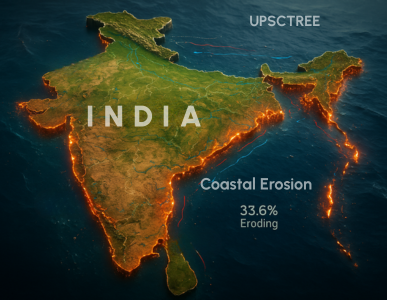
Coastal Erosion: About one-third of India’s coastline is eroding, with states like Tamil Nadu, Kerala, Karnataka, and West Bengal being most affected. Erosion is driven by natural processes (like cyclones and sea-level rise) and human activities such as urbanization, sand mining, and construction of coastal infrastructure. States like Karnataka (notably Dakshina Kannada district) have seen nearly half their coastline eroded in the last three decades, while Kerala’s Ernakulam coast battles relentless wave attacks and erosion worsened by port developments and sand dredging. This erosion leads to loss of land, displacement of communities, and damage to infrastructure.
-
Pollution: India’s coastal waters are heavily polluted by industrial effluents (accounting for nearly 40% of coastal water pollution), untreated sewage, plastic waste, and agricultural runoff. This pollution devastates marine biodiversity, threatens fisheries that millions depend on, and poses health risks to coastal populations. Despite existing laws like the Coastal Regulation Zone (CRZ) Notification and Plastic Waste Management Rules, enforcement remains weak, calling for stronger governance and community engagement.
-
Habitat Destruction: Critical coastal ecosystems such as mangroves, coral reefs, and wetlands, which act as natural buffers against storms and erosion, are being degraded by urbanization, port construction, and tourism. For example, the Sundarbans mangroves are vital for cyclone protection but are under threat from rising seas and human encroachment. Loss of these habitats reduces the coast’s resilience to climate shocks and biodiversity loss
-
Overexploitation of Resources: Unsustainable fishing practices, including illegal light fishing, have depleted marine life and undermined the livelihoods of traditional fishing communities.
-
Climate Change: Sea levels along India’s coast have risen by approximately 8.5 cm over the past 50 years, with projections warning of up to 1.2 meters rise by 2100 if greenhouse gas emissions continue unabated. This rise exacerbates flooding, saltwater intrusion, and habitat loss. Coastal megacities like Mumbai, Chennai, and Kolkata face severe risks of inundation, while rural communities, such as those in Odisha’s Satabhaya village, are already experiencing forced relocations due to repeated flooding and erosion.
-
Governance and Regulation: While India has a framework of laws and policies to protect its coasts, including CRZ notifications and environmental acts, enforcement gaps and outdated coastal maps hamper effective management. Coastal protective structures like seawalls and groynes are widely used but often insufficient or damaged, as seen in Kerala’s Ernakulam coasts. Innovative solutions such as geotubes have been introduced but require further evaluation.
Implementation of coastal regulations (like the Coastal Regulation Zone notifications) faces challenges due to weak enforcement, lack of coordination among agencies, and outdated mapping. The recent revision of India’s coastline length (now over 11,000 km) adds complexity to regulation and planning.
-
Socio-Economic Pressures: The erosion and climate impacts have led to the emergence of “ghost villages” along the east coast, where entire communities have abandoned homes due to environmental degradation. Villages like Uppada in Andhra Pradesh have lost hundreds of houses, markets, and schools to the sea, forcing large-scale migration. Livelihoods dependent on fishing and agriculture are severely disrupted by habitat destruction, salinization of soil, and declining fish stocks, threatening food security and economic stability
🔬 What Can Be Done?
1. Integrated Monitoring
- Use a real-time web of satellite, aerial, and ground data to understand the shifting coastline.
2. Eco-Restoration & Soft Engineering
- Replace concrete with nature: rebuild mangroves, coral reefs, dunes, and wetlands to protect coasts.
3. Smart Policy Backed by Science
- Move beyond ad-hoc solutions. Build science-informed policies using long-term coastal vulnerability models.
🧭 Final Thought:
“The coasts are not merely land meeting sea—they are living, breathing ecosystems on which millions depend.”
India’s coastal future demands more than short-term fixes. It needs an interdisciplinary, collaborative strategy—where technology meets tradition, and ecology shapes economy.
Recent Posts
- In the Large States category (overall), Chhattisgarh ranks 1st, followed by Odisha and Telangana, whereas, towards the bottom are Maharashtra at 16th, Assam at 17th and Gujarat at 18th. Gujarat is one State that has seen startling performance ranking 5th in the PAI 2021 Index outperforming traditionally good performing States like Andhra Pradesh and Karnataka, but ranks last in terms of Delta
- In the Small States category (overall), Nagaland tops, followed by Mizoram and Tripura. Towards the tail end of the overall Delta ranking is Uttarakhand (9th), Arunachal Pradesh (10th) and Meghalaya (11th). Nagaland despite being a poor performer in the PAI 2021 Index has come out to be the top performer in Delta, similarly, Mizoram’s performance in Delta is also reflected in it’s ranking in the PAI 2021 Index
- In terms of Equity, in the Large States category, Chhattisgarh has the best Delta rate on Equity indicators, this is also reflected in the performance of Chhattisgarh in the Equity Pillar where it ranks 4th. Following Chhattisgarh is Odisha ranking 2nd in Delta-Equity ranking, but ranks 17th in the Equity Pillar of PAI 2021. Telangana ranks 3rd in Delta-Equity ranking even though it is not a top performer in this Pillar in the overall PAI 2021 Index. Jharkhand (16th), Uttar Pradesh (17th) and Assam (18th) rank at the bottom with Uttar Pradesh’s performance in line with the PAI 2021 Index
- Odisha and Nagaland have shown the best year-on-year improvement under 12 Key Development indicators.
- In the 60:40 division States, the top three performers are Kerala, Goa and Tamil Nadu and, the bottom three performers are Uttar Pradesh, Jharkhand and Bihar.
- In the 90:10 division States, the top three performers were Himachal Pradesh, Sikkim and Mizoram; and, the bottom three performers are Manipur, Assam and Meghalaya.
- Among the 60:40 division States, Orissa, Chhattisgarh and Madhya Pradesh are the top three performers and Tamil Nadu, Telangana and Delhi appear as the bottom three performers.
- Among the 90:10 division States, the top three performers are Manipur, Arunachal Pradesh and Nagaland; and, the bottom three performers are Jammu and Kashmir, Uttarakhand and Himachal Pradesh
- Among the 60:40 division States, Goa, West Bengal and Delhi appear as the top three performers and Andhra Pradesh, Telangana and Bihar appear as the bottom three performers.
- Among the 90:10 division States, Mizoram, Himachal Pradesh and Tripura were the top three performers and Jammu & Kashmir, Nagaland and Arunachal Pradesh were the bottom three performers
- West Bengal, Bihar and Tamil Nadu were the top three States amongst the 60:40 division States; while Haryana, Punjab and Rajasthan appeared as the bottom three performers
- In the case of 90:10 division States, Mizoram, Assam and Tripura were the top three performers and Nagaland, Jammu & Kashmir and Uttarakhand featured as the bottom three
- Among the 60:40 division States, the top three performers are Kerala, Andhra Pradesh and Orissa and the bottom three performers are Madhya Pradesh, Jharkhand and Goa
- In the 90:10 division States, the top three performers are Mizoram, Sikkim and Nagaland and the bottom three performers are Manipur and Assam
In a diverse country like India, where each State is socially, culturally, economically, and politically distinct, measuring Governance becomes increasingly tricky. The Public Affairs Index (PAI 2021) is a scientifically rigorous, data-based framework that measures the quality of governance at the Sub-national level and ranks the States and Union Territories (UTs) of India on a Composite Index (CI).
States are classified into two categories – Large and Small – using population as the criteria.
In PAI 2021, PAC defined three significant pillars that embody Governance – Growth, Equity, and Sustainability. Each of the three Pillars is circumscribed by five governance praxis Themes.
The themes include – Voice and Accountability, Government Effectiveness, Rule of Law, Regulatory Quality and Control of Corruption.
At the bottom of the pyramid, 43 component indicators are mapped to 14 Sustainable Development Goals (SDGs) that are relevant to the States and UTs.
This forms the foundation of the conceptual framework of PAI 2021. The choice of the 43 indicators that go into the calculation of the CI were dictated by the objective of uncovering the complexity and multidimensional character of development governance

The Equity Principle
The Equity Pillar of the PAI 2021 Index analyses the inclusiveness impact at the Sub-national level in the country; inclusiveness in terms of the welfare of a society that depends primarily on establishing that all people feel that they have a say in the governance and are not excluded from the mainstream policy framework.
This requires all individuals and communities, but particularly the most vulnerable, to have an opportunity to improve or maintain their wellbeing. This chapter of PAI 2021 reflects the performance of States and UTs during the pandemic and questions the governance infrastructure in the country, analysing the effectiveness of schemes and the general livelihood of the people in terms of Equity.


Growth and its Discontents
Growth in its multidimensional form encompasses the essence of access to and the availability and optimal utilisation of resources. By resources, PAI 2021 refer to human resources, infrastructure and the budgetary allocations. Capacity building of an economy cannot take place if all the key players of growth do not drive development. The multiplier effects of better health care, improved educational outcomes, increased capital accumulation and lower unemployment levels contribute magnificently in the growth and development of the States.


The Pursuit Of Sustainability
The Sustainability Pillar analyses the access to and usage of resources that has an impact on environment, economy and humankind. The Pillar subsumes two themes and uses seven indicators to measure the effectiveness of government efforts with regards to Sustainability.


The Curious Case Of The Delta
The Delta Analysis presents the results on the State performance on year-on-year improvement. The rankings are measured as the Delta value over the last five to 10 years of data available for 12 Key Development Indicators (KDI). In PAI 2021, 12 indicators across the three Pillars of Equity (five indicators), Growth (five indicators) and Sustainability (two indicators). These KDIs are the outcome indicators crucial to assess Human Development. The Performance in the Delta Analysis is then compared to the Overall PAI 2021 Index.
Key Findings:-
In the Scheme of Things
The Scheme Analysis adds an additional dimension to ranking of the States on their governance. It attempts to complement the Governance Model by trying to understand the developmental activities undertaken by State Governments in the form of schemes. It also tries to understand whether better performance of States in schemes reflect in better governance.
The Centrally Sponsored schemes that were analysed are National Health Mission (NHM), Umbrella Integrated Child Development Services scheme (ICDS), Mahatma Gandh National Rural Employment Guarantee Scheme (MGNREGS), Samagra Shiksha Abhiyan (SmSA) and MidDay Meal Scheme (MDMS).
National Health Mission (NHM)
INTEGRATED CHILD DEVELOPMENT SERVICES (ICDS)
MID- DAY MEAL SCHEME (MDMS)
SAMAGRA SHIKSHA ABHIYAN (SMSA)
MAHATMA GANDHI NATIONAL RURAL EMPLOYMENT GUARANTEE SCHEME (MGNREGS)