Chandragupta Maurya
Chandragupta Maurya, the founder of the Maurya Empire, was undoubtedly one of the Indian sub-continents greatest monarchs.
Not much is known about Chandragupta’s family ancestry but where most historians concur is that he was not born into considerable power and his rise to prominence began when he came under the tutorship of the legendary philosopher Chanakya, who took a young Chandragupta from his birthplace of Magadha (southern Bihar) to the Takshashila (north-west Pakisthan) and tutored him for around 8 years.
With Chanakya architecting his military and political strategies, Chandragupta initially established his rule in regions around Magadha (southern-Bihar) by 321 BCE and then looked towards expanding his dominance over the Nanda Empire. The Nanda Empire was – at the time – the dominant power in the subcontinent. The legends of its military capabilities were so awe-inspiring that it had forced a mutiny within the army of Alexander the Great when his soldiers fearfully refused to engage the Nandas in battle, forcing Alexander to retreat from the Indian sub-continent.
What followed was a bitter war of around a decade which ended with Chandragupta Maurya – guided by the strategies of Chanakya – defeating the Nandas and assuming control of the Nanda capital, Pataliputra. By 312 BC, having established is rule over most of north and north-west India, Chandragupta Maurya began to look further west towards the regions which had been conquered by Alexander of Macedonia.
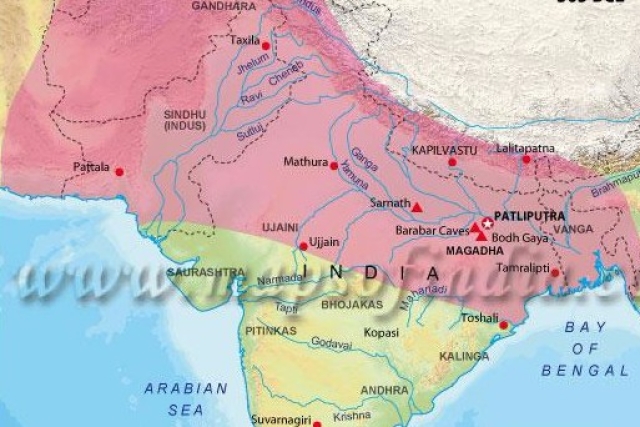
![]()
Seleucus I Nicator
Seleucus I Nicator was a member of the infamous Diadochi – a group of Alexander the Great’s generals and friends who battled of the control of his empire after his death in 323 BC.
Post the death of Alexander, Seleucus was one of the most powerful participants in the War of the Diadochi and managed to wrest control of the eastern territories of Alexander which also included regions in the Indus Valley.
After having established his dominance in the east, Seleucus engaged his major rival amongst the Diadochi, Antigonus, in the Babylonian War. The war ended in a decisive victory for Seleucus and Antigonus was forced to retreat westwards.
Soon after Seleucus, following the tradition of Greek kings founding cities in their names, constructed the city of Seleucia (within present day Iraq) and proclaimed himself king of the regions he controlled.
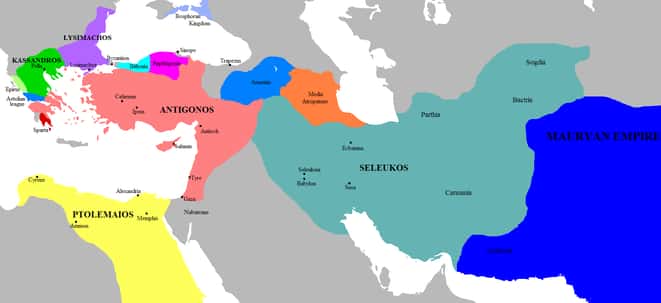
The Mauryan-Seleucid War
With his rule over northern India secure, Chandragupta and Chanakya saw the sudden death of Alexander and the disarray amongst his generals as on opportunity to expand their rule towards the west.
Alexander had left his Prefects in control of the regions he had conquered in the Indus Valley. Chandragupta is said to have taken control over the areas governed by four such Prefects – Nicanor, Phillip, Eudemus and Peithon, resulting in Mauryan control being established until the banks of the Indus River. Chandragupta’s conquest of these regions and his military prowess is vividly described by the Roman historian Marcus Junianus Justinus who went onto claim that the Mauryan king was even revered by ‘wild lions and elephants’.
News of Chandragupta’s western forays reached the ears of Seleucius, who decided that he needed to secure his eastern flank and thus began the Mauryan-Seleucid War.
The war is estimated to have begun in 305 BC, with Seleucius crossing the Indus and engaging Chandragupta’s forces in the Gandhara (north-west Pakisthan) region.
While no accounts of the actual battled fought exist today, the historical consensus is that Chandragupta Maurya emerged victorious against the Greek forces. Post the battle, Chandragupta continued control over all the regions he had conquered previously. Seleucius also ceded to Chandragupta his territories in Arachosia (Kandahar), Gedrosia (Balochisthan) and Gandhara. Around the same time, Chandragupta is said to have taken over the Hindu Kush, eastern Iran, Punjab and east Afghanistan – greatly growing his empire and expanding his victory of Seleucius to establish his dominance from modern-day Afghanistan to Bihar.
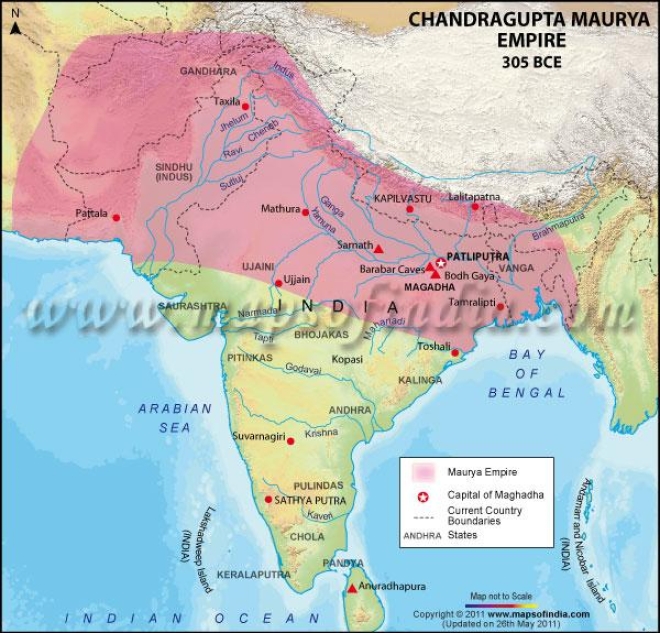
The Roman historian Appian of Alexandria also suggests that the terms of terms of peace negotiated by Seleucus with Chandragupta went beyond the ceding of Greek territories to the Indian monarch. Seleucus is also speculated to have married off his daughter to Chandragupta while receiving 500 war elephants in return – either as a gift or dowry.
Aftermath
Seleucus would put the 500 elephants he received from Chandragupta to good use soon after. The beasts were said to have played a decisive role in Seleucus’ final battle with his great rival Antigonos in the Battle of Ipsus. In the battle Seleucus inflicted a final defeat onto Antigonos and then added Antigonos’ regions into his own empire. With this victory, Seleucus was able to found what came to be known as the Seleucid Empire which ruled over large parts of the Mediterranean and the Middle East until its collapse in 63 BC.
Chandragupta Maurya, of course, had already established the Mauryan Empire by the time he came into conflict with Seleucus. Nevertheless, his victory in the Mauryan-Seleucid War and his tremendous expansions towards the west lifted him to exalted status in the region. He would soon turn his focus towards the south beyond the Vindhyas and into the Deccan. At the zenith of his reign, Chandragupta is said to have ruled over most of the Indian sub-continent.
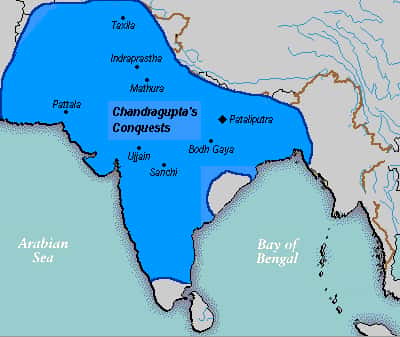
Chandragupta’s legacy went beyond his military conquests as well.
The Mauryan Empire, which he founded from next to nothing, became one of the largest empires in the world at the time. Under the guidance of Chanakya – unquestionably one of the greatest philosophers of all time – Chandragupta implemented administrative systems which allowed trade and agriculture to flourish under his rule, starting off a period of great economic activity in the Indian subcontinent. Chanakya’s mastery of economics, finance, defense and statecraft also enabled Chandragupta to ensure peace, prosperity and security for his citizens under his rule. This was also a time when the region enjoyed great religious peace and harmony along with flourishing art and culture. More importantly, the systems and structures which Chandragupta put in place lived beyond him – allowing his successors Bhindusara and Ashoka to build on his achievements and take the Mauryan kingdom to greater heights.
For his towering military and administrative achievements, Chandragupta Maurya is today remembered across India as Chandragupta Maurya the Great – one of the few monarchs to have been bestowed the epithet.
Unfortunately, this great conquest of Chandragupta – and those of others like him – are almost forgotten today. An intellectual project, spearheaded by Leftist academia, ‘rationalised’ out the great achievements and victories of Indic monarchs and generals from our textbooks and consequently, from the minds of our people.
However, for India to truly become the power that it deserves to be, it is important for its citizens to remember its real history and to truly appreciate the greatness of some of its successes.
Recent Posts
- In the Large States category (overall), Chhattisgarh ranks 1st, followed by Odisha and Telangana, whereas, towards the bottom are Maharashtra at 16th, Assam at 17th and Gujarat at 18th. Gujarat is one State that has seen startling performance ranking 5th in the PAI 2021 Index outperforming traditionally good performing States like Andhra Pradesh and Karnataka, but ranks last in terms of Delta
- In the Small States category (overall), Nagaland tops, followed by Mizoram and Tripura. Towards the tail end of the overall Delta ranking is Uttarakhand (9th), Arunachal Pradesh (10th) and Meghalaya (11th). Nagaland despite being a poor performer in the PAI 2021 Index has come out to be the top performer in Delta, similarly, Mizoram’s performance in Delta is also reflected in it’s ranking in the PAI 2021 Index
- In terms of Equity, in the Large States category, Chhattisgarh has the best Delta rate on Equity indicators, this is also reflected in the performance of Chhattisgarh in the Equity Pillar where it ranks 4th. Following Chhattisgarh is Odisha ranking 2nd in Delta-Equity ranking, but ranks 17th in the Equity Pillar of PAI 2021. Telangana ranks 3rd in Delta-Equity ranking even though it is not a top performer in this Pillar in the overall PAI 2021 Index. Jharkhand (16th), Uttar Pradesh (17th) and Assam (18th) rank at the bottom with Uttar Pradesh’s performance in line with the PAI 2021 Index
- Odisha and Nagaland have shown the best year-on-year improvement under 12 Key Development indicators.
- In the 60:40 division States, the top three performers are Kerala, Goa and Tamil Nadu and, the bottom three performers are Uttar Pradesh, Jharkhand and Bihar.
- In the 90:10 division States, the top three performers were Himachal Pradesh, Sikkim and Mizoram; and, the bottom three performers are Manipur, Assam and Meghalaya.
- Among the 60:40 division States, Orissa, Chhattisgarh and Madhya Pradesh are the top three performers and Tamil Nadu, Telangana and Delhi appear as the bottom three performers.
- Among the 90:10 division States, the top three performers are Manipur, Arunachal Pradesh and Nagaland; and, the bottom three performers are Jammu and Kashmir, Uttarakhand and Himachal Pradesh
- Among the 60:40 division States, Goa, West Bengal and Delhi appear as the top three performers and Andhra Pradesh, Telangana and Bihar appear as the bottom three performers.
- Among the 90:10 division States, Mizoram, Himachal Pradesh and Tripura were the top three performers and Jammu & Kashmir, Nagaland and Arunachal Pradesh were the bottom three performers
- West Bengal, Bihar and Tamil Nadu were the top three States amongst the 60:40 division States; while Haryana, Punjab and Rajasthan appeared as the bottom three performers
- In the case of 90:10 division States, Mizoram, Assam and Tripura were the top three performers and Nagaland, Jammu & Kashmir and Uttarakhand featured as the bottom three
- Among the 60:40 division States, the top three performers are Kerala, Andhra Pradesh and Orissa and the bottom three performers are Madhya Pradesh, Jharkhand and Goa
- In the 90:10 division States, the top three performers are Mizoram, Sikkim and Nagaland and the bottom three performers are Manipur and Assam
In a diverse country like India, where each State is socially, culturally, economically, and politically distinct, measuring Governance becomes increasingly tricky. The Public Affairs Index (PAI 2021) is a scientifically rigorous, data-based framework that measures the quality of governance at the Sub-national level and ranks the States and Union Territories (UTs) of India on a Composite Index (CI).
States are classified into two categories – Large and Small – using population as the criteria.
In PAI 2021, PAC defined three significant pillars that embody Governance – Growth, Equity, and Sustainability. Each of the three Pillars is circumscribed by five governance praxis Themes.
The themes include – Voice and Accountability, Government Effectiveness, Rule of Law, Regulatory Quality and Control of Corruption.
At the bottom of the pyramid, 43 component indicators are mapped to 14 Sustainable Development Goals (SDGs) that are relevant to the States and UTs.
This forms the foundation of the conceptual framework of PAI 2021. The choice of the 43 indicators that go into the calculation of the CI were dictated by the objective of uncovering the complexity and multidimensional character of development governance

The Equity Principle
The Equity Pillar of the PAI 2021 Index analyses the inclusiveness impact at the Sub-national level in the country; inclusiveness in terms of the welfare of a society that depends primarily on establishing that all people feel that they have a say in the governance and are not excluded from the mainstream policy framework.
This requires all individuals and communities, but particularly the most vulnerable, to have an opportunity to improve or maintain their wellbeing. This chapter of PAI 2021 reflects the performance of States and UTs during the pandemic and questions the governance infrastructure in the country, analysing the effectiveness of schemes and the general livelihood of the people in terms of Equity.


Growth and its Discontents
Growth in its multidimensional form encompasses the essence of access to and the availability and optimal utilisation of resources. By resources, PAI 2021 refer to human resources, infrastructure and the budgetary allocations. Capacity building of an economy cannot take place if all the key players of growth do not drive development. The multiplier effects of better health care, improved educational outcomes, increased capital accumulation and lower unemployment levels contribute magnificently in the growth and development of the States.


The Pursuit Of Sustainability
The Sustainability Pillar analyses the access to and usage of resources that has an impact on environment, economy and humankind. The Pillar subsumes two themes and uses seven indicators to measure the effectiveness of government efforts with regards to Sustainability.


The Curious Case Of The Delta
The Delta Analysis presents the results on the State performance on year-on-year improvement. The rankings are measured as the Delta value over the last five to 10 years of data available for 12 Key Development Indicators (KDI). In PAI 2021, 12 indicators across the three Pillars of Equity (five indicators), Growth (five indicators) and Sustainability (two indicators). These KDIs are the outcome indicators crucial to assess Human Development. The Performance in the Delta Analysis is then compared to the Overall PAI 2021 Index.
Key Findings:-
In the Scheme of Things
The Scheme Analysis adds an additional dimension to ranking of the States on their governance. It attempts to complement the Governance Model by trying to understand the developmental activities undertaken by State Governments in the form of schemes. It also tries to understand whether better performance of States in schemes reflect in better governance.
The Centrally Sponsored schemes that were analysed are National Health Mission (NHM), Umbrella Integrated Child Development Services scheme (ICDS), Mahatma Gandh National Rural Employment Guarantee Scheme (MGNREGS), Samagra Shiksha Abhiyan (SmSA) and MidDay Meal Scheme (MDMS).
National Health Mission (NHM)
INTEGRATED CHILD DEVELOPMENT SERVICES (ICDS)
MID- DAY MEAL SCHEME (MDMS)
SAMAGRA SHIKSHA ABHIYAN (SMSA)
MAHATMA GANDHI NATIONAL RURAL EMPLOYMENT GUARANTEE SCHEME (MGNREGS)