


The disappearance of the dinosaurs is probably the world’s most famous example of a mass extinction, but it’s certainly not the only one.
There have been at least four other mass extinctions on Earth over the past 500 million years.
A mass extinction refers to the die-off of a huge number of species in a relatively short period of time. In the past, mass extinctions have been caused by geological or climatic events, such as the asteroid strike that wiped out the dinosaurs.
But according to scientists, we are experiencing another mass extinction. And this time, it’s of our own making.
Biological Armageddon
A new study published in the journal Proceedings of the National Academy of Sciences says that there is a “biological annihilation” underway.
Researchers from Stanford University and the National Autonomous University of Mexico looked at 27,600 terrestrial vertebrate species (animals with a backbone that live on land), which represent around half of all vertebrate species, and found that 32% are decreasing in population.
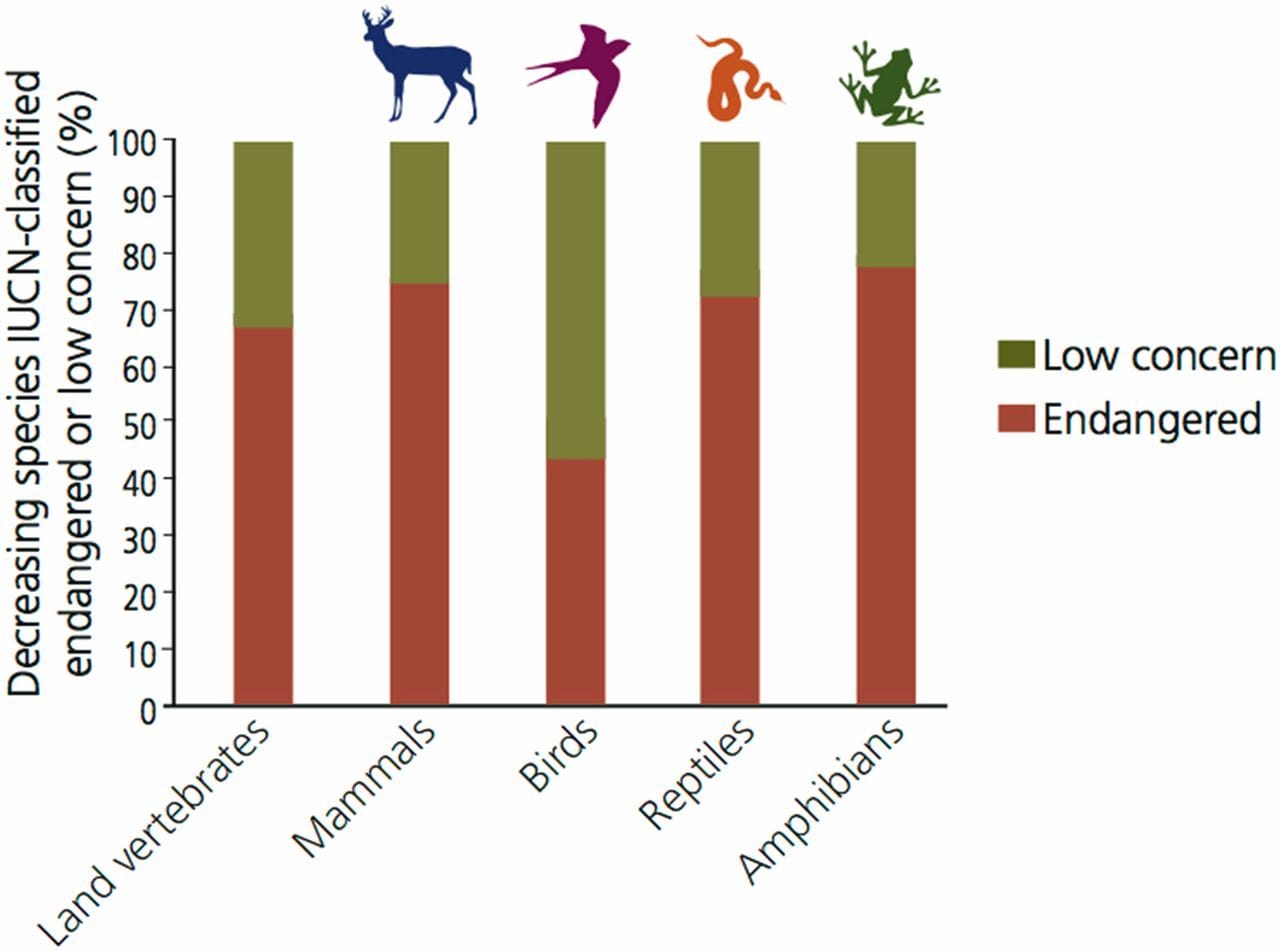
They also looked at 177 mammal species, and found that all have lost at least a third of their geographic ranges. In addition, nearly one in two of the species have experienced severe population declines.
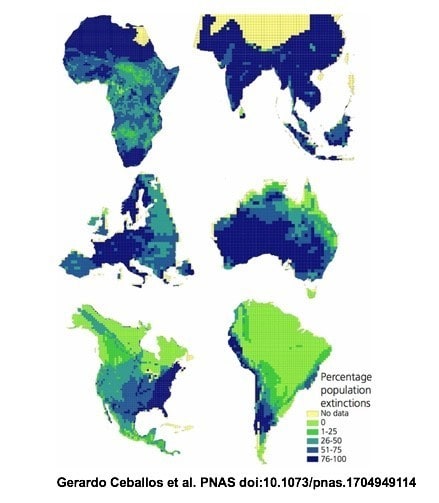
Several species of mammals that were relatively safe one or two decades ago are now endangered. For instance, the number of African lions has dropped by 43% since 1993.
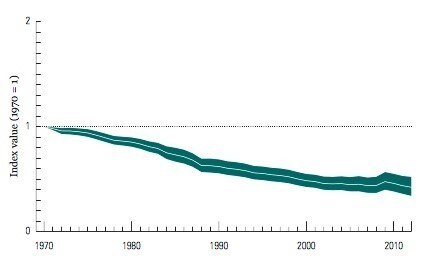
The study is not the only piece of research to come to the conclusion that certain species are declining rapidly. The Living Planet Index, which measures the number of 3706 vertebrate species, also shows a persistent downward trend.
This one is different
Although mass extinctions occurred before humans took over the planet, the scientists say that the rate of die-offs has speeded up considerably.
Even by their conservative estimates, almost 200 species of vertebrates have become extinct in the last 100 years. This is equivalent to around two species a year. In past extinctions, the loss of 200 species would have taken up to 10,000 years.
The problem, say the authors of the study, is that two extinctions a year do not attract enough global attention, especially if people have not heard of the creature in the first place. They use the examples of the Catarina pupfish and the Christmas Island pipistrelle, a small bat, which have both vanished in recent years.
They argue that the world should be paying attention, because the loss of biological diversity is one of the most severe human-caused global environmental problems.
In the last few decades, humans have taken over vast swathes of animal habitat and caused pollution and global warming. All of which, the authors say, have led to catastrophic declines in populations of both common and rare vertebrate species.
The problem with extinction is that it’s irreversible, and it has a profound effect on the planet’s ecosystem. Everything from the food we eat to the resources that we use are with us because of the Earth’s extraordinary biodiversity.
There’s not enough time, they say, to prevent the shrinking of biodiversity, and any notion that we can somehow bring extinct animals back to life is a “misimpression”.
But not everyone agrees with the scientists’ gloomy assessment.
Earth bouncing back?
Some argue that if we really were in the middle of a mass extinction, the world would already be over. Smithsonian paleontologist Doug Erwin told The Atlantic:
“People who claim we’re in the sixth mass extinction don’t understand enough about mass extinctions to understand the logical flaw in their argument.
“To a certain extent they’re claiming it as a way of frightening people into action, when in fact, if it’s actually true we’re in a sixth mass extinction, then there’s no point in conservation biology.”
Although he warns:
“I think that if we keep things up long enough, we’ll get to a mass extinction, but we’re not in a mass extinction yet, and I think that’s an optimistic discovery because that means we actually have time to avoid Armageddon.”
And there is another reason for a more optimistic outlook. New species are coming into existence faster than ever thanks to humans, according to Chris D Thomas, Professor of Evolutionary Biology at the University of York.
He argues that we underestimate just how far nature can adapt.
“Throughout the history of the Earth, species have survived by moving to new locations that permit them to flourish,” he says.
“A million or so years from now, the world could end up supporting more species, not fewer, as a consequence of the evolution of Homo sapiens.”
But the authors of the biological annihilation study have a stark warning: even our own days might be numbered.
“Earth’s sixth mass extinction episode has proceeded further than most assume,” they conclude.
“The window for effective action is very short, probably two or three decades at most.
“All signs point to ever more powerful assaults on biodiversity in the next two decades, painting a dismal picture of the future of life, including human life.”
Receive Daily Updates
Recent Posts
- In the Large States category (overall), Chhattisgarh ranks 1st, followed by Odisha and Telangana, whereas, towards the bottom are Maharashtra at 16th, Assam at 17th and Gujarat at 18th. Gujarat is one State that has seen startling performance ranking 5th in the PAI 2021 Index outperforming traditionally good performing States like Andhra Pradesh and Karnataka, but ranks last in terms of Delta
- In the Small States category (overall), Nagaland tops, followed by Mizoram and Tripura. Towards the tail end of the overall Delta ranking is Uttarakhand (9th), Arunachal Pradesh (10th) and Meghalaya (11th). Nagaland despite being a poor performer in the PAI 2021 Index has come out to be the top performer in Delta, similarly, Mizoram’s performance in Delta is also reflected in it’s ranking in the PAI 2021 Index
- In terms of Equity, in the Large States category, Chhattisgarh has the best Delta rate on Equity indicators, this is also reflected in the performance of Chhattisgarh in the Equity Pillar where it ranks 4th. Following Chhattisgarh is Odisha ranking 2nd in Delta-Equity ranking, but ranks 17th in the Equity Pillar of PAI 2021. Telangana ranks 3rd in Delta-Equity ranking even though it is not a top performer in this Pillar in the overall PAI 2021 Index. Jharkhand (16th), Uttar Pradesh (17th) and Assam (18th) rank at the bottom with Uttar Pradesh’s performance in line with the PAI 2021 Index
- Odisha and Nagaland have shown the best year-on-year improvement under 12 Key Development indicators.
- In the 60:40 division States, the top three performers are Kerala, Goa and Tamil Nadu and, the bottom three performers are Uttar Pradesh, Jharkhand and Bihar.
- In the 90:10 division States, the top three performers were Himachal Pradesh, Sikkim and Mizoram; and, the bottom three performers are Manipur, Assam and Meghalaya.
- Among the 60:40 division States, Orissa, Chhattisgarh and Madhya Pradesh are the top three performers and Tamil Nadu, Telangana and Delhi appear as the bottom three performers.
- Among the 90:10 division States, the top three performers are Manipur, Arunachal Pradesh and Nagaland; and, the bottom three performers are Jammu and Kashmir, Uttarakhand and Himachal Pradesh
- Among the 60:40 division States, Goa, West Bengal and Delhi appear as the top three performers and Andhra Pradesh, Telangana and Bihar appear as the bottom three performers.
- Among the 90:10 division States, Mizoram, Himachal Pradesh and Tripura were the top three performers and Jammu & Kashmir, Nagaland and Arunachal Pradesh were the bottom three performers
- West Bengal, Bihar and Tamil Nadu were the top three States amongst the 60:40 division States; while Haryana, Punjab and Rajasthan appeared as the bottom three performers
- In the case of 90:10 division States, Mizoram, Assam and Tripura were the top three performers and Nagaland, Jammu & Kashmir and Uttarakhand featured as the bottom three
- Among the 60:40 division States, the top three performers are Kerala, Andhra Pradesh and Orissa and the bottom three performers are Madhya Pradesh, Jharkhand and Goa
- In the 90:10 division States, the top three performers are Mizoram, Sikkim and Nagaland and the bottom three performers are Manipur and Assam
In a diverse country like India, where each State is socially, culturally, economically, and politically distinct, measuring Governance becomes increasingly tricky. The Public Affairs Index (PAI 2021) is a scientifically rigorous, data-based framework that measures the quality of governance at the Sub-national level and ranks the States and Union Territories (UTs) of India on a Composite Index (CI).
States are classified into two categories – Large and Small – using population as the criteria.
In PAI 2021, PAC defined three significant pillars that embody Governance – Growth, Equity, and Sustainability. Each of the three Pillars is circumscribed by five governance praxis Themes.
The themes include – Voice and Accountability, Government Effectiveness, Rule of Law, Regulatory Quality and Control of Corruption.
At the bottom of the pyramid, 43 component indicators are mapped to 14 Sustainable Development Goals (SDGs) that are relevant to the States and UTs.
This forms the foundation of the conceptual framework of PAI 2021. The choice of the 43 indicators that go into the calculation of the CI were dictated by the objective of uncovering the complexity and multidimensional character of development governance

The Equity Principle
The Equity Pillar of the PAI 2021 Index analyses the inclusiveness impact at the Sub-national level in the country; inclusiveness in terms of the welfare of a society that depends primarily on establishing that all people feel that they have a say in the governance and are not excluded from the mainstream policy framework.
This requires all individuals and communities, but particularly the most vulnerable, to have an opportunity to improve or maintain their wellbeing. This chapter of PAI 2021 reflects the performance of States and UTs during the pandemic and questions the governance infrastructure in the country, analysing the effectiveness of schemes and the general livelihood of the people in terms of Equity.


Growth and its Discontents
Growth in its multidimensional form encompasses the essence of access to and the availability and optimal utilisation of resources. By resources, PAI 2021 refer to human resources, infrastructure and the budgetary allocations. Capacity building of an economy cannot take place if all the key players of growth do not drive development. The multiplier effects of better health care, improved educational outcomes, increased capital accumulation and lower unemployment levels contribute magnificently in the growth and development of the States.


The Pursuit Of Sustainability
The Sustainability Pillar analyses the access to and usage of resources that has an impact on environment, economy and humankind. The Pillar subsumes two themes and uses seven indicators to measure the effectiveness of government efforts with regards to Sustainability.


The Curious Case Of The Delta
The Delta Analysis presents the results on the State performance on year-on-year improvement. The rankings are measured as the Delta value over the last five to 10 years of data available for 12 Key Development Indicators (KDI). In PAI 2021, 12 indicators across the three Pillars of Equity (five indicators), Growth (five indicators) and Sustainability (two indicators). These KDIs are the outcome indicators crucial to assess Human Development. The Performance in the Delta Analysis is then compared to the Overall PAI 2021 Index.
Key Findings:-
In the Scheme of Things
The Scheme Analysis adds an additional dimension to ranking of the States on their governance. It attempts to complement the Governance Model by trying to understand the developmental activities undertaken by State Governments in the form of schemes. It also tries to understand whether better performance of States in schemes reflect in better governance.
The Centrally Sponsored schemes that were analysed are National Health Mission (NHM), Umbrella Integrated Child Development Services scheme (ICDS), Mahatma Gandh National Rural Employment Guarantee Scheme (MGNREGS), Samagra Shiksha Abhiyan (SmSA) and MidDay Meal Scheme (MDMS).
National Health Mission (NHM)
INTEGRATED CHILD DEVELOPMENT SERVICES (ICDS)
MID- DAY MEAL SCHEME (MDMS)
SAMAGRA SHIKSHA ABHIYAN (SMSA)
MAHATMA GANDHI NATIONAL RURAL EMPLOYMENT GUARANTEE SCHEME (MGNREGS)