


In the post-Gandhian era, environmental problems surfaced at a breakneck speed with large-scale and indiscriminate industrialisation leading to environmental hazards and degradations. Mahatma Gandhi’s critique of modernity reveals his concern about the emergence of a social order that exploits nature for short-term gains. He had written widely about the need for human beings to exercise restraint with respect to the use of natural resources. His “counter-thinking” is now increasingly becoming a mainstream thought with greater awareness of the environmental problems.
Troubled by unrestricted industrialism and materialism, Gandhi had foreseen a time when the resources of the earth will not be enough to meet the growing demands of the people.
Understanding Gandhi

GANDHI’s Vision and Values is meant to be a serious exploration into the contemporary meaning of Hind Swaraj and the kind of possibility it indicates for agricultural practices in rural India. Hind Swaraj herein refers to Gandhi’s text and also to India’s last 50 years as an independent country.
In recent times, the significance of Hind Swaraj for an understanding of Gandhi’s thought has come to be widely recognised. Vivek Pinto’s book is perhaps among the first few to attempt a serious and comprehensive examination of the significance of Hind Swaraj for agriculture and life in rural India. For that, it merits serious attention.
The principal concern, in the words of the author, is to see if it would be possible to reconstruct a “harmonious, poverty-free, non-violent and self-reliant society” on the basis of ethical principles marked by Gandhi’s Hind Swaraj and his experiments with the agricultural communities.
Pinto’s argument unfolds at three related planes. The first section explores the cognitive significance of Hind Swaraj as a text. Another section seeks to clarify the significance of Gandhi’s own attempts, as also of various individuals, to work out in practice the basic principles marked in Hind Swaraj. The third section is a “Gandhian critique” of the experiment with planned agricultural development in independent India.
If one were to present Pinto’s work as a coherent argument, one could begin by saying that the third section is really the starting point of the argument. It spells out in distressing detail the worsening condition of agriculture in India. Most of the people still depend on agriculture and nearly 40 percent of them live below the poverty line.
After Independence, India chose to adopt the path of planned development. It was seen as a more humane and speedier way of securing a decent living for the millions of poor in the country. But, 50 years later, agricultural productivity still remains low.
Most of these grim details about peasant life and agriculture are fairly well-known. What is relevant is to see how the author proceeds to establish a kind of link between Gandhi’s text, his experiments and the present state of agriculture in the country.
Gandhi, while rejecting modern civilisation as a mode of life and work, invoked agriculture, charkha and the village as metaphors for sane human living. Pinto seeks out the implications of Hind Swaraj for agriculture as it could be practised in India. The citations from Gandhi’s writings on swadeshi as an idea of service and sensitivity to the needs of proximate communities is appropriate. The varied range of writings and case studies make interesting reading.
To Gandhi, the practice of agriculture signified a promise of limitless reach. The act of breaking and tending the soil carried within it an ageless quality. It signified a mode of work and being which, while sustaining life, could nurture an ultimate sense of meaning and worth. At this point, one could perhaps question the Hind Swaraj principles on two accounts:
– What is one to read into the fact that Gandhi, the creator of institutions, never sought to create one devoted specially to the practice and science of agriculture; and
– What about Gandhi’s silence on the practice of shifting cultivation, which at several levels is so close to the fundamental principles of Hind Swaraj?
Gandhian model of development
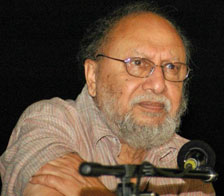
Mahatma Gandhi never used the words environment protection. However what he said and did makes him an environmentalist. His writings are replete with remarks on the excesses of industrial society. Political psychologist and social theorist Ashis Nandy has written extensively on Gandhi. In a freewheeling chat with Kaushik Das Gupta he spoke on Gandhi’s vision of social change, his critique of industrialisation and the way movements draw inspiration from Gandhi.
We often talk of two visions of development, the Gandhian vision and the Nehruvian vision. What is the fundamental difference between the two?
The Nehruvian concept is the dominant concept of development. Gandhi never used the word development. The word was first used by the US president Harry S Truman in 1949. Yes, people often talk of the Gandhian model of development. But if such a model is genuinely Gandhian then it is not about development. And if it’s about development, then bringing in Gandhi is an exercise in legitimising something alien to Gandhi’s vision.
Social change is possible without development. Society did not stop changing before the idea of development was coined. President Truman was not such a great thinker that the concept he enunciated is indispensable to human societies.
Many activists who are against big developmental projects talk of following the Gandhian way. Your comments
Yes. They draw inspiration from Gandhi to resist aspects of development that does not tally with the Gandhian vision. In one way they are humanising Gandhi. All social change is not development. The fundamental aspects of development—for example unending industrialisation, unending urbanisation, unending consumption—are not justifiable according to the Gandhian way.
Gandhians have tried to take head on some major assumptions of development. Those who challenge key aspects of development are doing us a service. They are resisting the framework in which we are caught.
Many of the solutions to the current environmental problems are actually within the purview of industrialised society. But there are others who talk of a path other than that of industrialisation. Is Gandhi’s vision in sync with such alternatives?
Gandhian vision is now seen as an inspiration, as a source, for many enterprises that offer alternative to industrialisation. These movements began in the 1980s.
None of the greatest Gandhians of today belong to India. In fact, the greatest Gandhians of our times have not read Gandhi that carefully. They perhaps read his works after people started calling them Gandhians.
Lech Walesa, the Polish shipyard trade unionist who later headed Poland’s non-Communist government, read Gandhi after people started calling him Gandhian. So did Benito Aquino. Gandhism has become a part of the process that offers alternatives to industrialisation. There are as many varieties of Gandhians as Marxists or liberals. Gandhi is a contemporary hero who is accessible—he was not a religious leader, yet religion has a big part in his politics, he was an ascetic but open to practical ways.
A lot of the de-growth movement, which believes progress is possible without economic growth, takes inspiration from Gandhi. Your comments?
I won’t use the word ‘progress’ because that is a contaminated word. The colonisers used the word progress. But yes, positive social change is possible without economic growth. And Gandhi has been an inspiration for such movements. However, we should also remember that most of the de-growth movement has taken place in societies which are over-consuming, exploiting nature and over-arming themselves—all these are hardly markers of good life.
I don’t think the hedonism associated with globalised capitalism is conducive to human happiness. Many communities have lived in poverty—but not destitution—and they haven’t been unhappy about it.
There are alternative visions but there is little by way of putting them into practice—except the endeavours of a few grassroots organisations. Your comments?
They have not been put into practice because our regimes are technocratic. Our solutions are technocratic. Technocrats go by the development textbooks. They do not keep elbow room for alternatives.
Yes, many with alternative vision keep away from the party-based political system. But they are part of the political process. The movement against dams is part of our political process. We need a group outside party politics to rate parties, rate individual candidates on yardsticks of honesty. We need an impartial agency to do that. For example, Uttar Pradesh has a system where bureaucrats vote on who the most corrupt bureaucrat is.
Receive Daily Updates
Recent Posts
Steve Ovett, the famous British middle-distance athlete, won the 800-metres gold medal at the Moscow Olympics of 1980. Just a few days later, he was about to win a 5,000-metres race at London’s Crystal Palace. Known for his burst of acceleration on the home stretch, he had supreme confidence in his ability to out-sprint rivals. With the final 100 metres remaining,
[wptelegram-join-channel link=”https://t.me/s/upsctree” text=”Join @upsctree on Telegram”]Ovett waved to the crowd and raised a hand in triumph. But he had celebrated a bit too early. At the finishing line, Ireland’s John Treacy edged past Ovett. For those few moments, Ovett had lost his sense of reality and ignored the possibility of a negative event.
This analogy works well for the India story and our policy failures , including during the ongoing covid pandemic. While we have never been as well prepared or had significant successes in terms of growth stability as Ovett did in his illustrious running career, we tend to celebrate too early. Indeed, we have done so many times before.
It is as if we’re convinced that India is destined for greater heights, come what may, and so we never run through the finish line. Do we and our policymakers suffer from a collective optimism bias, which, as the Nobel Prize winner Daniel Kahneman once wrote, “may well be the most significant of the cognitive biases”? The optimism bias arises from mistaken beliefs which form expectations that are better than the reality. It makes us underestimate chances of a negative outcome and ignore warnings repeatedly.
The Indian economy had a dream run for five years from 2003-04 to 2007-08, with an average annual growth rate of around 9%. Many believed that India was on its way to clocking consistent double-digit growth and comparisons with China were rife. It was conveniently overlooked that this output expansion had come mainly came from a few sectors: automobiles, telecom and business services.
Indians were made to believe that we could sprint without high-quality education, healthcare, infrastructure or banking sectors, which form the backbone of any stable economy. The plan was to build them as we went along, but then in the euphoria of short-term success, it got lost.
India’s exports of goods grew from $20 billion in 1990-91 to over $310 billion in 2019-20. Looking at these absolute figures it would seem as if India has arrived on the world stage. However, India’s share of global trade has moved up only marginally. Even now, the country accounts for less than 2% of the world’s goods exports.
More importantly, hidden behind this performance was the role played by one sector that should have never made it to India’s list of exports—refined petroleum. The share of refined petroleum exports in India’s goods exports increased from 1.4% in 1996-97 to over 18% in 2011-12.
An import-intensive sector with low labour intensity, exports of refined petroleum zoomed because of the then policy regime of a retail price ceiling on petroleum products in the domestic market. While we have done well in the export of services, our share is still less than 4% of world exports.
India seemed to emerge from the 2008 global financial crisis relatively unscathed. But, a temporary demand push had played a role in the revival—the incomes of many households, both rural and urban, had shot up. Fiscal stimulus to the rural economy and implementation of the Sixth Pay Commission scales had led to the salaries of around 20% of organized-sector employees jumping up. We celebrated, but once again, neither did we resolve the crisis brewing elsewhere in India’s banking sector, nor did we improve our capacity for healthcare or quality education.
Employment saw little economy-wide growth in our boom years. Manufacturing jobs, if anything, shrank. But we continued to celebrate. Youth flocked to low-productivity service-sector jobs, such as those in hotels and restaurants, security and other services. The dependence on such jobs on one hand and high-skilled services on the other was bound to make Indian society more unequal.
And then, there is agriculture, an elephant in the room. If and when farm-sector reforms get implemented, celebrations would once again be premature. The vast majority of India’s farmers have small plots of land, and though these farms are at least as productive as larger ones, net absolute incomes from small plots can only be meagre.
A further rise in farm productivity and consequent increase in supply, if not matched by a demand rise, especially with access to export markets, would result in downward pressure on market prices for farm produce and a further decline in the net incomes of small farmers.
We should learn from what John Treacy did right. He didn’t give up, and pushed for the finish line like it was his only chance at winning. Treacy had years of long-distance practice. The same goes for our economy. A long grind is required to build up its base before we can win and celebrate. And Ovett did not blame anyone for his loss. We play the blame game. Everyone else, right from China and the US to ‘greedy corporates’, seems to be responsible for our failures.
We have lowered absolute poverty levels and had technology-based successes like Aadhaar and digital access to public services. But there are no short cuts to good quality and adequate healthcare and education services. We must remain optimistic but stay firmly away from the optimism bias.
In the end, it is not about how we start, but how we finish. The disastrous second wave of covid and our inability to manage it is a ghastly reminder of this fact.