


Background :-
President of India recently presentted Shilp Guru Awards and National Awards to Master Craftspersons at Rashtrapati Bhavan.
*The craft and the associated region is important.
Kalamkari Painting – Andhra Pradesh – Shri K.Siva Prasada Reddy
Kalamkari or qalamkari is a type of hand-painted or block-printed cotton textile, produced in parts of India and Iran. Its name originates in the Persian which is derived from the words qalam (pen) and kari (craftmanship), meaning drawing with a pen.
The Machilipatnam Kalamkari craft made at Pedana near by Machilipatnam in Krishna district, Andhra Pradesh, evolved with patronage of the Mughals and the Golconda sultanate.

Ajrakh Hand Block Printing – Gujarat – Khatri Abdul Razak Mohmed
Ajrak is a name given to a unique form of block printed shawls and tiles found in Sindh, Pakistan; Kutch, Gujarat; and Barmer, Rajasthan in India. These shawls display special designs and patterns made using block printing by stamps. Common colours used while making these patterns may include but are not limited to blue, red, black, yellow and green. Over the years, ajraks have become a symbol of the Sindhi culture and traditions

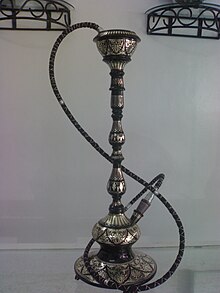
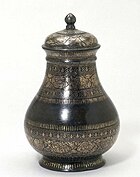
Bidri Craft – Karnataka – Abdul Raouf
Bidriware is a metal handicraft from Bidar. It was developed in the 14th century C.E. during the rule of the Bahamani Sultans.The term ‘Bidriware’ originates from the township of Bidar, which is still the chief centre for the manufacture of the unique metalware.Due to its striking inlay artwork, Bidriware is an important export handicraft of India and is prized as a symbol of wealth. The metal used is a blackened alloy of zinc and copper inlaid with thin sheets of pure silver.This native art form has obtained Geographical Indications (GI) registry.
Thewa Craft – Madhya Pradesh – Sh.Girish Kumar Rajsoni
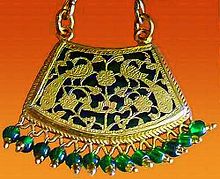
Thewa is a craft practised by a few craftsmen who specialise in the art of fusing filigreed gold sheets on to glass. The craft of thewa is still practised by hereditary craftspersons in the small fortified town of Pratapgarh in district Chittorgarh of south Rajasthan and in Rampur in Madhya Pradesh. This unique craft uses plaques of glass as its base material. Till today the tradition of using red, green, and blue glass continues.The technique of thewa has been used to create extremely interesting ornaments, plates, trays and jewellery, as well as small objects for daily use. This skill and the expertise required to create thewa objects is unique to Pratapgarh and Rampur. However, in the 19th century the towns of Indore and Ratlam in Madhya Pradesh also achieved widespread fame for this jewellery craft.
Stone Carving – Odisha – Shri Pravakar Maharana
Stone carving in Odisha is the ancient practice of sculpting stone into art and utilitarian objects. It is an ancient practice in the Indian state of Odisha. Stone carving is practiced by artisans mainly in Puri, Bhubaneswar and Lalitgiri in the Cuttack district, though some carvings can be found in Khiching in the Mayurbhanj District. Stone carving is one of the major handcrafts of Odisha. The art form primarily consists of custom carved works,[1] with the Sun Temple of Konark and its intricate sculpture and delicate carvings on the red vivid sandstone exemplifying the practice. Other noteworthy monuments include the Stupas of Udayagiri and Ratnagiri and the temples at Jagannath, Lingaraj, Mukteshwar and as well as other temples in the region.

Mithila Painting – Bihar – Smt.Punam Das
Mithila painting (also known as Madhubani painting) is practiced in the Mithila state of Nepal and in the Bihar state of India. Painting is done with fingers, twigs, brushes, nib-pens, and matchsticks, using natural dyes and pigments, and is characterized by eye-catching geometrical patterns. There is ritual content for particular occasions, such as birth or marriage, and festivals, such as Holi, Surya Shasti, Kali Puja, Upanayanam, Durga Puja. The Mithila region, from which the name Mithila art is derived, is believed to have been the kingdom of King Janak in present-day Janakpur in Nepal.

Papier Machie – Jammu & Kashmir –Zahid Hussain Beig
Papier-mâché is a handicraft of Kashmir that was brought by Muslims from Persia in the 15th century. It is based primarily on paper pulp, and is a richly decorated, colourful artifact; generally in the form of vases, bowls, or cups (with and without metal rims), boxes, trays, bases of lamps, and many other small objects. These are made in homes, and workshops, in Srinagar, and other parts of the Kashmir Valley, and are marketed primarily within India, although there is a significant international market
The product is protected under the Geographic Indication Act 1999 of Government of India, and was registered by the Controller General of Patents Designs and Trademarks during the period from April 2011 to March 2012 under the title “Kashmir Paper Machie”

Palmleaf Engraving – Odisha – Shri Biswanath Swain
It is believed that the craft emerged during the construction of temples and converted into hereditary craft for some families. Raghurajpura is famous for the artists belonging to this craft. Great or the well known tales are etched on palm leaf bearing in mind all ethics of craft and mythology.

Bone Carving – Uttar Pradesh – Shri Israr Ahmed
The British introduced ivory on furniture.Since the worldwide ban on ivory, craftsmen have been carving camel and buffalo bone with great skills.

Gulabi Meenakari – Uttar Pradesh – Shri Kunjbihari Singh
Meenakari is a crystal form of glass fused with metal oxides like silver, gold, copper and zinc. The meenakari of Varanasi is known by its pink colour and is known as gulabi meenakari.
The Pink painted enamel style was brought in Varanasi by the Persian enamellists around early 17th century during the Mughal era. This enameling style reached its peak of perfection at the Persian Court at Isfahan during the Qajar dynasty. The art of Meenakari was prosperous till about hundred year ago. Today there are only a handful of craft persons. They work on gold enamel, and silver enamel jewelry and other objects.

Black Pottery – Uttar Pradesh – Shri Sohit Kumar Prajapati
The black clay pottery of Nizamabad in Azamgarh district of Uttar Pradesh, India is unique type of clay pottery known for its dark shiny body with engraved silver patterns.It was registered for Geographical Indication tag in December 2015
Recent Posts
- In the Large States category (overall), Chhattisgarh ranks 1st, followed by Odisha and Telangana, whereas, towards the bottom are Maharashtra at 16th, Assam at 17th and Gujarat at 18th. Gujarat is one State that has seen startling performance ranking 5th in the PAI 2021 Index outperforming traditionally good performing States like Andhra Pradesh and Karnataka, but ranks last in terms of Delta
- In the Small States category (overall), Nagaland tops, followed by Mizoram and Tripura. Towards the tail end of the overall Delta ranking is Uttarakhand (9th), Arunachal Pradesh (10th) and Meghalaya (11th). Nagaland despite being a poor performer in the PAI 2021 Index has come out to be the top performer in Delta, similarly, Mizoram’s performance in Delta is also reflected in it’s ranking in the PAI 2021 Index
- In terms of Equity, in the Large States category, Chhattisgarh has the best Delta rate on Equity indicators, this is also reflected in the performance of Chhattisgarh in the Equity Pillar where it ranks 4th. Following Chhattisgarh is Odisha ranking 2nd in Delta-Equity ranking, but ranks 17th in the Equity Pillar of PAI 2021. Telangana ranks 3rd in Delta-Equity ranking even though it is not a top performer in this Pillar in the overall PAI 2021 Index. Jharkhand (16th), Uttar Pradesh (17th) and Assam (18th) rank at the bottom with Uttar Pradesh’s performance in line with the PAI 2021 Index
- Odisha and Nagaland have shown the best year-on-year improvement under 12 Key Development indicators.
- In the 60:40 division States, the top three performers are Kerala, Goa and Tamil Nadu and, the bottom three performers are Uttar Pradesh, Jharkhand and Bihar.
- In the 90:10 division States, the top three performers were Himachal Pradesh, Sikkim and Mizoram; and, the bottom three performers are Manipur, Assam and Meghalaya.
- Among the 60:40 division States, Orissa, Chhattisgarh and Madhya Pradesh are the top three performers and Tamil Nadu, Telangana and Delhi appear as the bottom three performers.
- Among the 90:10 division States, the top three performers are Manipur, Arunachal Pradesh and Nagaland; and, the bottom three performers are Jammu and Kashmir, Uttarakhand and Himachal Pradesh
- Among the 60:40 division States, Goa, West Bengal and Delhi appear as the top three performers and Andhra Pradesh, Telangana and Bihar appear as the bottom three performers.
- Among the 90:10 division States, Mizoram, Himachal Pradesh and Tripura were the top three performers and Jammu & Kashmir, Nagaland and Arunachal Pradesh were the bottom three performers
- West Bengal, Bihar and Tamil Nadu were the top three States amongst the 60:40 division States; while Haryana, Punjab and Rajasthan appeared as the bottom three performers
- In the case of 90:10 division States, Mizoram, Assam and Tripura were the top three performers and Nagaland, Jammu & Kashmir and Uttarakhand featured as the bottom three
- Among the 60:40 division States, the top three performers are Kerala, Andhra Pradesh and Orissa and the bottom three performers are Madhya Pradesh, Jharkhand and Goa
- In the 90:10 division States, the top three performers are Mizoram, Sikkim and Nagaland and the bottom three performers are Manipur and Assam
In a diverse country like India, where each State is socially, culturally, economically, and politically distinct, measuring Governance becomes increasingly tricky. The Public Affairs Index (PAI 2021) is a scientifically rigorous, data-based framework that measures the quality of governance at the Sub-national level and ranks the States and Union Territories (UTs) of India on a Composite Index (CI).
States are classified into two categories – Large and Small – using population as the criteria.
In PAI 2021, PAC defined three significant pillars that embody Governance – Growth, Equity, and Sustainability. Each of the three Pillars is circumscribed by five governance praxis Themes.
The themes include – Voice and Accountability, Government Effectiveness, Rule of Law, Regulatory Quality and Control of Corruption.
At the bottom of the pyramid, 43 component indicators are mapped to 14 Sustainable Development Goals (SDGs) that are relevant to the States and UTs.
This forms the foundation of the conceptual framework of PAI 2021. The choice of the 43 indicators that go into the calculation of the CI were dictated by the objective of uncovering the complexity and multidimensional character of development governance

The Equity Principle
The Equity Pillar of the PAI 2021 Index analyses the inclusiveness impact at the Sub-national level in the country; inclusiveness in terms of the welfare of a society that depends primarily on establishing that all people feel that they have a say in the governance and are not excluded from the mainstream policy framework.
This requires all individuals and communities, but particularly the most vulnerable, to have an opportunity to improve or maintain their wellbeing. This chapter of PAI 2021 reflects the performance of States and UTs during the pandemic and questions the governance infrastructure in the country, analysing the effectiveness of schemes and the general livelihood of the people in terms of Equity.


Growth and its Discontents
Growth in its multidimensional form encompasses the essence of access to and the availability and optimal utilisation of resources. By resources, PAI 2021 refer to human resources, infrastructure and the budgetary allocations. Capacity building of an economy cannot take place if all the key players of growth do not drive development. The multiplier effects of better health care, improved educational outcomes, increased capital accumulation and lower unemployment levels contribute magnificently in the growth and development of the States.


The Pursuit Of Sustainability
The Sustainability Pillar analyses the access to and usage of resources that has an impact on environment, economy and humankind. The Pillar subsumes two themes and uses seven indicators to measure the effectiveness of government efforts with regards to Sustainability.


The Curious Case Of The Delta
The Delta Analysis presents the results on the State performance on year-on-year improvement. The rankings are measured as the Delta value over the last five to 10 years of data available for 12 Key Development Indicators (KDI). In PAI 2021, 12 indicators across the three Pillars of Equity (five indicators), Growth (five indicators) and Sustainability (two indicators). These KDIs are the outcome indicators crucial to assess Human Development. The Performance in the Delta Analysis is then compared to the Overall PAI 2021 Index.
Key Findings:-
In the Scheme of Things
The Scheme Analysis adds an additional dimension to ranking of the States on their governance. It attempts to complement the Governance Model by trying to understand the developmental activities undertaken by State Governments in the form of schemes. It also tries to understand whether better performance of States in schemes reflect in better governance.
The Centrally Sponsored schemes that were analysed are National Health Mission (NHM), Umbrella Integrated Child Development Services scheme (ICDS), Mahatma Gandh National Rural Employment Guarantee Scheme (MGNREGS), Samagra Shiksha Abhiyan (SmSA) and MidDay Meal Scheme (MDMS).
National Health Mission (NHM)
INTEGRATED CHILD DEVELOPMENT SERVICES (ICDS)
MID- DAY MEAL SCHEME (MDMS)
SAMAGRA SHIKSHA ABHIYAN (SMSA)
MAHATMA GANDHI NATIONAL RURAL EMPLOYMENT GUARANTEE SCHEME (MGNREGS)