


Authored by: Umakant Sir (Founder, Mentor and Civil Servant)
Who does not like a good conspiracy?
We all have our own little conspiracy theories that we believe in contradiction to facts even. And that is understandable because that is a pure “Human Psychological Error”. Psychologists call it “cognitive dissonance” (When the facts are in contrast to the things we believe in, yet we still believe in them).
But the Bangladesh saga, seems like a plot from a movie altogether. A Prime Minister as strong as Sheikh Hasina was given only 45 mins to wind up and run?
That is enough ingredient for us to cook up a conspiracy biriyani. Nonetheless, let me feed you with some more questions that may make you smell the “conspiracy biryani”: –
Question no. 1:
If you have read history, read your history well, you know that every revolution/protest has a shelf-life. Gandhiji knew it well than others. Revolution has its fatigue.
But….
The events (Protests) in Bangladesh unfolded in the Monsoon Months. And, they say “when it rains in Bangladesh, it pours in Bangaladesh”; so how did the students manage to protest for months and mount pressure on the government in the monsoon months.
How long can a protester stand in the “Bangaladeshi rain” and shout?
Because it unfolded in the monsoon months, makes you wonder: Was there a foreign hand in all of this?
Also, because, sustaining a protest of this size requires logistics and supply chain or more bluntly it requires a “good deal of Money”. Thus, the next question…Who financed it?
Question no. 2:
Every revolution requires financing…that’s how it has always been. Take any lasting revolution from your history books and you will see a financier.
Who financed it then? Who gave the food, fodder and shelter to the protesters?
That makes one wonder of the “invisible foreign hand”.
Question no. 3:
Just before the protest, Sheikh Hasina made a trip to China, however the trip was cut-short and when she returned to Bangladesh, she gave a statement that was in favour of India.

That makes one wonder, Is there a “Chinese Hand” or “China-Pakistan Conspiracy”, given the fact that a Bangladesh under the sphere of influence of Chinese can make Indian policy makers “Paranoid” perpetually.
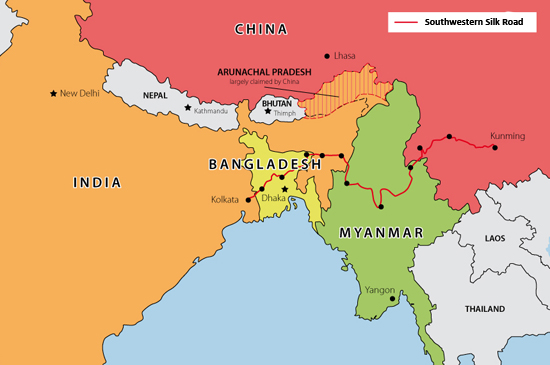
We have a border with Bangaladesh i.e. running upto 4096 kms and the worrisome part is: – it is a porous border. There is no natural or geographical barrier between Indo-Bangladesh border…. which makes India extremely vulnerable. Guarding a border that runs for more than 4000 km and runs through agricultural fields, river and wetlands is extremely difficult.
In that situation, China-Pakistan will be very happy, and India will be very anxious. Of Course, Chinese will prefer an anxious India rather than an assertive India.
Thus, the smell of conspiracy.
Question no. 4:
There has been reports that it might be a USA conspiracy. In this regard we can consider couple of things: –
USA through its CIA had funded revolution and toppled governments. Look at South America, Look at other parts of the world. USA had done it in the past and done it multiple times across multiple continents. So, it is hardly a surprise to anyone.
But this begs the question, why USA will topple a government in Bangladesh ? What’s the catch ? We can understand the Chinese-Pakistan angle but USA…Why?
Well, in that regard, we can consider the following: –
- USA does not see Russia as its biggest threat anymore. As long as Russia posed a threat, USA was in Afghanistan.
- The challenger to USA’s hegemony is China and to counter China, what could be a better base than Bangladesh.
- If USA had its sway over Bangladesh
- India will lose some of its “strategic autonomy” and may be pushed towards the “USA Camp”.
- China will be anxious perpetually.
In that sense, from USA’s point of view, “Bangaldesh can be the new Afghanistan“. A base to fight the Chinese threat and contain it.
All of the above, definitely makes one wonder of the “supposedly external hand” in the Bangladesh protests.
Let’s consider the counter, that it was an internal rebellion and there was no foreign hand.
Let’s go back to the Revolution of 1857 or If you give a closer look at ” Arab Spring”. What we learn from these episodes is that :-
- Every revolution has a “trigger” (In case of 1857 revolution, it was arrest of Mangal Pandey and the “cartridge issue” and in case of Arab spring it was self-immolation of a vegetable vendor”)
- Every revolution has a “deep seeded anger” against the status-quo that has been burning slowing for years, even decades.
- Every revolution has a social, political and economic cause behind it.
If people’s social mobility is curtailed, if there is widespread unemployment and if the political rights of the people are suppressed (real or perceived), it gives rise to revolution.
And in this context, if one looks at Bangladesh, it appears that the protest was natural and organic one. It started as simple protest against the reservation quota in jobs and catapulted into an anti-government protest.
Bangaladesh did well economically under Sheikh Hasina’s rule. The “Textile sector boom” created jobs for millions. However, recently the textile sector became stagnant. The Political rights of ‘people and the opposition’ perceived as to be undermined. Which seems to have created the “deep seeded anger” running over a decade. The “reservation protest” was the “trigger” and death of students at the hands of “state” catapulted it as “anti-government” protest.
Conclusion:
In conclusion, one can say that the protest in Bangladesh was organic one in the beginning, but eventually the role of “external actor” cannot be discredited as well. Afterall geopolitics is a “ruthless” game. And “some foreign actors” may have been tempted to influence and build a narrative by financing and supporting the revolution.
But as we learn from history, strong empires fall mostly because of internal weakness, external factors usually accentuate it. And seems to be the case with what happened in Bangladesh. We learn more about it as the situation unfolds.
*Disclaimer: The above writing is just an analysis, and the opinion is based on Newspaper articles and editorials etc. This must not be construed as “Fact”.