By Categories: Misc

The killing of 22 security personnel by Maoists in Bijapur district of Chhattisgarh serves as a grim reminder that left-wing insurgency continues to be one of the biggest internal security threats for the country.

[wptelegram-join-channel link=”https://t.me/s/upsctree” text=”Join @upsctree on Telegram”]

Initial reports suggest that security forces in Chhattisgarh had launched a massive operation on April 4, after there were intelligence reports about the presence of top Maoist commander Hidma along with 60-70 Maoists in and around Tekulugudam Hill in Bijapur. As the forces reached the top of the hill and were combing through the intended “target” (Tekulugudam Hill), they came under heavy fire. It was then the forces realised that they had walked into a trap. The initial assessment indicates that there were around 300 Maoists, which included men and women belonging to the local tribal militia.
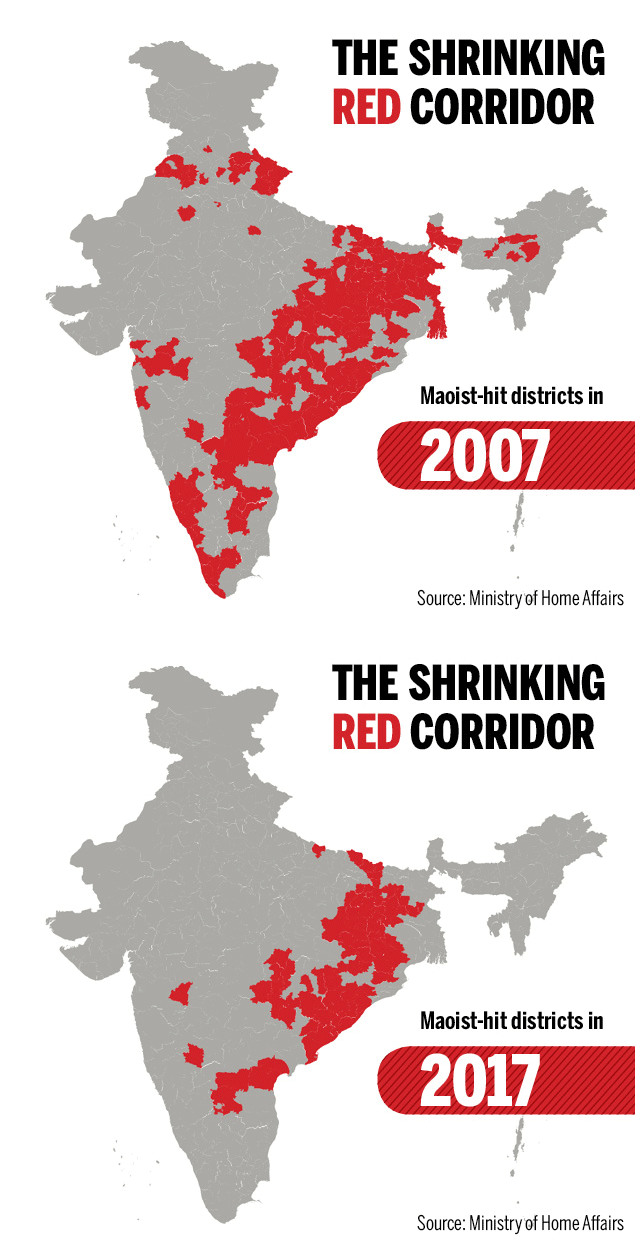
In the past few years, Maoist violence seemed to have been on a downward spiral. The government has, in fact, had some major successes in the form of arrests and surrender of important Maoist leaders. The figures associated with the key indicators of violence like the number of incidents also support the contention that “insurgency is on the downward spiral”. However, some experts believed that it was too early to sound the last post and cautioned that this drop could be the result of a “tactical withdrawal” by the Maoists, something which they have done in the past as well. The attack should thus serve as a wake-up call to those who had begun to get complacent about the Maoist threat.

It appears that Maoists continue to hold on to their key strengths which include:

(i) a robust and efficient intelligence network;

(ii) the devolution of authority to local commanders;

(iii) an ability to quickly readjust their strategy;

(iv) extensive support from local tribes and the ability to organise them into a tribal militia for short-term tactical purposes and

(v) domination of the local landscape.

This brings us to the most important question about the nature of the Counterinsurgency (hereafter COIN) strategy, which governments both in the states and at the Centre are adopting or should adopt. Debates about the utility of different COIN models in the Indian scenario have continued since India began dealing with its first full-blown insurgency in Nagaland in the 1950s.

One school believes that given the Maoist insurgency posturing itself as a “people’s war”, the mandate is for a people-centric approach of “winning hearts and minds” that is built on the notions of competitive state-building to address economic and governance deficiencies.

The other school argues that an enemy-centric approach predicated on kinetic operations is best suited for the Maoist insurgency, where the fear of the population seceding from India is remote. The success of the erstwhile state of Andhra Pradesh in curbing the Maoist problem is often attributed to this enemy-centric approach.

However, there is robust scholarly work available that shows that the Andhra government based its COIN strategy on a judicious mix of the enemy-centric and population-centric approaches. The successes achieved by the Greyhounds, Andhra’s elite special forces, could only be consolidated through the robust implementation of short-gestation-period developmental works in the Maoist-affected rural areas. Moreover, the erstwhile state is also the first state to have a comprehensive surrender-cum-rehabilitation policy.

After the 2014 guidelines of the central government were brought out, many states have crafted attractive surrender and rehabilitation policies. Odisha, for one, seems to have achieved fair success in its surrender policy but this was possible only after successful kinetic operations against Maoists. It is fair to say that a surrender and rehabilitation policy only works when there is sustained military pressure on the Maoists.

Another important question is whether the government should keep the option of talking to Maoists open. Debates about negotiating with insurgents and terrorists are often met with anger and, at times, disgust, at the possibility of sitting across a table from individuals who were responsible for some horrific violent acts.

The US government had to share a table with the Taliban, which played host to al Qaeda as the latter prepared to kill thousands of innocent Americans. The willingness to talk to rebel groups seems to incentivise insurgents and may demonstrate that violence pays.

Yet, time and again, governments face the distasteful reality of engaging with groups that have been involved in violent attacks against their forces and citizens. History is replete with examples that show the goal of ending terrorist violence or bringing an end to civil war invariably involves negotiating with the enemy, even the worst ones.

And Maoists may not fall under the “worst” category, as successive governments have labelled them as “misguided” youth. Even the present central government’s surrender policy guidelines are aimed at bringing these “misguided” youth into the mainstream.

In the last decade or so, insurgency-affected states have started to undertake serious efforts to defeat the Maoist insurgency. Most of these states have raised special forces on the lines of Greyhounds, and are being given rigorous training in “counter-guerrilla” tactics and jungle warfare.

A Maoist guerrilla can only be countered by a state guerrilla. The operating environment of these special forces has to demonstrate the employment of superior tactics to defeat the insurgents, something which at times seems lacking.

Besides, the Maoists have mastered the art of exploiting the grey zone areas. The jungles around the interstate borders have always been the preferred hiding spaces for the Maoists. Soon after decimating the top state Congress leadership in Darbha in Chhattisgarh in 2013, the assault group moved to the Chhattisgarh-Odisha border to avoid any kind of kinetic response from the Chhattisgarh police.

States must do more to synergise their efforts by launching coordinated operations, thereby denying Maoists any space for manoeuvrability. These efforts need to be supplemented by well-crafted development schemes. Proper implementation and timely disbursal of benefits add to the credibility of the government policies. It is also important to segregate the population from the insurgents both operationally and ideologically. The hawks and the doves need to be viewed and treated differently.

Indian counterinsurgency has to work with a dual objective of defeating the insurgents militarily and fully quell the insurgent impulses. This will need institutional overhauls. The conflict over the distribution of resources can be mended with economic development, but the bigger challenge would be to create a system where the tribal population feels that the government is representative, not repressive.

Opening negotiation channels and policies like surrender and rehabilitation can give such a representative sense to the rebels that the government cares for them if they (rebels) are willing to shun the violent path. Lastly, the asymmetry in the distribution of power cannot solely be ironed out by just economic policies, it is critically important to create a system where the distribution of power is not controlled by the traditional elite.


Share is Caring, Choose Your Platform!

Recent Posts


  • In a diverse country like India, where each State is socially, culturally, economically, and politically distinct, measuring Governance becomes increasingly tricky. The Public Affairs Index (PAI 2021) is a scientifically rigorous, data-based framework that measures the quality of governance at the Sub-national level and ranks the States and Union Territories (UTs) of India on a Composite Index (CI).


    States are classified into two categories – Large and Small – using population as the criteria.

    In PAI 2021, PAC defined three significant pillars that embody GovernanceGrowth, Equity, and Sustainability. Each of the three Pillars is circumscribed by five governance praxis Themes.

    The themes include – Voice and Accountability, Government Effectiveness, Rule of Law, Regulatory Quality and Control of Corruption.

    At the bottom of the pyramid, 43 component indicators are mapped to 14 Sustainable Development Goals (SDGs) that are relevant to the States and UTs.

    This forms the foundation of the conceptual framework of PAI 2021. The choice of the 43 indicators that go into the calculation of the CI were dictated by the objective of uncovering the complexity and multidimensional character of development governance

    The Equity Principle

    The Equity Pillar of the PAI 2021 Index analyses the inclusiveness impact at the Sub-national level in the country; inclusiveness in terms of the welfare of a society that depends primarily on establishing that all people feel that they have a say in the governance and are not excluded from the mainstream policy framework.

    This requires all individuals and communities, but particularly the most vulnerable, to have an opportunity to improve or maintain their wellbeing. This chapter of PAI 2021 reflects the performance of States and UTs during the pandemic and questions the governance infrastructure in the country, analysing the effectiveness of schemes and the general livelihood of the people in terms of Equity.

    Growth and its Discontents

    Growth in its multidimensional form encompasses the essence of access to and the availability and optimal utilisation of resources. By resources, PAI 2021 refer to human resources, infrastructure and the budgetary allocations. Capacity building of an economy cannot take place if all the key players of growth do not drive development. The multiplier effects of better health care, improved educational outcomes, increased capital accumulation and lower unemployment levels contribute magnificently in the growth and development of the States.

    The Pursuit Of Sustainability

    The Sustainability Pillar analyses the access to and usage of resources that has an impact on environment, economy and humankind. The Pillar subsumes two themes and uses seven indicators to measure the effectiveness of government efforts with regards to Sustainability.


    The Curious Case Of The Delta

    The Delta Analysis presents the results on the State performance on year-on-year improvement. The rankings are measured as the Delta value over the last five to 10 years of data available for 12 Key Development Indicators (KDI). In PAI 2021, 12 indicators across the three Pillars of Equity (five indicators), Growth (five indicators) and Sustainability (two indicators). These KDIs are the outcome indicators crucial to assess Human Development. The Performance in the Delta Analysis is then compared to the Overall PAI 2021 Index.

    Key Findings:-

    1. In the Large States category (overall), Chhattisgarh ranks 1st, followed by Odisha and Telangana, whereas, towards the bottom are Maharashtra at 16th, Assam at 17th and Gujarat at 18th. Gujarat is one State that has seen startling performance ranking 5th in the PAI 2021 Index outperforming traditionally good performing States like Andhra Pradesh and Karnataka, but ranks last in terms of Delta
    2. In the Small States category (overall), Nagaland tops, followed by Mizoram and Tripura. Towards the tail end of the overall Delta ranking is Uttarakhand (9th), Arunachal Pradesh (10th) and Meghalaya (11th). Nagaland despite being a poor performer in the PAI 2021 Index has come out to be the top performer in Delta, similarly, Mizoram’s performance in Delta is also reflected in it’s ranking in the PAI 2021 Index
    3. In terms of Equity, in the Large States category, Chhattisgarh has the best Delta rate on Equity indicators, this is also reflected in the performance of Chhattisgarh in the Equity Pillar where it ranks 4th. Following Chhattisgarh is Odisha ranking 2nd in Delta-Equity ranking, but ranks 17th in the Equity Pillar of PAI 2021. Telangana ranks 3rd in Delta-Equity ranking even though it is not a top performer in this Pillar in the overall PAI 2021 Index. Jharkhand (16th), Uttar Pradesh (17th) and Assam (18th) rank at the bottom with Uttar Pradesh’s performance in line with the PAI 2021 Index
    4. Odisha and Nagaland have shown the best year-on-year improvement under 12 Key Development indicators.

    In the Scheme of Things

    The Scheme Analysis adds an additional dimension to ranking of the States on their governance. It attempts to complement the Governance Model by trying to understand the developmental activities undertaken by State Governments in the form of schemes. It also tries to understand whether better performance of States in schemes reflect in better governance.

    The Centrally Sponsored schemes that were analysed are National Health Mission (NHM), Umbrella Integrated Child Development Services scheme (ICDS), Mahatma Gandh National Rural Employment Guarantee Scheme (MGNREGS), Samagra Shiksha Abhiyan (SmSA) and MidDay Meal Scheme (MDMS).

    National Health Mission (NHM)

    • In the 60:40 division States, the top three performers are Kerala, Goa and Tamil Nadu and, the bottom three performers are Uttar Pradesh, Jharkhand and Bihar.
    • In the 90:10 division States, the top three performers were Himachal Pradesh, Sikkim and Mizoram; and, the bottom three performers are Manipur, Assam and Meghalaya.


    INTEGRATED CHILD DEVELOPMENT SERVICES (ICDS)

    • Among the 60:40 division States, Orissa, Chhattisgarh and Madhya Pradesh are the top three performers and Tamil Nadu, Telangana and Delhi appear as the bottom three performers.
    • Among the 90:10 division States, the top three performers are Manipur, Arunachal Pradesh and Nagaland; and, the bottom three performers are Jammu and Kashmir, Uttarakhand and Himachal Pradesh


    MID- DAY MEAL SCHEME (MDMS)

    • Among the 60:40 division States, Goa, West Bengal and Delhi appear as the top three performers and Andhra Pradesh, Telangana and Bihar appear as the bottom three performers.
    • Among the 90:10 division States, Mizoram, Himachal Pradesh and Tripura were the top three performers and Jammu & Kashmir, Nagaland and Arunachal Pradesh were the bottom three performers


    SAMAGRA SHIKSHA ABHIYAN (SMSA)

    • West Bengal, Bihar and Tamil Nadu were the top three States amongst the 60:40 division States; while Haryana, Punjab and Rajasthan appeared as the bottom three performers
    • In the case of 90:10 division States, Mizoram, Assam and Tripura were the top three performers and Nagaland, Jammu & Kashmir and Uttarakhand featured as the bottom three


    MAHATMA GANDHI NATIONAL RURAL EMPLOYMENT GUARANTEE SCHEME (MGNREGS)

    • Among the 60:40 division States, the top three performers are Kerala, Andhra Pradesh and Orissa and the bottom three performers are Madhya Pradesh, Jharkhand and Goa
    • In the 90:10 division States, the top three performers are Mizoram, Sikkim and Nagaland and the bottom three performers are Manipur and Assam