


🌳 The Sacred Groves: Where Faith Meets Forest
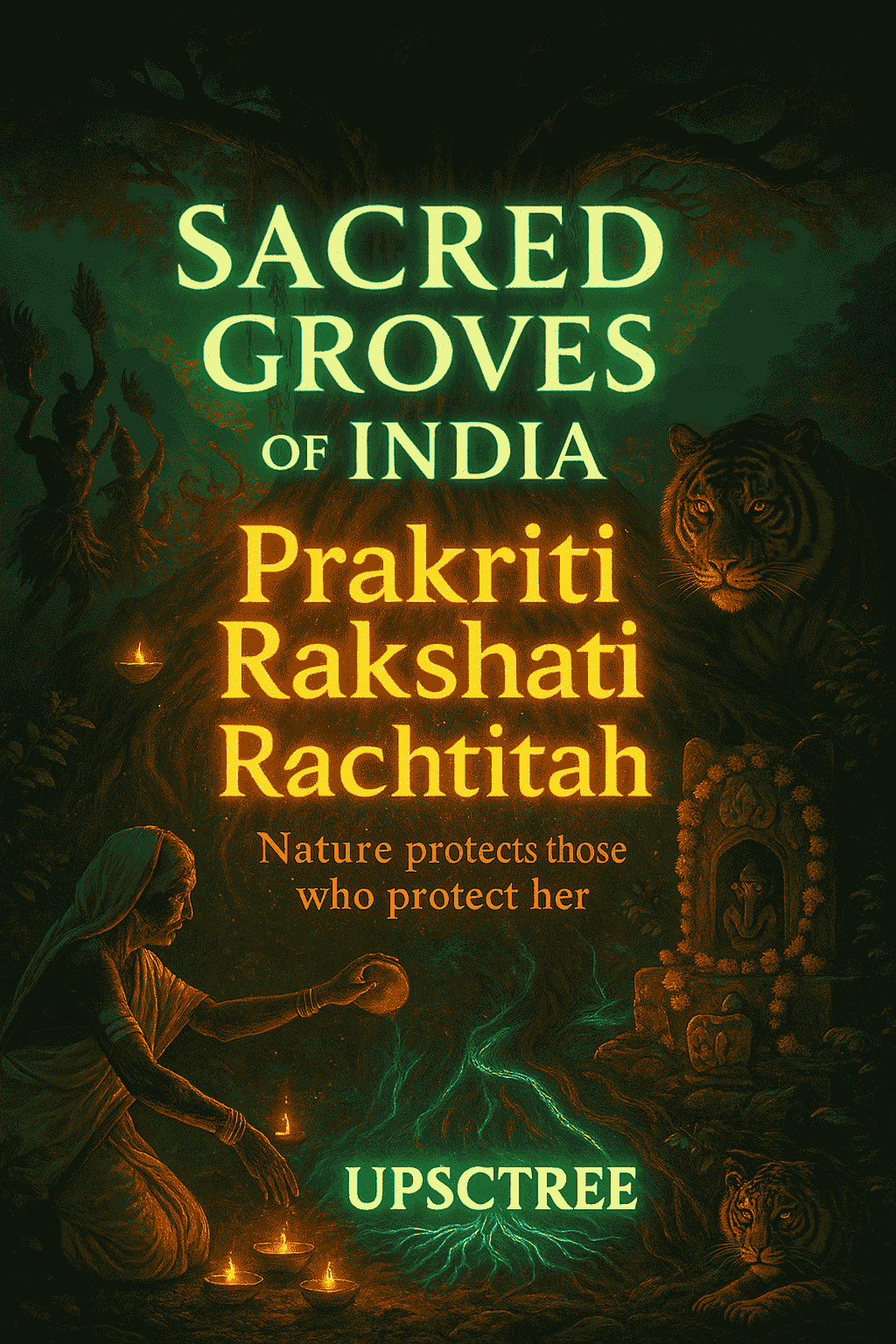
In a world racing toward concrete skylines and digital dreams, there exist quiet sanctuaries of life—sacred groves. These are not just patches of greenery, but living temples, where nature and faith have coexisted for centuries.
 Piplantri Village, Rajasthan – A Model of Eco-Feminism
Located in the Rajsamand district of Rajasthan, Piplantri was once plagued by deforestation, marble mining, and deep-rooted gender inequality. Today, it is globally recognized for a unique initiative: planting 111 trees for every girl child born.
This transformative movement was initiated by Padma Shri Shyam Sundar Paliwal, who began planting trees in memory of his deceased daughter. Over time, the practice became a community tradition. Along with planting trees, the villagers also contribute ₹31,000 as a fixed deposit for each girl’s future.
Key Impacts:
-
-
Over 3.5 lakh trees planted, restoring the ecosystem.
-
Promotion of gender equality and girl child empowerment.
-
Generation of additional income through forest produce.
-
Climate resilience and biodiversity revival through indigenous tree species.
-
Piplantri stands as a symbol of community-driven environmental stewardship and social change, integrating ecological conservation with gender justice.
A Legacy Rooted in Belief
Long before the idea of biodiversity conservation took scientific shape, ancient Indian societies had already found a way to protect nature: by making it sacred.
In every corner of India, these groves go by different names—Kaavu in Kerala, Sarna in Jharkhand, Devrai in Goa, and Pavithravanam in Andhra Pradesh. Though the names vary, the purpose remains the same: protect the forest, and the forest will protect you.
These groves are believed to be the abode of gods, ancestral spirits, or serpents. Cutting a tree or hunting within their boundaries isn’t just frowned upon—it’s seen as a sin that could invite disease, misfortune, or divine wrath.
📍 Case Study 1: Sarpakavu, Kerala – A Forest for the Serpent Gods
In Kerala, Sarpakavu (sacred serpent groves) are found near traditional Nair homes. These thick patches of forest are untouched, dark, and humid—ideal for biodiversity.
-
Associated Deity: Naga (serpent deity)
-
Ritual: Ayilyam Puja, an annual festival to appease the snakes
-
Belief: Removing a tree from the grove invites misfortune—droughts, infertility, illness.
🔥 Impact: These groves act as natural water-harvesting sites, preventing soil erosion and maintaining local hydrology.
🌲 Case Study 2: Mawphlang Sacred Grove, Meghalaya
Deep in the Khasi Hills lies a 78-hectare forest where no branch can be taken out—even if it’s dead.
-
Tribe: Khasi
-
Belief: A powerful deity, Labasa, guards the forest.
-
Rituals: Animal sacrifices and tribal ceremonies are held for protection and abundance.
🦋 Ecological Value:
-
Over 200 species of medicinal plants, lichens, and ferns
-
Source of clean air and water for neighboring villages
👣 Ethical Dimension: Embodies deep ecology—valuing nature for its own sake, not just for utility.
🌿 Case Study 3: Jama Jharana Sacred Grove, Kandhamal, Odisha – The Forest That Heals
In the heart of Odisha’s Kandhamal district, nestled among the Eastern Ghats, lies a grove revered not just as sacred—but as sacrosanct.
Locally called the “Jama Jharana Devata Ban”, this sacred grove is protected by the Kondh tribal community, one of the oldest Adivasi groups in India.
-
Associated Deity: Jama Devata, a local rain and fertility spirit
🪴 Ecological Richness:
-
Dense canopy with Sal, Bamboo, and medicinal herbs
-
Natural spring water source that sustains nearby villages
-
Habitat for hill mynas, pangolins, and various endemic reptiles
🚫 Taboos:
-
No one dares to cut a tree, take firewood, or bathe in the spring without ritual permission.
-
Locals believe desecrating the grove brings misfortune, crop failure, and illness.
🎯 Significance:
-
Serves as a traditional water management system.
-
Protects indigenous knowledge of medicinal plants, passed down orally through generations.
-
Symbolises tribal cosmology—where land, spirit, and survival are inseparable.
🌺 Nature’s Own Temple
These sacred spaces are often small, sometimes just a few trees, but within them lies an incredible wealth of biodiversity—medicinal herbs, ancient trees, rare reptiles, and endangered species that no other forest might hold. Protected by communities—not governments—these groves became India’s oldest model of in-situ conservation.
And they worked.
Generation after generation respected the unseen deities, followed the unwritten rules, and kept the groves intact. This intimate relationship with nature gave rise to unique festivals, offerings, and stories, all echoing the same message: reverence for the Earth.
⚠️ A Crisis in the Making
But as India marches toward rapid urbanisation, this tradition is slowly fading. Skyscrapers rise, myths fall. Modernisation has crept in, and the groves are disappearing.
What once was sacred is now being eyed for roads, industries, and real estate. Many young people see these customs as superstition. The grove becomes secondary—the temple at the center is preserved, but the forest around it is forgotten.
Deforestation, land encroachments, and commercial exploitation have shrunk or erased thousands of groves across India. Of the estimated 1,00,000–1,50,000 sacred groves, many are now just a memory.
⚖️ Legal and Constitutional Framework
Ownership: Varies – individuals, families, temple trusts, panchayats, NGOs.
Forest Departments maintain grove databases and monitor biodiversity status.
Constitutional Provisions:
-
Article 48A: Duty of the State to protect forests and wildlife.
-
Article 51A(g): Duty of citizens to protect the environment.
-
Article 21: Implied right to a healthy environment.
Wildlife Protection (Amendment) Act, 2002:
-
Added Sections 18A & 18B to bring sacred groves under the ambit of protected areas.
🌍 The Path Ahead
To protect these living legacies, India needs:
- A dedicated national law for sacred groves
- Community participation in management and monitoring
- Public awareness campaigns to revive respect for traditional eco-wisdom
- Recognition that these are not just cultural relics, but ecological powerhouses
Because these groves are more than patches of land. They are green time machines, reminding us of a world where humans didn’t dominate nature—but lived with it, in harmony.
🧭 Final Thought
In an age of climate change and collapsing ecosystems, the answer may not lie in always looking ahead—but in looking back. To our roots. To the groves.
Let’s not just remember the sacred groves. Let’s protect them. Before they become legends told by our grandparents, instead of forests seen by our grandchildren.