By Categories: Society

📰 What is the story?

In July 2025, a wedding photo from Himachal Pradesh’s Shillai village went viral. Sunita Chauhan, dressed as a bride, was seen sitting between two grooms—brothers Pradeep and Kapil Negi. Their marriage wasn’t a gimmick or media stunt—it was a revival of an old tribal custom known as Jodidaran, practiced by the Hatti tribe.
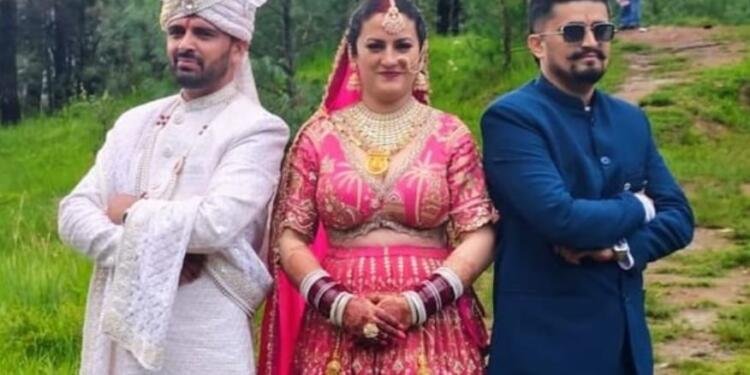
This was not an isolated case. The Hatti community has witnessed five such polyandrous marriages in just six years, showing that the tradition, though fading, still finds support in some parts of the region.


🕊️ What is the custom?

Jodidaran, also known as ‘Ujla Paksh’ or ‘Draupadi Pratha’, is a form of fraternal polyandry, where one woman marries multiple brothers. Practiced by the Hatti tribe (now officially recognized as a Scheduled Tribe), this tradition has deep cultural and economic roots:

  • Land Protection: Scarce farmland in the hilly region is kept undivided when brothers share a wife. This helps families avoid splitting property into unviable portions.
  • Family Unity & Cooperation: A shared wife ensures that the family remains intact, resources are pooled, and brothers remain close-knit.
  • Economic & Physical Security: In remote areas with difficult terrain, a larger family unit offers better protection and labor support.

Weddings are celebrated with traditional three-day rituals called ‘Jajda’, with spiritual offerings like ‘Seenj’ (holy water and jaggery), reflecting the tribe’s sacred beliefs.


⚖️ What does the law of the land say?

Legally, polyandry is not recognized under Indian marriage laws:

  • The Hindu Marriage Act (1955) and the Special Marriage Act do not permit polyandrous unions.
  • Under the Bhartiya Nyaya Sanhita, such arrangements may even attract criminal liability.

However, there’s a constitutional exception:

  • Article 342 allows Scheduled Tribes to follow their customary laws, unless explicitly overridden by the state.
  • The Himachal Pradesh High Court has in the past recognized such unions based on village records (Wajib-ul-Arz) for purposes like inheritance.
  • Even the Uttarakhand Uniform Civil Code (2025) excludes Scheduled Tribes from its purview, protecting traditions like this in regions such as Kinnaur and Jaunsar-Bawar.

So, while Jodidaran isn’t legally a “marriage”, in tribal areas it’s treated with cultural legitimacy, especially in revenue and inheritance matters.

🔍 Sociologists on Polyandry in India

Sociologists have long studied polyandry in the Himalayan belt—including regions like Kinnaur, Jaunsar, and Trans-Giri—where the practice was shaped by environmental, social, and economic conditions.

Key insights from experts include:

  • Resource Management: Sharing one wife was a practical solution in places with scarce land and tough terrain, allowing families to remain united and financially stable.
  • Demographic Reality: Skewed sex ratios and harsh living conditions historically made polyandry more viable.
  • Cultural Identity: For communities like the Hattis, polyandry isn’t just a practice—it’s a symbol of tribal distinctiveness.

Renowned sociologist Dr. Y.S. Parmar, who later became Himachal’s first Chief Minister, studied Himalayan polyandry extensively. He warned that while the system may serve practical needs, it can also reinforce patriarchal norms and suppress women’s autonomy.

Others, like Dr. O.P. Sharma, advocate for a more empathetic view:

“If live-in relationships are socially accepted, why condemn customs rooted in survival and tradition?”


💭 A Tradition at a Crossroads

The wedding of Sunita Chauhan and the Negi brothers brings an ancient tradition into sharp focus. While some hail it as a proud assertion of tribal identity, others raise valid concerns about its legal status and gender dynamics.

With increasing migration, education, and awareness, Jodidaran may slowly fade, but it continues to pose essential questions:

  • Can India’s diverse legal and cultural landscape make space for such age-old traditions?
  • Where do we draw the line between cultural autonomy and individual rights?

As the Supreme Court noted recently:

“Customs cannot remain stuck in time… but others cannot hide behind them to deprive rights.”

For now, in the misty mountains of Himachal, the bond of land, love, and legacy continues—between two brothers and one bride.


Share is Caring, Choose Your Platform!

Recent Posts

  • Petrol in India is cheaper than in countries like Hong Kong, Germany and the UK but costlier than in China, Brazil, Japan, the US, Russia, Pakistan and Sri Lanka, a Bank of Baroda Economics Research report showed.

    Rising fuel prices in India have led to considerable debate on which government, state or central, should be lowering their taxes to keep prices under control.

    The rise in fuel prices is mainly due to the global price of crude oil (raw material for making petrol and diesel) going up. Further, a stronger dollar has added to the cost of crude oil.

    Amongst comparable countries (per capita wise), prices in India are higher than those in Vietnam, Kenya, Ukraine, Bangladesh, Nepal, Pakistan, Sri Lanka, and Venezuela. Countries that are major oil producers have much lower prices.

    In the report, the Philippines has a comparable petrol price but has a per capita income higher than India by over 50 per cent.

    Countries which have a lower per capita income like Kenya, Bangladesh, Nepal, Pakistan, and Venezuela have much lower prices of petrol and hence are impacted less than India.

    “Therefore there is still a strong case for the government to consider lowering the taxes on fuel to protect the interest of the people,” the report argued.

    India is the world’s third-biggest oil consuming and importing nation. It imports 85 per cent of its oil needs and so prices retail fuel at import parity rates.

    With the global surge in energy prices, the cost of producing petrol, diesel and other petroleum products also went up for oil companies in India.

    They raised petrol and diesel prices by Rs 10 a litre in just over a fortnight beginning March 22 but hit a pause button soon after as the move faced criticism and the opposition parties asked the government to cut taxes instead.

    India imports most of its oil from a group of countries called the ‘OPEC +’ (i.e, Iran, Iraq, Saudi Arabia, Venezuela, Kuwait, United Arab Emirates, Russia, etc), which produces 40% of the world’s crude oil.

    As they have the power to dictate fuel supply and prices, their decision of limiting the global supply reduces supply in India, thus raising prices

    The government charges about 167% tax (excise) on petrol and 129% on diesel as compared to US (20%), UK (62%), Italy and Germany (65%).

    The abominable excise duty is 2/3rd of the cost, and the base price, dealer commission and freight form the rest.

    Here is an approximate break-up (in Rs):

    a)Base Price

    39

    b)Freight

    0.34

    c) Price Charged to Dealers = (a+b)

    39.34

    d) Excise Duty

    40.17

    e) Dealer Commission

    4.68

    f) VAT

    25.35

    g) Retail Selling Price

    109.54


    Looked closely, much of the cost of petrol and diesel is due to higher tax rate by govt, specifically excise duty.

    So the question is why government is not reducing the prices ?

    India, being a developing country, it does require gigantic amount of funding for its infrastructure projects as well as welfare schemes.

    However, we as a society is yet to be tax-compliant. Many people evade the direct tax and that’s the reason why govt’s hands are tied. Govt. needs the money to fund various programs and at the same time it is not generating enough revenue from direct taxes.

    That’s the reason why, govt is bumping up its revenue through higher indirect taxes such as GST or excise duty as in the case of petrol and diesel.

    Direct taxes are progressive as it taxes according to an individuals’ income however indirect tax such as excise duty or GST are regressive in the sense that the poorest of the poor and richest of the rich have to pay the same amount.

    Does not matter, if you are an auto-driver or owner of a Mercedes, end of the day both pay the same price for petrol/diesel-that’s why it is regressive in nature.

    But unlike direct tax where tax evasion is rampant, indirect tax can not be evaded due to their very nature and as long as huge no of Indians keep evading direct taxes, indirect tax such as excise duty will be difficult for the govt to reduce, because it may reduce the revenue and hamper may programs of the govt.