


Health & Society
No Road, No Map, But No Child Left Behind: The Five-Hour River Journey to Deliver Healthcare in Tripura
Deep inside Tripura’s Atharamura mountains, a tiny hamlet called Kalicharan Para has no road connecting it to the world. Getting there means a five-hour boat ride through rough waters and thick jungle. For the health teams who made the journey, that was exactly the point.
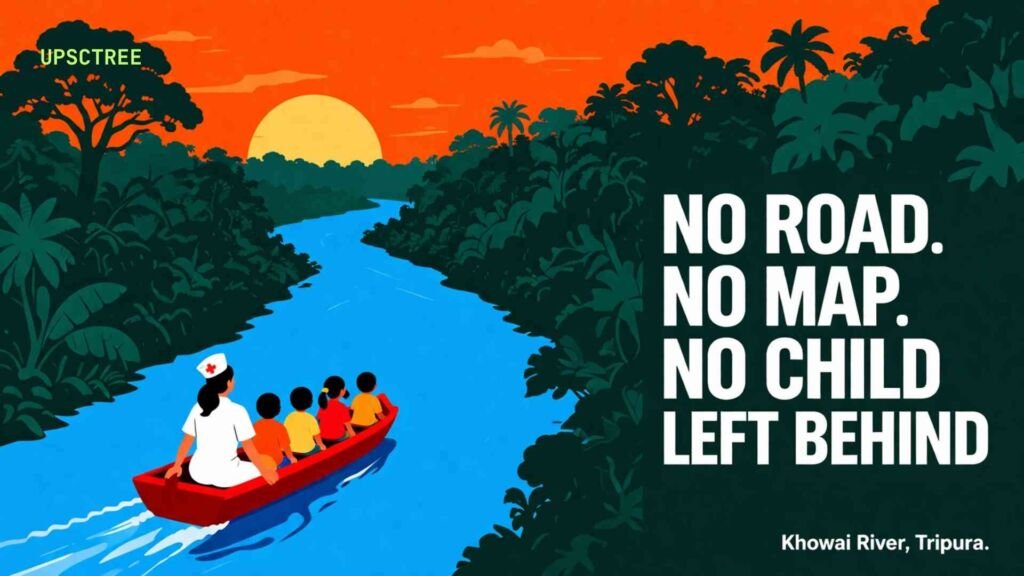 At dawn, the Khowai River runs quiet through dense forest and steep hills in Tripura. The water catches the early light. There are no roads here. No highway signs. No last-mile connectivity in any sense that a planner in a state capital would recognise. There is only the river, and the forest, and somewhere deep inside the Atharamura mountain range, a small hamlet called Kalicharan Para — home to families for whom this waterway is not a scenic route but the only route.
To reach Kalicharan Para, you must board a boat, navigate rough currents, pass through thick jungle and unforgiving terrain, and arrive — five hours later — at a village that exists, for most practical purposes, beyond the reach of the Indian public health system. No road means no regular ambulance. No routine immunisation visit.
That changed when the district administration and the WHO National Public Health Surveillance Network (WHO-NPSN) identified Kalicharan Para as a priority high-risk area and decided, simply, to go there.
The Team That Made the Journey
What made this outreach mission unusual was not just that it happened — it was who made it happen together. The team that arrived in Kalicharan Para was not a small squad of frontline workers sent alone into the forest. It included the Medical Officer from the Primary Health Centre, the Community Health Officer from the nearest Ayushman Arogya Mandir, the Chief Medical Officer, the Sub-Divisional Magistrate, and Primary Health Centre officials.
Critically, senior leadership made the journey too. Dr Soubhik Debbarma, Member Secretary of the National Health Mission, and Mr Rajat Pant, the District Magistrate and Collector of Khowai, travelled alongside frontline workers. They were joined by the WHO-NPSN team led by Dr Tigran Avagyan.
In public health, this matters more than it might seem. When senior officials travel to a remote village rather than receiving reports from it, the message to both their teams and to the community is unmistakable: this place is worth the effort. These people are worth the journey.
What the Team Brought — and What It Found
The outreach camp brought together multiple health services under one roof — something that is easy to take for granted in a city and extraordinary in a village with no road. Services included:
- Immunisation — scheduled childhood vaccines delivered directly to families
- Screening for non-communicable diseases — hypertension, diabetes, and other conditions that often go undetected in remote areas
- Malaria awareness activities — critical in a forested, river-adjacent region
- Antenatal care — check-ups and guidance for pregnant women
- Village Health and Nutrition Day services
- Deworming
What the team also found, and what no health camp checklist could have prepared them for, was the conversation. Sitting with villagers and listening to their daily realities — the difficulty of accessing even basic communication, the long distances to any government facility, the quiet weight of living beyond reach — transformed what could have been a logistical exercise into something more human. Statistics became people. Data became stories.
A Remarkable Finding: No Home Deliveries
One of the most significant things the team discovered was something that wasn’t a problem. Despite the extreme isolation of Kalicharan Para, the village has recorded no home deliveries. Every expectant mother has gone to a government-run health facility for an institutional delivery.
This is not something that happens automatically in remote communities. It reflects sustained effort, trust built over time between the community and health workers, and a commitment on the part of families to make extraordinarily difficult journeys — the same five-hour river route — for the sake of a safe birth. In public health terms, it is a significant achievement, and one that deserved to be recognised and strengthened rather than simply noted.
What Happens After the Visit
The value of a single outreach camp is real but limited. What makes the Kalicharan Para visit matter beyond the day itself is what was set in motion because of it.
Mr Pant directed the District Health Department to make regular visits to the village — not one-off events, but a sustained schedule of outreach. He also asked the Engineering Department to explore developing an alternative road. A physical connection to the rest of the district would change not just healthcare access but the entire texture of daily life for Kalicharan Para’s families.
The lessons from the visit also travelled back to the State Headquarters. WHO-NPSN convened a high-level meeting with senior officials to discuss building a sustainable, scalable framework for immunisation and primary healthcare delivery in hard-to-reach areas — so that what was done once in Kalicharan Para could become a repeatable system rather than a one-time effort.
What “Last-Mile Healthcare” Actually Means
“Last mile” is a term borrowed from logistics — it describes the final, hardest leg of a delivery, when a package has to get from a regional hub to an individual door. In healthcare, it refers to the challenge of reaching people who are geographically, economically, or socially the furthest from health services.
In India, last-mile healthcare is not a metaphor. It is a five-hour boat ride. It is a forest trail that becomes impassable in monsoon. It is a family that knows a government health facility exists somewhere, but has no practical way to reach it. Solving the last-mile problem requires more than good intentions — it requires systems, transport, trained workers, and the institutional will to keep showing up even when showing up is genuinely hard.
At dawn, the Khowai River is quiet again. The health team has gone back. The children who were vaccinated will not remember the day. The mothers whose blood pressure was checked will carry the results for a while, and then — as all of us do — file the paper somewhere and return to the business of living.
But something has shifted in Kalicharan Para. A place that was, for the purposes of the health system, effectively invisible is now visible. It has been visited by senior officials who will not forget having made the journey.
It has been entered into plans and directives and meeting agendas in Khowai and Agartala. The five-hour river route has been travelled once — which means it can be travelled again, and eventually, perhaps, it will not need to be travelled at all.
No child should be left behind, no matter how distant the destination. That sentence, spoken into the forested silence of the Atharamura hills, is the entire point. And in Kalicharan Para, someone finally came far enough to say it in person.
Receive Daily Updates
Recent Posts
- In the Large States category (overall), Chhattisgarh ranks 1st, followed by Odisha and Telangana, whereas, towards the bottom are Maharashtra at 16th, Assam at 17th and Gujarat at 18th. Gujarat is one State that has seen startling performance ranking 5th in the PAI 2021 Index outperforming traditionally good performing States like Andhra Pradesh and Karnataka, but ranks last in terms of Delta
- In the Small States category (overall), Nagaland tops, followed by Mizoram and Tripura. Towards the tail end of the overall Delta ranking is Uttarakhand (9th), Arunachal Pradesh (10th) and Meghalaya (11th). Nagaland despite being a poor performer in the PAI 2021 Index has come out to be the top performer in Delta, similarly, Mizoram’s performance in Delta is also reflected in it’s ranking in the PAI 2021 Index
- In terms of Equity, in the Large States category, Chhattisgarh has the best Delta rate on Equity indicators, this is also reflected in the performance of Chhattisgarh in the Equity Pillar where it ranks 4th. Following Chhattisgarh is Odisha ranking 2nd in Delta-Equity ranking, but ranks 17th in the Equity Pillar of PAI 2021. Telangana ranks 3rd in Delta-Equity ranking even though it is not a top performer in this Pillar in the overall PAI 2021 Index. Jharkhand (16th), Uttar Pradesh (17th) and Assam (18th) rank at the bottom with Uttar Pradesh’s performance in line with the PAI 2021 Index
- Odisha and Nagaland have shown the best year-on-year improvement under 12 Key Development indicators.
- In the 60:40 division States, the top three performers are Kerala, Goa and Tamil Nadu and, the bottom three performers are Uttar Pradesh, Jharkhand and Bihar.
- In the 90:10 division States, the top three performers were Himachal Pradesh, Sikkim and Mizoram; and, the bottom three performers are Manipur, Assam and Meghalaya.
- Among the 60:40 division States, Orissa, Chhattisgarh and Madhya Pradesh are the top three performers and Tamil Nadu, Telangana and Delhi appear as the bottom three performers.
- Among the 90:10 division States, the top three performers are Manipur, Arunachal Pradesh and Nagaland; and, the bottom three performers are Jammu and Kashmir, Uttarakhand and Himachal Pradesh
- Among the 60:40 division States, Goa, West Bengal and Delhi appear as the top three performers and Andhra Pradesh, Telangana and Bihar appear as the bottom three performers.
- Among the 90:10 division States, Mizoram, Himachal Pradesh and Tripura were the top three performers and Jammu & Kashmir, Nagaland and Arunachal Pradesh were the bottom three performers
- West Bengal, Bihar and Tamil Nadu were the top three States amongst the 60:40 division States; while Haryana, Punjab and Rajasthan appeared as the bottom three performers
- In the case of 90:10 division States, Mizoram, Assam and Tripura were the top three performers and Nagaland, Jammu & Kashmir and Uttarakhand featured as the bottom three
- Among the 60:40 division States, the top three performers are Kerala, Andhra Pradesh and Orissa and the bottom three performers are Madhya Pradesh, Jharkhand and Goa
- In the 90:10 division States, the top three performers are Mizoram, Sikkim and Nagaland and the bottom three performers are Manipur and Assam
In a diverse country like India, where each State is socially, culturally, economically, and politically distinct, measuring Governance becomes increasingly tricky. The Public Affairs Index (PAI 2021) is a scientifically rigorous, data-based framework that measures the quality of governance at the Sub-national level and ranks the States and Union Territories (UTs) of India on a Composite Index (CI).
States are classified into two categories – Large and Small – using population as the criteria.
In PAI 2021, PAC defined three significant pillars that embody Governance – Growth, Equity, and Sustainability. Each of the three Pillars is circumscribed by five governance praxis Themes.
The themes include – Voice and Accountability, Government Effectiveness, Rule of Law, Regulatory Quality and Control of Corruption.
At the bottom of the pyramid, 43 component indicators are mapped to 14 Sustainable Development Goals (SDGs) that are relevant to the States and UTs.
This forms the foundation of the conceptual framework of PAI 2021. The choice of the 43 indicators that go into the calculation of the CI were dictated by the objective of uncovering the complexity and multidimensional character of development governance

The Equity Principle
The Equity Pillar of the PAI 2021 Index analyses the inclusiveness impact at the Sub-national level in the country; inclusiveness in terms of the welfare of a society that depends primarily on establishing that all people feel that they have a say in the governance and are not excluded from the mainstream policy framework.
This requires all individuals and communities, but particularly the most vulnerable, to have an opportunity to improve or maintain their wellbeing. This chapter of PAI 2021 reflects the performance of States and UTs during the pandemic and questions the governance infrastructure in the country, analysing the effectiveness of schemes and the general livelihood of the people in terms of Equity.


Growth and its Discontents
Growth in its multidimensional form encompasses the essence of access to and the availability and optimal utilisation of resources. By resources, PAI 2021 refer to human resources, infrastructure and the budgetary allocations. Capacity building of an economy cannot take place if all the key players of growth do not drive development. The multiplier effects of better health care, improved educational outcomes, increased capital accumulation and lower unemployment levels contribute magnificently in the growth and development of the States.


The Pursuit Of Sustainability
The Sustainability Pillar analyses the access to and usage of resources that has an impact on environment, economy and humankind. The Pillar subsumes two themes and uses seven indicators to measure the effectiveness of government efforts with regards to Sustainability.


The Curious Case Of The Delta
The Delta Analysis presents the results on the State performance on year-on-year improvement. The rankings are measured as the Delta value over the last five to 10 years of data available for 12 Key Development Indicators (KDI). In PAI 2021, 12 indicators across the three Pillars of Equity (five indicators), Growth (five indicators) and Sustainability (two indicators). These KDIs are the outcome indicators crucial to assess Human Development. The Performance in the Delta Analysis is then compared to the Overall PAI 2021 Index.
Key Findings:-
In the Scheme of Things
The Scheme Analysis adds an additional dimension to ranking of the States on their governance. It attempts to complement the Governance Model by trying to understand the developmental activities undertaken by State Governments in the form of schemes. It also tries to understand whether better performance of States in schemes reflect in better governance.
The Centrally Sponsored schemes that were analysed are National Health Mission (NHM), Umbrella Integrated Child Development Services scheme (ICDS), Mahatma Gandh National Rural Employment Guarantee Scheme (MGNREGS), Samagra Shiksha Abhiyan (SmSA) and MidDay Meal Scheme (MDMS).
National Health Mission (NHM)
INTEGRATED CHILD DEVELOPMENT SERVICES (ICDS)
MID- DAY MEAL SCHEME (MDMS)
SAMAGRA SHIKSHA ABHIYAN (SMSA)
MAHATMA GANDHI NATIONAL RURAL EMPLOYMENT GUARANTEE SCHEME (MGNREGS)