


Scientists say a month of concentrated efforts is all it takes to control mosquitoes responsible for diseases like dengue and chikungunya. But the claim sounds far-fetched at a time when almost the entire country has been reporting these diseases for the past few months .
The country registered 36,110 confirmed cases of dengue and 14,656 cases of chikungunya till September 11. Government data shows dengue has also claimed 70 lives. An alarming number of cases have been reported of another type of fever whose symptoms are similar to chikungunya and dengue. It is being dubbed mystery fever. Unable to understand what causes the fever, government agencies have started screening for Zika, another vector-borne disease, as a precaution. The National Institute of Virology, Pune, has already checked over 300 blood samples for Zika virus, but the samples have tested negative, confirms D T Mourya, director of the institute.
Ask B N Nagpal, scientist at the National Institute of Malaria Research, Delhi, why the country has failed to avert such an outbreak of vector-borne diseases and he says it is because of lack of political will. “Even if existing methods are employed properly, it is possible to control the population of mosquitoes,” says Nagpal. His sentiments were echoed by the National Green Tribunal, which on September 21, reprimanded the Delhi government for its “shameful and shocking” response to the outbreak. The capital has so far registered four dengue deaths.

 Note*: Disability-adjusted life year (DALY) is a measure of overall disease burden and is expressed as the number of years lost due to ill-health, disability or early death
Shifting places
A fallout of this political apathy has been the failure of the government to adapt to the changing nature of Aedes aegypti mosquito, which is responsible for the diseases plaguing the country.
Normally, the mosquito would breed only in clean stagnant water accumulated in potholes, discarded containers and tyres. Not only has intermittent rains associated with climate change increased breeding places for the mosquito, the vector is also adapting to newer environments. Now there is evidence that it can grow in dirty water, using it as a habitat throughout the year. A study published in the Indian Journal of Medical Research in 2015 shows that Aedes mosquitoes that breed in dirty water are bigger and have longer wing spans. The National Vector Borne Disease Control Programme’s 2016 Urban Vector-Borne Disease Scheme does not consider dirty water as a breeding area. The authors of the 2015 study suggest that the country’s vector control programme should include sewage drains as breeding habitats of dengue vector mosquitoes.
The scheme includes methods such as controlling mosquito breeding sites, use of anti-larval methods with approved larvicides and biological control through larvivorous fishes and biolarvicides. And even these are not being employed properly, which is clear from the current outbreak.
High on research, low on practice
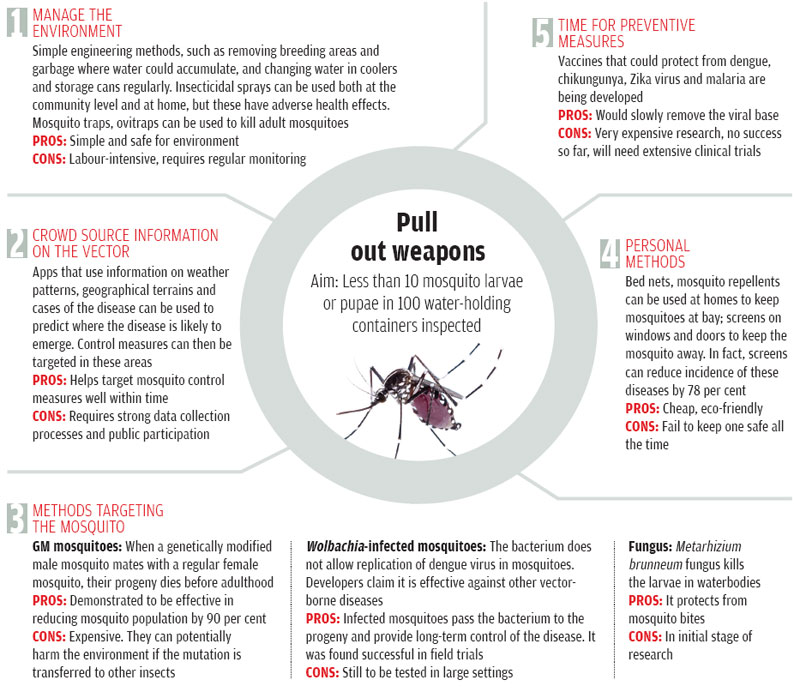
Many innovative methods have been developed in the past few years to fight mosquitoes, but they are still in experimental stages . One way is the use of crowd-sourced data to predict the disease outbreaks in advance. Scientists at Nanyang Technological University (NTU), National University of Singapore (NUS), and the Indian Institute of Technology Bombay, Mumbai (IITB), collaborated to create a web- and mobile-based application for dengue surveillance.
The Mo-Buzz application combines three elements of dengue management—predictive surveillance, civic engagement and health communication. It was first used in Colombo in 2013 through a group of Sri Lanka’s public health inspectors.
The inspectors monitored different areas in the city and fed their reports in the system, which used a pre-loaded algorithm to generate hotspots of infection in real time. “The predictions informed public health inspectors about the areas that needed immediate interventions,” says May O Lwin, professor at NTU and the principal investigator at Mo-Buzz. The application also allows citizens to “report dengue-breeding sites through geo-tagged picture reports”. The application has not been tried in India so far because of funding issues, says Ravi Poovaiah of IITB, who was part of the team that developed the app.
In fact, the lone experiment in India to use crowd sourced data for sensitising people about dengue has been tried by a Mumbai-based agency called Vamanetra Digihealth. The company, set up in April 2014, started an app in Mumbai to detect dengue-breeding spots in the city. “The response from the public was lukewarm primarily because of limited marketing of the product and the underlying campaign,” says Rintu R Patnaik, managing partner, Vamanetra Digihealth.
He adds that the veracity of data is a big issue on crowd-sourcing platforms. “The challenge we faced in running the trial was similar to what the public health teams regularly face—people are generally unwilling to volunteer or allow health workers to find trouble spots that can allow mosquito breeding.” Though the company has stopped developing apps that require crowd sourcing of data, they are still working on modules that rely on government data and open data sets. Patnaik says the behaviour of people can change for the better “through greater media coverage and awareness”.
Researchers across the globe are also actively developing genetically modified (GM) mosquitoes to control vector population. GM mosquitoes are created by injecting the eggs with modified DNA. The male progeny is released to mate with normal mosquitoes and their progeny has a short lifespan.
Oxitec, a British company, has tested GM mosquitoes in Piracicaba, Brazil, and found that it resulted in an 82 per cent decline of the mosquito population in the area in just eight months.
In August last year, the company got a go-ahead from the US Food and Drug Administration to release the GM mosquitoes as part of an investigational field trial in Key Haven in Florida Keys. Residents of Key Haven will soon vote on the trial and the final approval will be given by the Florida Keys Mosquito Control Board. “In India, we have recommended controlled field trials of GM mosquitoes,” says K Gunasekaran, scientist at the Vector Control Research Centre in Puducherry. He says the Department of Science and Technology is in the process of preparing guidelines for conducting trials in India.
 A device effective in controlling mosquito population in septic tanks
The use of GM mosquito, however, is controversial as they have been implicated in the spread of the Zika virus. Zika virus infection began in those areas of Brazil where Oxitec had first released the modified mosquitoes. Even activists in Florida Keys are against the use of these mosquitoes.
Use of Wolbachia bacterium has shown potential in controlling the vector. The bacterium reduces the growth of the disease-causing virus such as dengue, chikungunya and Zika in the body of Aedes aegypti. Both Wolbachia-infected male and female mosquitoes are released into the environment. When they mate with normal mosquitoes, they transfer the bacterium to the progeny. Wolbachia is self-sustaining. “This makes the method cost effective,” says Lewti Hunghanfoo, communications adviser for Eliminate Dengue, international collaboration led by Monash University, Australia.
Some experiments have also shown that when Wolbachia-infected male mosquitoes mate with normal female mosquitoes, they are unable to reproduce. Singapore plans to introduce male Aedes mos quitoes carrying Wolbachia bacteria in three housing estates in October this year. The field trial will continue for six months to assess the impact on the mosquito popu lation. India too plans to use Wolbachia in the next two years.
Preliminary research shows that parasitic fungus Metarhizium brunneum has the potential to control the population of the Aedes mosquito. A study published on July 7, 2016, in PLoS Pathogens demonstrates that the fungus can attack Aedes larvae in a rapid and effective way. Researchers of the study say the approach is safe for humans. The biggest advantage of the fungus is that it grows in freshwater, which is the natural habitat of Aedes mosquito.
There is an Indian invention to combat mosquitoes as well. Hawker is an indigenous mosquito and fly trapper developed by Kerala resident Mathews K Mathew. The device uses biogas to lure mosquitoes and sunlight to kill them. It makes use of the smell from the septic tank to attract the mosquitoes. Once the mosquitoes get trapped, the heat built up inside the device kills them. Mathew says a single Hawker can control mosquito population in 0.4 hectare of land and its surroundings. He initially used Hawker in churches and old age homes and has got a patent for the product. He now plans to start mass-producing the device, which currently sells for Rs 1,500.
 Colombo mayor A J M Muzammil (second from right) launches the Mo-Buzz application for mapping dengue hotspots at the Colombo Municipal Council on February 12, 2015. Hawker (Courtesy: mo-buzz.org)
He is in talks with officials of the Kochi Municipal Corporation (KMC) because the city has over 260,000 septic tanks. A senior KMC official says, “The device is the most effective fly remedy we have seen so far. It does not produce chemicals or other toxic waste and has a larger operational area with little maintenance cost. We have already proposed to use Hawker widely.”
Experts say the key lies in using a combined effort, which should have both national policies and local innovations.
“All the innovative methods have potential, but it is unlikely that any of them when used alone, will be effective in disease prevention and control. None has been fully validated so it is too early to tell which will be most effective,” says Duane J Gubler, professor emeritus and founding director of Signature Research Program in Emer ging Infectious Disease, Duke-NUS Medical School, Singapore.
The vector Aedes aegypti has spread across the globe and India is infested with it. It is time we used the one-month opportunity to control the population. We have both established and experimental tools. “These are not difficult to implement. What is difficult is to have sustainable commitment by the government and the people,” says Gubler.
Sri Lanka conquers malariaThe last case of malaria was reported in the country in October 2012
A public health officer treats patients at a mobile malaria clinic in Sri Lanka (Courtesy: Government Of Sri Lanka)The world Health Organization (WHO) declared Sri Lanka malaria-free on September 6, 2016. “Sri Lanka’s achievement is truly remarkable. In the mid-20th century, it was among the most malaria-affected countries, but now it is malaria-free,” says Poonam Khetrapal Singh, WHO regional director. Health officials in Colombo claim that policy and programmatic shifts led to the success. “This is a combination that worked,” says Hemantha Herath, deputy director, Anti-Malaria Campaign. Sri Lanka signed up early for WHO’s Global Malaria Eradication Programme (GMEP) in 1958 which resulted in an immediate decline in reported malaria cases spread by Anopheles mosquito. But malaria cases continued to spike intermittently in the 1960s, 1980s and 1990s. Malaria reached epidemic levels in 1999 with confirmed cases reaching 265,000. This served as a wake-up call for the government. The country first shifted from the single-vector control to an integrated vector-control programme that was applied across the island. A decade later, Sri Lanka added web-based surveillance methods and began working closely with the community to eradicate malaria. By November 2012, there was remarkable progress. The locally reported cases by then stood at zero with the last local case being reported in October 2012. It is about vigilance and follow up, says Herath. In the three years that followed, 95, 49 and 36 cases of malaria were reported, all of them having contracted malaria overseas. Due to a strong web-based surveillance, the campaign was able to track citizens travelling from countries with a history of malaria transmission and immediately refer them for treatment. Special attention was paid to security forces personnel, immigrants and tourists. “A 24×7 hotline was added next for improved tracking and the method of treatment was also changed. Isolation treatment was provided to patients to contain the spreading of infection.” The country’s strong public health system is responsible for the success, says Anura Jayawickrama, Sri Lanka’s health secretary. Early detection and continuous treatment were the key to success. For years, mobile clinics have been used to reach communities, particularly those living in the malaria-affected regions such as the island’s north-west and north-central, he says. Mobile malaria clinics in high transmission areas meant that prompt and effective treatment could reduce the parasite reservoir and the possibility of further transmission, WHO stated in its statement issued after announcing the country malaria-free. Sri Lanka is the second country in Southeast Asia to eradicate malaria. Last year, WHO had declared the Maldives malaria-free. The country has not reported malaria cases since 1982. The country maintained strong epidemiological and entomological surveillance to sustain its malaria-free status for the past three decades. The same strategy is adopted in India but according to K Gunaksekaran, scientist, Vector Control Research Centre, Puducherry, the reason for Sri Lanka’s success is that they were consistent with the effort. “Unlike us, Sri Lanka continued its efforts even after it had brought down the number of malaria cases. We don’t even have regular surveillance for dengue and chikungunya.” |

Receive Daily Updates
Recent Posts
- In the Large States category (overall), Chhattisgarh ranks 1st, followed by Odisha and Telangana, whereas, towards the bottom are Maharashtra at 16th, Assam at 17th and Gujarat at 18th. Gujarat is one State that has seen startling performance ranking 5th in the PAI 2021 Index outperforming traditionally good performing States like Andhra Pradesh and Karnataka, but ranks last in terms of Delta
- In the Small States category (overall), Nagaland tops, followed by Mizoram and Tripura. Towards the tail end of the overall Delta ranking is Uttarakhand (9th), Arunachal Pradesh (10th) and Meghalaya (11th). Nagaland despite being a poor performer in the PAI 2021 Index has come out to be the top performer in Delta, similarly, Mizoram’s performance in Delta is also reflected in it’s ranking in the PAI 2021 Index
- In terms of Equity, in the Large States category, Chhattisgarh has the best Delta rate on Equity indicators, this is also reflected in the performance of Chhattisgarh in the Equity Pillar where it ranks 4th. Following Chhattisgarh is Odisha ranking 2nd in Delta-Equity ranking, but ranks 17th in the Equity Pillar of PAI 2021. Telangana ranks 3rd in Delta-Equity ranking even though it is not a top performer in this Pillar in the overall PAI 2021 Index. Jharkhand (16th), Uttar Pradesh (17th) and Assam (18th) rank at the bottom with Uttar Pradesh’s performance in line with the PAI 2021 Index
- Odisha and Nagaland have shown the best year-on-year improvement under 12 Key Development indicators.
- In the 60:40 division States, the top three performers are Kerala, Goa and Tamil Nadu and, the bottom three performers are Uttar Pradesh, Jharkhand and Bihar.
- In the 90:10 division States, the top three performers were Himachal Pradesh, Sikkim and Mizoram; and, the bottom three performers are Manipur, Assam and Meghalaya.
- Among the 60:40 division States, Orissa, Chhattisgarh and Madhya Pradesh are the top three performers and Tamil Nadu, Telangana and Delhi appear as the bottom three performers.
- Among the 90:10 division States, the top three performers are Manipur, Arunachal Pradesh and Nagaland; and, the bottom three performers are Jammu and Kashmir, Uttarakhand and Himachal Pradesh
- Among the 60:40 division States, Goa, West Bengal and Delhi appear as the top three performers and Andhra Pradesh, Telangana and Bihar appear as the bottom three performers.
- Among the 90:10 division States, Mizoram, Himachal Pradesh and Tripura were the top three performers and Jammu & Kashmir, Nagaland and Arunachal Pradesh were the bottom three performers
- West Bengal, Bihar and Tamil Nadu were the top three States amongst the 60:40 division States; while Haryana, Punjab and Rajasthan appeared as the bottom three performers
- In the case of 90:10 division States, Mizoram, Assam and Tripura were the top three performers and Nagaland, Jammu & Kashmir and Uttarakhand featured as the bottom three
- Among the 60:40 division States, the top three performers are Kerala, Andhra Pradesh and Orissa and the bottom three performers are Madhya Pradesh, Jharkhand and Goa
- In the 90:10 division States, the top three performers are Mizoram, Sikkim and Nagaland and the bottom three performers are Manipur and Assam
In a diverse country like India, where each State is socially, culturally, economically, and politically distinct, measuring Governance becomes increasingly tricky. The Public Affairs Index (PAI 2021) is a scientifically rigorous, data-based framework that measures the quality of governance at the Sub-national level and ranks the States and Union Territories (UTs) of India on a Composite Index (CI).
States are classified into two categories – Large and Small – using population as the criteria.
In PAI 2021, PAC defined three significant pillars that embody Governance – Growth, Equity, and Sustainability. Each of the three Pillars is circumscribed by five governance praxis Themes.
The themes include – Voice and Accountability, Government Effectiveness, Rule of Law, Regulatory Quality and Control of Corruption.
At the bottom of the pyramid, 43 component indicators are mapped to 14 Sustainable Development Goals (SDGs) that are relevant to the States and UTs.
This forms the foundation of the conceptual framework of PAI 2021. The choice of the 43 indicators that go into the calculation of the CI were dictated by the objective of uncovering the complexity and multidimensional character of development governance

The Equity Principle
The Equity Pillar of the PAI 2021 Index analyses the inclusiveness impact at the Sub-national level in the country; inclusiveness in terms of the welfare of a society that depends primarily on establishing that all people feel that they have a say in the governance and are not excluded from the mainstream policy framework.
This requires all individuals and communities, but particularly the most vulnerable, to have an opportunity to improve or maintain their wellbeing. This chapter of PAI 2021 reflects the performance of States and UTs during the pandemic and questions the governance infrastructure in the country, analysing the effectiveness of schemes and the general livelihood of the people in terms of Equity.


Growth and its Discontents
Growth in its multidimensional form encompasses the essence of access to and the availability and optimal utilisation of resources. By resources, PAI 2021 refer to human resources, infrastructure and the budgetary allocations. Capacity building of an economy cannot take place if all the key players of growth do not drive development. The multiplier effects of better health care, improved educational outcomes, increased capital accumulation and lower unemployment levels contribute magnificently in the growth and development of the States.


The Pursuit Of Sustainability
The Sustainability Pillar analyses the access to and usage of resources that has an impact on environment, economy and humankind. The Pillar subsumes two themes and uses seven indicators to measure the effectiveness of government efforts with regards to Sustainability.


The Curious Case Of The Delta
The Delta Analysis presents the results on the State performance on year-on-year improvement. The rankings are measured as the Delta value over the last five to 10 years of data available for 12 Key Development Indicators (KDI). In PAI 2021, 12 indicators across the three Pillars of Equity (five indicators), Growth (five indicators) and Sustainability (two indicators). These KDIs are the outcome indicators crucial to assess Human Development. The Performance in the Delta Analysis is then compared to the Overall PAI 2021 Index.
Key Findings:-
In the Scheme of Things
The Scheme Analysis adds an additional dimension to ranking of the States on their governance. It attempts to complement the Governance Model by trying to understand the developmental activities undertaken by State Governments in the form of schemes. It also tries to understand whether better performance of States in schemes reflect in better governance.
The Centrally Sponsored schemes that were analysed are National Health Mission (NHM), Umbrella Integrated Child Development Services scheme (ICDS), Mahatma Gandh National Rural Employment Guarantee Scheme (MGNREGS), Samagra Shiksha Abhiyan (SmSA) and MidDay Meal Scheme (MDMS).
National Health Mission (NHM)
INTEGRATED CHILD DEVELOPMENT SERVICES (ICDS)
MID- DAY MEAL SCHEME (MDMS)
SAMAGRA SHIKSHA ABHIYAN (SMSA)
MAHATMA GANDHI NATIONAL RURAL EMPLOYMENT GUARANTEE SCHEME (MGNREGS)