


India’s 7,500 km-long coastline is more than just a scenic boundary—it’s a hub of biodiversity, economy, culture, and climate resilience. But today, our coasts are under siege—from erosion, pollution, habitat destruction, and climate extremes.
🌊 India’s Coast: Beauty on the Brink
⚠️ Key Challenges Facing India’s Coasts
-
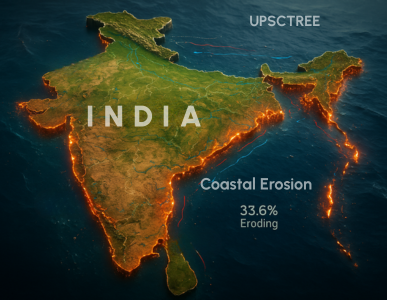
Coastal Erosion: About one-third of India’s coastline is eroding, with states like Tamil Nadu, Kerala, Karnataka, and West Bengal being most affected. Erosion is driven by natural processes (like cyclones and sea-level rise) and human activities such as urbanization, sand mining, and construction of coastal infrastructure. States like Karnataka (notably Dakshina Kannada district) have seen nearly half their coastline eroded in the last three decades, while Kerala’s Ernakulam coast battles relentless wave attacks and erosion worsened by port developments and sand dredging. This erosion leads to loss of land, displacement of communities, and damage to infrastructure.
-
Pollution: India’s coastal waters are heavily polluted by industrial effluents (accounting for nearly 40% of coastal water pollution), untreated sewage, plastic waste, and agricultural runoff. This pollution devastates marine biodiversity, threatens fisheries that millions depend on, and poses health risks to coastal populations. Despite existing laws like the Coastal Regulation Zone (CRZ) Notification and Plastic Waste Management Rules, enforcement remains weak, calling for stronger governance and community engagement.
-
Habitat Destruction: Critical coastal ecosystems such as mangroves, coral reefs, and wetlands, which act as natural buffers against storms and erosion, are being degraded by urbanization, port construction, and tourism. For example, the Sundarbans mangroves are vital for cyclone protection but are under threat from rising seas and human encroachment. Loss of these habitats reduces the coast’s resilience to climate shocks and biodiversity loss
-
Overexploitation of Resources: Unsustainable fishing practices, including illegal light fishing, have depleted marine life and undermined the livelihoods of traditional fishing communities.
-
Climate Change: Sea levels along India’s coast have risen by approximately 8.5 cm over the past 50 years, with projections warning of up to 1.2 meters rise by 2100 if greenhouse gas emissions continue unabated. This rise exacerbates flooding, saltwater intrusion, and habitat loss. Coastal megacities like Mumbai, Chennai, and Kolkata face severe risks of inundation, while rural communities, such as those in Odisha’s Satabhaya village, are already experiencing forced relocations due to repeated flooding and erosion.
-
Governance and Regulation: While India has a framework of laws and policies to protect its coasts, including CRZ notifications and environmental acts, enforcement gaps and outdated coastal maps hamper effective management. Coastal protective structures like seawalls and groynes are widely used but often insufficient or damaged, as seen in Kerala’s Ernakulam coasts. Innovative solutions such as geotubes have been introduced but require further evaluation.
Implementation of coastal regulations (like the Coastal Regulation Zone notifications) faces challenges due to weak enforcement, lack of coordination among agencies, and outdated mapping. The recent revision of India’s coastline length (now over 11,000 km) adds complexity to regulation and planning.
-
Socio-Economic Pressures: The erosion and climate impacts have led to the emergence of “ghost villages” along the east coast, where entire communities have abandoned homes due to environmental degradation. Villages like Uppada in Andhra Pradesh have lost hundreds of houses, markets, and schools to the sea, forcing large-scale migration. Livelihoods dependent on fishing and agriculture are severely disrupted by habitat destruction, salinization of soil, and declining fish stocks, threatening food security and economic stability
🔬 What Can Be Done?
1. Integrated Monitoring
- Use a real-time web of satellite, aerial, and ground data to understand the shifting coastline.
2. Eco-Restoration & Soft Engineering
- Replace concrete with nature: rebuild mangroves, coral reefs, dunes, and wetlands to protect coasts.
3. Smart Policy Backed by Science
- Move beyond ad-hoc solutions. Build science-informed policies using long-term coastal vulnerability models.
🧭 Final Thought:
“The coasts are not merely land meeting sea—they are living, breathing ecosystems on which millions depend.”
India’s coastal future demands more than short-term fixes. It needs an interdisciplinary, collaborative strategy—where technology meets tradition, and ecology shapes economy.
Receive Daily Updates
Recent Posts
Steve Ovett, the famous British middle-distance athlete, won the 800-metres gold medal at the Moscow Olympics of 1980. Just a few days later, he was about to win a 5,000-metres race at London’s Crystal Palace. Known for his burst of acceleration on the home stretch, he had supreme confidence in his ability to out-sprint rivals. With the final 100 metres remaining,
[wptelegram-join-channel link=”https://t.me/s/upsctree” text=”Join @upsctree on Telegram”]Ovett waved to the crowd and raised a hand in triumph. But he had celebrated a bit too early. At the finishing line, Ireland’s John Treacy edged past Ovett. For those few moments, Ovett had lost his sense of reality and ignored the possibility of a negative event.
This analogy works well for the India story and our policy failures , including during the ongoing covid pandemic. While we have never been as well prepared or had significant successes in terms of growth stability as Ovett did in his illustrious running career, we tend to celebrate too early. Indeed, we have done so many times before.
It is as if we’re convinced that India is destined for greater heights, come what may, and so we never run through the finish line. Do we and our policymakers suffer from a collective optimism bias, which, as the Nobel Prize winner Daniel Kahneman once wrote, “may well be the most significant of the cognitive biases”? The optimism bias arises from mistaken beliefs which form expectations that are better than the reality. It makes us underestimate chances of a negative outcome and ignore warnings repeatedly.
The Indian economy had a dream run for five years from 2003-04 to 2007-08, with an average annual growth rate of around 9%. Many believed that India was on its way to clocking consistent double-digit growth and comparisons with China were rife. It was conveniently overlooked that this output expansion had come mainly came from a few sectors: automobiles, telecom and business services.
Indians were made to believe that we could sprint without high-quality education, healthcare, infrastructure or banking sectors, which form the backbone of any stable economy. The plan was to build them as we went along, but then in the euphoria of short-term success, it got lost.
India’s exports of goods grew from $20 billion in 1990-91 to over $310 billion in 2019-20. Looking at these absolute figures it would seem as if India has arrived on the world stage. However, India’s share of global trade has moved up only marginally. Even now, the country accounts for less than 2% of the world’s goods exports.
More importantly, hidden behind this performance was the role played by one sector that should have never made it to India’s list of exports—refined petroleum. The share of refined petroleum exports in India’s goods exports increased from 1.4% in 1996-97 to over 18% in 2011-12.
An import-intensive sector with low labour intensity, exports of refined petroleum zoomed because of the then policy regime of a retail price ceiling on petroleum products in the domestic market. While we have done well in the export of services, our share is still less than 4% of world exports.
India seemed to emerge from the 2008 global financial crisis relatively unscathed. But, a temporary demand push had played a role in the revival—the incomes of many households, both rural and urban, had shot up. Fiscal stimulus to the rural economy and implementation of the Sixth Pay Commission scales had led to the salaries of around 20% of organized-sector employees jumping up. We celebrated, but once again, neither did we resolve the crisis brewing elsewhere in India’s banking sector, nor did we improve our capacity for healthcare or quality education.
Employment saw little economy-wide growth in our boom years. Manufacturing jobs, if anything, shrank. But we continued to celebrate. Youth flocked to low-productivity service-sector jobs, such as those in hotels and restaurants, security and other services. The dependence on such jobs on one hand and high-skilled services on the other was bound to make Indian society more unequal.
And then, there is agriculture, an elephant in the room. If and when farm-sector reforms get implemented, celebrations would once again be premature. The vast majority of India’s farmers have small plots of land, and though these farms are at least as productive as larger ones, net absolute incomes from small plots can only be meagre.
A further rise in farm productivity and consequent increase in supply, if not matched by a demand rise, especially with access to export markets, would result in downward pressure on market prices for farm produce and a further decline in the net incomes of small farmers.
We should learn from what John Treacy did right. He didn’t give up, and pushed for the finish line like it was his only chance at winning. Treacy had years of long-distance practice. The same goes for our economy. A long grind is required to build up its base before we can win and celebrate. And Ovett did not blame anyone for his loss. We play the blame game. Everyone else, right from China and the US to ‘greedy corporates’, seems to be responsible for our failures.
We have lowered absolute poverty levels and had technology-based successes like Aadhaar and digital access to public services. But there are no short cuts to good quality and adequate healthcare and education services. We must remain optimistic but stay firmly away from the optimism bias.
In the end, it is not about how we start, but how we finish. The disastrous second wave of covid and our inability to manage it is a ghastly reminder of this fact.