Backgound:-
The third India-Central Asia Dialogue convened by External Affairs Minister S. Jaishankar on Sunday is one in a series of timely connections to the region by New Delhi this year, spurred in some measure by events in Afghanistan.
The dialogue has been held a month before leaders of all five Central Asian Republics (CARs) come to New Delhi as chief guests for the Republic Day celebrations, and a month after National Security Adviser Ajit Doval’s “Regional Security Dialogue” with his CAR counterparts to discuss Afghanistan.
Key Outcomes:-
- Extending “immediate” humanitarian aid to Afghanistan, increasing trade, and improving connectivity.
- A “broad regional consensus” on Afghanistan, is apt, given that, like India, all the Central Asian neighbours of Afghanistan worry about the threat of terrorism, radicalisation, narcotics, and refugees.
- However, unlike India, most of the CARs maintain bilateral talks with the Taliban regime; Uzbekistan and Turkmenistan have reopened missions there.
- Trade between India and Central Asia has long languished below $2 billion, with all sides keen to grow this.
- In addition, India’s $1 billion Line of Credit for projects in Central Asia, and connectivity initiatives such as Chabahar port, the International North-South Transport Corridor and the Turkmenistan-Afghanistan-Pakistan-India gas pipeline were all part of the dialogue.
- While Russia continues to wield influence in the CAR governments, China’s Belt and Road Initiative and $100 billion trade (by some estimates) have made it a central figure in the region.
- The U.S. has also been seeking a foothold in the region, especially after Afghanistan. Meanwhile, India’s land connectivity to Central Asia is hampered by Pakistan which is building strong links and transit trade agreements with each of the CARs.
- The alternative route, via Iran’s Chabahar, has received a setback after the Taliban takeover of Kabul, and the development of the Indian managed Shahid Beheshti terminal there continues to suffer due to the threat of American sanctions.
- While India has strengthened ties with other parts of Asia, it must now redouble its efforts towards Central Asia if it is to counter the ‘Great Game’ rivalries playing out in the region, and reclaim its shared history with countries that are an important market, a source for energy, and also a bulwark against the threats of extremism and radicalisation.
Chabahar Port
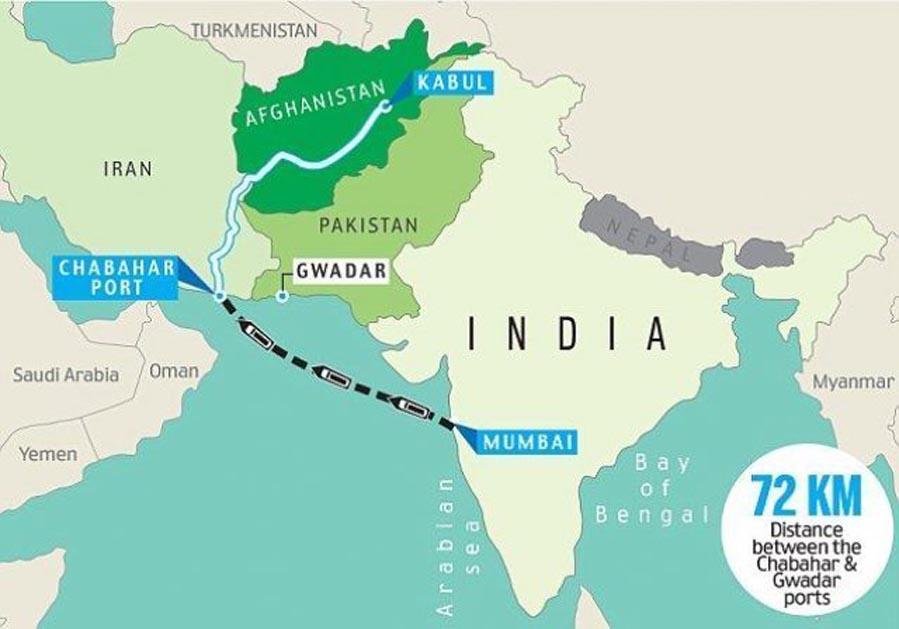
International North-South Transport Corridor

Turkmenistan-Afghanistan-Pakistan-India gas pipeline

Recent Posts
Petrol in India is cheaper than in countries like Hong Kong, Germany and the UK but costlier than in China, Brazil, Japan, the US, Russia, Pakistan and Sri Lanka, a Bank of Baroda Economics Research report showed.
Rising fuel prices in India have led to considerable debate on which government, state or central, should be lowering their taxes to keep prices under control.
The rise in fuel prices is mainly due to the global price of crude oil (raw material for making petrol and diesel) going up. Further, a stronger dollar has added to the cost of crude oil.
Amongst comparable countries (per capita wise), prices in India are higher than those in Vietnam, Kenya, Ukraine, Bangladesh, Nepal, Pakistan, Sri Lanka, and Venezuela. Countries that are major oil producers have much lower prices.
In the report, the Philippines has a comparable petrol price but has a per capita income higher than India by over 50 per cent.
Countries which have a lower per capita income like Kenya, Bangladesh, Nepal, Pakistan, and Venezuela have much lower prices of petrol and hence are impacted less than India.
“Therefore there is still a strong case for the government to consider lowering the taxes on fuel to protect the interest of the people,” the report argued.
India is the world’s third-biggest oil consuming and importing nation. It imports 85 per cent of its oil needs and so prices retail fuel at import parity rates.
With the global surge in energy prices, the cost of producing petrol, diesel and other petroleum products also went up for oil companies in India.
They raised petrol and diesel prices by Rs 10 a litre in just over a fortnight beginning March 22 but hit a pause button soon after as the move faced criticism and the opposition parties asked the government to cut taxes instead.
India imports most of its oil from a group of countries called the ‘OPEC +’ (i.e, Iran, Iraq, Saudi Arabia, Venezuela, Kuwait, United Arab Emirates, Russia, etc), which produces 40% of the world’s crude oil.
As they have the power to dictate fuel supply and prices, their decision of limiting the global supply reduces supply in India, thus raising prices
The government charges about 167% tax (excise) on petrol and 129% on diesel as compared to US (20%), UK (62%), Italy and Germany (65%).
The abominable excise duty is 2/3rd of the cost, and the base price, dealer commission and freight form the rest.
Here is an approximate break-up (in Rs):
a)Base Price | 39 |
b)Freight | 0.34 |
c) Price Charged to Dealers = (a+b) | 39.34 |
d) Excise Duty | 40.17 |
e) Dealer Commission | 4.68 |
f) VAT | 25.35 |
g) Retail Selling Price | 109.54 |
Looked closely, much of the cost of petrol and diesel is due to higher tax rate by govt, specifically excise duty.
So the question is why government is not reducing the prices ?
India, being a developing country, it does require gigantic amount of funding for its infrastructure projects as well as welfare schemes.
However, we as a society is yet to be tax-compliant. Many people evade the direct tax and that’s the reason why govt’s hands are tied. Govt. needs the money to fund various programs and at the same time it is not generating enough revenue from direct taxes.
That’s the reason why, govt is bumping up its revenue through higher indirect taxes such as GST or excise duty as in the case of petrol and diesel.
Direct taxes are progressive as it taxes according to an individuals’ income however indirect tax such as excise duty or GST are regressive in the sense that the poorest of the poor and richest of the rich have to pay the same amount.
Does not matter, if you are an auto-driver or owner of a Mercedes, end of the day both pay the same price for petrol/diesel-that’s why it is regressive in nature.
But unlike direct tax where tax evasion is rampant, indirect tax can not be evaded due to their very nature and as long as huge no of Indians keep evading direct taxes, indirect tax such as excise duty will be difficult for the govt to reduce, because it may reduce the revenue and hamper may programs of the govt.