


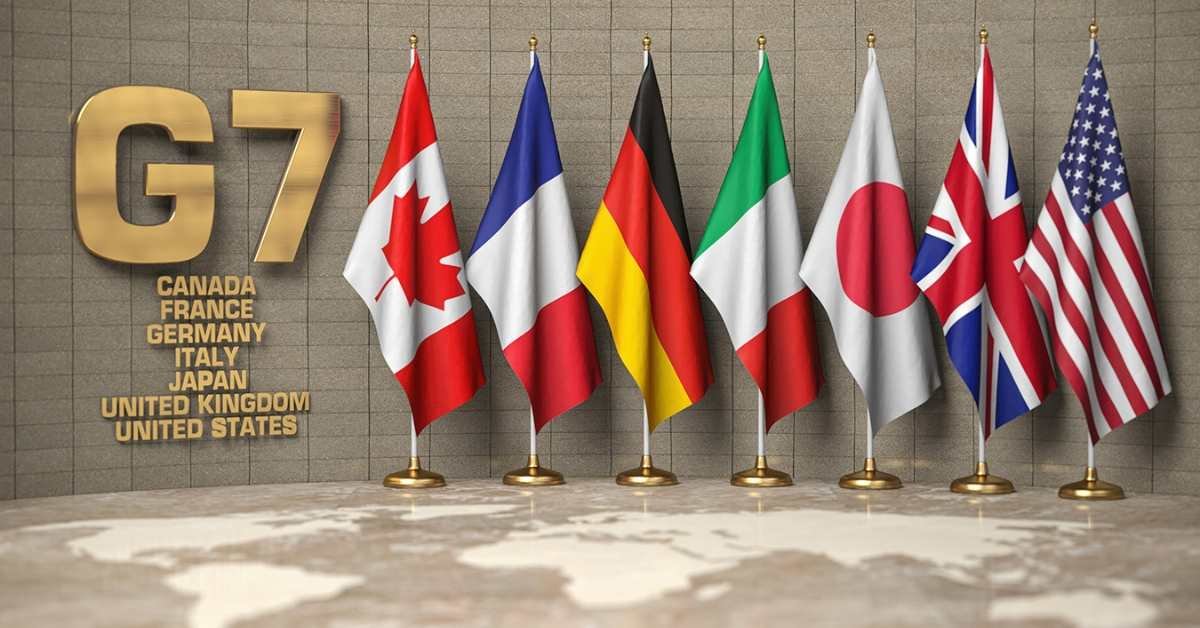
 Backdrop:
The 2025 G7 summit in Alberta, Canada, is occurring amid global turbulence—wars in Ukraine and Gaza, rising tensions between Israel and Iran, and instability in the Indo-Pacific due to China’s maneuvers. While a US-China trade truce and India-Pakistan ceasefire exist, global geopolitics remain volatile.
This aligns with Realist theories in International Relations, which emphasize the anarchic nature of the international system, state-centric power struggles, and the perpetual quest for security and influence.
🟦 Realist Theory:
States are like competitors in a game, each seeking their own power and security in a world without a central authority.
Shifting Influence:
The G7 in its heyday was an extremely powerful grouping on account of its overwhelming share of the global GDP. For instance, in the 1980s, the G7’s share of global GDP was almost 70 per cent. The share in 2024 is barely above 30 per cent. The main reason for this is that the economic centre of gravity has shifted from the West to the East, led by China but also because of countries like India.
China is not part of G7. Neither is Russia. This does bestow some leverage on India, which practices strategic autonomy, follows an independent foreign policy and more broadly, represents the Global South.
The G7’s declining share of global GDP—from ~70% in the 1980s to just over 30% today—reflects the World Systems Theory and Global Power Shift. The rise of China and India as economic powerhouses exemplifies the move from a unipolar or Western-dominated system to a more multipolar world order, supporting Neorealist notions of power balancing and the redistribution of global influence
🟦 World Systems Theory:
The world is divided into “core” (wealthy) and “periphery” (developing) countries, but the economic center can shift over time as new powers rise.
🟦 Multipolarity (Neorealism):
Instead of one or two big powers, several strong countries now influence world affairs, making the system more complex.
G7’s Renewed Relevance:
Until recently, the G7 was dismissed as “yesterday’s club”, especially after the formation of the G20. But a combination of geopolitical factors means G7 can have another shot at being relevant.
This also has to do with the UN Security Council’s increasing powerlessness, the gradual irrelevance of WTO and America’s decision to pull out of the WHO and the Paris Climate Accord.
The G20 (after an impressive showing by India under its presidency) is mired in difficulty for a variety of reasons. The G7 could fill a vacuum in the international relations system.
The G7 could regain significance due to the UN Security Council’s ineffectiveness, the diminishing role of the WTO, the US withdrawal from global agreements, and the current dysfunction within the G20.
The G7, once dismissed as obsolete (“yesterday’s club”), is experiencing a resurgence due to the declining effectiveness of global governance institutions like the UN Security Council and WTO. This shift supports Regime Theory, which posits that international institutions become more or less relevant depending on their ability to adapt to new power realities. The relative ineffectiveness of the G20 and the US withdrawal from key multilateral agreements highlight the Limits of Liberal Institutionalism, pointing to a renewed reliance on smaller, more cohesive groupings.
🟦 Regime Theory:
International organizations matter only if they help states achieve their goals and adapt to changes.
🟦 Liberal Institutionalism:
Cooperation is possible through institutions, but if they stop working, states look for other ways to cooperate.
Canada’s Summit Goals:
Canada has set three broad goals for the Alberta Summit.
- Peace and security—countering foreign interference and transnational crime.
- Energy security and digital transition—strengthening critical mineral supply chains and leveraging AI/quantum tech.
- Infrastructure and jobs—boosting private investment for better jobs and stronger infrastructure.
Canada’s leadership could deliver a strong summit declaration if consensus is achieved.
India’s Role:
The invitation to India to attend the summit was a non-issue. It is hard to believe India, which has been part of 12 G7 Summits, could have been overlooked. In response to odd voices in Canada arguing against an invitation to Prime Minister Narendra Modi, the newly minted Canadian premier put it well: “As chair of the G7, it is important to invite the most important countries to attend to talk about issues such as energy, artificial intelligence, critical minerals, and India is really at the very centre of global supply chains.”
India’s invitation was natural, reflecting its central role in global supply chains and its experience at past G7 summits. PM Modi’s participation, including bilateral talks with Canadian PM Carney, could influence global opinion, especially post-“Operation Sindoor.”
India’s inclusion and growing leverage reflects its adherence to Non-Alignment and Strategic Autonomy—core tenets of India’s foreign policy, resonating with the Constructivist Theory (India as a norm entrepreneur representing the Global South).
🟦 Strategic Autonomy/Non-Alignment:
India avoids being tied to any single major power, choosing its partners and policies freely.
🟦 Constructivist Theory:
Countries can shape world politics based on their unique ideas, values, and roles (like India’s leadership for the Global South).
Indo-Canadian Relations:
On Indo-Canadian ties, the fact of the matter is that India took the first steps to initiate a rapprochement with Canada. When Mark Carney was elected as Canada’s Premier, PM Modi made it a point to reach out and congratulate him. The foreign ministers of India and Canada spoke over the phone and committed themselves to improving bilateral relations.
It is hoped by many well-wishers that PM Modi and PM Carney can hit it off when they sit together for a bilateral meeting in Alberta. The best possible and immediate outcome would be the quick reinstatement of high commissioners in both Delhi and Ottawa with substantial restoration of the strength of both diplomatic missions.
Canada and India have too much at stake in the relationship to allow it to be derailed. The geopolitical uncertainty along with strategic turbulence means that both countries stand to gain enormously by not just restoring their ties to status quo ante, but also to chart a clear trajectory for taking the relationship to the next level.
In short:
The Alberta G7 Summit is a meeting point of old and new powers, new alliances, and shifting global roles. These political science theories help explain why countries act the way they do and why summits like this matter for the future.