By Categories: FP & IR

Backdrop:

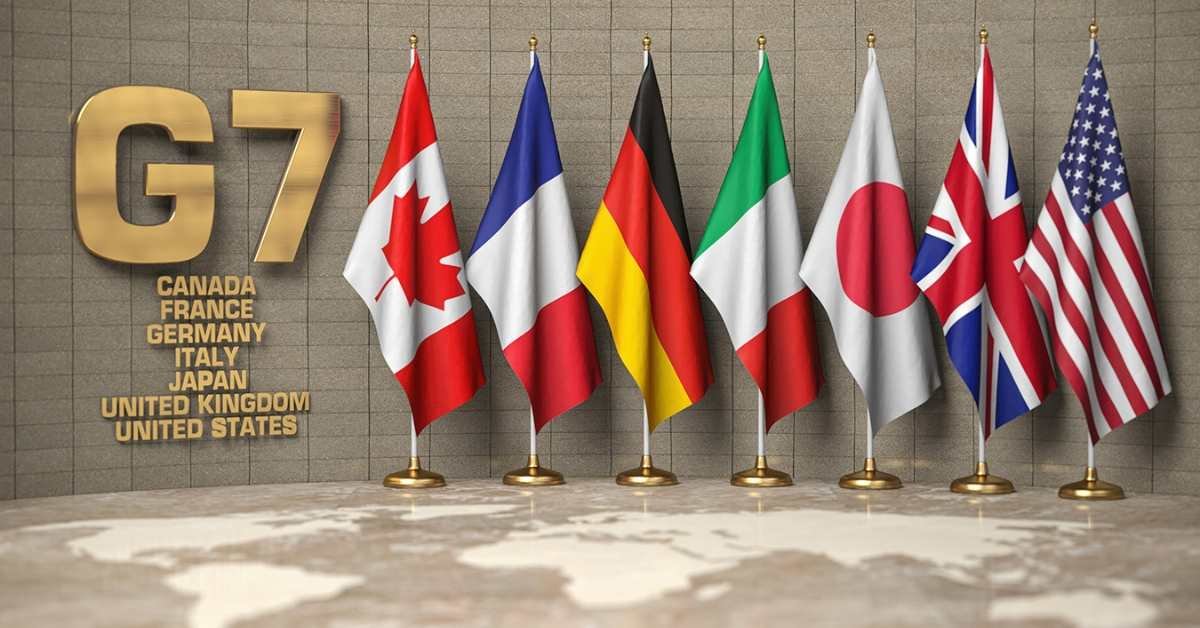
The 2025 G7 summit in Alberta, Canada, is occurring amid global turbulence—wars in Ukraine and Gaza, rising tensions between Israel and Iran, and instability in the Indo-Pacific due to China’s maneuvers. While a US-China trade truce and India-Pakistan ceasefire exist, global geopolitics remain volatile.

This aligns with Realist theories in International Relations, which emphasize the anarchic nature of the international system, state-centric power struggles, and the perpetual quest for security and influence.

🟦 Realist Theory:
States are like competitors in a game, each seeking their own power and security in a world without a central authority.

Shifting Influence:

The G7 in its heyday was an extremely powerful grouping on account of its overwhelming share of the global GDP. For instance, in the 1980s, the G7’s share of global GDP was almost 70 per cent. The share in 2024 is barely above 30 per cent. The main reason for this is that the economic centre of gravity has shifted from the West to the East, led by China but also because of countries like India.

China is not part of G7. Neither is Russia. This does bestow some leverage on India, which practices strategic autonomy, follows an independent foreign policy and more broadly, represents the Global South.

The G7’s declining share of global GDP—from ~70% in the 1980s to just over 30% today—reflects the World Systems Theory and Global Power Shift. The rise of China and India as economic powerhouses exemplifies the move from a unipolar or Western-dominated system to a more multipolar world order, supporting Neorealist notions of power balancing and the redistribution of global influence

🟦 World Systems Theory:
The world is divided into “core” (wealthy) and “periphery” (developing) countries, but the economic center can shift over time as new powers rise.

🟦 Multipolarity (Neorealism):
Instead of one or two big powers, several strong countries now influence world affairs, making the system more complex.

G7’s Renewed Relevance:

Until recently, the G7 was dismissed as “yesterday’s club”, especially after the formation of the G20. But a combination of geopolitical factors means G7 can have another shot at being relevant.

This also has to do with the UN Security Council’s increasing powerlessness, the gradual irrelevance of WTO and America’s decision to pull out of the WHO and the Paris Climate Accord.

The G20 (after an impressive showing by India under its presidency) is mired in difficulty for a variety of reasons. The G7 could fill a vacuum in the international relations system.

The G7 could regain significance due to the UN Security Council’s ineffectiveness, the diminishing role of the WTO, the US withdrawal from global agreements, and the current dysfunction within the G20.

The G7, once dismissed as obsolete (“yesterday’s club”), is experiencing a resurgence due to the declining effectiveness of global governance institutions like the UN Security Council and WTO. This shift supports Regime Theory, which posits that international institutions become more or less relevant depending on their ability to adapt to new power realities. The relative ineffectiveness of the G20 and the US withdrawal from key multilateral agreements highlight the Limits of Liberal Institutionalism, pointing to a renewed reliance on smaller, more cohesive groupings.

🟦 Regime Theory:
International organizations matter only if they help states achieve their goals and adapt to changes.

🟦 Liberal Institutionalism:
Cooperation is possible through institutions, but if they stop working, states look for other ways to cooperate.

Canada’s Summit Goals:

Canada has set three broad goals for the Alberta Summit.

  1. Peace and security—countering foreign interference and transnational crime.
  2. Energy security and digital transition—strengthening critical mineral supply chains and leveraging AI/quantum tech.
  3. Infrastructure and jobs—boosting private investment for better jobs and stronger infrastructure.

Canada’s leadership could deliver a strong summit declaration if consensus is achieved.

India’s Role:

The invitation to India to attend the summit was a non-issue. It is hard to believe India, which has been part of 12 G7 Summits, could have been overlooked. In response to odd voices in Canada arguing against an invitation to Prime Minister Narendra Modi, the newly minted Canadian premier put it well: “As chair of the G7, it is important to invite the most important countries to attend to talk about issues such as energy, artificial intelligence, critical minerals, and India is really at the very centre of global supply chains.

India’s invitation was natural, reflecting its central role in global supply chains and its experience at past G7 summits. PM Modi’s participation, including bilateral talks with Canadian PM Carney, could influence global opinion, especially post-“Operation Sindoor.”

India’s inclusion and growing leverage reflects its adherence to Non-Alignment and Strategic Autonomy—core tenets of India’s foreign policy, resonating with the Constructivist Theory (India as a norm entrepreneur representing the Global South).

🟦 Strategic Autonomy/Non-Alignment:
India avoids being tied to any single major power, choosing its partners and policies freely.

🟦 Constructivist Theory:
Countries can shape world politics based on their unique ideas, values, and roles (like India’s leadership for the Global South).

Indo-Canadian Relations:

On Indo-Canadian ties, the fact of the matter is that India took the first steps to initiate a rapprochement with Canada. When Mark Carney was elected as Canada’s Premier, PM Modi made it a point to reach out and congratulate him. The foreign ministers of India and Canada spoke over the phone and committed themselves to improving bilateral relations.

It is hoped by many well-wishers that PM Modi and PM Carney can hit it off when they sit together for a bilateral meeting in Alberta. The best possible and immediate outcome would be the quick reinstatement of high commissioners in both Delhi and Ottawa with substantial restoration of the strength of both diplomatic missions.

Canada and India have too much at stake in the relationship to allow it to be derailed. The geopolitical uncertainty along with strategic turbulence means that both countries stand to gain enormously by not just restoring their ties to status quo ante, but also to chart a clear trajectory for taking the relationship to the next level.

In short:

The Alberta G7 Summit is a meeting point of old and new powers, new alliances, and shifting global roles. These political science theories help explain why countries act the way they do and why summits like this matter for the future.


Share is Caring, Choose Your Platform!

Recent Posts


  • In a diverse country like India, where each State is socially, culturally, economically, and politically distinct, measuring Governance becomes increasingly tricky. The Public Affairs Index (PAI 2021) is a scientifically rigorous, data-based framework that measures the quality of governance at the Sub-national level and ranks the States and Union Territories (UTs) of India on a Composite Index (CI).


    States are classified into two categories – Large and Small – using population as the criteria.

    In PAI 2021, PAC defined three significant pillars that embody GovernanceGrowth, Equity, and Sustainability. Each of the three Pillars is circumscribed by five governance praxis Themes.

    The themes include – Voice and Accountability, Government Effectiveness, Rule of Law, Regulatory Quality and Control of Corruption.

    At the bottom of the pyramid, 43 component indicators are mapped to 14 Sustainable Development Goals (SDGs) that are relevant to the States and UTs.

    This forms the foundation of the conceptual framework of PAI 2021. The choice of the 43 indicators that go into the calculation of the CI were dictated by the objective of uncovering the complexity and multidimensional character of development governance

    The Equity Principle

    The Equity Pillar of the PAI 2021 Index analyses the inclusiveness impact at the Sub-national level in the country; inclusiveness in terms of the welfare of a society that depends primarily on establishing that all people feel that they have a say in the governance and are not excluded from the mainstream policy framework.

    This requires all individuals and communities, but particularly the most vulnerable, to have an opportunity to improve or maintain their wellbeing. This chapter of PAI 2021 reflects the performance of States and UTs during the pandemic and questions the governance infrastructure in the country, analysing the effectiveness of schemes and the general livelihood of the people in terms of Equity.

    Growth and its Discontents

    Growth in its multidimensional form encompasses the essence of access to and the availability and optimal utilisation of resources. By resources, PAI 2021 refer to human resources, infrastructure and the budgetary allocations. Capacity building of an economy cannot take place if all the key players of growth do not drive development. The multiplier effects of better health care, improved educational outcomes, increased capital accumulation and lower unemployment levels contribute magnificently in the growth and development of the States.

    The Pursuit Of Sustainability

    The Sustainability Pillar analyses the access to and usage of resources that has an impact on environment, economy and humankind. The Pillar subsumes two themes and uses seven indicators to measure the effectiveness of government efforts with regards to Sustainability.


    The Curious Case Of The Delta

    The Delta Analysis presents the results on the State performance on year-on-year improvement. The rankings are measured as the Delta value over the last five to 10 years of data available for 12 Key Development Indicators (KDI). In PAI 2021, 12 indicators across the three Pillars of Equity (five indicators), Growth (five indicators) and Sustainability (two indicators). These KDIs are the outcome indicators crucial to assess Human Development. The Performance in the Delta Analysis is then compared to the Overall PAI 2021 Index.

    Key Findings:-

    1. In the Large States category (overall), Chhattisgarh ranks 1st, followed by Odisha and Telangana, whereas, towards the bottom are Maharashtra at 16th, Assam at 17th and Gujarat at 18th. Gujarat is one State that has seen startling performance ranking 5th in the PAI 2021 Index outperforming traditionally good performing States like Andhra Pradesh and Karnataka, but ranks last in terms of Delta
    2. In the Small States category (overall), Nagaland tops, followed by Mizoram and Tripura. Towards the tail end of the overall Delta ranking is Uttarakhand (9th), Arunachal Pradesh (10th) and Meghalaya (11th). Nagaland despite being a poor performer in the PAI 2021 Index has come out to be the top performer in Delta, similarly, Mizoram’s performance in Delta is also reflected in it’s ranking in the PAI 2021 Index
    3. In terms of Equity, in the Large States category, Chhattisgarh has the best Delta rate on Equity indicators, this is also reflected in the performance of Chhattisgarh in the Equity Pillar where it ranks 4th. Following Chhattisgarh is Odisha ranking 2nd in Delta-Equity ranking, but ranks 17th in the Equity Pillar of PAI 2021. Telangana ranks 3rd in Delta-Equity ranking even though it is not a top performer in this Pillar in the overall PAI 2021 Index. Jharkhand (16th), Uttar Pradesh (17th) and Assam (18th) rank at the bottom with Uttar Pradesh’s performance in line with the PAI 2021 Index
    4. Odisha and Nagaland have shown the best year-on-year improvement under 12 Key Development indicators.

    In the Scheme of Things

    The Scheme Analysis adds an additional dimension to ranking of the States on their governance. It attempts to complement the Governance Model by trying to understand the developmental activities undertaken by State Governments in the form of schemes. It also tries to understand whether better performance of States in schemes reflect in better governance.

    The Centrally Sponsored schemes that were analysed are National Health Mission (NHM), Umbrella Integrated Child Development Services scheme (ICDS), Mahatma Gandh National Rural Employment Guarantee Scheme (MGNREGS), Samagra Shiksha Abhiyan (SmSA) and MidDay Meal Scheme (MDMS).

    National Health Mission (NHM)

    • In the 60:40 division States, the top three performers are Kerala, Goa and Tamil Nadu and, the bottom three performers are Uttar Pradesh, Jharkhand and Bihar.
    • In the 90:10 division States, the top three performers were Himachal Pradesh, Sikkim and Mizoram; and, the bottom three performers are Manipur, Assam and Meghalaya.


    INTEGRATED CHILD DEVELOPMENT SERVICES (ICDS)

    • Among the 60:40 division States, Orissa, Chhattisgarh and Madhya Pradesh are the top three performers and Tamil Nadu, Telangana and Delhi appear as the bottom three performers.
    • Among the 90:10 division States, the top three performers are Manipur, Arunachal Pradesh and Nagaland; and, the bottom three performers are Jammu and Kashmir, Uttarakhand and Himachal Pradesh


    MID- DAY MEAL SCHEME (MDMS)

    • Among the 60:40 division States, Goa, West Bengal and Delhi appear as the top three performers and Andhra Pradesh, Telangana and Bihar appear as the bottom three performers.
    • Among the 90:10 division States, Mizoram, Himachal Pradesh and Tripura were the top three performers and Jammu & Kashmir, Nagaland and Arunachal Pradesh were the bottom three performers


    SAMAGRA SHIKSHA ABHIYAN (SMSA)

    • West Bengal, Bihar and Tamil Nadu were the top three States amongst the 60:40 division States; while Haryana, Punjab and Rajasthan appeared as the bottom three performers
    • In the case of 90:10 division States, Mizoram, Assam and Tripura were the top three performers and Nagaland, Jammu & Kashmir and Uttarakhand featured as the bottom three


    MAHATMA GANDHI NATIONAL RURAL EMPLOYMENT GUARANTEE SCHEME (MGNREGS)

    • Among the 60:40 division States, the top three performers are Kerala, Andhra Pradesh and Orissa and the bottom three performers are Madhya Pradesh, Jharkhand and Goa
    • In the 90:10 division States, the top three performers are Mizoram, Sikkim and Nagaland and the bottom three performers are Manipur and Assam