


Drought:-
- Drought is one of the most frequently occurring national disasters in India. With its increased frequency and expanded coverage in the recent years, about one third of the
country is either drought prone or under desert areas. - These areas are lagging behind in agriculture and also in overall economic growth. They experience wide year-to-year fluctuations in agricultural production and incomes and have a relatively high incidence of poverty.
- The poor in these regions are highly vulnerable to a variety of risks due to their low and fluctuating incomes, high indebtedness and low human development. Helping the poor to come out of vulnerability and poverty and integrating the drought prone areas into the mainstream of development is a serious challenge faced by policy makers at present.
The History of Drought in India:-
- Droughts and famines have received attention of rulers in India right from the 13th and 14th century.
- Muhammad Tughlakh was perhaps the first Sultan to take systematic steps to alleviate efforts of droughts by distributing grains to drought affected people in Delhi in 1343 AD.
- This approach was followed and improved upon by Mughals and many other kings and rulers later on.
- During the British period also efforts were made to provide relief to droughts / famine affected people by organizing relief works and food distribution, distribution of fodder, loans to farmers to start cultivation in the next season etc.The first Scarcity Manual was prepared by the British Government in 1883, which was followed by other manuals by some provincial governments.
- The Royal Commission on Agriculture in 1928 recommended promotion of dry land farming to promote agriculture in famine affected regions. However, the efforts were
scanty and there was an alarming increase in the frequency of during the British period.
After Independence government has adopted a three pronged strategy to face droughts:
(1) providing relief to drought hit population under scarcity relief programmes
(2) designing special area development programme for drought prone areas and desert areas (DPAP – drought prone area programme and DDP – desert development programme) and
(3) promoting dry farming agriculture as a part of agricultural policy.
Somehow this approach has not worked very well, as is evident from the increasing drought prone areas in the country and the relatively high poverty and vulnerability of
people living in these areas.The new opportunities of globalization are likely to bypass these regions if adequate steps are not taken to integrate them into the mainstream economy.
Long term impacts of drought :-
- Its long term impact on agriculture in terms of farmers’ adjustment to uncertain rainfall and uncertain agricultural prospects
- poor performance of agriculture and of the overall economy
- impact on environmental resources like water, forest, land etc and biodiversity including damages to animal and plant species, which tend to raise the frequency
and intensity of droughts in the long run and which affect the life and livelihood of people adversely. - income poverty, vulnerability, and human poverty, which tend to raise the incidence of chronic poverty and of vulnerability of the poor.
What is Drought :-
According to IMD (Indian Meteorological Department) drought is a situation when the rainfall is less than 25 percent of the normal rainfall. The meteorological definition,
however, need not coincide with the hydrological or agricultural definition of drought.
Hydrological drought: Hydrological drought is a situation when the surface and ground water levels fall below the average levels and are affected not only by precipitation but also by infiltration and evaporation. Hydrological dimension of drought refers to the water distribution on land surface after precipitation has reached the ground. Major
indicators of hydrological drought are low reservoir storage, inadequate stream flows, aggregate runoff less than long term average runoff and precipitation at high elevation. Its
frequency is defined on the basis of its influence on river basin: SWSI (surface water supply index) is mostly used to measure hydrological drought.
Agricultural drought: Agricultural drought refers to shortage of water for crop growth or consistently high soil moisture deficiency over the growing season. Major indicators of agricultural drought are shortage of precipitation – departure from the normal, abnormal evaporation, deficiency of sub-soil moisture etc. Its intensity depends on the difference.between plants water demand and water availability. Crop moisture index (CMI) is used to measure agricultural drought.
Ecological drought: Ecological drought occurs when primary productivity of natural or (managed) ecosystem declines significantly owing to reduced precipitation. Socioeconomic drought incorporates features of all the above types of droughts. It occurs when precipitation is not sufficient to meet needs of human activities.
Socio-economic droughts are the aggregate of all the above droughts when precipitation is not adequate to meet the needs of human activities.
Though meteorological drought is mainly a natural phenomenon, a natural disaster, the intensity of its impact on hydrological, agricultural and ecological droughts can be
reduced by appropriate interventions, which, in turn, can also impact on socio-economic droughts. The crux of drought policy is to reduce this impact so as to reduce the adverse
impact of droughts on human well-being. The impact of droughts varies with the time scale of droughts. The longer the period of drought and the larger the number of
consecutive droughts, the greater will be its impact on agriculture, ecology and economy. The regions, which are subjected to frequent droughts, therefore need careful attention of policy makers.
Drought Prone areas of India:-
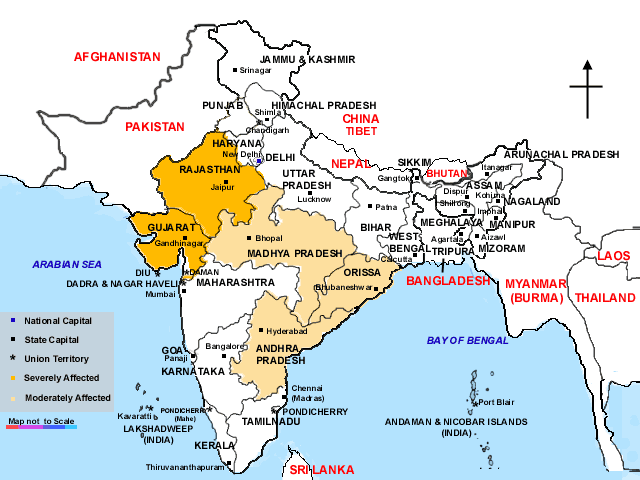
Drought Prone Area Programmee:-
The basic objective of the programme is to minimise the adverse effects of drought on production of crops and livestock and productivity of land, water and human resources ultimately leading to drought proofing of the affected areas. The programme also aims to promote overall economic development and improving the socio-economic conditions of the resource poor and disadvantaged sections inhabiting the programme areas.
How to Fight Drought :-
Drougth is a climatic phenomenon, hence it can only be fought as a long term strategy.
Short-term:- The short-term drought fighting mechanism is to reduce the socio-economic impact of drought. This is essentially bringing the vulnerable from out of imminent danger .
Long – Term:-The long term requires a integrated approach :-
- Integrated watershed development
- Ground water recharge programmes
- Afforestation to contain loss of moisture
- Desert development programmee- Fighting the aridity and restricting new regions getting decertified.
- River valley Projects
Receive Daily Updates
Recent Posts
[wptelegram-join-channel link=”https://t.me/s/upsctree” text=”Join @upsctree on Telegram”]2021 WEF Global Gender Gap report, which confirmed its 2016 finding of a decline in worldwide progress towards gender parity.
Over 2.8 billion women are legally restricted from having the same choice of jobs as men. As many as 104 countries still have laws preventing women from working in specific jobs, 59 countries have no laws on sexual harassment in the workplace, and it is astonishing that a handful of countries still allow husbands to legally stop their wives from working.
Globally, women’s participation in the labour force is estimated at 63% (as against 94% of men who participate), but India’s is at a dismal 25% or so currently. Most women are in informal and vulnerable employment—domestic help, agriculture, etc—and are always paid less than men.
Recent reports from Assam suggest that women workers in plantations are paid much less than men and never promoted to supervisory roles. The gender wage gap is about 24% globally, and women have lost far more jobs than men during lockdowns.
The problem of gender disparity is compounded by hurdles put up by governments, society and businesses: unequal access to social security schemes, banking services, education, digital services and so on, even as a glass ceiling has kept leadership roles out of women’s reach.
Yes, many governments and businesses had been working on parity before the pandemic struck. But the global gender gap, defined by differences reflected in the social, political, intellectual, cultural and economic attainments or attitudes of men and women, will not narrow in the near future without all major stakeholders working together on a clear agenda—that of economic growth by inclusion.
The WEF report estimates 135 years to close the gap at our current rate of progress based on four pillars: educational attainment, health, economic participation and political empowerment.
India has slipped from rank 112 to 140 in a single year, confirming how hard women were hit by the pandemic. Pakistan and Afghanistan are the only two Asian countries that fared worse.
Here are a few things we must do:
One, frame policies for equal-opportunity employment. Use technology and artificial intelligence to eliminate biases of gender, caste, etc, and select candidates at all levels on merit. Numerous surveys indicate that women in general have a better chance of landing jobs if their gender is not known to recruiters.
Two, foster a culture of gender sensitivity. Take a review of current policies and move from gender-neutral to gender-sensitive. Encourage and insist on diversity and inclusion at all levels, and promote more women internally to leadership roles. Demolish silos to let women grab potential opportunities in hitherto male-dominant roles. Work-from-home has taught us how efficiently women can manage flex-timings and productivity.
Three, deploy corporate social responsibility (CSR) funds for the education and skilling of women and girls at the bottom of the pyramid. CSR allocations to toilet building, the PM-Cares fund and firms’ own trusts could be re-channelled for this.
Four, get more women into research and development (R&D) roles. A study of over 4,000 companies found that more women in R&D jobs resulted in radical innovation. It appears women score far higher than men in championing change. If you seek growth from affordable products and services for low-income groups, women often have the best ideas.
Five, break barriers to allow progress. Cultural and structural issues must be fixed. Unconscious biases and discrimination are rampant even in highly-esteemed organizations. Establish fair and transparent human resource policies.
Six, get involved in local communities to engage them. As Michael Porter said, it is not possible for businesses to sustain long-term shareholder value without ensuring the welfare of the communities they exist in. It is in the best interest of enterprises to engage with local communities to understand and work towards lowering cultural and other barriers in society. It will also help connect with potential customers, employees and special interest groups driving the gender-equity agenda and achieve better diversity.