


The Arctic could be free of sea ice by 2040, 30 years earlier than previously suggested
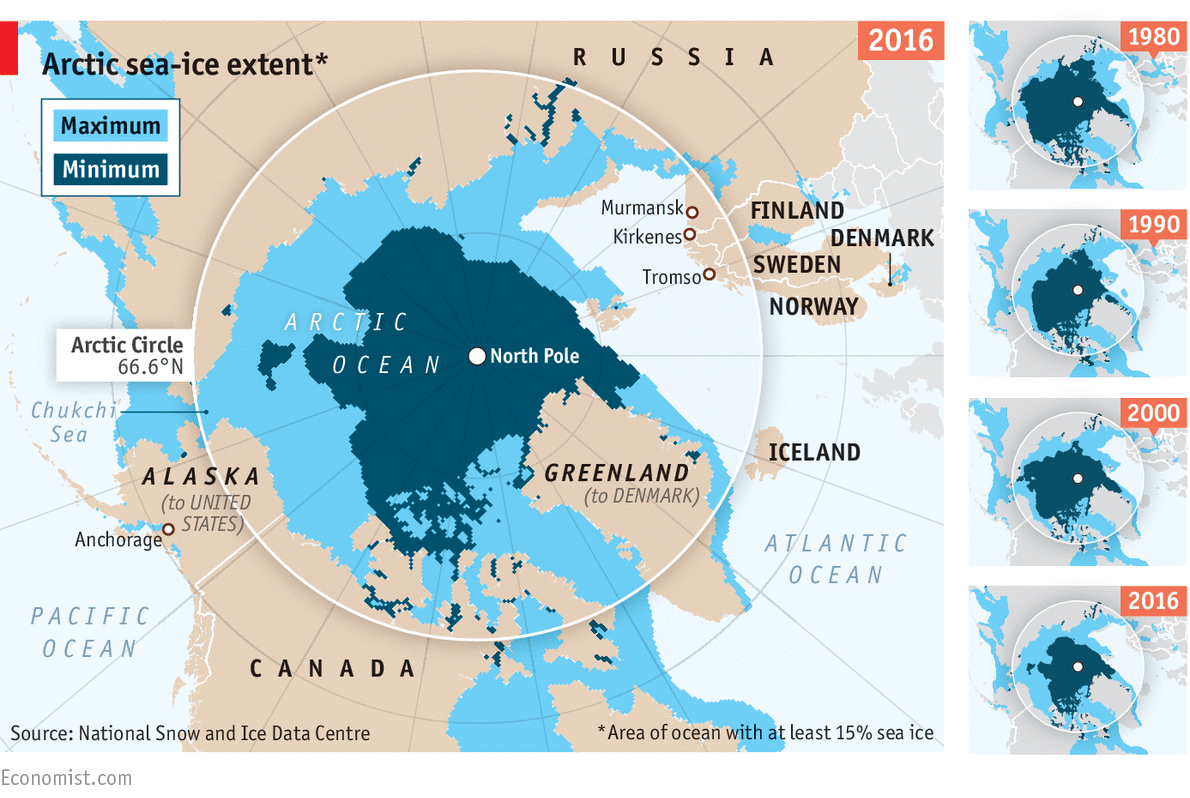
OVER the past three decades the area of sea ice in the Arctic has fallen by more than half and its volume has plummeted by three-quarters. So says a report “Snow, Water, Ice, Permafrost in the Arctic” (SWIPA), produced under the auspices of the Arctic Council (Prelims question in 2014), a scientific-policy club for the eight countries with territory in the Arctic Circle, as well as observers including China and India.
SWIPA estimates that the Arctic will be free of sea ice in the summer by 2040. Scientists previously suggested this would not occur until 2070. The thickness of ice in the central Arctic ocean declined by 65% between 1975 and 2012; record lows in the maximum extent of Arctic sea ice occurred in March.
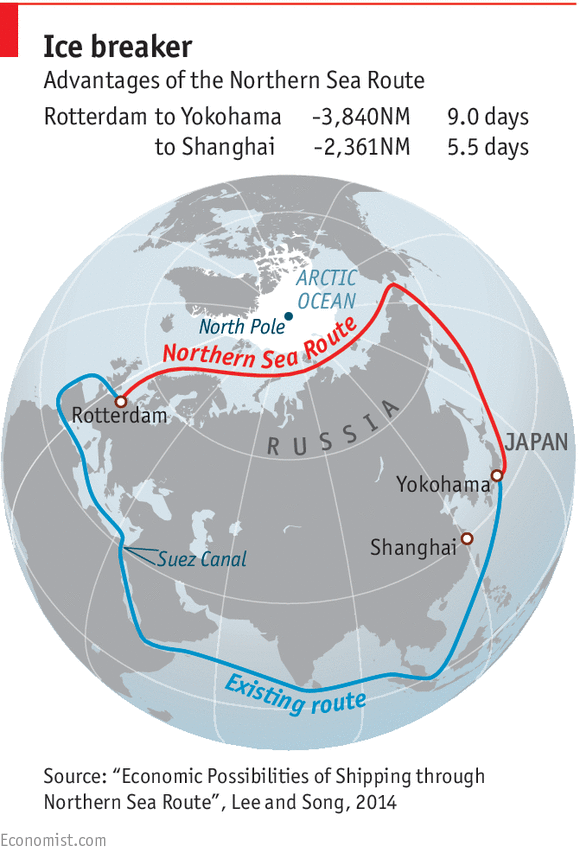
In theory shipping firms should benefit from access to a more open seaway. Using it to sail from northern Europe to north-east Asia can cut the length of voyages by two-fifths compared with travelling via the Suez Canal. But any Arctic promise has drifted away and the expected shipping boom has not materialised. In 2012 only 1m tonnes of goods were shipped through the northern passage, a paltry level of activity yet one not achieved since.
Even in the summer months the Arctic ocean is stormy, making timely delivery of goods impossible to guarantee. Drifting ice also poses a danger. Ships must be strengthened to withstand it, adding to construction costs. And a lack of coastal infrastructure, such as deepwater ports, means that spills of the heavy fuel oil that powers most vessels could wreak havoc on both ecosystems and reputations, because clean-up missions would have to set out from much farther away and would take much longer to be effective.
A new Polar Code from the International Maritime Organisation, which regulates shipping, came into force at the beginning of the year to try to address some of these concerns. It bans discharges of sewage and oily mixtures in polar waters. America and Canada, among others, want to go further. For one thing, they want a ban on heavy fuel-oil (as there is in the Antarctic, which has various special protections).
Nothing, however, looms larger than the potential for environmental calamity. The question of thawing is rising up the list of priorities both of countries with territory in the region and those farther afield. Sticking to the Paris agreement could, eventually, stabilise temperatures. But more radical measures may be needed given that countries are unlikely to keep within the limits set in Paris.
Polar Code
IMO has adopted the International Code for Ships Operating in Polar Waters (Polar Code) and related amendments to make it mandatory under both the International Convention for the Safety of Life at Sea (SOLAS) and the International Convention for the Prevention of Pollution from Ships (MARPOL).
The Polar Code entered into force on 1 January 2017. This marks an historic milestone in the Organization’s work to protect ships and people aboard them, both seafarers and passengers, in the harsh environment of the waters surrounding the two poles.
The Polar Code and SOLAS amendments were adopted during the 94th session of IMO’s Maritime Safety Committee (MSC), in November 2014; the environmental provisions and MARPOL amendments were adopted during the 68th session of the Marine Environment Protection Committee (MEPC) in May 2015.
The Polar Code covers the full range of design, construction, equipment, operational, training, search and rescue and environmental protection matters relevant to ships operating in the inhospitable waters surrounding the two poles.
The Polar Code includes mandatory measures covering safety part (part I-A) and pollution prevention (part II-A) and recommendatory provisions for both (parts I-B and II-B).
Whilst Arctic and Antarctic waters have a number of similarities, there are also significant differences. The Arctic is an ocean surrounded by continents while the Antarctic is a continent surrounded by an ocean. The Antarctic sea ice retreats significantly during the summer season or is dispersed by permanent gyres in the two major seas of the Antarctic: the Weddell and the Ross. Thus there is relatively little multi-year ice in the Antarctic. Conversely, Arctic sea ice survives many summer seasons and there is a significant amount of multi-year ice. Whilst the marine environments of both Polar seas are similarly vulnerable, response to such challenge should duly take into account specific features of the legal and political regimes applicable to their respective marine spaces.
Receive Daily Updates
Recent Posts
Steve Ovett, the famous British middle-distance athlete, won the 800-metres gold medal at the Moscow Olympics of 1980. Just a few days later, he was about to win a 5,000-metres race at London’s Crystal Palace. Known for his burst of acceleration on the home stretch, he had supreme confidence in his ability to out-sprint rivals. With the final 100 metres remaining,
[wptelegram-join-channel link=”https://t.me/s/upsctree” text=”Join @upsctree on Telegram”]Ovett waved to the crowd and raised a hand in triumph. But he had celebrated a bit too early. At the finishing line, Ireland’s John Treacy edged past Ovett. For those few moments, Ovett had lost his sense of reality and ignored the possibility of a negative event.
This analogy works well for the India story and our policy failures , including during the ongoing covid pandemic. While we have never been as well prepared or had significant successes in terms of growth stability as Ovett did in his illustrious running career, we tend to celebrate too early. Indeed, we have done so many times before.
It is as if we’re convinced that India is destined for greater heights, come what may, and so we never run through the finish line. Do we and our policymakers suffer from a collective optimism bias, which, as the Nobel Prize winner Daniel Kahneman once wrote, “may well be the most significant of the cognitive biases”? The optimism bias arises from mistaken beliefs which form expectations that are better than the reality. It makes us underestimate chances of a negative outcome and ignore warnings repeatedly.
The Indian economy had a dream run for five years from 2003-04 to 2007-08, with an average annual growth rate of around 9%. Many believed that India was on its way to clocking consistent double-digit growth and comparisons with China were rife. It was conveniently overlooked that this output expansion had come mainly came from a few sectors: automobiles, telecom and business services.
Indians were made to believe that we could sprint without high-quality education, healthcare, infrastructure or banking sectors, which form the backbone of any stable economy. The plan was to build them as we went along, but then in the euphoria of short-term success, it got lost.
India’s exports of goods grew from $20 billion in 1990-91 to over $310 billion in 2019-20. Looking at these absolute figures it would seem as if India has arrived on the world stage. However, India’s share of global trade has moved up only marginally. Even now, the country accounts for less than 2% of the world’s goods exports.
More importantly, hidden behind this performance was the role played by one sector that should have never made it to India’s list of exports—refined petroleum. The share of refined petroleum exports in India’s goods exports increased from 1.4% in 1996-97 to over 18% in 2011-12.
An import-intensive sector with low labour intensity, exports of refined petroleum zoomed because of the then policy regime of a retail price ceiling on petroleum products in the domestic market. While we have done well in the export of services, our share is still less than 4% of world exports.
India seemed to emerge from the 2008 global financial crisis relatively unscathed. But, a temporary demand push had played a role in the revival—the incomes of many households, both rural and urban, had shot up. Fiscal stimulus to the rural economy and implementation of the Sixth Pay Commission scales had led to the salaries of around 20% of organized-sector employees jumping up. We celebrated, but once again, neither did we resolve the crisis brewing elsewhere in India’s banking sector, nor did we improve our capacity for healthcare or quality education.
Employment saw little economy-wide growth in our boom years. Manufacturing jobs, if anything, shrank. But we continued to celebrate. Youth flocked to low-productivity service-sector jobs, such as those in hotels and restaurants, security and other services. The dependence on such jobs on one hand and high-skilled services on the other was bound to make Indian society more unequal.
And then, there is agriculture, an elephant in the room. If and when farm-sector reforms get implemented, celebrations would once again be premature. The vast majority of India’s farmers have small plots of land, and though these farms are at least as productive as larger ones, net absolute incomes from small plots can only be meagre.
A further rise in farm productivity and consequent increase in supply, if not matched by a demand rise, especially with access to export markets, would result in downward pressure on market prices for farm produce and a further decline in the net incomes of small farmers.
We should learn from what John Treacy did right. He didn’t give up, and pushed for the finish line like it was his only chance at winning. Treacy had years of long-distance practice. The same goes for our economy. A long grind is required to build up its base before we can win and celebrate. And Ovett did not blame anyone for his loss. We play the blame game. Everyone else, right from China and the US to ‘greedy corporates’, seems to be responsible for our failures.
We have lowered absolute poverty levels and had technology-based successes like Aadhaar and digital access to public services. But there are no short cuts to good quality and adequate healthcare and education services. We must remain optimistic but stay firmly away from the optimism bias.
In the end, it is not about how we start, but how we finish. The disastrous second wave of covid and our inability to manage it is a ghastly reminder of this fact.