By 2050, India will experience a temperature rise of 1-4°C and rainfall will increase by 9-16 per cent. This will have a detrimental effect on farmers.

Sensitivity


12 states*  have districts that are highly sensitive to climate change

Sensitivity is the degree to which a region gets affected by climate-related stimuli, such as climate variability and the frequency and magnitude of extremes events like cyclone and drought. It is determined by demographic and environmental conditions of the region. Most districts in north-western India are highly sensitive to climate change impacts. Eastern, north-eastern, northern and west coast of the country have relatively low sensitivity.


Exposure

Exposure
21 states* have districts that are highly exposed to climate change risks

Exposure is defined as the nature and degree to which a system is exposed to significant climatic variations. It includes parameters, such as maximum and minimum temperatures and the number of rainy days. High to very high exposure is observed in the districts of Madhya Pradesh, Karnataka, Rajasthan, Gujarat, Maharashtra, Bihar, Tamil Nadu, north-eastern states and Jammu & Kashmir. Districts with low exposure are seen in Andhra Pradesh, Odisha, West Bengal, Punjab, Haryana, Rajasthan and Uttar Pradesh.

Adaptive capacity

17 states# have districts with low adaptive capacity to climate change

Adaptive capacity is the ability of a region to adjust to climate change. It is a function of wealth, technology, education, skills, infrastructure, access to resources, and management capabilities. Adaptive capacity is found to be very low in the eastern and north-eastern states, Rajasthan, Madhya Pradesh, peninsular and hill regions. Adaptive capacity is high in Punjab, Haryana, western Uttar Pradesh and Tamil Nadu.

Vulnerability
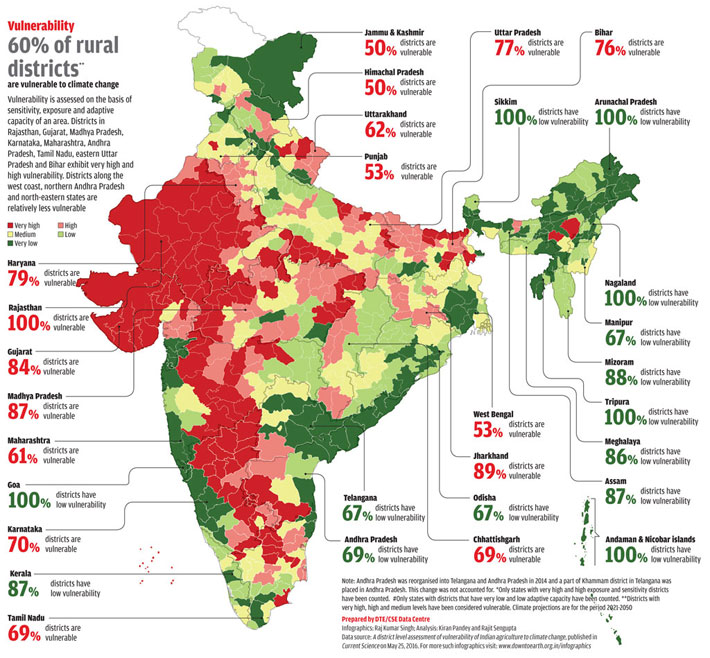

60% of rural districts** are vulnerable to climate change

Vulnerability is assessed on the basis of sensitivity, exposure and adaptive capacity of an area. Districts in Rajasthan, Gujarat, Madhya Pradesh, Karnataka, Maharashtra, Andhra Pradesh, Tamil Nadu, eastern Uttar Pradesh and Bihar exhibit very high and high vulnerability. Districts along the west coast, northern Andhra Pradesh and north-eastern states are relatively less vulnerable


Share is Caring, Choose Your Platform!

Recent Posts

  • Petrol in India is cheaper than in countries like Hong Kong, Germany and the UK but costlier than in China, Brazil, Japan, the US, Russia, Pakistan and Sri Lanka, a Bank of Baroda Economics Research report showed.

    Rising fuel prices in India have led to considerable debate on which government, state or central, should be lowering their taxes to keep prices under control.

    The rise in fuel prices is mainly due to the global price of crude oil (raw material for making petrol and diesel) going up. Further, a stronger dollar has added to the cost of crude oil.

    Amongst comparable countries (per capita wise), prices in India are higher than those in Vietnam, Kenya, Ukraine, Bangladesh, Nepal, Pakistan, Sri Lanka, and Venezuela. Countries that are major oil producers have much lower prices.

    In the report, the Philippines has a comparable petrol price but has a per capita income higher than India by over 50 per cent.

    Countries which have a lower per capita income like Kenya, Bangladesh, Nepal, Pakistan, and Venezuela have much lower prices of petrol and hence are impacted less than India.

    “Therefore there is still a strong case for the government to consider lowering the taxes on fuel to protect the interest of the people,” the report argued.

    India is the world’s third-biggest oil consuming and importing nation. It imports 85 per cent of its oil needs and so prices retail fuel at import parity rates.

    With the global surge in energy prices, the cost of producing petrol, diesel and other petroleum products also went up for oil companies in India.

    They raised petrol and diesel prices by Rs 10 a litre in just over a fortnight beginning March 22 but hit a pause button soon after as the move faced criticism and the opposition parties asked the government to cut taxes instead.

    India imports most of its oil from a group of countries called the ‘OPEC +’ (i.e, Iran, Iraq, Saudi Arabia, Venezuela, Kuwait, United Arab Emirates, Russia, etc), which produces 40% of the world’s crude oil.

    As they have the power to dictate fuel supply and prices, their decision of limiting the global supply reduces supply in India, thus raising prices

    The government charges about 167% tax (excise) on petrol and 129% on diesel as compared to US (20%), UK (62%), Italy and Germany (65%).

    The abominable excise duty is 2/3rd of the cost, and the base price, dealer commission and freight form the rest.

    Here is an approximate break-up (in Rs):

    a)Base Price

    39

    b)Freight

    0.34

    c) Price Charged to Dealers = (a+b)

    39.34

    d) Excise Duty

    40.17

    e) Dealer Commission

    4.68

    f) VAT

    25.35

    g) Retail Selling Price

    109.54


    Looked closely, much of the cost of petrol and diesel is due to higher tax rate by govt, specifically excise duty.

    So the question is why government is not reducing the prices ?

    India, being a developing country, it does require gigantic amount of funding for its infrastructure projects as well as welfare schemes.

    However, we as a society is yet to be tax-compliant. Many people evade the direct tax and that’s the reason why govt’s hands are tied. Govt. needs the money to fund various programs and at the same time it is not generating enough revenue from direct taxes.

    That’s the reason why, govt is bumping up its revenue through higher indirect taxes such as GST or excise duty as in the case of petrol and diesel.

    Direct taxes are progressive as it taxes according to an individuals’ income however indirect tax such as excise duty or GST are regressive in the sense that the poorest of the poor and richest of the rich have to pay the same amount.

    Does not matter, if you are an auto-driver or owner of a Mercedes, end of the day both pay the same price for petrol/diesel-that’s why it is regressive in nature.

    But unlike direct tax where tax evasion is rampant, indirect tax can not be evaded due to their very nature and as long as huge no of Indians keep evading direct taxes, indirect tax such as excise duty will be difficult for the govt to reduce, because it may reduce the revenue and hamper may programs of the govt.