Winter is coming – and it is DEMOGRAPHIC !!!

For most of their existence, hominids lived much like other animals. Over hundreds of thousands of years, their numbers were shaped by natural selection, with high birth rates matched by equally high death rates.
A decisive shift came with the emergence of Homo sapiens. We spread across the Earth, built the first permanent settlements, and learned to domesticate plants and animals. By the beginning of the Common Era, the world’s population is estimated to have been around 250 million.
It took nearly 1,600 years for our numbers to double to 500 million, a process further slowed by catastrophes such as the Black Death in the fourteenth century. After this, the pace of growth began to quicken. By 1804, our population reached one billion for the first time, reflecting the transformative effects of industrialisation, improved agriculture, and medical advances.
In 1798, the English economist Thomas Malthus presented his Essay on the principle of population. In it, he popularized the idea of the Malthusian trap (or Malthusian catastrophe), according to which he predicted that the population would continue to grow exponentially, doubling every 25 years, while resources would only grow arithmetically. This decoupling, according to Malthus’ theory, would cause continuous impoverishment of citizens, leading to the extinction of humanity by 1880.

Extinction did not occur in 1880; however, the human population continued to expand at an unusually rapid pace. In 1927, the population reached 2 billion, and in 1975, it reached 4 billion. Gladly, technological advances continued to improve food production, and medicine made it possible to effectively combat diseases that were previously incurable. However, the fear of overpopulation remained latent in society, and many organisations continued to warn of the great threat and its consequences.
The demographic transition:
After analysing demographic changes in several countries following industrialisation, scientists such as Warren Thompson and Adolphe Landry began to propose a series of demographic theories that would eventually be formalised in the 1940s by Frank W. Notestein. This model is known as the theory of demographic transition.
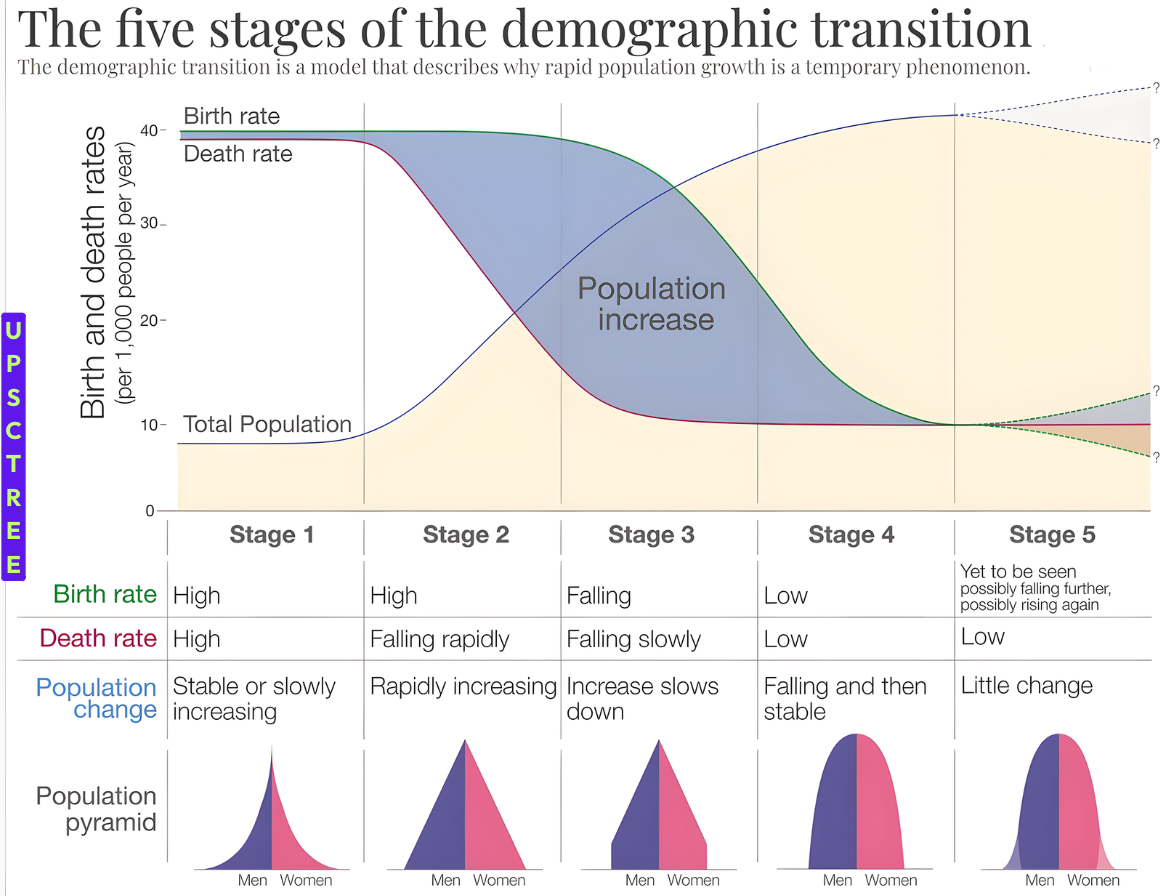
This model is based on a premise that can be verified with historical data: pre-industrial societies had very low growth rates, with very high birth and death rates. With industrialisation, societies moved from this paradigm to one of zero growth, in which both birth and death rates plummeted to record lows. The most interesting part of the model is how this transition occurs. The decline in mortality and birth rates occurs at different rates, allowing natural population growth (more births than deaths) to skyrocket during this period.
This model, which was initially created to explain industrialisation in the 19th and early 20th centuries, proved to be quite effective in modelling demographic changes throughout the 20th century. Industrialising societies experienced excessive growth, while those that had been industrialised for longer gradually stabilised their natural growth, bringing it closer to the equilibrium predicted by Notestein.
However, at the end of the 20th century, something began to happen that the model did not anticipate. There were countries whose natural growth did not remain at zero, but fell below the replacement rate.
The onset of demographic winter:
Although there are already many countries, mainly in Europe, with negative natural growth, where deaths outnumber births, there are still more countries where the opposite is true. Africa’s great engine continues to drive growth, but fertility rates continue to decline worldwide, at a much faster pace than expected.

The UN has been revising its global population growth forecasts downwards for several years. In 2017, the estimate was that the global population would peak in 2100, with a total of 11.2 billion inhabitants. A couple of years ago, in 2022, this was revised downwards, with an estimated peak of 10.4 billion in 2084. Global population growth is declining, and zero growth will not be the end point of this demographic trend.
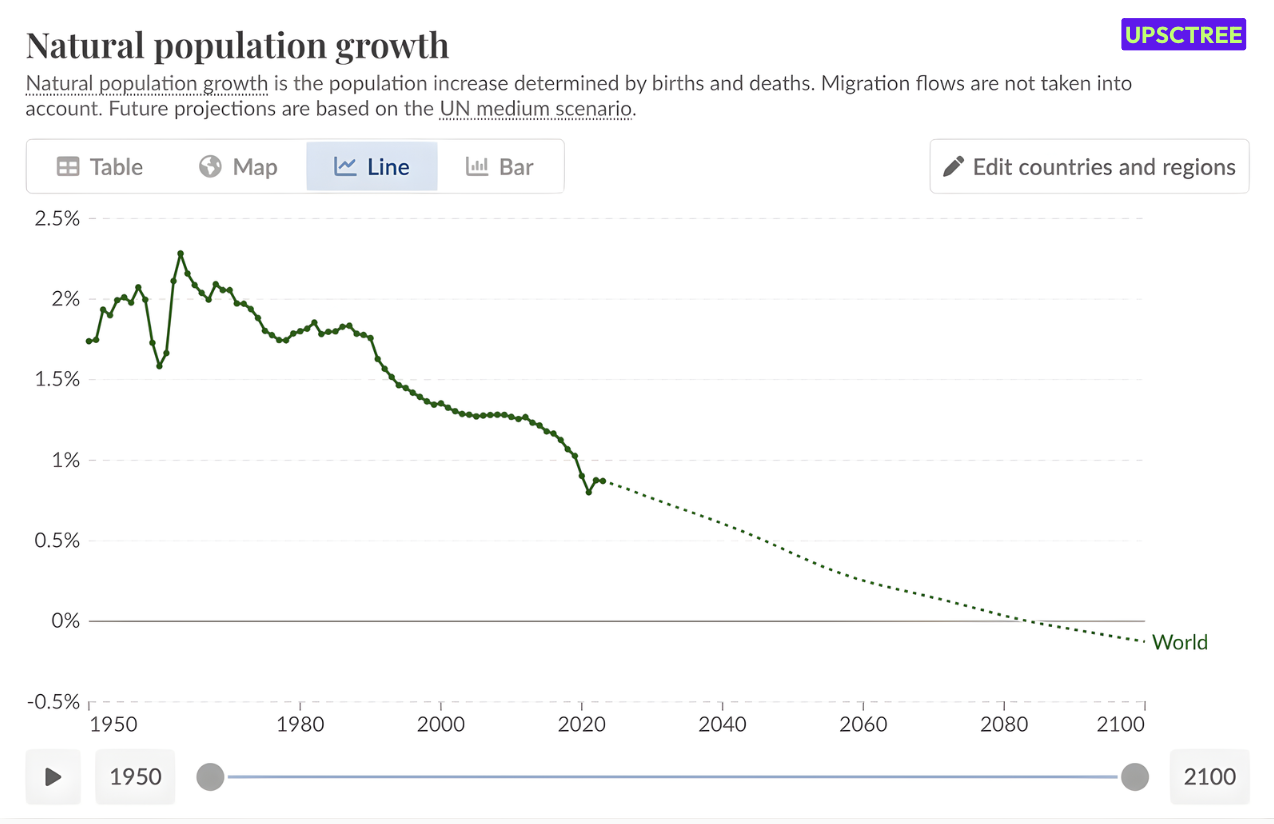
We are already seeing how negative population growth in many countries is being offset by migration flows, but this solution may have significant long-term consequences. Few countries currently function as magnets for migrants, but this number will grow.
China is already losing inhabitants, and fertility rates suggest that this decline will be very pronounced in the coming decades.
It will become increasingly common for countries in demographic decline to start competing for migrants from the few countries with positive natural growth.
From this perspective, demographic winter appears to be a plausible long-term outcome for humanity. While future medical, technological, or social transformations could fundamentally alter current trends, existing evidence makes it difficult to envisage a radically different trajectory.
Receive Daily Updates
Recent Posts
Steve Ovett, the famous British middle-distance athlete, won the 800-metres gold medal at the Moscow Olympics of 1980. Just a few days later, he was about to win a 5,000-metres race at London’s Crystal Palace. Known for his burst of acceleration on the home stretch, he had supreme confidence in his ability to out-sprint rivals. With the final 100 metres remaining,
[wptelegram-join-channel link=”https://t.me/s/upsctree” text=”Join @upsctree on Telegram”]Ovett waved to the crowd and raised a hand in triumph. But he had celebrated a bit too early. At the finishing line, Ireland’s John Treacy edged past Ovett. For those few moments, Ovett had lost his sense of reality and ignored the possibility of a negative event.
This analogy works well for the India story and our policy failures , including during the ongoing covid pandemic. While we have never been as well prepared or had significant successes in terms of growth stability as Ovett did in his illustrious running career, we tend to celebrate too early. Indeed, we have done so many times before.
It is as if we’re convinced that India is destined for greater heights, come what may, and so we never run through the finish line. Do we and our policymakers suffer from a collective optimism bias, which, as the Nobel Prize winner Daniel Kahneman once wrote, “may well be the most significant of the cognitive biases”? The optimism bias arises from mistaken beliefs which form expectations that are better than the reality. It makes us underestimate chances of a negative outcome and ignore warnings repeatedly.
The Indian economy had a dream run for five years from 2003-04 to 2007-08, with an average annual growth rate of around 9%. Many believed that India was on its way to clocking consistent double-digit growth and comparisons with China were rife. It was conveniently overlooked that this output expansion had come mainly came from a few sectors: automobiles, telecom and business services.
Indians were made to believe that we could sprint without high-quality education, healthcare, infrastructure or banking sectors, which form the backbone of any stable economy. The plan was to build them as we went along, but then in the euphoria of short-term success, it got lost.
India’s exports of goods grew from $20 billion in 1990-91 to over $310 billion in 2019-20. Looking at these absolute figures it would seem as if India has arrived on the world stage. However, India’s share of global trade has moved up only marginally. Even now, the country accounts for less than 2% of the world’s goods exports.
More importantly, hidden behind this performance was the role played by one sector that should have never made it to India’s list of exports—refined petroleum. The share of refined petroleum exports in India’s goods exports increased from 1.4% in 1996-97 to over 18% in 2011-12.
An import-intensive sector with low labour intensity, exports of refined petroleum zoomed because of the then policy regime of a retail price ceiling on petroleum products in the domestic market. While we have done well in the export of services, our share is still less than 4% of world exports.
India seemed to emerge from the 2008 global financial crisis relatively unscathed. But, a temporary demand push had played a role in the revival—the incomes of many households, both rural and urban, had shot up. Fiscal stimulus to the rural economy and implementation of the Sixth Pay Commission scales had led to the salaries of around 20% of organized-sector employees jumping up. We celebrated, but once again, neither did we resolve the crisis brewing elsewhere in India’s banking sector, nor did we improve our capacity for healthcare or quality education.
Employment saw little economy-wide growth in our boom years. Manufacturing jobs, if anything, shrank. But we continued to celebrate. Youth flocked to low-productivity service-sector jobs, such as those in hotels and restaurants, security and other services. The dependence on such jobs on one hand and high-skilled services on the other was bound to make Indian society more unequal.
And then, there is agriculture, an elephant in the room. If and when farm-sector reforms get implemented, celebrations would once again be premature. The vast majority of India’s farmers have small plots of land, and though these farms are at least as productive as larger ones, net absolute incomes from small plots can only be meagre.
A further rise in farm productivity and consequent increase in supply, if not matched by a demand rise, especially with access to export markets, would result in downward pressure on market prices for farm produce and a further decline in the net incomes of small farmers.
We should learn from what John Treacy did right. He didn’t give up, and pushed for the finish line like it was his only chance at winning. Treacy had years of long-distance practice. The same goes for our economy. A long grind is required to build up its base before we can win and celebrate. And Ovett did not blame anyone for his loss. We play the blame game. Everyone else, right from China and the US to ‘greedy corporates’, seems to be responsible for our failures.
We have lowered absolute poverty levels and had technology-based successes like Aadhaar and digital access to public services. But there are no short cuts to good quality and adequate healthcare and education services. We must remain optimistic but stay firmly away from the optimism bias.
In the end, it is not about how we start, but how we finish. The disastrous second wave of covid and our inability to manage it is a ghastly reminder of this fact.
