The latest Global Peace Index report, released recently, finds that 2015 was a bad year for international peace and security. It recorded a further deterioration in global peace based on historic trends.
2015 witnessed the highest number of global battle deaths for 25 years, persistently high levels of terrorism, and the highest number of refugees and displaced people since World War II.
This violence had a huge cost. The report finds that the economic impact of violence to the global economy was $13.6 trillion in 2015 in terms of purchasing power parity (PPP). This is equivalent to $5 per day for every person on the planet, or 11 times the size of global foreign direct investment (FDI).

The toll of violence is typically counted in terms of its human and emotional cost, but the financial damage to the economy is yet another additional factor to consider.
When counting the economic impact one must look at the costs of preventing and containing violence, as well as measuring its consequences. This is important because spending on containing violence, while perhaps necessary, is fundamentally economically unproductive.
The costs of war:-
The $13.6 trillion of expenditures and losses represent 13.3% of world GDP. To break this figure down, it’s the equivalent of $1,876 for every person on the planet.
The numbers refer to the current expenditures and their estimated flow-on effects in 2015, and are represented in PPP international dollars.
These numbers are notable for two reasons:-
Firstly, over 70% of the economic impact of violence accrues from what is mostly government spending on the military and internal security. This shows that significant amounts of government expenditure are tied up to this end. In a perfectly peaceful world, these huge resources could be directed elsewhere.
Secondly, the remaining amount is consequential losses from violence and conflict and these, too, are enormous. They significantly outweigh the international community’s spending on building peace.
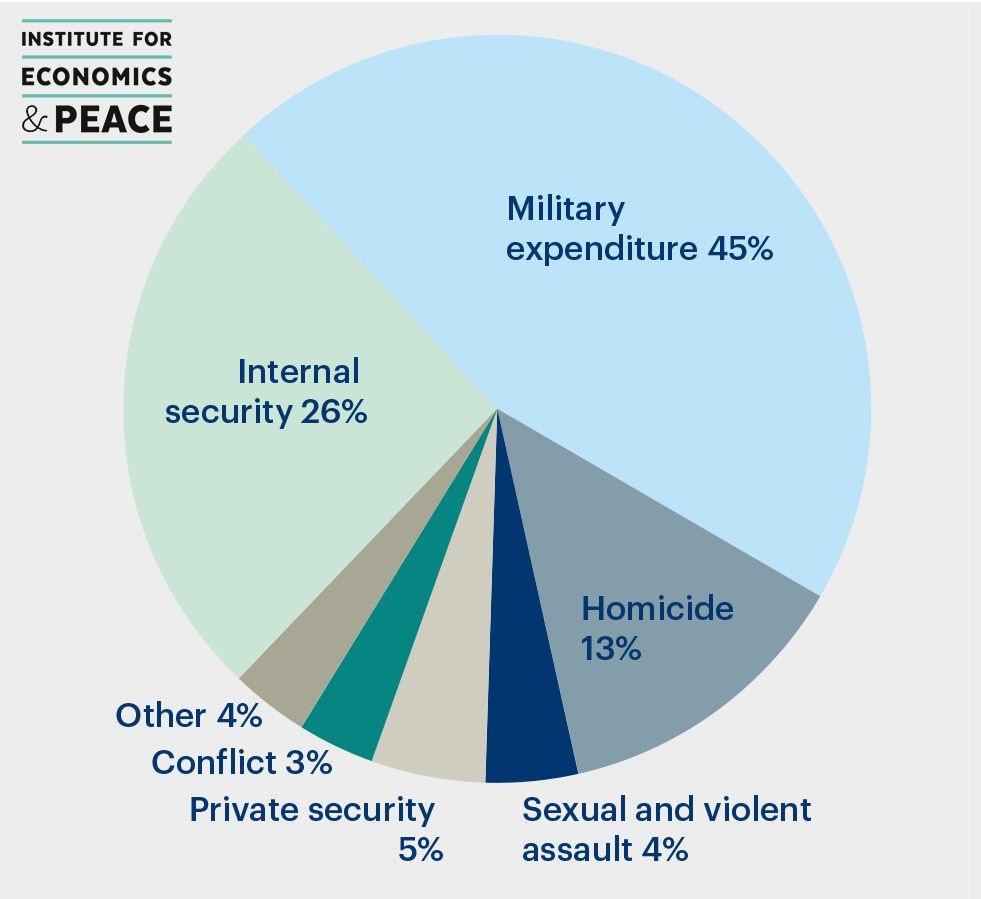
A quick examination of the numbers reveals that the world continues to spend vastly disproportionate resources on creating and containing violence compared to what it spends on peace.
In 2015 alone, UN peacekeeping expenditures of $8.27 billion totalled only 1.1% of the estimated $742 billion of economic losses from armed conflict.
Fundamental to future improvements in peace is a greater investment in peace-building and peace-keeping. Peace-keeping operations are measures aimed at responding to a conflict, whereas peace-building expenditures are aimed at developing and maintaining the capacities for resilience to conflict.
Peace-building expenditure aims to reduce the risk of lapsing or relapsing into violent conflict by strengthening national capacities and institutions for conflict management and laying the foundations of sustainable peace and development.
These numbers suggest a serious under-investment in the activities that build peace and demonstrate that the international community is spending too much on conflict and too little on peace. Given the fact that the cost of violence is so significant, the economic argument for more spending on peace is indeed powerful.
The rise of peace inequality
Furthermore, a new phenomenon is emerging as some countries grow more peaceful while overall levels of violence increase: peace inequality. This drives a broader dynamic of greater economic inequalities between nations; as the least peaceful countries spiral into greater violence and conflict, they are also further set back economically.
Receive Daily Updates
Recent Posts
Petrol in India is cheaper than in countries like Hong Kong, Germany and the UK but costlier than in China, Brazil, Japan, the US, Russia, Pakistan and Sri Lanka, a Bank of Baroda Economics Research report showed.
Rising fuel prices in India have led to considerable debate on which government, state or central, should be lowering their taxes to keep prices under control.
The rise in fuel prices is mainly due to the global price of crude oil (raw material for making petrol and diesel) going up. Further, a stronger dollar has added to the cost of crude oil.
Amongst comparable countries (per capita wise), prices in India are higher than those in Vietnam, Kenya, Ukraine, Bangladesh, Nepal, Pakistan, Sri Lanka, and Venezuela. Countries that are major oil producers have much lower prices.
In the report, the Philippines has a comparable petrol price but has a per capita income higher than India by over 50 per cent.
Countries which have a lower per capita income like Kenya, Bangladesh, Nepal, Pakistan, and Venezuela have much lower prices of petrol and hence are impacted less than India.
“Therefore there is still a strong case for the government to consider lowering the taxes on fuel to protect the interest of the people,” the report argued.
India is the world’s third-biggest oil consuming and importing nation. It imports 85 per cent of its oil needs and so prices retail fuel at import parity rates.
With the global surge in energy prices, the cost of producing petrol, diesel and other petroleum products also went up for oil companies in India.
They raised petrol and diesel prices by Rs 10 a litre in just over a fortnight beginning March 22 but hit a pause button soon after as the move faced criticism and the opposition parties asked the government to cut taxes instead.
India imports most of its oil from a group of countries called the ‘OPEC +’ (i.e, Iran, Iraq, Saudi Arabia, Venezuela, Kuwait, United Arab Emirates, Russia, etc), which produces 40% of the world’s crude oil.
As they have the power to dictate fuel supply and prices, their decision of limiting the global supply reduces supply in India, thus raising prices
The government charges about 167% tax (excise) on petrol and 129% on diesel as compared to US (20%), UK (62%), Italy and Germany (65%).
The abominable excise duty is 2/3rd of the cost, and the base price, dealer commission and freight form the rest.
Here is an approximate break-up (in Rs):
a)Base Price | 39 |
b)Freight | 0.34 |
c) Price Charged to Dealers = (a+b) | 39.34 |
d) Excise Duty | 40.17 |
e) Dealer Commission | 4.68 |
f) VAT | 25.35 |
g) Retail Selling Price | 109.54 |
Looked closely, much of the cost of petrol and diesel is due to higher tax rate by govt, specifically excise duty.
So the question is why government is not reducing the prices ?
India, being a developing country, it does require gigantic amount of funding for its infrastructure projects as well as welfare schemes.
However, we as a society is yet to be tax-compliant. Many people evade the direct tax and that’s the reason why govt’s hands are tied. Govt. needs the money to fund various programs and at the same time it is not generating enough revenue from direct taxes.
That’s the reason why, govt is bumping up its revenue through higher indirect taxes such as GST or excise duty as in the case of petrol and diesel.
Direct taxes are progressive as it taxes according to an individuals’ income however indirect tax such as excise duty or GST are regressive in the sense that the poorest of the poor and richest of the rich have to pay the same amount.
Does not matter, if you are an auto-driver or owner of a Mercedes, end of the day both pay the same price for petrol/diesel-that’s why it is regressive in nature.
But unlike direct tax where tax evasion is rampant, indirect tax can not be evaded due to their very nature and as long as huge no of Indians keep evading direct taxes, indirect tax such as excise duty will be difficult for the govt to reduce, because it may reduce the revenue and hamper may programs of the govt.