


Animals in our backyard:-
Monkeys, along with Grey langurs and bonnet macaques, have adapted to urban habitats over the years.Out of the nearly 225 living species of non-human primates, these three species have adapted to the urban way of life.

In case of other animals, India does not lack protected areas, but the very idea of a protected area appears skewed. The protected areas were historically meant to be the breeding grounds for animals raised in the wild for the purpose of hunting.This space is not enough to have a full-fledged habitat for wild animals.
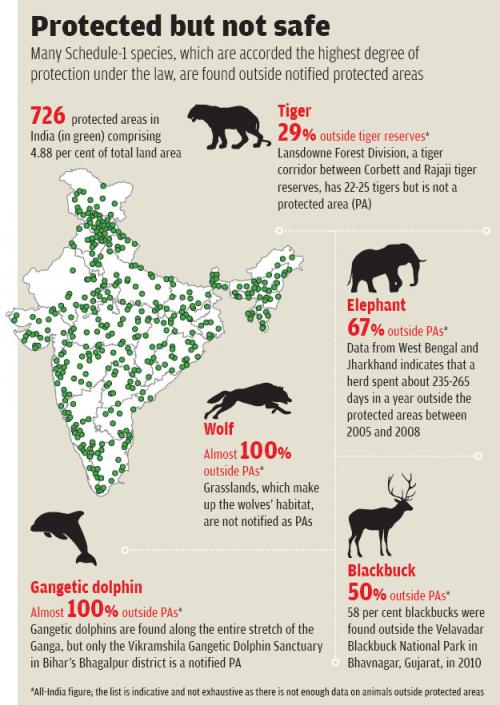
A territorial animal like a male tiger needs an area of 60-100 sq km. But the area allocated to an entire tiger reserve, like the Bor Tiger Reserve in Maharashtra, is 138.12 sq km. This is barely enough for one or two tigers.
The elephants need to travel at least 10-20 km a day. If a herd is restricted to an area of about 100 sq km, they are bound to move out in search of food and water. Elephants are used to travelling long distances, most of which fall outside the protected areas.
The condition of the existing protected areas is not very good, either. Wildlife experts claim that territorial animals do not have enough space within reserves and their prey do not have enough fodder to thrive on. This is forcing the wild animals to move out and venture close to human habitation in search of food.
Rising numbers
The population of monkeys has multiplied after their natural habitat was destroyed because of their ability to adapt to new habitats. In forests, a Rhesus macaque has to spend about 10 to 14 hours in search of food. However, if we look at the street-dwelling urban monkeys or even those living dangerously close to human settlements in a rural setting, finding food takes only 10 minutes.When there is food in abundance, monkeys spend more time procreating.
A primary reason for the increasing human-animal conflicts is the presence of a large number of animals and birds outside the notified protected areas. Wildlife experts estimate that 29 per cent of the tigers in India are outside the protected areas. “If we take their number to be 2,200, the tigers outside the protected areas are about 640. This is almost twice the number of tigers found in Russia.
Government action may fail to yield results
Another reason why animals move to new geographical areas is the government’s practice of translocating monkeys from the cities to forest areas near rural areas. Residents of Chaukha village, which is at an altitude of 2,072 metres above sea level, say monkeys were brought to the forests from Shimla and Mandi. Monkeys are never found at such high altitudes. But the government forcefully dumped the animals in our forests.
Even Delhi’s attempt to translocate monkeys has backfired. In 2007, the state wildlife department captured over 19,000 monkeys to translocate them to a wildlife sanctuary created at Asola Bhatti mines on the outskirts of the city. While New Delhi breathed a temporary sigh of relief by the move, the residents of Sanjay Colony near the sanctuary struggled. The illegal colony of the Od community, who for three decades mined Bhatti area of the Aravalli hills, registered an alarmingly high number of attacks by monkeys who would escape the sanctuary.
State governments have tried various strategies so far—from culling and sterilisation drives to awareness campaigns not to feed monkeys. In Himachal Pradesh, the sterilisation rate at the centres has been poor. On an average, each camp has the capacity to sterilise 45 monkeys every day. This adds up to 54,000 sterilisations every year or 430,000 sterilisations in the past eight years. But just 96,500 monkeys have been sterilised since 2007.
Wildlife experts warn that if wildlife protection is confined to reserves and parks alone, several species will stand at the brink of extinction. This is best exemplified by the Great Indian Bustard, which is a Schedule-I animal. Despite having sanctuaries to itself, the bird has been driven to the brink of extinction. Various bustard sanctuaries had sizeable population once upon a time. But as of March 2015, there are an estimated 169 birds left. The problem is how do you restrict a bird? They fly out of the protected areas and are then hunted for their meat.
Receive Daily Updates
Recent Posts
Steve Ovett, the famous British middle-distance athlete, won the 800-metres gold medal at the Moscow Olympics of 1980. Just a few days later, he was about to win a 5,000-metres race at London’s Crystal Palace. Known for his burst of acceleration on the home stretch, he had supreme confidence in his ability to out-sprint rivals. With the final 100 metres remaining,
[wptelegram-join-channel link=”https://t.me/s/upsctree” text=”Join @upsctree on Telegram”]Ovett waved to the crowd and raised a hand in triumph. But he had celebrated a bit too early. At the finishing line, Ireland’s John Treacy edged past Ovett. For those few moments, Ovett had lost his sense of reality and ignored the possibility of a negative event.
This analogy works well for the India story and our policy failures , including during the ongoing covid pandemic. While we have never been as well prepared or had significant successes in terms of growth stability as Ovett did in his illustrious running career, we tend to celebrate too early. Indeed, we have done so many times before.
It is as if we’re convinced that India is destined for greater heights, come what may, and so we never run through the finish line. Do we and our policymakers suffer from a collective optimism bias, which, as the Nobel Prize winner Daniel Kahneman once wrote, “may well be the most significant of the cognitive biases”? The optimism bias arises from mistaken beliefs which form expectations that are better than the reality. It makes us underestimate chances of a negative outcome and ignore warnings repeatedly.
The Indian economy had a dream run for five years from 2003-04 to 2007-08, with an average annual growth rate of around 9%. Many believed that India was on its way to clocking consistent double-digit growth and comparisons with China were rife. It was conveniently overlooked that this output expansion had come mainly came from a few sectors: automobiles, telecom and business services.
Indians were made to believe that we could sprint without high-quality education, healthcare, infrastructure or banking sectors, which form the backbone of any stable economy. The plan was to build them as we went along, but then in the euphoria of short-term success, it got lost.
India’s exports of goods grew from $20 billion in 1990-91 to over $310 billion in 2019-20. Looking at these absolute figures it would seem as if India has arrived on the world stage. However, India’s share of global trade has moved up only marginally. Even now, the country accounts for less than 2% of the world’s goods exports.
More importantly, hidden behind this performance was the role played by one sector that should have never made it to India’s list of exports—refined petroleum. The share of refined petroleum exports in India’s goods exports increased from 1.4% in 1996-97 to over 18% in 2011-12.
An import-intensive sector with low labour intensity, exports of refined petroleum zoomed because of the then policy regime of a retail price ceiling on petroleum products in the domestic market. While we have done well in the export of services, our share is still less than 4% of world exports.
India seemed to emerge from the 2008 global financial crisis relatively unscathed. But, a temporary demand push had played a role in the revival—the incomes of many households, both rural and urban, had shot up. Fiscal stimulus to the rural economy and implementation of the Sixth Pay Commission scales had led to the salaries of around 20% of organized-sector employees jumping up. We celebrated, but once again, neither did we resolve the crisis brewing elsewhere in India’s banking sector, nor did we improve our capacity for healthcare or quality education.
Employment saw little economy-wide growth in our boom years. Manufacturing jobs, if anything, shrank. But we continued to celebrate. Youth flocked to low-productivity service-sector jobs, such as those in hotels and restaurants, security and other services. The dependence on such jobs on one hand and high-skilled services on the other was bound to make Indian society more unequal.
And then, there is agriculture, an elephant in the room. If and when farm-sector reforms get implemented, celebrations would once again be premature. The vast majority of India’s farmers have small plots of land, and though these farms are at least as productive as larger ones, net absolute incomes from small plots can only be meagre.
A further rise in farm productivity and consequent increase in supply, if not matched by a demand rise, especially with access to export markets, would result in downward pressure on market prices for farm produce and a further decline in the net incomes of small farmers.
We should learn from what John Treacy did right. He didn’t give up, and pushed for the finish line like it was his only chance at winning. Treacy had years of long-distance practice. The same goes for our economy. A long grind is required to build up its base before we can win and celebrate. And Ovett did not blame anyone for his loss. We play the blame game. Everyone else, right from China and the US to ‘greedy corporates’, seems to be responsible for our failures.
We have lowered absolute poverty levels and had technology-based successes like Aadhaar and digital access to public services. But there are no short cuts to good quality and adequate healthcare and education services. We must remain optimistic but stay firmly away from the optimism bias.
In the end, it is not about how we start, but how we finish. The disastrous second wave of covid and our inability to manage it is a ghastly reminder of this fact.