


Honor Killing – Why it happens and how to check it ?
Disclaimer- In this article , we are not only answering the question of the debate but also trying to probe Honor itself as a concept from philosophical to sociological perspective and then find out its utility in society.
What is Honor :- Figment of Imagination or a real thing ?
Come to think of it, what constitutes honor ? – is indeed a fundamental questions .Honor is probably akin to air – we can not see it , although we can feel it , yet unlike air which is around us , honor is probably has its home in our minds.A realistic view would be to conclude honor as figment of our imagination ?
So why does one kill to satisfy the figment of an imagination ?
To address the above question it is necessary to understand that what utility does honor have ?Air has its utility – it sustains life , does honor sustain life ? or at least does it have any profound impact on our lives ?
Many anthropologist tried to answer this question and their views are as divided as two shorelines of a river, however fortunately they do have a convergence when the definition of honor is concerned.
From technical standpoint honor can be broadly divided in to two categories- Horizontal honor and Vertical honor.
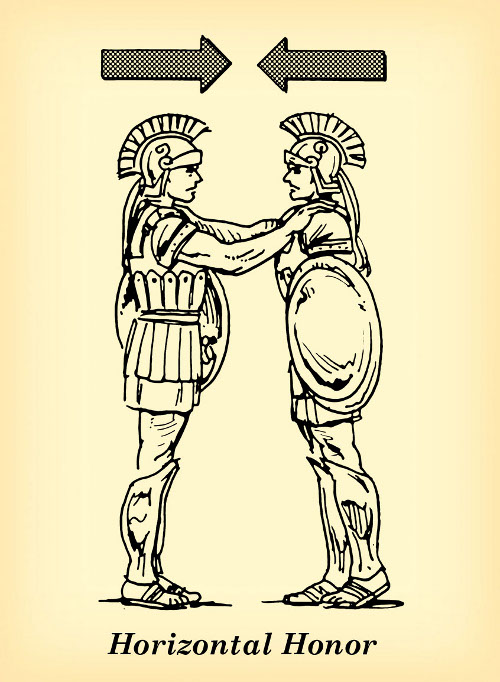 Horizontal honor is defined as the “right to respect among an exclusive society of equals.”
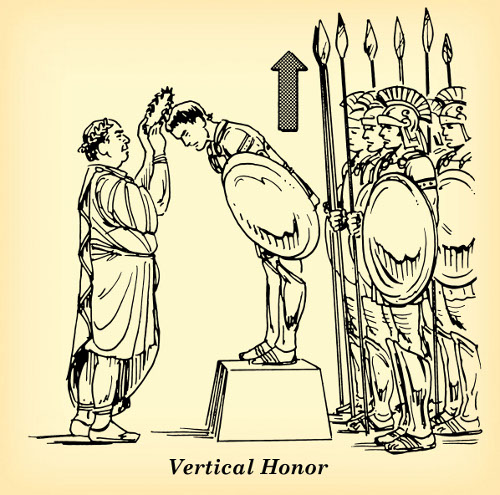
Vertical honor, on the other hand, isn’t about mutual respect, but is rather about giving praise and esteem to those “who are superior, whether by virtue of their abilities, their rank, their services to the community, their sex, their kinship, their office, or anything else.
Vertical honor, by its nature, is hierarchical and competitive. Vertical honor goes to the man who not only lives the code of honor, but excels at doing so
Honor has equivalence in reputation and honor killing has its genesis to protect the reputation.Honor killing is carried out to protect both the horizontal honor and vertical honor.
Honor Killing :-
‘Honor’ killings stem from a social system that has been conditioned by a rigid, often local, understanding of what honor means. Understanding of honor is colored by attitudinal factors like patrilineal mindset and misconstrued religious and cultural values.
Its existence till date with a ugly face despite India putting greater strides In the path of civilization , it can be attributed to several social, attitudinal and political factors.
The Victims:-
The victims of honor killing in India are largely the “Love Birds”. As the philosophers conclude – “love is blind” and when two consenting adults from different social backgrounds such as – different caste or differ religion try to marry , in order to uphold the perceived notion of honor in society the act is committed either by parents or relatives or others concerned.
Social factors
- In several communities across India, women are seen as the emblems of family honor. Their behavior, decisions and actions are seen as a reflection of the family’s “values” .So any deviation from the “accepted” route is a dent on family status.
- Since inter-caste marriages ,village exogamy tend to weaken the differences existing among the different caste groups disturbing the caste hierarchies. So marriage or a love affair between a high caste girl and a low caste boy is always contested and criminalized.
Attitudinal factors
- Social fencing attitude– In which a circle is surrounded around a woman to protect her, and crossing that line, by a man or woman, calls for action from family men whose sense of honor or masculinity has been perceived to have been challenged.
- Patrilinial mindset emphasizes the need for controlling the female sexuality to assure the paternity and lineage of the offspring. A man’s honour largely lies in his ability to impose such control on his womenfolk.
Political factors
- Cold-blooded murders for the preservation of honor is the direct cause due to a feudal-mindset, the belief in male-chauvinism, lack of formal governance in rural areas and Khap panchayat acting as parallel courts.
- The “culture of silence” adopted by the villagers leading to lack of any substantial evidence thereby hampering the process of investigation, when taken up, is another perpetrator of this social stigma.
- Lack of political will to take steps towards the abolition of the Khaps. The state government and other major political parties take stringent measures against the Khap Panchayats in the fear of losing votebanks.
- Even the police and the judiciary at times act as mute spectators and passive supporters of the honor protectors. It is generally mostly targeted against women even though the murder of men also takes place.
- The recent murders in Tamilnadu and Karnataka brought this gruesome act to the limelight again.
Laws:
- Honour Killing is ultimately a form of homicide and thus constitutes a violation of Article 14, 15(1) and (3), 19, 21 and 39(f) of The Constitution of India.
- It is against the various International Commitments the Government of India has made in the “United Nations Convention on the Elimination of all forms of Discrimination against Women” (1982), Universal Declaration of Human Rights (1948) and International Covenant on Civil and Political Rights (1966).
- Article 51 (e) of the Indian Constitution enumerates the fundamental duty to promote harmony and the spirit of common brotherhood amongst all people of India transcending religious, linguistic and regional or sectional diversities and to renounce practices derogatory to the dignity of women.
- Inter-caste marriages have been validated in India as early as in 1949 by the Hindu Marriages Validity Act, 1949.
- Hindu Marriage Act, 1955, diametrically against the customary marriage rules in India, offers more freedom in marriage by doing away with identification of marital partners according to caste and permits inter-caste marriages.
- Preventing a woman from marrying a person of her choice is an emotional abuse under the Protection of Women from Domestic Violence Act, 2005.
Supreme court:
- The Supreme Court in 2011, outlawed the evil practice of of protracted illegal honour killings by Khap Panchayats in India establishing that individual liberty under Article 21 has the highest place in the Constitution
- Landmark case of Lata Singh v State of Uttar Pradesh the Supreme Court has ruled that “there is nothing honourable in such killings, and in fact they are nothing but barbaric and shameful acts of murder”
- In the case of Arumugam Servai vs.State of Tamil Nadu, the Supreme Court has declared honour killings based on the perception of the Khaps, wholly illegal that must be stamped out.
- The Supreme Court in Bhagwan Dass v. State of NCT, Delhi, 2011 laid down that honour killings satisfy ‘the rarest of the rare’ doctrine so as to attract the death penalty for its perpetrators.
Suggestions:
- Honour killing crimes goes unreported resulting in a very low conviction rate. To deal with this issue, it is essential that a specific legislation in this regard with heavy penalty is enacted.
- Like all social evils, unless society shuns these practices, the police and judiciary alone cannot save the victims who want to decide their life partner on their own.
- Measures should be taken by the government, media houses and several institutions through audio-visuals, skits and short dramas in villages etc. to appeal emotionally to the parents to respect the liberty of their children rather than to uphold some orthodox social norms which sometimes result in the death of their only child.
- It is clear from the above legal provisions that honor killing is nothing but murder in clod blood and how to stop society from committing such acts has to have multidimensional approach.
- Family is at epicenter of it and reforms in family itself can be most profound antidote to honor killing.How to permeate the values of individual liberty in to individual families is the most significant questions and should be the focus of all measures directed against honor killing.