


In an effort to boost the agriculture sector, the Indian government has set an ambitious goal to double farmers’ income by 2022. In doing so, it has unveiled strategies ranging from irrigation to crop insurance.
But if the food value chain is to undergo true transformation, it needs to move from a production-driven system to one driven by demand, one that increasingly connects consumers with producers.
This will require new approaches and innovations, as well as increasing collaboration between the private sector and other stakeholders in the food system. It will require integrated value chains that connect farm to fork, competitive markets that provide better prices to farmers, and an enabling environment that supports innovation and action.
The facts before us:-
-
795 million people in the world go hungry everyday.
-
2 Billion people lack the nutrient to live a healthy life.
-
The world population is expected to reach 9 billion by 2050.
-
Africa alone will double in size – from 1 billion to 2 billion.
-
As people become more affluent they drift towards a diet richer in processed food, meat and dairy.
-
Farmable land continues to be lost to sprawl and soil degradation.
-
As global temperature rise, more land will turn into deserts.
-
It takes 1500 litres of water to produce 1 kg of wheat and 15000 litre to produce 1 kg of meat.
-
Food production is already responsible for 70% of the worlds’s water consumption.
-
By 2050, we need as much as twice of water that we need today.
No one stakeholder – whether governmental, corporate or from civil society – can do this alone, especially given climate change and increasing pressure on land and water resources. Real impact will come from combining the competencies of diverse organizations and stakeholders and creating better alignment through partnership platforms.
What does this alignment look like? Simply: more investment, more on-the-ground resources, new collaboration models that combine the knowledge and resources of diverse stakeholders, and which share best practices, risks and mutual accountability.

Seeds of success
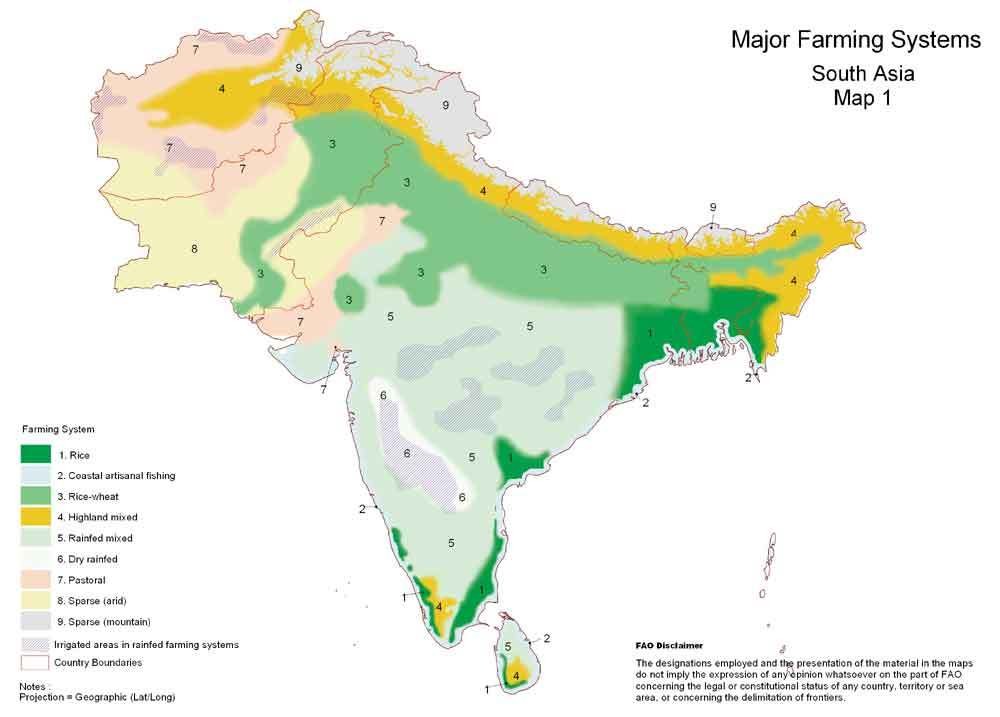
In India, several key states are developing such partnership platforms, including in Andhra Pradesh, Karnataka and Maharashtra. Supported by the World Economic Forum’s New Vision for Agriculture initiative and FAO initiatives , these state-level projects bring together government, private sector, farmer organizations and civil society to jointly develop solutions for integrated value-chain projects that will provide farmers with more and better opportunities.
There are currently more than 20 organizations engaged in these state partnerships, ranging from processors to retailers, multinational corporations to local enterprises. There is a strong commitment from CEOs to support this model though business leadership and support.
– Maharashtra was one of the first states to initiate this partnership model, with a 2012 government programme that aimed to develop integrated value chains for specific crops. Within three years, the initiative had reached half a million farmers and improved their incomes by 10-30%. This year the state government has introduced new marketing laws, hoping to encourage more competition and investments in agriculture markets.
– In the state of Andhra Pradesh, a partnership platform is aiming to achieve double-digit inclusive agriculture growth. The state has identified 25 growth sectors – including agriculture, horticulture, animal husbandry and fishery – and within a few months has mobilized more than $175 million in private-sector commitments to support several value-chain projects.
– In Karnataka last year, the state government launched a public-private partnership to improve horticulture value chains through value addition, technology and marketing solutions. In less than a year, five projects are already underway, led by both global and local private-sector companies.
While each state-level partnership follows a unique model, they share similar guiding principles, which have been developed and validated by countries around the world. These are:
– Locally owned and aligned with the state’s goals and priorities for the sector
– Market-driven with projects led by the private sector and rooted in viable business models
– Multistakeholder in their approach, with open and inclusive engagement that includes all relevant stakeholders
– Holistic, integrating full value chains that benefit all actors in the food system
– Supported by an international network that offers solidarity, connection and resources.
The state-level partnership platforms hold great potential for application elsewhere in India. Several other states have indicated interest. A key success factor for such models has been strong leadership and co-creation, with the government setting the vision and enabling policy framework; the private sector helping to deliver on that vision through scalable and inclusive market-based activity; and key stakeholders such as farmer organizations, civil society and international organizations combining their resources and expertise.
Only through such strong leadership from diverse stakeholders can we create the conditions needed for unlocking the entrepreneurship of smallholder farmers and ultimately boosting their income.
Receive Daily Updates
Recent Posts
- In the Large States category (overall), Chhattisgarh ranks 1st, followed by Odisha and Telangana, whereas, towards the bottom are Maharashtra at 16th, Assam at 17th and Gujarat at 18th. Gujarat is one State that has seen startling performance ranking 5th in the PAI 2021 Index outperforming traditionally good performing States like Andhra Pradesh and Karnataka, but ranks last in terms of Delta
- In the Small States category (overall), Nagaland tops, followed by Mizoram and Tripura. Towards the tail end of the overall Delta ranking is Uttarakhand (9th), Arunachal Pradesh (10th) and Meghalaya (11th). Nagaland despite being a poor performer in the PAI 2021 Index has come out to be the top performer in Delta, similarly, Mizoram’s performance in Delta is also reflected in it’s ranking in the PAI 2021 Index
- In terms of Equity, in the Large States category, Chhattisgarh has the best Delta rate on Equity indicators, this is also reflected in the performance of Chhattisgarh in the Equity Pillar where it ranks 4th. Following Chhattisgarh is Odisha ranking 2nd in Delta-Equity ranking, but ranks 17th in the Equity Pillar of PAI 2021. Telangana ranks 3rd in Delta-Equity ranking even though it is not a top performer in this Pillar in the overall PAI 2021 Index. Jharkhand (16th), Uttar Pradesh (17th) and Assam (18th) rank at the bottom with Uttar Pradesh’s performance in line with the PAI 2021 Index
- Odisha and Nagaland have shown the best year-on-year improvement under 12 Key Development indicators.
- In the 60:40 division States, the top three performers are Kerala, Goa and Tamil Nadu and, the bottom three performers are Uttar Pradesh, Jharkhand and Bihar.
- In the 90:10 division States, the top three performers were Himachal Pradesh, Sikkim and Mizoram; and, the bottom three performers are Manipur, Assam and Meghalaya.
- Among the 60:40 division States, Orissa, Chhattisgarh and Madhya Pradesh are the top three performers and Tamil Nadu, Telangana and Delhi appear as the bottom three performers.
- Among the 90:10 division States, the top three performers are Manipur, Arunachal Pradesh and Nagaland; and, the bottom three performers are Jammu and Kashmir, Uttarakhand and Himachal Pradesh
- Among the 60:40 division States, Goa, West Bengal and Delhi appear as the top three performers and Andhra Pradesh, Telangana and Bihar appear as the bottom three performers.
- Among the 90:10 division States, Mizoram, Himachal Pradesh and Tripura were the top three performers and Jammu & Kashmir, Nagaland and Arunachal Pradesh were the bottom three performers
- West Bengal, Bihar and Tamil Nadu were the top three States amongst the 60:40 division States; while Haryana, Punjab and Rajasthan appeared as the bottom three performers
- In the case of 90:10 division States, Mizoram, Assam and Tripura were the top three performers and Nagaland, Jammu & Kashmir and Uttarakhand featured as the bottom three
- Among the 60:40 division States, the top three performers are Kerala, Andhra Pradesh and Orissa and the bottom three performers are Madhya Pradesh, Jharkhand and Goa
- In the 90:10 division States, the top three performers are Mizoram, Sikkim and Nagaland and the bottom three performers are Manipur and Assam
In a diverse country like India, where each State is socially, culturally, economically, and politically distinct, measuring Governance becomes increasingly tricky. The Public Affairs Index (PAI 2021) is a scientifically rigorous, data-based framework that measures the quality of governance at the Sub-national level and ranks the States and Union Territories (UTs) of India on a Composite Index (CI).
States are classified into two categories – Large and Small – using population as the criteria.
In PAI 2021, PAC defined three significant pillars that embody Governance – Growth, Equity, and Sustainability. Each of the three Pillars is circumscribed by five governance praxis Themes.
The themes include – Voice and Accountability, Government Effectiveness, Rule of Law, Regulatory Quality and Control of Corruption.
At the bottom of the pyramid, 43 component indicators are mapped to 14 Sustainable Development Goals (SDGs) that are relevant to the States and UTs.
This forms the foundation of the conceptual framework of PAI 2021. The choice of the 43 indicators that go into the calculation of the CI were dictated by the objective of uncovering the complexity and multidimensional character of development governance

The Equity Principle
The Equity Pillar of the PAI 2021 Index analyses the inclusiveness impact at the Sub-national level in the country; inclusiveness in terms of the welfare of a society that depends primarily on establishing that all people feel that they have a say in the governance and are not excluded from the mainstream policy framework.
This requires all individuals and communities, but particularly the most vulnerable, to have an opportunity to improve or maintain their wellbeing. This chapter of PAI 2021 reflects the performance of States and UTs during the pandemic and questions the governance infrastructure in the country, analysing the effectiveness of schemes and the general livelihood of the people in terms of Equity.


Growth and its Discontents
Growth in its multidimensional form encompasses the essence of access to and the availability and optimal utilisation of resources. By resources, PAI 2021 refer to human resources, infrastructure and the budgetary allocations. Capacity building of an economy cannot take place if all the key players of growth do not drive development. The multiplier effects of better health care, improved educational outcomes, increased capital accumulation and lower unemployment levels contribute magnificently in the growth and development of the States.


The Pursuit Of Sustainability
The Sustainability Pillar analyses the access to and usage of resources that has an impact on environment, economy and humankind. The Pillar subsumes two themes and uses seven indicators to measure the effectiveness of government efforts with regards to Sustainability.


The Curious Case Of The Delta
The Delta Analysis presents the results on the State performance on year-on-year improvement. The rankings are measured as the Delta value over the last five to 10 years of data available for 12 Key Development Indicators (KDI). In PAI 2021, 12 indicators across the three Pillars of Equity (five indicators), Growth (five indicators) and Sustainability (two indicators). These KDIs are the outcome indicators crucial to assess Human Development. The Performance in the Delta Analysis is then compared to the Overall PAI 2021 Index.
Key Findings:-
In the Scheme of Things
The Scheme Analysis adds an additional dimension to ranking of the States on their governance. It attempts to complement the Governance Model by trying to understand the developmental activities undertaken by State Governments in the form of schemes. It also tries to understand whether better performance of States in schemes reflect in better governance.
The Centrally Sponsored schemes that were analysed are National Health Mission (NHM), Umbrella Integrated Child Development Services scheme (ICDS), Mahatma Gandh National Rural Employment Guarantee Scheme (MGNREGS), Samagra Shiksha Abhiyan (SmSA) and MidDay Meal Scheme (MDMS).
National Health Mission (NHM)
INTEGRATED CHILD DEVELOPMENT SERVICES (ICDS)
MID- DAY MEAL SCHEME (MDMS)
SAMAGRA SHIKSHA ABHIYAN (SMSA)
MAHATMA GANDHI NATIONAL RURAL EMPLOYMENT GUARANTEE SCHEME (MGNREGS)