Every country has military and Pakistan Military has a country. This statement is only vindicated by the fact that the Pakistan PrimeMinister was nowhere to be seen while Munir-Trump were having lunch.
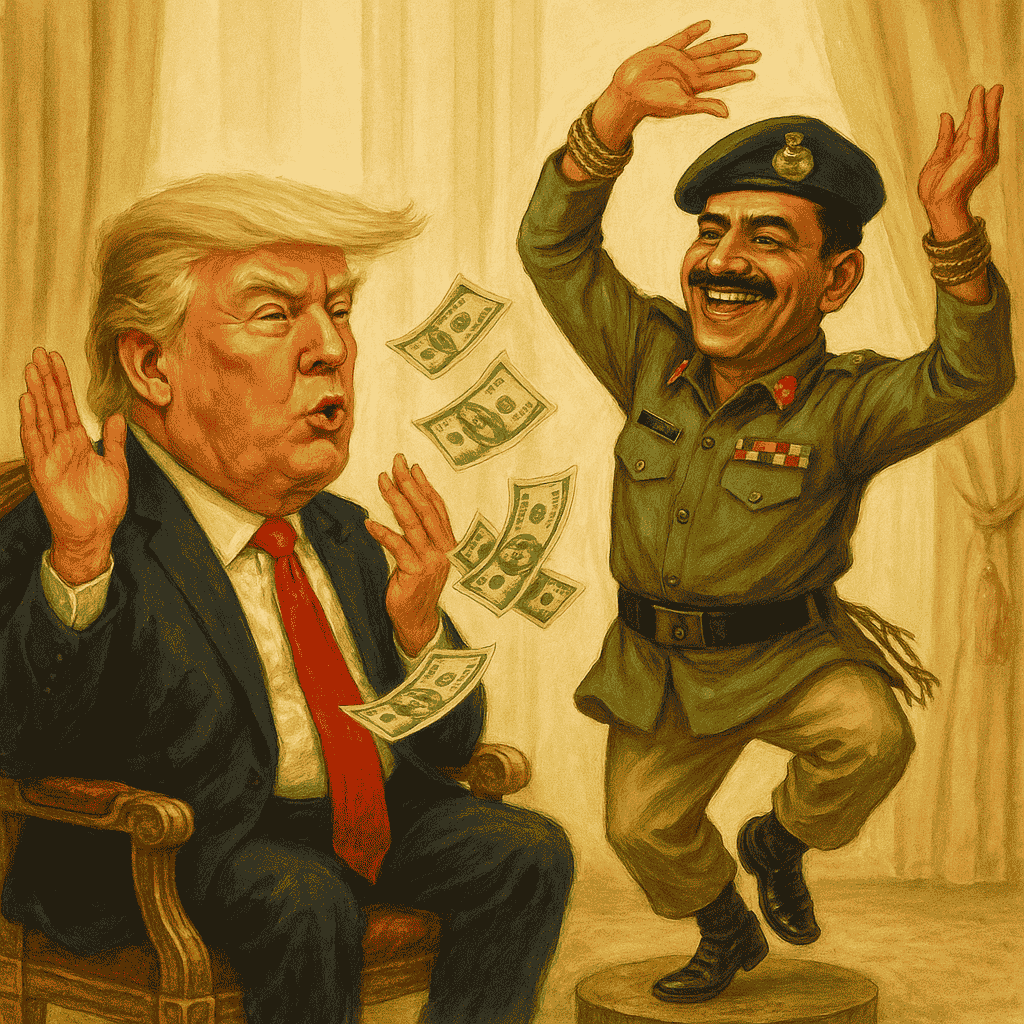
In the high-stakes theatre of South Asian geopolitics, the United States, India, and Pakistan are once again entangled in a strategic triangle — one shaped by history, ambition, and shifting alliances.
“Geography gives no second chances, but diplomacy often plays the same hand twice.”
🍽️ Trump’s Lunch, Pakistan’s Leverage
Former U.S. President Donald Trump’s White House lunch with Pakistan’s Army Chief Asim Munir, was more than ceremonial. It signaled a revival of Cold War-style realpolitik, marked by nostalgia, optics, and short-term deals. Despite India’s denials, Trump’s claims of brokering ceasefires and using trade as leverage underscore a return to “deal over doctrine” diplomacy.
This pivot threatens decades of U.S.-India strategic alignment, particularly around counterterrorism and China containment — once hailed as one of Washington’s most successful post-Cold War recalibrations.
💸 From Rebuke to Reward: A U.S.–Pakistan Reset
Trump’s earlier bluntness — calling out Pakistan’s “double game” — had resonated well with New Delhi. But in a startling shift, his administration revived military aid to Pakistan, greenlighting $397 million for F-16 support, while U.S. officials began calling Pakistan a “phenomenal partner.”
This transactional reset serves America’s immediate goals: Iran intelligence, Afghanistan access, and keeping a foothold in China’s backyard. But for India, it threatens a values-based partnership and signals Washington’s growing ambivalence.
⚔️ India’s ‘New Normal’: From Restraint to Retaliation
“This is not a ceasefire. This is a pause.” — PM Modi
After the Pahalgam terror attack, India responded with Operation Sindoor — a decisive military strike signaling a doctrinal shift from strategic restraint to assertive retaliation. Governement frames this as a “new normal” — where diplomacy walks in lockstep with military resolve.
The message is clear: India will no longer play by old rules. But Beijing’s proximity to Islamabad raises fears of a two-front challenge.
🧊 Rawalpindi’s Hard State Doctrine
Pakistan, meanwhile, is doubling down on its military-first approach. Elevating Asim Munir to Field Marshal reflects a hardening of the state, centralizing power in the military, and sidelining civilian checks. At the same time, Pakistan is wooing Washington through trade deals, rare earth cooperation, and charm offensives — a classic case of geography meets guile.
🎭 Washington’s Balancing Act: Strategy or Shortcuts?
Today’s U.S. foreign policy seems torn between values and convenience. Its obsession with trade tariffs and tactical wins risks sidelining India’s Indo-Pacific role, even as strategic platforms like the Quad limp on.
By flirting with Pakistan while ignoring New Delhi’s red lines on Kashmir, the U.S. risks “re-hyphenating” India and Pakistan — a move antithetical to India’s global ambitions and sovereignty claims.
🧭 Why Pakistan Still Matters (To America)
Pakistan’s relevance rests on unchanging geography and sharp diplomacy. Bordering Iran, Afghanistan, and China, and situated at a regional crossroads, it remains a logistical and intelligence asset — especially as Washington recalibrates its stance on Iran and Central Asia.
Personal rapport — not policy alignment — often determines aid flows and access, keeping Pakistan in the game, despite its economic fragility.
🪙 Conclusion: Between Transactions and Trust
The U.S. must tread carefully. In a region bristling with nuclear arms, historical scars, and rising powers, short-term deals can undermine long-term stability. India seeks principled partnership. Pakistan seeks renewed relevance. The U.S. risks becoming a power pulled between idealism, realism, and impulsive diplomacy.
“Allies are chosen by choice, not by geography. But geography has a stubborn way of making its case.”
Recent Posts
Petrol in India is cheaper than in countries like Hong Kong, Germany and the UK but costlier than in China, Brazil, Japan, the US, Russia, Pakistan and Sri Lanka, a Bank of Baroda Economics Research report showed.
Rising fuel prices in India have led to considerable debate on which government, state or central, should be lowering their taxes to keep prices under control.
The rise in fuel prices is mainly due to the global price of crude oil (raw material for making petrol and diesel) going up. Further, a stronger dollar has added to the cost of crude oil.
Amongst comparable countries (per capita wise), prices in India are higher than those in Vietnam, Kenya, Ukraine, Bangladesh, Nepal, Pakistan, Sri Lanka, and Venezuela. Countries that are major oil producers have much lower prices.
In the report, the Philippines has a comparable petrol price but has a per capita income higher than India by over 50 per cent.
Countries which have a lower per capita income like Kenya, Bangladesh, Nepal, Pakistan, and Venezuela have much lower prices of petrol and hence are impacted less than India.
“Therefore there is still a strong case for the government to consider lowering the taxes on fuel to protect the interest of the people,” the report argued.
India is the world’s third-biggest oil consuming and importing nation. It imports 85 per cent of its oil needs and so prices retail fuel at import parity rates.
With the global surge in energy prices, the cost of producing petrol, diesel and other petroleum products also went up for oil companies in India.
They raised petrol and diesel prices by Rs 10 a litre in just over a fortnight beginning March 22 but hit a pause button soon after as the move faced criticism and the opposition parties asked the government to cut taxes instead.
India imports most of its oil from a group of countries called the ‘OPEC +’ (i.e, Iran, Iraq, Saudi Arabia, Venezuela, Kuwait, United Arab Emirates, Russia, etc), which produces 40% of the world’s crude oil.
As they have the power to dictate fuel supply and prices, their decision of limiting the global supply reduces supply in India, thus raising prices
The government charges about 167% tax (excise) on petrol and 129% on diesel as compared to US (20%), UK (62%), Italy and Germany (65%).
The abominable excise duty is 2/3rd of the cost, and the base price, dealer commission and freight form the rest.
Here is an approximate break-up (in Rs):
a)Base Price | 39 |
b)Freight | 0.34 |
c) Price Charged to Dealers = (a+b) | 39.34 |
d) Excise Duty | 40.17 |
e) Dealer Commission | 4.68 |
f) VAT | 25.35 |
g) Retail Selling Price | 109.54 |
Looked closely, much of the cost of petrol and diesel is due to higher tax rate by govt, specifically excise duty.
So the question is why government is not reducing the prices ?
India, being a developing country, it does require gigantic amount of funding for its infrastructure projects as well as welfare schemes.
However, we as a society is yet to be tax-compliant. Many people evade the direct tax and that’s the reason why govt’s hands are tied. Govt. needs the money to fund various programs and at the same time it is not generating enough revenue from direct taxes.
That’s the reason why, govt is bumping up its revenue through higher indirect taxes such as GST or excise duty as in the case of petrol and diesel.
Direct taxes are progressive as it taxes according to an individuals’ income however indirect tax such as excise duty or GST are regressive in the sense that the poorest of the poor and richest of the rich have to pay the same amount.
Does not matter, if you are an auto-driver or owner of a Mercedes, end of the day both pay the same price for petrol/diesel-that’s why it is regressive in nature.
But unlike direct tax where tax evasion is rampant, indirect tax can not be evaded due to their very nature and as long as huge no of Indians keep evading direct taxes, indirect tax such as excise duty will be difficult for the govt to reduce, because it may reduce the revenue and hamper may programs of the govt.