


“Operation Sindoor was a strike. But defeating the ‘Other Punjab’—Pakistan’s jihadi heartland—will require a war of patience, precision, and persistence.”
To truly defeat terrorism, India must go beyond bombs. It must break the spine of Pakistan’s Punjab—the breeding ground of jihad.”
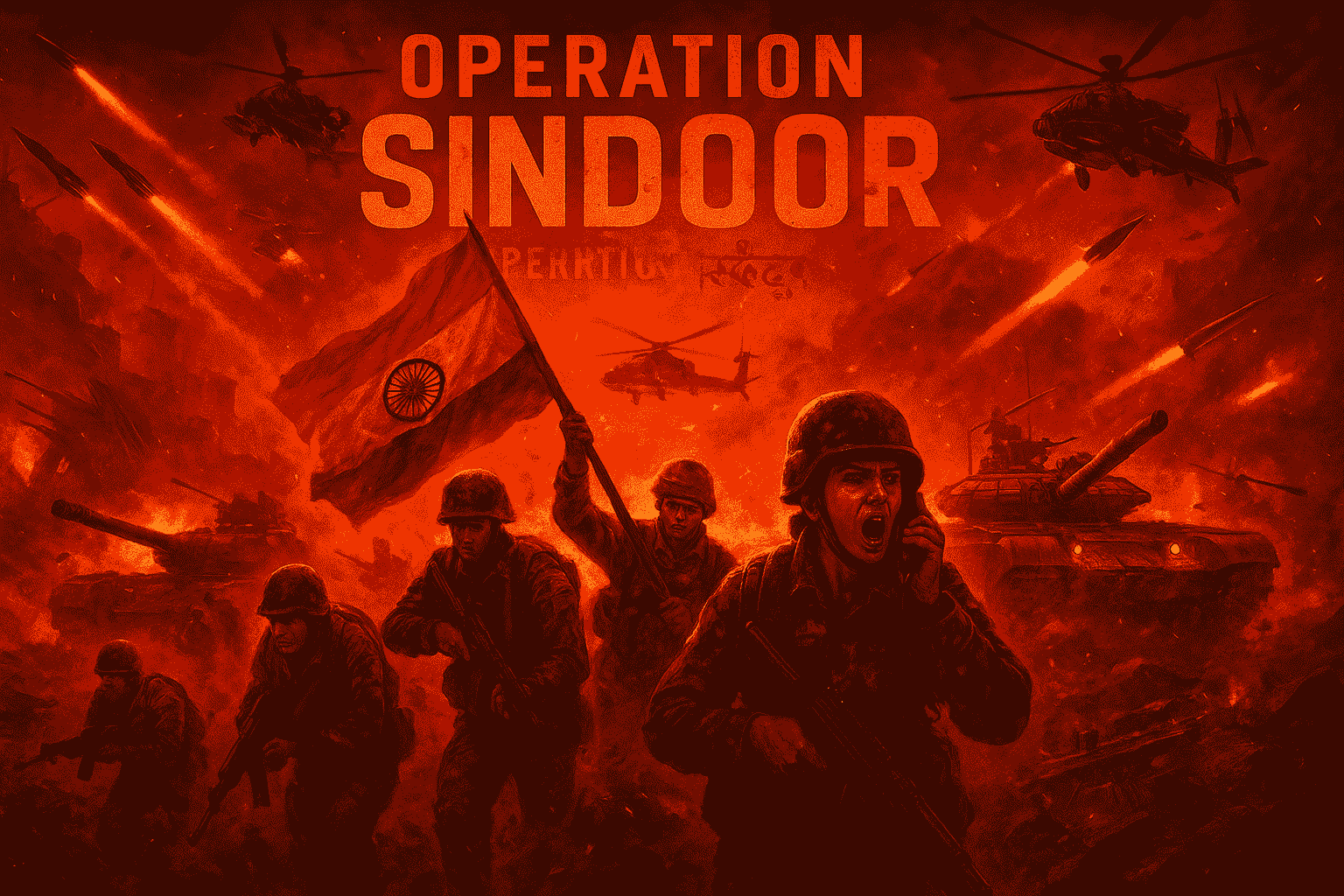
From Pahalgam to Bahawalpur:
On April 22, 2025, the scenic town of Pahalgam was shattered by a brutal terrorist attack that killed 26 civilians. The strike was not random—it was orchestrated. And India knew where it came from: across the border, where terror groups enjoy not just sanctuary—but sponsorship.
India’s answer was swift. Operation Sindoor, launched on May 6, saw the Indian Air Force targeting terror hubs across Pakistan-occupied Kashmir (PoK), Khyber Pakhtunkhwa, and critically—Pakistan’s Punjab.
Operation Sindoor: Tactical Victory, Strategic Pause
Between May 6 and 10, the Indian Air Force pounded terror camps and airbases across PoK, Khyber Pakhtunkhwa, and Pakistani Punjab, including high-value targets like Muridke (Lashkar-e-Taiba) and Bahawalpur (Jaish-e-Mohammad). For the first time since the 1971 war, India hit deep inside Punjab, Pakistan’s political and military core.
And Pakistan blinked. The Director General of Military Operations (DGMO) reached out to halt the escalation—marking a short-term tactical win for India.
But will it deter future attacks?
Pakistan’s Punjab – The Heart of Pakistan’s ‘Jihadi-industrial Complex’
Pakistani Punjab is not just another province. It is the recruitment base of the Pakistan Army, the cradle of terrorist tanzeems, and the nerve centre of anti-India jihad. It is t Pakistan’s ‘Fertile Crescent’ of Terrorism.
It is Pakistan’s political and military powerhouse, home to:
-
Over 60% of Pakistan’s population
-
The bulk of the Pakistan Army’s recruitment
-
The headquarters of terror outfits like Lashkar-e-Taiba (Muridke) and Jaish-e-Mohammad (Bahawalpur)
With a robust counter-intelligence network, Rawalpindi has successfully shielded this region from Indian covert penetration—making it India’s toughest target.
Even lethal airstrikes cannot uproot deeply embedded jihadist networks. What India needs is a non-linear, layered, and patient campaign to dismantle the ecosystem feeding Pakistan’s terrorism. For India, this is the real battlefield. And it is as psychological as it is territorial.
Beyond the Bombs: Why India Needs a Strategy of Attrition
Military might is necessary, but not sufficient.
Like Israel’s shadow war with Iran, India must now embrace a strategy of exhaustion (Ermattungsstrategie)—wearing down Pakistan’s ability and will to support terrorism through:
-
Covert Intelligence Operations: Targeting terror leadership and infrastructure, especially in Pakistan’s Punjab.
-
Economic Warfare: Leveraging tools like FATF blacklisting and trade isolation.
-
Hydro-Diplomacy: Reconsidering the Indus Waters Treaty to tighten the pressure.
-
Cyber & Narrative Warfare: Exposing Pakistan’s duplicity on global platforms.
India’s past restraint has shifted now, which has shown greater political will to escalate post-attack. However, unless consistent across future administrations, India risks reverting to the oscillation between airstrikes and inaction—a dangerous pattern.
Deterrence won’t work if India swings between surgical strikes and strategic silence. There must be political continuity, regardless of party in power.
If not, Pakistan’s jihadi machine will adapt, recover, and return.
Attrition is the Only Way to Break Pakistan’s Terror Hub
Attritional warfare does not seek a single decisive victory. It seeks to bleed the adversary slowly but irreversibly—militarily, economically, diplomatically, and psychologically.
To make this work, India must:
-
Invest in language-capable, deep-cover intelligence assets
-
Build long-term technological and cyber capabilities
-
Ensure cross-party strategic consistency
-
Prepare conventional forces for short, sharp wars—even two-front scenarios with China
Strategic Patience Over Tactical Blows
The lesson from Operation Sindoor is clear: strikes punish, but they don’t dismantle. Without a sustained attritional campaign—surgical, covert, and prolonged—the terror networks embedded in the “Other Punjab” will regenerate.
India’s security doctrine must now evolve. Not just to retaliate, but to reshape the battlefield. Attrition—silent, deliberate, and sustained—is not weakness. It is the warfare of those who think long, and strike deep.
Beyond Operation Sindoor:
If Operation Sindoor leads to months of silence on the terror front, it will be hailed as a deterrent victory.
If another Chittisinghpura, Pulwama, or Pahalgam happens, India must not hesitate—but escalate wisely. And more importantly, do so silently, consistently, and surgically.
Receive Daily Updates
Recent Posts
Steve Ovett, the famous British middle-distance athlete, won the 800-metres gold medal at the Moscow Olympics of 1980. Just a few days later, he was about to win a 5,000-metres race at London’s Crystal Palace. Known for his burst of acceleration on the home stretch, he had supreme confidence in his ability to out-sprint rivals. With the final 100 metres remaining,
[wptelegram-join-channel link=”https://t.me/s/upsctree” text=”Join @upsctree on Telegram”]Ovett waved to the crowd and raised a hand in triumph. But he had celebrated a bit too early. At the finishing line, Ireland’s John Treacy edged past Ovett. For those few moments, Ovett had lost his sense of reality and ignored the possibility of a negative event.
This analogy works well for the India story and our policy failures , including during the ongoing covid pandemic. While we have never been as well prepared or had significant successes in terms of growth stability as Ovett did in his illustrious running career, we tend to celebrate too early. Indeed, we have done so many times before.
It is as if we’re convinced that India is destined for greater heights, come what may, and so we never run through the finish line. Do we and our policymakers suffer from a collective optimism bias, which, as the Nobel Prize winner Daniel Kahneman once wrote, “may well be the most significant of the cognitive biases”? The optimism bias arises from mistaken beliefs which form expectations that are better than the reality. It makes us underestimate chances of a negative outcome and ignore warnings repeatedly.
The Indian economy had a dream run for five years from 2003-04 to 2007-08, with an average annual growth rate of around 9%. Many believed that India was on its way to clocking consistent double-digit growth and comparisons with China were rife. It was conveniently overlooked that this output expansion had come mainly came from a few sectors: automobiles, telecom and business services.
Indians were made to believe that we could sprint without high-quality education, healthcare, infrastructure or banking sectors, which form the backbone of any stable economy. The plan was to build them as we went along, but then in the euphoria of short-term success, it got lost.
India’s exports of goods grew from $20 billion in 1990-91 to over $310 billion in 2019-20. Looking at these absolute figures it would seem as if India has arrived on the world stage. However, India’s share of global trade has moved up only marginally. Even now, the country accounts for less than 2% of the world’s goods exports.
More importantly, hidden behind this performance was the role played by one sector that should have never made it to India’s list of exports—refined petroleum. The share of refined petroleum exports in India’s goods exports increased from 1.4% in 1996-97 to over 18% in 2011-12.
An import-intensive sector with low labour intensity, exports of refined petroleum zoomed because of the then policy regime of a retail price ceiling on petroleum products in the domestic market. While we have done well in the export of services, our share is still less than 4% of world exports.
India seemed to emerge from the 2008 global financial crisis relatively unscathed. But, a temporary demand push had played a role in the revival—the incomes of many households, both rural and urban, had shot up. Fiscal stimulus to the rural economy and implementation of the Sixth Pay Commission scales had led to the salaries of around 20% of organized-sector employees jumping up. We celebrated, but once again, neither did we resolve the crisis brewing elsewhere in India’s banking sector, nor did we improve our capacity for healthcare or quality education.
Employment saw little economy-wide growth in our boom years. Manufacturing jobs, if anything, shrank. But we continued to celebrate. Youth flocked to low-productivity service-sector jobs, such as those in hotels and restaurants, security and other services. The dependence on such jobs on one hand and high-skilled services on the other was bound to make Indian society more unequal.
And then, there is agriculture, an elephant in the room. If and when farm-sector reforms get implemented, celebrations would once again be premature. The vast majority of India’s farmers have small plots of land, and though these farms are at least as productive as larger ones, net absolute incomes from small plots can only be meagre.
A further rise in farm productivity and consequent increase in supply, if not matched by a demand rise, especially with access to export markets, would result in downward pressure on market prices for farm produce and a further decline in the net incomes of small farmers.
We should learn from what John Treacy did right. He didn’t give up, and pushed for the finish line like it was his only chance at winning. Treacy had years of long-distance practice. The same goes for our economy. A long grind is required to build up its base before we can win and celebrate. And Ovett did not blame anyone for his loss. We play the blame game. Everyone else, right from China and the US to ‘greedy corporates’, seems to be responsible for our failures.
We have lowered absolute poverty levels and had technology-based successes like Aadhaar and digital access to public services. But there are no short cuts to good quality and adequate healthcare and education services. We must remain optimistic but stay firmly away from the optimism bias.
In the end, it is not about how we start, but how we finish. The disastrous second wave of covid and our inability to manage it is a ghastly reminder of this fact.