


Written by : Umakant Sir (ex-Civil Servant & Mentor)
GenZ does not want to work endlessly, because their parents and grandparents did. And there is nothing wrong about it.
GenZ prefers meaningful work rather than “just hard work”.

The Debate of Work:
The question of how much one should work has re-emerged as a contentious public debate in recent times. Statements by business leaders such as Elon Musk, who advocates 80–100 hour workweeks, and N.R. Narayana Murthy, who called for a 70-hour workweek for India’s youth, have reignited discussions on productivity, national growth, and personal well-being.
At its core, the debate reflects a deeper conflict between industrial-era notions of sacrifice and post-industrial concerns for sustainability, dignity, and mental health.
Proponents of longer working hours argue from the standpoint of economic urgency and competitive pressure. For developing economies like India, they contend, rapid growth demands extraordinary effort. Narayana Murthy framed his argument as a moral appeal to nation-building, recalling the post-war reconstruction of countries like Japan and Germany. The underlying belief is that “hard work precedes prosperity.”
Similarly, Elon Musk’s defence of extreme work hours in his companies stems from a mission-driven worldview. For Musk, innovation—whether in electric vehicles or space exploration—requires exceptional commitment. His oft-quoted assertion that “nobody ever changed the world on 40 hours a week” reflects the idea that transformative outcomes demand personal sacrifice.
Critics challenge the glorification of long hours on both empirical and ethical grounds. Studies across countries consistently show that productivity per hour declines sharply beyond a threshold, often around 45–50 hours per week. Beyond this point, fatigue reduces efficiency, creativity, and decision-making quality. Thus, long hours may signal inefficiency rather than dedication.
More importantly, the debate brings mental health to the forefront. In an era marked by anxiety, burnout, and depression, excessive work hours are seen as socially unsustainable. Critics argue that celebrating overwork normalises exploitative work cultures, particularly in economies with weak labour protections.
GenZ and Work:
Younger workers increasingly prioritise work-life balance, flexibility, and mental well-being. For them, productivity is measured not by hours logged but by outcomes achieved.
A 2024 Unstop survey showed that 47% of Gen Z prioritise work-life balance above salary or job title, and prefer jobs that allow hybrid working, meaningful tasks, and mental well-being support. The same survey revealed that young employees are more willing than any previous generation to quit a job that feels draining, even within a year.
But, we are not here to debate, who is right or who is wrong …..
We need to understand that, GenZ has this ability because their pervious generation sacrificed a lot. So comparing choices of GenZ with their previous generation is wrong on so many levels.
This shift in attitude can be very well explained by a theory from Psychology : Known as Maslow’s Hierarchy of Needs
What is Maslow’s Hierarchy of Needs:
Maslow argued that human motivation progresses through stages—from physiological needs and safety, to belonging, esteem, and finally self-actualisation. When survival and security dominate, work becomes a necessity. When these needs are largely met, work becomes a means of self-expression and fulfilment.
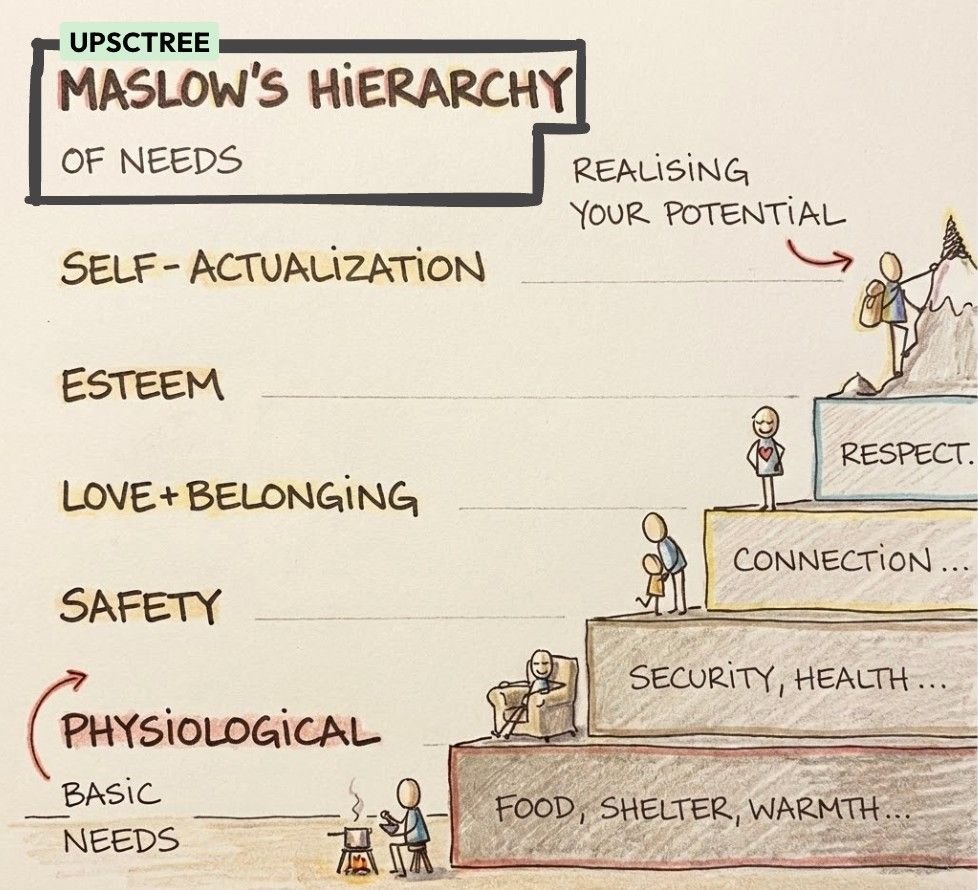 For much of India’s post-independence history, employment was about survival and stability. Long hours were not a choice but a compulsion. Today, many young Indians enter the workforce with basic needs already secured. As a result, their aspirations naturally shift towards autonomy, purpose, and well-being.
As Maslow famously noted, “What a person can be, they must be.”
Gen Z’s approach to work reflects this transition from survival-driven labour to meaning-driven engagement.
This does not render calls for hard work irrelevant. Nation-building, innovation, and crisis moments will always demand extraordinary effort from some sections of society. But it does suggest that a single work ethic cannot be imposed across generations, sectors, or stages of development. The mistake lies in universalising exceptional conditions into everyday norms.
Ultimately, the debate on work culture must move beyond glorifying exhaustion or romanticising leisure. As societies progress, the goal should not be to work endlessly, but to work intelligently and sustainably. In redefining the culture of work, the task is not to reject the past—but to evolve from it.
Receive Daily Updates
Recent Posts
Steve Ovett, the famous British middle-distance athlete, won the 800-metres gold medal at the Moscow Olympics of 1980. Just a few days later, he was about to win a 5,000-metres race at London’s Crystal Palace. Known for his burst of acceleration on the home stretch, he had supreme confidence in his ability to out-sprint rivals. With the final 100 metres remaining,
[wptelegram-join-channel link=”https://t.me/s/upsctree” text=”Join @upsctree on Telegram”]Ovett waved to the crowd and raised a hand in triumph. But he had celebrated a bit too early. At the finishing line, Ireland’s John Treacy edged past Ovett. For those few moments, Ovett had lost his sense of reality and ignored the possibility of a negative event.
This analogy works well for the India story and our policy failures , including during the ongoing covid pandemic. While we have never been as well prepared or had significant successes in terms of growth stability as Ovett did in his illustrious running career, we tend to celebrate too early. Indeed, we have done so many times before.
It is as if we’re convinced that India is destined for greater heights, come what may, and so we never run through the finish line. Do we and our policymakers suffer from a collective optimism bias, which, as the Nobel Prize winner Daniel Kahneman once wrote, “may well be the most significant of the cognitive biases”? The optimism bias arises from mistaken beliefs which form expectations that are better than the reality. It makes us underestimate chances of a negative outcome and ignore warnings repeatedly.
The Indian economy had a dream run for five years from 2003-04 to 2007-08, with an average annual growth rate of around 9%. Many believed that India was on its way to clocking consistent double-digit growth and comparisons with China were rife. It was conveniently overlooked that this output expansion had come mainly came from a few sectors: automobiles, telecom and business services.
Indians were made to believe that we could sprint without high-quality education, healthcare, infrastructure or banking sectors, which form the backbone of any stable economy. The plan was to build them as we went along, but then in the euphoria of short-term success, it got lost.
India’s exports of goods grew from $20 billion in 1990-91 to over $310 billion in 2019-20. Looking at these absolute figures it would seem as if India has arrived on the world stage. However, India’s share of global trade has moved up only marginally. Even now, the country accounts for less than 2% of the world’s goods exports.
More importantly, hidden behind this performance was the role played by one sector that should have never made it to India’s list of exports—refined petroleum. The share of refined petroleum exports in India’s goods exports increased from 1.4% in 1996-97 to over 18% in 2011-12.
An import-intensive sector with low labour intensity, exports of refined petroleum zoomed because of the then policy regime of a retail price ceiling on petroleum products in the domestic market. While we have done well in the export of services, our share is still less than 4% of world exports.
India seemed to emerge from the 2008 global financial crisis relatively unscathed. But, a temporary demand push had played a role in the revival—the incomes of many households, both rural and urban, had shot up. Fiscal stimulus to the rural economy and implementation of the Sixth Pay Commission scales had led to the salaries of around 20% of organized-sector employees jumping up. We celebrated, but once again, neither did we resolve the crisis brewing elsewhere in India’s banking sector, nor did we improve our capacity for healthcare or quality education.
Employment saw little economy-wide growth in our boom years. Manufacturing jobs, if anything, shrank. But we continued to celebrate. Youth flocked to low-productivity service-sector jobs, such as those in hotels and restaurants, security and other services. The dependence on such jobs on one hand and high-skilled services on the other was bound to make Indian society more unequal.
And then, there is agriculture, an elephant in the room. If and when farm-sector reforms get implemented, celebrations would once again be premature. The vast majority of India’s farmers have small plots of land, and though these farms are at least as productive as larger ones, net absolute incomes from small plots can only be meagre.
A further rise in farm productivity and consequent increase in supply, if not matched by a demand rise, especially with access to export markets, would result in downward pressure on market prices for farm produce and a further decline in the net incomes of small farmers.
We should learn from what John Treacy did right. He didn’t give up, and pushed for the finish line like it was his only chance at winning. Treacy had years of long-distance practice. The same goes for our economy. A long grind is required to build up its base before we can win and celebrate. And Ovett did not blame anyone for his loss. We play the blame game. Everyone else, right from China and the US to ‘greedy corporates’, seems to be responsible for our failures.
We have lowered absolute poverty levels and had technology-based successes like Aadhaar and digital access to public services. But there are no short cuts to good quality and adequate healthcare and education services. We must remain optimistic but stay firmly away from the optimism bias.
In the end, it is not about how we start, but how we finish. The disastrous second wave of covid and our inability to manage it is a ghastly reminder of this fact.