


Scientists have fabricated a device that can mimic human brain cognitive actions and is more efficient than conventional techniques in emulating artificial intelligence, thus enhancing the computational speed and power consumption efficiency.
[wptelegram-join-channel link=”https://t.me/s/upsctree” text=”Join @upsctree on Telegram”]
Artificial intelligence is now a part of our daily lives, starting from email filters and smart replies in communication to helping battle the Covid-19 pandemic. But AI can do much more such as facilitate self-driving autonomous vehicles, augmented reality for healthcare, drug discovery, big data handling, real-time pattern/image recognition, solving real-world problems, and so on.
These can be realised with the help of a neuromorphic device which can mimic the human brain synapse to bring about brain-inspired efficient computing ability. The human brain comprises of nearly a hundred billion neurons consisting of axons and dendrites. These neurons massively interconnect with each other via axons and dendrites, forming colossal junctions called synapse. This complex bio-neural network is believed to give rise to superior cognitive abilities.
Software-based artificial neural networks (ANN) can be seen defeating humans in games (AlphaGo and AlphaZero) or helping handle the Covid-19 situation. However, the power-hungry (in megawatts) von Neumann computer architecture slows down ANNs performance due to the available serial processing while the brain does the job via parallel processing consuming just 20 W.
It is estimated that the brain consumes 20% of the total body energy. From the calory conversion, it amounts to 20 watts. While the conventional computing platforms consume megawatts, i.e., 10 lakh watts of energy, to mimic basic human cognition.
To overcome this bottleneck, a hardware-based solution involves an artificial synaptic device that, unlike transistors, could emulate the functions of human brain synapse. Scientists had long been trying to develop a synaptic device that can mimic complex psychological behaviors without the aid of external supporting (CMOS) circuits.
To address this challenge, Scientists from Jawaharlal Nehru Centre for Advanced Scientific Research, Bengaluru, an autonomous institute of the Department of Science & Technology, Government of India, devised a novel approach of fabricating an artificial synaptic network (ASN) resembling the biological neural network via a simple self-forming method (the device structure is formed by itself while heating). This work has been recently published in the journal ‘Materials Horizons’.
Aiming to develop a synaptic device for neuromorphic applications with a humble fabrication method, the JNCASR team explored a material system mimicking neuronal bodies and axonal network connectivity much like the biological system. In order to realize such a structure, they found that a self-forming process was easy, scalable, and cost-effective.
In their research JNCASR team dewetted Silver (Ag) metal to form branched islands and nanoparticles with nanogap separations to resemble bio neurons and neurotransmitters where dewetting is a process of rupture of continuous film into disconnected/isolated islands or spherical particles.
With such an architecture, several higher-order cognitive activities are emulated. The fabricated artificial synaptic network (ASN) consisted of Silver (Ag) agglomerates network separated by nanogaps filled with isolated nanoparticles. They found that dewetting Ag film at a higher temperature resulted in the formation of island structures separated by nanogaps resembling the bio-neural network.
Using programmed electrical signals as a real-world stimulus, this hierarchical structure emulated various learning activities such as short-term memory (STM), long-term memory (LTM), potentiation, depression, associative learning, interest-based learning, supervision, etc. impression of supervision.
Synaptic fatigue due to excessive learning and its self-recovery was also mimicked. Remarkably, all these behaviors were emulated in a single material system without the aid of external CMOS circuits. A prototype kit has been developed to emulate Pavlov’s dog behavior which demonstrates the potential of this device towards neuromorphic artificial intelligence. By organizing a nanomaterial resembling the biological neural substance, the JNCASR team has moved a step further in accomplishing advanced neuromorphic artificial intelligence.
Nature has had an incredible amount of time and diversity to engineer ever new forms and functions through evolution. Learning and emulating new processes, technologies, materials and devices from the nature and biology are the important pathways to the significant advances of the future which will increasingly integrate the worlds of the living with the man-made technologies.
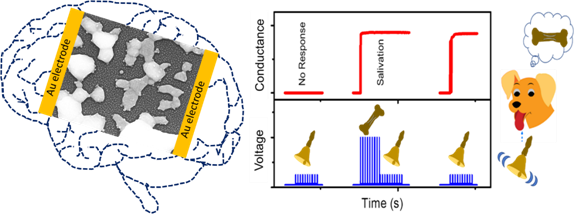
Pavlov’s dog -Classical Conditioning
First discovered by Russian physiologist Ivan Pavlov, this method of conditioning focuses on pairing a neutral stimulus with the response from a biologically potent stimulus. This can be seen in the example of Pavlov’s dogs.
The physiologist discovered this phenomenon when he was studying digestion in dogs. When the food was brought in, the dogs salivated; an involuntary biological response to food. However, he experimented with ringing a bell every time the food was brought in, thus creating a connection between the sound of the bell and the food.
This resulted in the dogs salivating whenever they heard the bell ring, thus being ‘conditioned’ to respond in a way similar to how they would to a conditioned stimulus (food), except without the stimulus being present. Thus, they had ‘learned’ that the sound of the bell meant food was coming.
Receive Daily Updates
Recent Posts
Steve Ovett, the famous British middle-distance athlete, won the 800-metres gold medal at the Moscow Olympics of 1980. Just a few days later, he was about to win a 5,000-metres race at London’s Crystal Palace. Known for his burst of acceleration on the home stretch, he had supreme confidence in his ability to out-sprint rivals. With the final 100 metres remaining,
[wptelegram-join-channel link=”https://t.me/s/upsctree” text=”Join @upsctree on Telegram”]Ovett waved to the crowd and raised a hand in triumph. But he had celebrated a bit too early. At the finishing line, Ireland’s John Treacy edged past Ovett. For those few moments, Ovett had lost his sense of reality and ignored the possibility of a negative event.
This analogy works well for the India story and our policy failures , including during the ongoing covid pandemic. While we have never been as well prepared or had significant successes in terms of growth stability as Ovett did in his illustrious running career, we tend to celebrate too early. Indeed, we have done so many times before.
It is as if we’re convinced that India is destined for greater heights, come what may, and so we never run through the finish line. Do we and our policymakers suffer from a collective optimism bias, which, as the Nobel Prize winner Daniel Kahneman once wrote, “may well be the most significant of the cognitive biases”? The optimism bias arises from mistaken beliefs which form expectations that are better than the reality. It makes us underestimate chances of a negative outcome and ignore warnings repeatedly.
The Indian economy had a dream run for five years from 2003-04 to 2007-08, with an average annual growth rate of around 9%. Many believed that India was on its way to clocking consistent double-digit growth and comparisons with China were rife. It was conveniently overlooked that this output expansion had come mainly came from a few sectors: automobiles, telecom and business services.
Indians were made to believe that we could sprint without high-quality education, healthcare, infrastructure or banking sectors, which form the backbone of any stable economy. The plan was to build them as we went along, but then in the euphoria of short-term success, it got lost.
India’s exports of goods grew from $20 billion in 1990-91 to over $310 billion in 2019-20. Looking at these absolute figures it would seem as if India has arrived on the world stage. However, India’s share of global trade has moved up only marginally. Even now, the country accounts for less than 2% of the world’s goods exports.
More importantly, hidden behind this performance was the role played by one sector that should have never made it to India’s list of exports—refined petroleum. The share of refined petroleum exports in India’s goods exports increased from 1.4% in 1996-97 to over 18% in 2011-12.
An import-intensive sector with low labour intensity, exports of refined petroleum zoomed because of the then policy regime of a retail price ceiling on petroleum products in the domestic market. While we have done well in the export of services, our share is still less than 4% of world exports.
India seemed to emerge from the 2008 global financial crisis relatively unscathed. But, a temporary demand push had played a role in the revival—the incomes of many households, both rural and urban, had shot up. Fiscal stimulus to the rural economy and implementation of the Sixth Pay Commission scales had led to the salaries of around 20% of organized-sector employees jumping up. We celebrated, but once again, neither did we resolve the crisis brewing elsewhere in India’s banking sector, nor did we improve our capacity for healthcare or quality education.
Employment saw little economy-wide growth in our boom years. Manufacturing jobs, if anything, shrank. But we continued to celebrate. Youth flocked to low-productivity service-sector jobs, such as those in hotels and restaurants, security and other services. The dependence on such jobs on one hand and high-skilled services on the other was bound to make Indian society more unequal.
And then, there is agriculture, an elephant in the room. If and when farm-sector reforms get implemented, celebrations would once again be premature. The vast majority of India’s farmers have small plots of land, and though these farms are at least as productive as larger ones, net absolute incomes from small plots can only be meagre.
A further rise in farm productivity and consequent increase in supply, if not matched by a demand rise, especially with access to export markets, would result in downward pressure on market prices for farm produce and a further decline in the net incomes of small farmers.
We should learn from what John Treacy did right. He didn’t give up, and pushed for the finish line like it was his only chance at winning. Treacy had years of long-distance practice. The same goes for our economy. A long grind is required to build up its base before we can win and celebrate. And Ovett did not blame anyone for his loss. We play the blame game. Everyone else, right from China and the US to ‘greedy corporates’, seems to be responsible for our failures.
We have lowered absolute poverty levels and had technology-based successes like Aadhaar and digital access to public services. But there are no short cuts to good quality and adequate healthcare and education services. We must remain optimistic but stay firmly away from the optimism bias.
In the end, it is not about how we start, but how we finish. The disastrous second wave of covid and our inability to manage it is a ghastly reminder of this fact.