


The Natural Resources Data Management System (NRDMS) is an initiative of Department of Science and Technology of Government of India, conceived to help Policy makers and planners to formulate developmental strategy. In doing so, they have the advantage of the progress made in recent years in the methodologies designed to collect, archive and process the multidisciplinary ground data
This basic data on land, its people and the natural resources has been collected since several decades by multiple national and private organizations on varying scales. Initially, the size and data population was restricted only to major parameters but gradually with advancement of the science and development of methodologies in data collection, it was possible to gather a wealth of data over a large terrain for several parameters in a short time and store in a more convenient format for retrieval at a desired time, for use in governance or for research purposes.
This changed scenario, especially the support and application of computers and tools of Information Technology, with application of indigenously developed GIS package, Geo Referenced Area Management (GRAM++) on Windows 95/NT platform has enabled quicker data mining and its use. The development of spatial data management tools has further made the application and research in this field possible giving impetus to micro level, integrated panchayat and district level planning. India has been making tremendous inroads in the sphere of information technology and has been keeping pace with the developments being made internationally. It is rightly being considered to be one of the main sources, globally, of intellectual force behind the new developments taking place in this field.
Several governmental agencies such as:
- Survey of India (SOI),
- Geological Survey of India (GSI),
- Indian Bureau of Mines (IBM),
- Space Application Centre (SAC) of ISRO,
- Snow and Avalanche Study Establishment (SASE) of DRDO and its numerous laboratories,
- National Centre for Earth Science Studies (NCESS),
- Wadia Institute of Himalayan Geology (WIHG),
- Indian Institute of Geomagnetism (IIG),
- Botanical Survey of India (BSI),
- Zoological Survey of India (ZSI),
- National Atlas & Thematic Mapping Organization (NMTMO),
- Central Ground Water Board (CGWB),
- National Institute of Hydrology (NIH),
- Census of India,
- Bureau of Soil Survey and Land Use Planning (NBSS & LUP),
- India Meteorological Department (IMD),
- Indian Institute of Tropical Meteorology (IITM),
- National Medium Range Weather Forecasting (NMRWF) Indian National Centre for Ocean Information Services (INCOIS),
- National Centre for Seismology (NCS), National Centre for Antarctic and Ocean Research (NCAOR),
- National Institute of Oceanography (NIO),
- Centre for Marine Living Resources and Ecology (CMLRE),
- Fishery Survey of India (FSI), Central Marine Fishery Research Institute (CMFRI),
- Wild Life Institute of India (WII), etc are engaged in collecting, updating and collating the database in the field of their respective expertise.
As a result of such concerted efforts, the nation has developed huge databases that cover nearly all important fields of living and non living natural resources, basic data on demographic details, socio-economics, agro-economy, rainfall and other met parameters as well as basic data on infrastructure with village/ district as the basic unit.
The SOI, for example, has prepared topographical maps of entire India on varying scales but more commonly on 1:50,000, which give information of infrastructure such as roads, railway lines, rivers, canals and all important structures that can be projected on that scale.
The lateral distances and vertical heights are depicted. The contours along with heights above mean sea level of some triangulation points help in linking the sites to such trigonometric positions. The use of aerial photography and photogrammetric tools has enabled SOI to map difficult Himalayan and other inaccessible terrains. These maps serve as a basic tool for plotting other detailed subject wise database and prepare hundreds of thematic maps such as soil and agronomic maps (Fig 1), satellite image maps (Fig 2), Seismic zonation map maps (Fig 3) and maps showing distribution of economic minerals. Geological maps, earthquake risk and coastal management maps etc. may be quoted in this line. The list is unending.

Fig 1. Soil map of Karnataka.

Fig. 2. Satellite Map of parts of Bengaluru (Roads and Buildings)

Fig.3. Seismic Zonation map of India
Applicability in Governance:
Most of the above information is linked to location of the site of data in 3-D form or in latitudes, longitudes and vertical height (the coordinate system) i.e. it is spatial. The integration of Geographical Information System (GIS) and Global Positioning System (GPS) into spatial datasets has increased the accuracy and ease of adoptability of the information for various governance purposes. Need for collating this vast data and information into a system that can be used by governmental and private bodies has given rise to the National Spatial Data Infrastructure (NSDI).
This spatial information on natural resources, cultural and environmental aspects is available at the local/state and national levels for concerned authorities for putting to use in decision making towards formulation and execution of socio-economic/ developmental programs for communities. The spatial database will come handy for infra-structure development and disaster management, especially during natural calamities such as floods, droughts, landslides, earthquakes etc.
The proposed developments of “e-superhighways” and “going digital” movement of Government of India, have opened new vistas of data sharing. The fast way of sharing the data would greatly help in coordination and cooperation efforts between sister organizations and adjoining districts as well as between state and national Bodies, especially, for hazard mitigation activities.
To quote some examples: the mapping of active landslide areas, mapping of glacial lakes under threat of outburst (GLOF), preparation of microzonation maps of earthquake prone districts – installation of seismometers and activation of Tsunami prediction Centres, mapping of coastal regions, especially of Andhra Pradesh, Orissa, Tamil Nadu likely to be inundated by cyclones and linkages of this and similar data with district/ state and central agencies demonstrates how the National Spatial Data Infrastructure can be of immense use to communities at ground level.
ISRO’s Annual Report for 2016-17 describes ‘the societal services offered by INSAT / GSAT satellites in the area of tele-education and telemedicine and that of the applications of Remote Sensing projects at National, State and Local levels through well-established multi-pronged implementation under NNRMS in the country. The Indian Remote Sensing Satellite constellation has helped in Agricultural Crops Inventory, Agricultural Drought, Forest Fire, Landslides and Earthquake Monitoring, Gas pipeline monitoring, Groundwater Prospects Mapping, Inventory, Monitoring of Glacial Lakes / Water Bodies and Satellite Aided Search & Rescue.’
Some of the societal programs where NRDMS / NSDI database is going to be developed for used by multiple agencies are :
- a) Development of village level geospatial information system, especially for health related issues,
- b) Revival of village ponds to store rain water to make up for water scarcity ,
- c) Ground water availability/ aquifer mapping in drought prone areas
- d) Water resource availability in different water sheds, or drinking and agricultural, purposes
- e) Geological and geotechnical mapping of vulnerable areas w .r .t. landslides in Uttarakhand and other Himalayan regions,
- f) Land records and land management
- g) Energy resource- thermal / hydro / solar
- h) Natural Disaster mitigation
- i) Identification and mapping of proglacial lakes that have potential of breaching.
Receive Daily Updates
Recent Posts
The United Nations has shaped so much of global co-operation and regulation that we wouldn’t recognise our world today without the UN’s pervasive role in it. So many small details of our lives – such as postage and copyright laws – are subject to international co-operation nurtured by the UN.
In its 75th year, however, the UN is in a difficult moment as the world faces climate crisis, a global pandemic, great power competition, trade wars, economic depression and a wider breakdown in international co-operation.
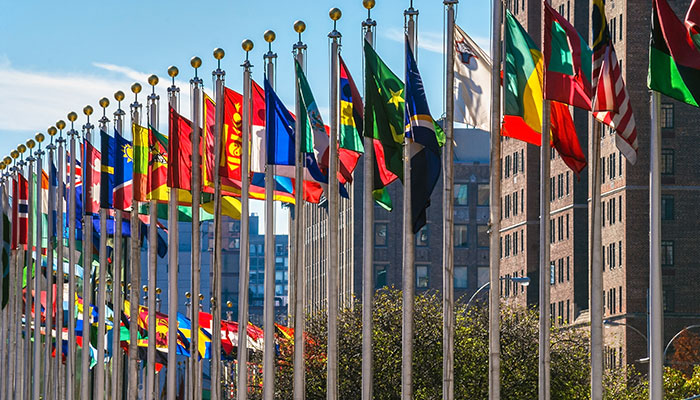
Still, the UN has faced tough times before – over many decades during the Cold War, the Security Council was crippled by deep tensions between the US and the Soviet Union. The UN is not as sidelined or divided today as it was then. However, as the relationship between China and the US sours, the achievements of global co-operation are being eroded.
The way in which people speak about the UN often implies a level of coherence and bureaucratic independence that the UN rarely possesses. A failure of the UN is normally better understood as a failure of international co-operation.
We see this recently in the UN’s inability to deal with crises from the ethnic cleansing of the Rohingya Muslims in Myanmar, to civil conflict in Syria, and the failure of the Security Council to adopt a COVID-19 resolution calling for ceasefires in conflict zones and a co-operative international response to the pandemic.
The UN administration is not primarily to blame for these failures; rather, the problem is the great powers – in the case of COVID-19, China and the US – refusing to co-operate.
Where states fail to agree, the UN is powerless to act.
Marking the 75th anniversary of the official formation of the UN, when 50 founding nations signed the UN Charter on June 26, 1945, we look at some of its key triumphs and resounding failures.
Five successes
1. Peacekeeping
The United Nations was created with the goal of being a collective security organisation. The UN Charter establishes that the use of force is only lawful either in self-defence or if authorised by the UN Security Council. The Security Council’s five permanent members, being China, US, UK, Russia and France, can veto any such resolution.
The UN’s consistent role in seeking to manage conflict is one of its greatest successes.
A key component of this role is peacekeeping. The UN under its second secretary-general, the Swedish statesman Dag Hammarskjöld – who was posthumously awarded the Nobel Peace prize after he died in a suspicious plane crash – created the concept of peacekeeping. Hammarskjöld was responding to the 1956 Suez Crisis, in which the US opposed the invasion of Egypt by its allies Israel, France and the UK.
UN peacekeeping missions involve the use of impartial and armed UN forces, drawn from member states, to stabilise fragile situations. “The essence of peacekeeping is the use of soldiers as a catalyst for peace rather than as the instruments of war,” said then UN Secretary-General Javier Pérez de Cuéllar, when the forces won the 1988 Nobel Peace Prize following missions in conflict zones in the Middle East, Africa, Asia, Central America and Europe.
However, peacekeeping also counts among the UN’s major failures.
2. Law of the Sea
Negotiated between 1973 and 1982, the UN Convention on the Law of the Sea (UNCLOS) set up the current international law of the seas. It defines states’ rights and creates concepts such as exclusive economic zones, as well as procedures for the settling of disputes, new arrangements for governing deep sea bed mining, and importantly, new provisions for the protection of marine resources and ocean conservation.
Mostly, countries have abided by the convention. There are various disputes that China has over the East and South China Seas which present a conflict between power and law, in that although UNCLOS creates mechanisms for resolving disputes, a powerful state isn’t necessarily going to submit to those mechanisms.
Secondly, on the conservation front, although UNCLOS is a huge step forward, it has failed to adequately protect oceans that are outside any state’s control. Ocean ecosystems have been dramatically transformed through overfishing. This is an ecological catastrophe that UNCLOS has slowed, but failed to address comprehensively.
3. Decolonisation
The idea of racial equality and of a people’s right to self-determination was discussed in the wake of World War I and rejected. After World War II, however, those principles were endorsed within the UN system, and the Trusteeship Council, which monitored the process of decolonisation, was one of the initial bodies of the UN.
Although many national independence movements only won liberation through bloody conflicts, the UN has overseen a process of decolonisation that has transformed international politics. In 1945, around one third of the world’s population lived under colonial rule. Today, there are less than 2 million people living in colonies.
When it comes to the world’s First Nations, however, the UN generally has done little to address their concerns, aside from the non-binding UN Declaration on the Rights of Indigenous Peoples of 2007.
4. Human rights
The Human Rights Declaration of 1948 for the first time set out fundamental human rights to be universally protected, recognising that the “inherent dignity and of the equal and inalienable rights of all members of the human family is the foundation of freedom, justice and peace in the world”.
Since 1948, 10 human rights treaties have been adopted – including conventions on the rights of children and migrant workers, and against torture and discrimination based on gender and race – each monitored by its own committee of independent experts.
The language of human rights has created a new framework for thinking about the relationship between the individual, the state and the international system. Although some people would prefer that political movements focus on ‘liberation’ rather than ‘rights’, the idea of human rights has made the individual person a focus of national and international attention.
5. Free trade
Depending on your politics, you might view the World Trade Organisation as a huge success, or a huge failure.
The WTO creates a near-binding system of international trade law with a clear and efficient dispute resolution process.
The majority Australian consensus is that the WTO is a success because it has been good for Australian famers especially, through its winding back of subsidies and tariffs.
However, the WTO enabled an era of globalisation which is now politically controversial.
Recently, the US has sought to disrupt the system. In addition to the trade war with China, the Trump Administration has also refused to appoint tribunal members to the WTO’s Appellate Body, so it has crippled the dispute resolution process. Of course, the Trump Administration is not the first to take issue with China’s trade strategies, which include subsidises for ‘State Owned Enterprises’ and demands that foreign firms transfer intellectual property in exchange for market access.
The existence of the UN has created a forum where nations can discuss new problems, and climate change is one of them. The Intergovernmental Panel on Climate Change (IPCC) was set up in 1988 to assess climate science and provide policymakers with assessments and options. In 1992, the UN Framework Convention on Climate Change created a permanent forum for negotiations.
However, despite an international scientific body in the IPCC, and 165 signatory nations to the climate treaty, global greenhouse gas emissions have continued to increase.
Under the Paris Agreement, even if every country meets its greenhouse gas emission targets we are still on track for ‘dangerous warming’. Yet, no major country is even on track to meet its targets; while emissions will probably decline this year as a result of COVID-19, atmospheric concentrations of greenhouse gases will still increase.
This illustrates a core conundrum of the UN in that it opens the possibility of global cooperation, but is unable to constrain states from pursuing their narrowly conceived self-interests. Deep co-operation remains challenging.
Five failures of the UN
1. Peacekeeping
During the Bosnian War, Dutch peacekeeping forces stationed in the town of Srebrenica, declared a ‘safe area’ by the UN in 1993, failed in 1995 to stop the massacre of more than 8000 Muslim men and boys by Bosnian Serb forces. This is one of the most widely discussed examples of the failures of international peacekeeping operations.
On the massacre’s 10th anniversary, then UN Secretary General Kofi Annan wrote that the UN had “made serious errors of judgement, rooted in a philosophy of impartiality”, contributing to a mass murder that would “haunt our history forever”.
If you look at some of the other infamous failures of peacekeeping missions – in places such as Rwanda, Somalia and Angola – it is the limited powers given to peacekeeping operations that have resulted in those failures.
2. The invasion of Iraq
The invasion of Iraq by the US in 2003, which was unlawful and without Security Council authorisation, reflects the fact that the UN is has very limited capacity to constrain the actions of great powers.
The Security Council designers created the veto power so that any of the five permanent members could reject a Council resolution, so in that way it is programmed to fail when a great power really wants to do something that the international community generally condemns.
In the case of the Iraq invasion, the US didn’t veto a resolution, but rather sought authorisation that it did not get. The UN, if you go by the idea of collective security, should have responded by defending Iraq against this unlawful use of force.
The invasion proved a humanitarian disaster with the loss of more than 400,000 lives, and many believe that it led to the emergence of the terrorist Islamic State.
3. Refugee crises
The UN brokered the 1951 Refugee Convention to address the plight of people displaced in Europe due to World War II; years later, the 1967 Protocol removed time and geographical restrictions so that the Convention can now apply universally (although many countries in Asia have refused to sign it, owing in part to its Eurocentric origins).
Despite these treaties, and the work of the UN High Commission for Refugees, there is somewhere between 30 and 40 million refugees, many of them, such as many Palestinians, living for decades outside their homelands. This is in addition to more than 40 million people displaced within their own countries.
While for a long time refugee numbers were reducing, in recent years, particularly driven by the Syrian conflict, there have been increases in the number of people being displaced.
During the COVID-19 crisis, boatloads of Rohingya refugees were turned away by port after port. This tragedy has echoes of pre-World War II when ships of Jewish refugees fleeing Nazi Germany were refused entry by multiple countries.
And as a catastrophe of a different kind looms, there is no international framework in place for responding to people who will be displaced by rising seas and other effects of climate change.
4. Conflicts without end
Across the world, there is a shopping list of unresolved civil conflicts and disputed territories.
Palestine and Kashmir are two of the longest-running failures of the UN to resolve disputed lands. More recent, ongoing conflicts include the civil wars in Syria and Yemen.
The common denominator of unresolved conflicts is either division among the great powers, or a lack of international interest due to the geopolitical stakes not being sufficiently high. For instance, the inaction during the Rwandan civil war in the 1990s was not due to a division among great powers, but rather a lack of political will to engage.
In Syria, by contrast, Russia and the US have opposing interests and back opposing sides: Russia backs the government of the Syrian dictator Bashar al-Assad, whereas the US does not.
5. Acting like it’s 1945
The UN is increasingly out of step with the reality of geopolitics today.
The permanent members of the Security Council reflect the division of power internationally at the end of World War II. The continuing exclusion of Germany, Japan, and rising powers such as India and Indonesia, reflects the failure to reflect the changing balance of power.
Also, bodies such as the IMF and the World Bank, which are part of the UN system, continue to be dominated by the West. In response, China has created potential rival institutions such as the Asian Infrastructure Investment Bank.
Western domination of UN institutions undermines their credibility. However, a more fundamental problem is that institutions designed in 1945 are a poor fit with the systemic global challenges – of which climate change is foremost – that we face today.