


Life has no meaning, purpose or value – Nihilism
If you’ve been online lately, you’ve probably seen the Nihilist Penguin. It’s a small, tired-looking penguin paired with captions like “Nothing matters” or “Why bother?” There’s no joke setup, no twist—just blunt honesty.
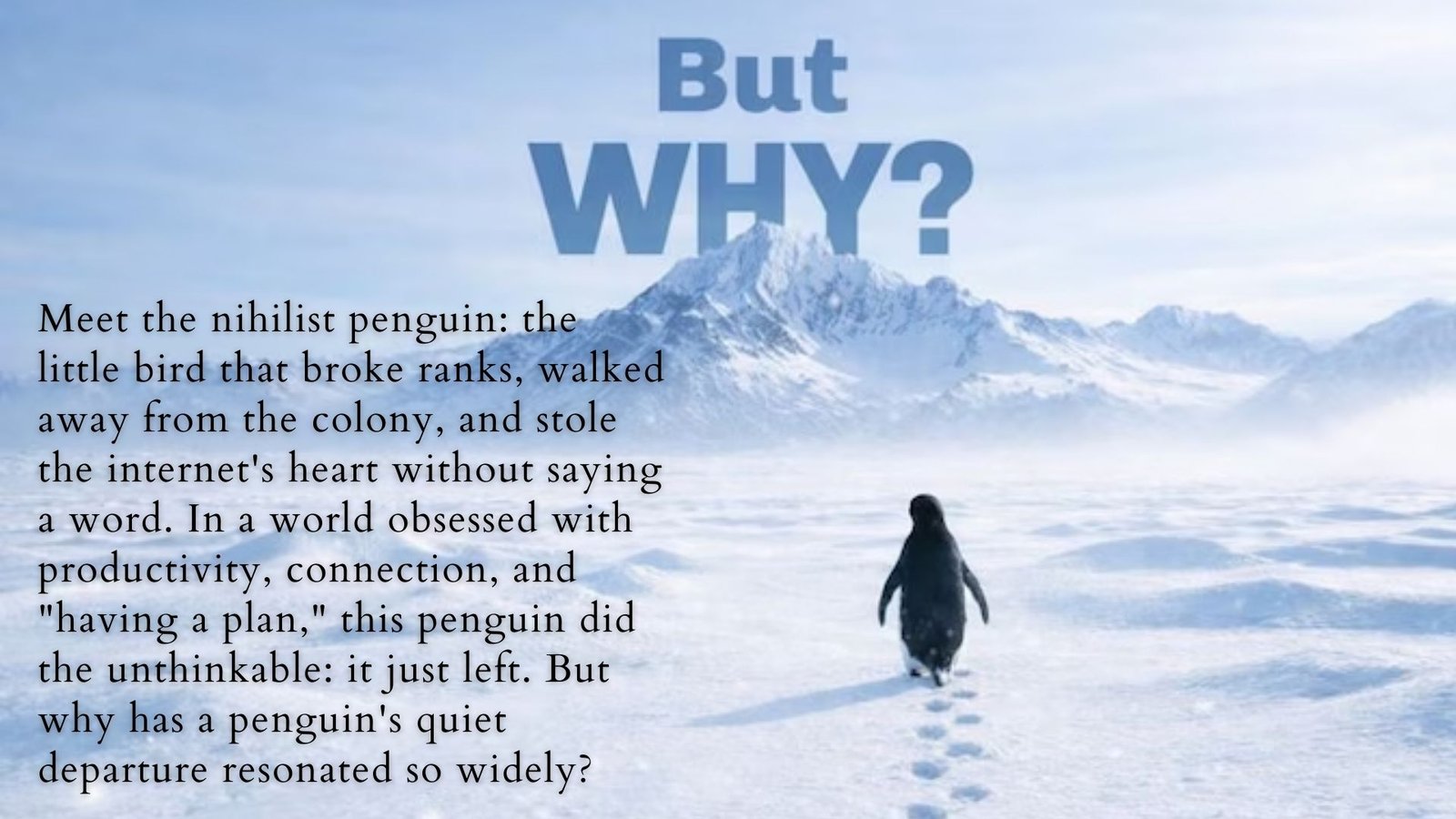
The penguin captures a feeling many people have today: exhaustion. Not dramatic sadness, not anger—just quiet resignation. In a world that constantly pushes motivation, success, and “finding your purpose,” the penguin does the opposite. It simply exists. And even that feels optional.
Behind this meme is a serious philosophical idea called nihilism.
What Is Nihilism?
Nihilism is a philosophy that says life has no inherent meaning. According to nihilism, there is no built-in purpose to existence, no absolute truth, and no universal moral values.
The word comes from the Latin nihil, meaning nothing. As a philosophical idea, nihilism developed in Europe in the 19th and 20th centuries, especially during times when traditional beliefs—religion, morality, social order—were being questioned.
At its core, nihilism isn’t about sadness. It’s about emptiness.
Basic Ideas of Nihilism
Most forms of nihilism share a few core ideas:
1. Existence is useless
There is no ultimate reason for living or believing in anything.
2. There is no truth
Truth, like morality, is not fixed or universal.
3. Everything is meaningless
Life, values, goals, and even the idea of “meaning” itself have no objective value.
Thinkers Who Wrote About Nihilism
Several major thinkers explored or reacted to nihilism:
-
Friedrich Jacobi: Buddhism first references the concept of nihilism, and Socrates even discussed the topic as well. However, the first person to coin the term nihilism was Friedrich Jacobi. He equated it to rationalism and how all rationalism will become nihilistic. Jacobi felt that this went against the concept of God. .
-
Søren Kierkegaard: strongly opposed nihilism, arguing that life does have meaning and that nihilism erases individuality.
-
Ivan Turgenev: Russian nihilism became a form of political nihilism in Russia because of a cultural movement in the country from 1860–1917. The Russian Ivan Turgenev referenced nihilism in the novel Fathers and Sons, which he published in 1862. In it, the main character of the book, Yevgeny Bazarov, states that he is a nihilist and shuns all societal norms. Fathers and Sons created a movement of nihilists.
-
Friedrich Nietzsche: A German philosopher who lived during the nineteenth century, Friedrich Nietzsche associated nihilism and nihilistic tendencies with Western culture. His point of view on nihilism was that it took away any inherent meaning from human beings. His work often discussed Christianity and problems related to moral nihilism. He believed Western society was moving toward nihilism after losing belief in God and traditional values. His famous line “God is dead” was a warning, not a celebration.
-
Albert Camus explored similar ideas through absurdism, asking how humans should live in a meaningless universe.
Different Types of Nihilism
Nihilism appears in different forms:
-
Epistemological nihilism: True knowledge does not exist—or cannot be known.
-
Ethical nihilism: There are no moral rules or ethical standards.
-
Existential nihilism: Life has no meaning or value.
-
Passive nihilism: Accepting meaninglessness without trying to change it.
-
Political nihilism: Rejecting all political systems and institutions.
The Nihilist Penguin fits best with passive nihilism—no rebellion, no solutions, just acceptance.
Why the Nihilist Penguin Feels So Real
The penguin isn’t popular because people truly believe nothing matters. It’s popular because people are tired of being told that everything must matter all the time.
The meme doesn’t motivate you.
It doesn’t inspire you.
It doesn’t sell hope.
It just says what many people are quietly thinking—and sometimes, that honesty feels like relief.
In a strange way, the Nihilist Penguin doesn’t make life emptier. It simply stops pretending that meaning is easy.