


Life has no meaning, purpose or value – Nihilism
If you’ve been online lately, you’ve probably seen the Nihilist Penguin. It’s a small, tired-looking penguin paired with captions like “Nothing matters” or “Why bother?” There’s no joke setup, no twist—just blunt honesty.
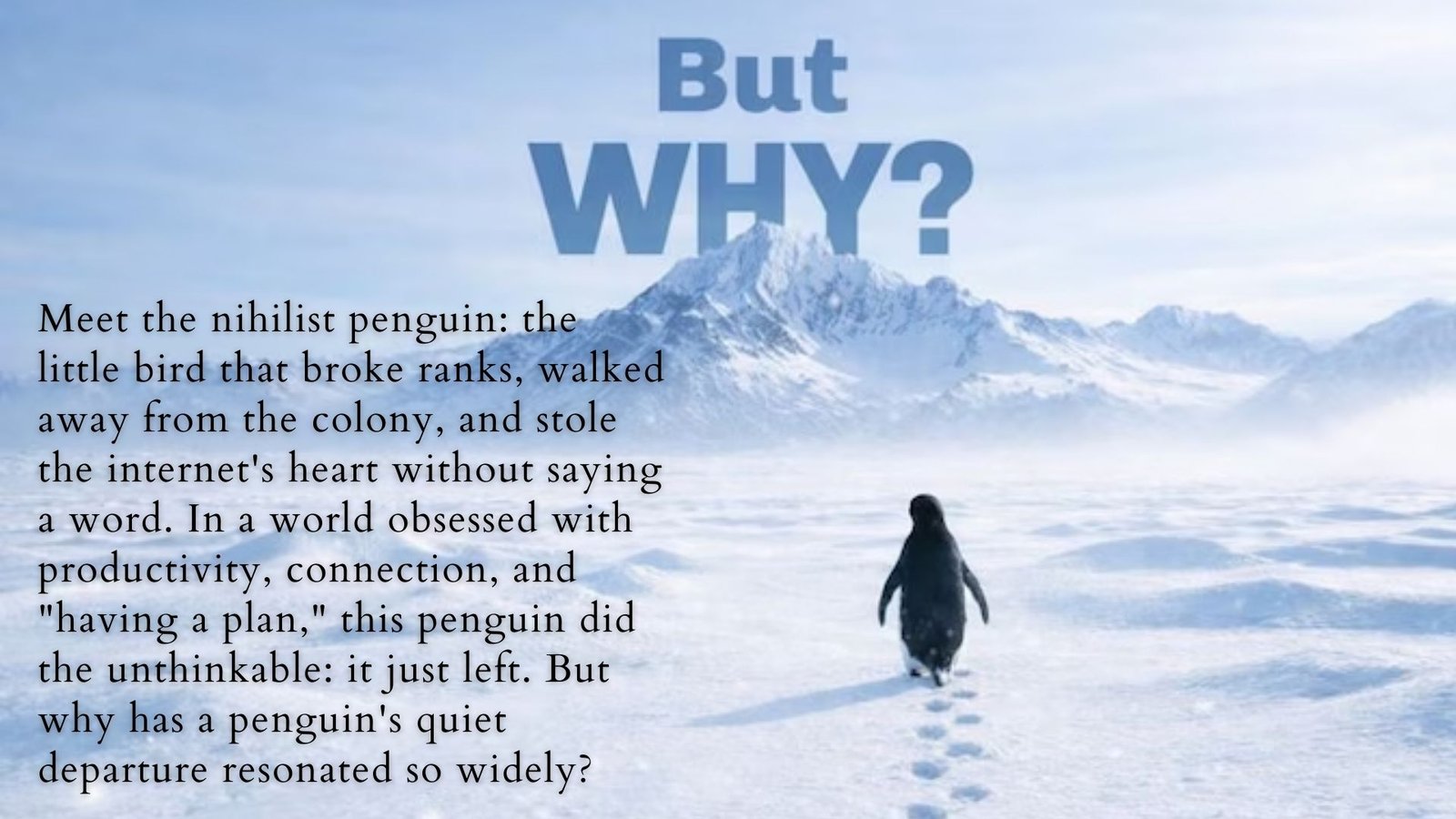
The penguin captures a feeling many people have today: exhaustion. Not dramatic sadness, not anger—just quiet resignation. In a world that constantly pushes motivation, success, and “finding your purpose,” the penguin does the opposite. It simply exists. And even that feels optional.
Behind this meme is a serious philosophical idea called nihilism.
What Is Nihilism?
Nihilism is a philosophy that says life has no inherent meaning. According to nihilism, there is no built-in purpose to existence, no absolute truth, and no universal moral values.
The word comes from the Latin nihil, meaning nothing. As a philosophical idea, nihilism developed in Europe in the 19th and 20th centuries, especially during times when traditional beliefs—religion, morality, social order—were being questioned.
At its core, nihilism isn’t about sadness. It’s about emptiness.
Basic Ideas of Nihilism
Most forms of nihilism share a few core ideas:
1. Existence is useless
There is no ultimate reason for living or believing in anything.
2. There is no truth
Truth, like morality, is not fixed or universal.
3. Everything is meaningless
Life, values, goals, and even the idea of “meaning” itself have no objective value.
Thinkers Who Wrote About Nihilism
Several major thinkers explored or reacted to nihilism:
-
Friedrich Jacobi: Buddhism first references the concept of nihilism, and Socrates even discussed the topic as well. However, the first person to coin the term nihilism was Friedrich Jacobi. He equated it to rationalism and how all rationalism will become nihilistic. Jacobi felt that this went against the concept of God. .
-
Søren Kierkegaard: strongly opposed nihilism, arguing that life does have meaning and that nihilism erases individuality.
-
Ivan Turgenev: Russian nihilism became a form of political nihilism in Russia because of a cultural movement in the country from 1860–1917. The Russian Ivan Turgenev referenced nihilism in the novel Fathers and Sons, which he published in 1862. In it, the main character of the book, Yevgeny Bazarov, states that he is a nihilist and shuns all societal norms. Fathers and Sons created a movement of nihilists.
-
Friedrich Nietzsche: A German philosopher who lived during the nineteenth century, Friedrich Nietzsche associated nihilism and nihilistic tendencies with Western culture. His point of view on nihilism was that it took away any inherent meaning from human beings. His work often discussed Christianity and problems related to moral nihilism. He believed Western society was moving toward nihilism after losing belief in God and traditional values. His famous line “God is dead” was a warning, not a celebration.
-
Albert Camus explored similar ideas through absurdism, asking how humans should live in a meaningless universe.
Different Types of Nihilism
Nihilism appears in different forms:
-
Epistemological nihilism: True knowledge does not exist—or cannot be known.
-
Ethical nihilism: There are no moral rules or ethical standards.
-
Existential nihilism: Life has no meaning or value.
-
Passive nihilism: Accepting meaninglessness without trying to change it.
-
Political nihilism: Rejecting all political systems and institutions.
The Nihilist Penguin fits best with passive nihilism—no rebellion, no solutions, just acceptance.
Why the Nihilist Penguin Feels So Real
The penguin isn’t popular because people truly believe nothing matters. It’s popular because people are tired of being told that everything must matter all the time.
The meme doesn’t motivate you.
It doesn’t inspire you.
It doesn’t sell hope.
It just says what many people are quietly thinking—and sometimes, that honesty feels like relief.
In a strange way, the Nihilist Penguin doesn’t make life emptier. It simply stops pretending that meaning is easy.
Receive Daily Updates
Recent Posts
Steve Ovett, the famous British middle-distance athlete, won the 800-metres gold medal at the Moscow Olympics of 1980. Just a few days later, he was about to win a 5,000-metres race at London’s Crystal Palace. Known for his burst of acceleration on the home stretch, he had supreme confidence in his ability to out-sprint rivals. With the final 100 metres remaining,
[wptelegram-join-channel link=”https://t.me/s/upsctree” text=”Join @upsctree on Telegram”]Ovett waved to the crowd and raised a hand in triumph. But he had celebrated a bit too early. At the finishing line, Ireland’s John Treacy edged past Ovett. For those few moments, Ovett had lost his sense of reality and ignored the possibility of a negative event.
This analogy works well for the India story and our policy failures , including during the ongoing covid pandemic. While we have never been as well prepared or had significant successes in terms of growth stability as Ovett did in his illustrious running career, we tend to celebrate too early. Indeed, we have done so many times before.
It is as if we’re convinced that India is destined for greater heights, come what may, and so we never run through the finish line. Do we and our policymakers suffer from a collective optimism bias, which, as the Nobel Prize winner Daniel Kahneman once wrote, “may well be the most significant of the cognitive biases”? The optimism bias arises from mistaken beliefs which form expectations that are better than the reality. It makes us underestimate chances of a negative outcome and ignore warnings repeatedly.
The Indian economy had a dream run for five years from 2003-04 to 2007-08, with an average annual growth rate of around 9%. Many believed that India was on its way to clocking consistent double-digit growth and comparisons with China were rife. It was conveniently overlooked that this output expansion had come mainly came from a few sectors: automobiles, telecom and business services.
Indians were made to believe that we could sprint without high-quality education, healthcare, infrastructure or banking sectors, which form the backbone of any stable economy. The plan was to build them as we went along, but then in the euphoria of short-term success, it got lost.
India’s exports of goods grew from $20 billion in 1990-91 to over $310 billion in 2019-20. Looking at these absolute figures it would seem as if India has arrived on the world stage. However, India’s share of global trade has moved up only marginally. Even now, the country accounts for less than 2% of the world’s goods exports.
More importantly, hidden behind this performance was the role played by one sector that should have never made it to India’s list of exports—refined petroleum. The share of refined petroleum exports in India’s goods exports increased from 1.4% in 1996-97 to over 18% in 2011-12.
An import-intensive sector with low labour intensity, exports of refined petroleum zoomed because of the then policy regime of a retail price ceiling on petroleum products in the domestic market. While we have done well in the export of services, our share is still less than 4% of world exports.
India seemed to emerge from the 2008 global financial crisis relatively unscathed. But, a temporary demand push had played a role in the revival—the incomes of many households, both rural and urban, had shot up. Fiscal stimulus to the rural economy and implementation of the Sixth Pay Commission scales had led to the salaries of around 20% of organized-sector employees jumping up. We celebrated, but once again, neither did we resolve the crisis brewing elsewhere in India’s banking sector, nor did we improve our capacity for healthcare or quality education.
Employment saw little economy-wide growth in our boom years. Manufacturing jobs, if anything, shrank. But we continued to celebrate. Youth flocked to low-productivity service-sector jobs, such as those in hotels and restaurants, security and other services. The dependence on such jobs on one hand and high-skilled services on the other was bound to make Indian society more unequal.
And then, there is agriculture, an elephant in the room. If and when farm-sector reforms get implemented, celebrations would once again be premature. The vast majority of India’s farmers have small plots of land, and though these farms are at least as productive as larger ones, net absolute incomes from small plots can only be meagre.
A further rise in farm productivity and consequent increase in supply, if not matched by a demand rise, especially with access to export markets, would result in downward pressure on market prices for farm produce and a further decline in the net incomes of small farmers.
We should learn from what John Treacy did right. He didn’t give up, and pushed for the finish line like it was his only chance at winning. Treacy had years of long-distance practice. The same goes for our economy. A long grind is required to build up its base before we can win and celebrate. And Ovett did not blame anyone for his loss. We play the blame game. Everyone else, right from China and the US to ‘greedy corporates’, seems to be responsible for our failures.
We have lowered absolute poverty levels and had technology-based successes like Aadhaar and digital access to public services. But there are no short cuts to good quality and adequate healthcare and education services. We must remain optimistic but stay firmly away from the optimism bias.
In the end, it is not about how we start, but how we finish. The disastrous second wave of covid and our inability to manage it is a ghastly reminder of this fact.