


The Views of Mill and Spencer:-
This dream of social reform and the building of a more ideal society was basic to the thinking of JOHN STUART MILL also. He believed that the phenomena of social living conformed to fixed laws just as other phenomena do. However, he recognized that the factors involved in society are so numerous and are changing so constantly that prediction is impossible.
[wptelegram-join-channel link=”https://t.me/s/upsctree” text=”Join @upsctree on Telegram”]
Thus, the methods of study used in other sciences, those of the laboratory, are not applicable to a study of society. By the method of deduction from many instances we can see tendencies in human social development and can point to them as guides to activity, he taught.
Believing this to be true, Mill held that the task of the social scientists was to investigate social groups to discover how the different forms of society develop and follow each other. Thus, by a study of history we can discover the laws of social progress and development.Then we can point to tendencies in the present social structure and predict that there is a high degree of probability that certain social results can be expected. For example, a study of ancient civilizations will show the reasons for their fall. The historian can point to factors in the social structure which contributed to the downfall of the civilization. Then, if an examination of a present society reveals the same factors as present and operating, it can be predicted with a degree of probability that that society will also fall.
Mill, as many of his predecessors, recognized that social well-being was necessary for individual well-being, that the individual was tied up with the group and that his happiness was dependent upon the status of the group. Thus, he dreamed of a society in which the happiness and prosperity of all was certain, and in which all would share the wealth of the group.
In his Autobiography he wrote, “While we repudiated with the greatest energy that tyranny of society over the individual which most Socialistic systems are supposed to involve, we yet looked forward to a time when society will no longer be divided into the idle and the industrious; when the rule that they who do not work shall not eat will be applied not to paupers only, but impartially to all; when the division of the produce of labor, instead of depending, as in so great a degree it now does, on the accident of birth, will be made by concert on an acknowledged principle of justice; and when it will no longer either be, or be thought to be, impossible for human beings to exert themselves strenuously in procuring benefits which are not to be exclusively their own, but to be shared with the society they belong to.
The social problem of the future, we considered to be: how to unite the greatest individual liberty of action, with a common ownership in the raw material of the globe, and an equal participation of all in the benefits of combined labor. Mill was struggling here with a problem that seems to have become more and more clear since his day: the problem of undeserved poverty and equally undeserved wealth.
Society, as he understood it, exists for the good of all individual members. Therefore, each must have freedom to work and be rewarded for his effort But, the raw materials of the world cannot be the exclusive possession of a few. These belong to all, and must be held by society as the representative of a;ll. Mill believed that a time would come when such would be the case and when society could guarantee economic freedom to all/
HERBERT SPENCER accepted the doctrine that each individual had the right to preserve himself. Indeed, he saw in nature a struggle in which the fittest survived and the less fit perished. Thus, men must be free to struggle and prove their fitness to survive. But, the survival of the fittest among human individuals depends, he argued, upon group life. Isolated from his fellows, even the fittest of men would perish. Therefore society is essential. This necessitates a course of activity in which each individual is restricted by the rights of others.
One may do what he wills in this struggle, but he must not violate the freedom of others. Everyone has the right to act to a certain limit, but no further. However, Spencer would not accept the socialistic thesis of Mill. For him, the state is greatly restricted. Its chief functions are to prevent internal aggression and to protect its members from foreign invasion. Beyond this it cannot go. To own the raw materials of the world and distribute them for the good of all was not a function of the state, to his thinking. In this direction he saw only danger, the danger of complete state control and the inevitable suppression of the individual. Competition among the members of society was to be permitted and encouraged. He believed that society, and the welfare of each individual, was better served by the establishment of as few restrictions upon competition as possible. In this, Spencer was an advocate of the laissez-faire theory. The best life, he taught, was one lived with only a minimum of regulation by the state.
Nietzsche’s Conception of the State:-
FRIEDRICH NIETZSCHE had no use for equality or anything that suggested democracy. The will to power is his dominant idea. In the struggle of the universe, this will to power is expressed; and the most powerful wins and has the right to win. If others are weaker and are unable to survive, that is good. The weak should be destroyed anyhow to make room for the strong. He recognizes differences among men and believes that these differences should be magnified.
The more powerful should rule, and the weaker should be ruled. Slavery seems perfectly natural to him; and he feels that women, being weaker than men, cannot be expected to have the same rights as men. Thus, he repudiates all that has been held by that long line of philosophers whose constant theme has been the equality of all men and the right of all to share equally in the goods of society. For Nietzsche, society is merely a field in which the strong have a chance to demonstrate their strength and win their rewards, while the weak are defeated and dragged from the arena to be disposed of completely. Since inequality is characteristic of nature and the natural state of man, it is unnatural to replace it with a forced equality.
The Views of Dewey and Recent Thinkers:-
JOHN DEWEY has shown at all times a strong interest in society and its problems. He constantly attempts to interpret the modern democratic point of view, to reveal its implications, and to forecast its future. He thinks of society, at its best, as a group of individuals sharing their experiences and growing through this sharing. The individual is to be free, but this freedom is not to be that of the older tradition.
As the individual becomes a true member of society he is incorporated into the group in such a way that he can contribute to the welfare of the whole and receive from the whole that which makes him truly human. At all times Dewey recognizes the importance of the individual. He holds that no one should ever be treated as an instrument, as a means to some goal that is not his. Rather, each one should be treated as an end in himself. “Respect for human personality is the chief doctrine of his philosophy.
This is, perhaps, the only absolute known to Dewey and his school of thought Man, Dewey holds, is man because he lives in society. To the extent that his activities in the group lead on to richer and more rewarding activities for him and for all members of the group, he is acting wisely and truly. Society, group life, is the way to this complete and full life since here mutual sharing is possible.
Thus, we may say that two points of view are basic to the great mass of recent writing which deals with matters of the state. On the one hand are those who follow more or less completely the lead of men from Plato to Nietzsche and hold that inequality is the natural state of man. This being the case, each member of the state must take his proper place in the social structure. It is perfectly right and natural, these men argue, that some should be rulers and others should be ruled, and the ruled should not question the acts of the rulers.
Such writers spurn democracy, socialism, and all other systems of human equality and freedom. Plato saw democracy as the open door to anarchy. He would have the philosopher-king rule, and all others take their places in a tightly organized system.
Hegel carried this idea one step further when he held that certain states or groups of individuals were by nature superior to others and therefore should rule them. This, of course, is the basic point of view of all totalitarian systems of government.
Opposed to this entire trend is the democratic tradition which grew out of the Renaissance and came to fruition in the work of men like Locke, Rousseau, and their followers. It holds that all men are by nature free and equal/ This position is basic to the French Revolution and the American Declaration of Independence and Constitution.
It affirms that there are certain rights with which all men are endowed by their Creator, and which cannot be taken away from them under any conditions. These rights have been listed in many ways, chief of which is “life, liberty, and the pursuit of happiness.’* This position led to the influential doctrine of laissez faire, a doctrine which characterized the early years of development in the United States. It limited the authority of the state and magnified the freedom of the individual to work and hold the rewards of his work.
Today philosophers are seeking to discover a balance between these two positions. Complete freedom leads to a crass individualism in which the powerful oppress the weak. Complete regulation leads to the same end, but the oppressors are those who happen to gain control of the government. Dewey—and many modern thinkers agree in this— seeks a freedom within the social group by which both the individual and the group will prosper. A great many of the social experiments of the present are in this direction, seeking to balance individual interests and group interests in such a way that both will be served and neither sacrificed to the other.
Receive Daily Updates
Recent Posts
The United Nations has shaped so much of global co-operation and regulation that we wouldn’t recognise our world today without the UN’s pervasive role in it. So many small details of our lives – such as postage and copyright laws – are subject to international co-operation nurtured by the UN.
In its 75th year, however, the UN is in a difficult moment as the world faces climate crisis, a global pandemic, great power competition, trade wars, economic depression and a wider breakdown in international co-operation.
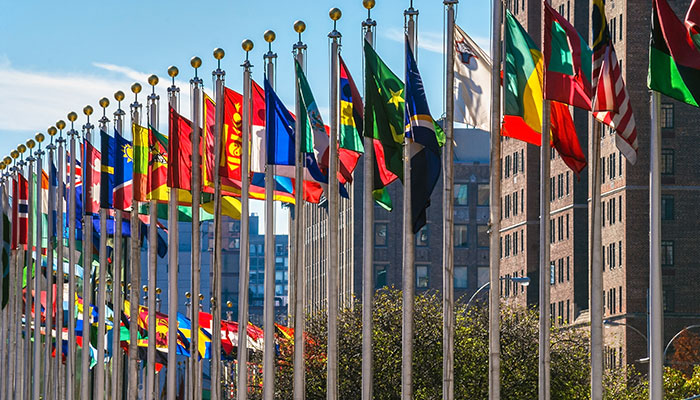
Still, the UN has faced tough times before – over many decades during the Cold War, the Security Council was crippled by deep tensions between the US and the Soviet Union. The UN is not as sidelined or divided today as it was then. However, as the relationship between China and the US sours, the achievements of global co-operation are being eroded.
The way in which people speak about the UN often implies a level of coherence and bureaucratic independence that the UN rarely possesses. A failure of the UN is normally better understood as a failure of international co-operation.
We see this recently in the UN’s inability to deal with crises from the ethnic cleansing of the Rohingya Muslims in Myanmar, to civil conflict in Syria, and the failure of the Security Council to adopt a COVID-19 resolution calling for ceasefires in conflict zones and a co-operative international response to the pandemic.
The UN administration is not primarily to blame for these failures; rather, the problem is the great powers – in the case of COVID-19, China and the US – refusing to co-operate.
Where states fail to agree, the UN is powerless to act.
Marking the 75th anniversary of the official formation of the UN, when 50 founding nations signed the UN Charter on June 26, 1945, we look at some of its key triumphs and resounding failures.
Five successes
1. Peacekeeping
The United Nations was created with the goal of being a collective security organisation. The UN Charter establishes that the use of force is only lawful either in self-defence or if authorised by the UN Security Council. The Security Council’s five permanent members, being China, US, UK, Russia and France, can veto any such resolution.
The UN’s consistent role in seeking to manage conflict is one of its greatest successes.
A key component of this role is peacekeeping. The UN under its second secretary-general, the Swedish statesman Dag Hammarskjöld – who was posthumously awarded the Nobel Peace prize after he died in a suspicious plane crash – created the concept of peacekeeping. Hammarskjöld was responding to the 1956 Suez Crisis, in which the US opposed the invasion of Egypt by its allies Israel, France and the UK.
UN peacekeeping missions involve the use of impartial and armed UN forces, drawn from member states, to stabilise fragile situations. “The essence of peacekeeping is the use of soldiers as a catalyst for peace rather than as the instruments of war,” said then UN Secretary-General Javier Pérez de Cuéllar, when the forces won the 1988 Nobel Peace Prize following missions in conflict zones in the Middle East, Africa, Asia, Central America and Europe.
However, peacekeeping also counts among the UN’s major failures.
2. Law of the Sea
Negotiated between 1973 and 1982, the UN Convention on the Law of the Sea (UNCLOS) set up the current international law of the seas. It defines states’ rights and creates concepts such as exclusive economic zones, as well as procedures for the settling of disputes, new arrangements for governing deep sea bed mining, and importantly, new provisions for the protection of marine resources and ocean conservation.
Mostly, countries have abided by the convention. There are various disputes that China has over the East and South China Seas which present a conflict between power and law, in that although UNCLOS creates mechanisms for resolving disputes, a powerful state isn’t necessarily going to submit to those mechanisms.
Secondly, on the conservation front, although UNCLOS is a huge step forward, it has failed to adequately protect oceans that are outside any state’s control. Ocean ecosystems have been dramatically transformed through overfishing. This is an ecological catastrophe that UNCLOS has slowed, but failed to address comprehensively.
3. Decolonisation
The idea of racial equality and of a people’s right to self-determination was discussed in the wake of World War I and rejected. After World War II, however, those principles were endorsed within the UN system, and the Trusteeship Council, which monitored the process of decolonisation, was one of the initial bodies of the UN.
Although many national independence movements only won liberation through bloody conflicts, the UN has overseen a process of decolonisation that has transformed international politics. In 1945, around one third of the world’s population lived under colonial rule. Today, there are less than 2 million people living in colonies.
When it comes to the world’s First Nations, however, the UN generally has done little to address their concerns, aside from the non-binding UN Declaration on the Rights of Indigenous Peoples of 2007.
4. Human rights
The Human Rights Declaration of 1948 for the first time set out fundamental human rights to be universally protected, recognising that the “inherent dignity and of the equal and inalienable rights of all members of the human family is the foundation of freedom, justice and peace in the world”.
Since 1948, 10 human rights treaties have been adopted – including conventions on the rights of children and migrant workers, and against torture and discrimination based on gender and race – each monitored by its own committee of independent experts.
The language of human rights has created a new framework for thinking about the relationship between the individual, the state and the international system. Although some people would prefer that political movements focus on ‘liberation’ rather than ‘rights’, the idea of human rights has made the individual person a focus of national and international attention.
5. Free trade
Depending on your politics, you might view the World Trade Organisation as a huge success, or a huge failure.
The WTO creates a near-binding system of international trade law with a clear and efficient dispute resolution process.
The majority Australian consensus is that the WTO is a success because it has been good for Australian famers especially, through its winding back of subsidies and tariffs.
However, the WTO enabled an era of globalisation which is now politically controversial.
Recently, the US has sought to disrupt the system. In addition to the trade war with China, the Trump Administration has also refused to appoint tribunal members to the WTO’s Appellate Body, so it has crippled the dispute resolution process. Of course, the Trump Administration is not the first to take issue with China’s trade strategies, which include subsidises for ‘State Owned Enterprises’ and demands that foreign firms transfer intellectual property in exchange for market access.
The existence of the UN has created a forum where nations can discuss new problems, and climate change is one of them. The Intergovernmental Panel on Climate Change (IPCC) was set up in 1988 to assess climate science and provide policymakers with assessments and options. In 1992, the UN Framework Convention on Climate Change created a permanent forum for negotiations.
However, despite an international scientific body in the IPCC, and 165 signatory nations to the climate treaty, global greenhouse gas emissions have continued to increase.
Under the Paris Agreement, even if every country meets its greenhouse gas emission targets we are still on track for ‘dangerous warming’. Yet, no major country is even on track to meet its targets; while emissions will probably decline this year as a result of COVID-19, atmospheric concentrations of greenhouse gases will still increase.
This illustrates a core conundrum of the UN in that it opens the possibility of global cooperation, but is unable to constrain states from pursuing their narrowly conceived self-interests. Deep co-operation remains challenging.
Five failures of the UN
1. Peacekeeping
During the Bosnian War, Dutch peacekeeping forces stationed in the town of Srebrenica, declared a ‘safe area’ by the UN in 1993, failed in 1995 to stop the massacre of more than 8000 Muslim men and boys by Bosnian Serb forces. This is one of the most widely discussed examples of the failures of international peacekeeping operations.
On the massacre’s 10th anniversary, then UN Secretary General Kofi Annan wrote that the UN had “made serious errors of judgement, rooted in a philosophy of impartiality”, contributing to a mass murder that would “haunt our history forever”.
If you look at some of the other infamous failures of peacekeeping missions – in places such as Rwanda, Somalia and Angola – it is the limited powers given to peacekeeping operations that have resulted in those failures.
2. The invasion of Iraq
The invasion of Iraq by the US in 2003, which was unlawful and without Security Council authorisation, reflects the fact that the UN is has very limited capacity to constrain the actions of great powers.
The Security Council designers created the veto power so that any of the five permanent members could reject a Council resolution, so in that way it is programmed to fail when a great power really wants to do something that the international community generally condemns.
In the case of the Iraq invasion, the US didn’t veto a resolution, but rather sought authorisation that it did not get. The UN, if you go by the idea of collective security, should have responded by defending Iraq against this unlawful use of force.
The invasion proved a humanitarian disaster with the loss of more than 400,000 lives, and many believe that it led to the emergence of the terrorist Islamic State.
3. Refugee crises
The UN brokered the 1951 Refugee Convention to address the plight of people displaced in Europe due to World War II; years later, the 1967 Protocol removed time and geographical restrictions so that the Convention can now apply universally (although many countries in Asia have refused to sign it, owing in part to its Eurocentric origins).
Despite these treaties, and the work of the UN High Commission for Refugees, there is somewhere between 30 and 40 million refugees, many of them, such as many Palestinians, living for decades outside their homelands. This is in addition to more than 40 million people displaced within their own countries.
While for a long time refugee numbers were reducing, in recent years, particularly driven by the Syrian conflict, there have been increases in the number of people being displaced.
During the COVID-19 crisis, boatloads of Rohingya refugees were turned away by port after port. This tragedy has echoes of pre-World War II when ships of Jewish refugees fleeing Nazi Germany were refused entry by multiple countries.
And as a catastrophe of a different kind looms, there is no international framework in place for responding to people who will be displaced by rising seas and other effects of climate change.
4. Conflicts without end
Across the world, there is a shopping list of unresolved civil conflicts and disputed territories.
Palestine and Kashmir are two of the longest-running failures of the UN to resolve disputed lands. More recent, ongoing conflicts include the civil wars in Syria and Yemen.
The common denominator of unresolved conflicts is either division among the great powers, or a lack of international interest due to the geopolitical stakes not being sufficiently high. For instance, the inaction during the Rwandan civil war in the 1990s was not due to a division among great powers, but rather a lack of political will to engage.
In Syria, by contrast, Russia and the US have opposing interests and back opposing sides: Russia backs the government of the Syrian dictator Bashar al-Assad, whereas the US does not.
5. Acting like it’s 1945
The UN is increasingly out of step with the reality of geopolitics today.
The permanent members of the Security Council reflect the division of power internationally at the end of World War II. The continuing exclusion of Germany, Japan, and rising powers such as India and Indonesia, reflects the failure to reflect the changing balance of power.
Also, bodies such as the IMF and the World Bank, which are part of the UN system, continue to be dominated by the West. In response, China has created potential rival institutions such as the Asian Infrastructure Investment Bank.
Western domination of UN institutions undermines their credibility. However, a more fundamental problem is that institutions designed in 1945 are a poor fit with the systemic global challenges – of which climate change is foremost – that we face today.