Drought:-

  • Drought is one of the most frequently occurring national disasters in India. With its increased frequency and expanded coverage in the recent years, about one third of the
    country is either drought prone or under desert areas.
  • These areas are lagging behind in agriculture and also in overall economic growth. They experience wide year-to-year fluctuations in agricultural production and incomes and  have a relatively high incidence of poverty.
  • The poor in these regions are highly vulnerable to a variety of risks due to their low and fluctuating incomes, high indebtedness and low human development. Helping the poor to come out of vulnerability and poverty and integrating the drought prone areas into the mainstream of development is a serious challenge faced by policy makers at present.

The History of Drought in India:-

  • Droughts and famines have received attention of rulers in India right from the 13th and 14th century.
  • Muhammad Tughlakh was perhaps the first Sultan to take systematic steps to alleviate efforts of droughts by distributing grains to drought affected people in Delhi in 1343 AD.
  • This approach was followed and improved upon by Mughals and many other kings and rulers later on.
  • During the British period also efforts were made to provide relief to droughts / famine affected people by organizing relief works and food distribution, distribution of fodder, loans to farmers to start cultivation in the next season etc.The first Scarcity Manual was prepared by the British Government in 1883, which was followed by other manuals by some provincial governments.
  • The Royal Commission on Agriculture in 1928 recommended promotion of dry land farming to promote agriculture in famine affected regions. However, the efforts were
    scanty and there was an alarming increase in the frequency of during the British period.

After Independence government has adopted a three pronged strategy to face droughts:

(1) providing relief to drought hit population under scarcity relief programmes

(2) designing special area development programme for drought prone areas and desert areas (DPAP – drought prone area programme and DDP – desert development programme) and

(3) promoting dry farming agriculture as a part of agricultural policy.

Somehow this approach has not worked very well, as is evident from the increasing drought prone areas in the country and the relatively high poverty and vulnerability of
people living in these areas.The new opportunities of globalization are likely to bypass these regions if adequate steps are not taken to integrate them into the mainstream economy.

Long term impacts of drought :-

  • Its long term impact on agriculture in terms of farmers’ adjustment to uncertain rainfall and uncertain agricultural prospects
  • poor performance of agriculture and of the overall economy
  • impact on environmental resources like water, forest, land etc and biodiversity including damages to animal and plant species, which tend to raise the frequency
    and intensity of droughts in the long run and which affect the life and livelihood of people adversely.
  • income poverty, vulnerability, and human poverty, which tend to raise the incidence of chronic poverty and of vulnerability of the poor.

What is Drought :-

According to IMD (Indian Meteorological Department) drought is a situation when the rainfall is less than 25 percent of the normal rainfall. The meteorological definition,
however, need not coincide with the hydrological or agricultural definition of drought.

Hydrological drought: Hydrological drought is a situation when the surface and ground water levels fall below the average levels and are affected not only by precipitation but also by infiltration and evaporation. Hydrological dimension of drought refers to the water distribution on land surface after precipitation has reached the ground. Major
indicators of hydrological drought are low reservoir storage, inadequate stream flows, aggregate runoff less than long term average runoff and precipitation at high elevation. Its
frequency is defined on the basis of its influence on river basin: SWSI (surface water supply index) is mostly used to measure hydrological drought.

Agricultural drought: Agricultural drought refers to shortage of water for crop growth or consistently high soil moisture deficiency over the growing season. Major indicators of agricultural drought are shortage of precipitation – departure from the normal, abnormal evaporation, deficiency of sub-soil moisture etc. Its intensity depends on the difference.between plants water demand and water availability. Crop moisture index (CMI) is used to measure agricultural drought.

Ecological drought: Ecological drought occurs when primary productivity of natural or (managed) ecosystem declines significantly owing to reduced precipitation. Socioeconomic drought incorporates features of all the above types of droughts. It occurs when precipitation is not sufficient to meet needs of human activities.

Socio-economic droughts are the aggregate of all the above droughts when precipitation is not adequate to meet the needs of human activities.

Though meteorological drought is mainly a natural phenomenon, a natural disaster, the intensity of its impact on hydrological, agricultural and ecological droughts can be
reduced by appropriate interventions, which, in turn, can also impact on socio-economic droughts. The crux of drought policy is to reduce this impact so as to reduce the adverse
impact of droughts on human well-being. The impact of droughts varies with the time scale of droughts. The longer the period of drought and the larger the number of
consecutive droughts, the greater will be its impact on agriculture, ecology and economy. The regions, which are subjected to frequent droughts, therefore need careful attention of policy makers.

Drought Prone areas of India:-
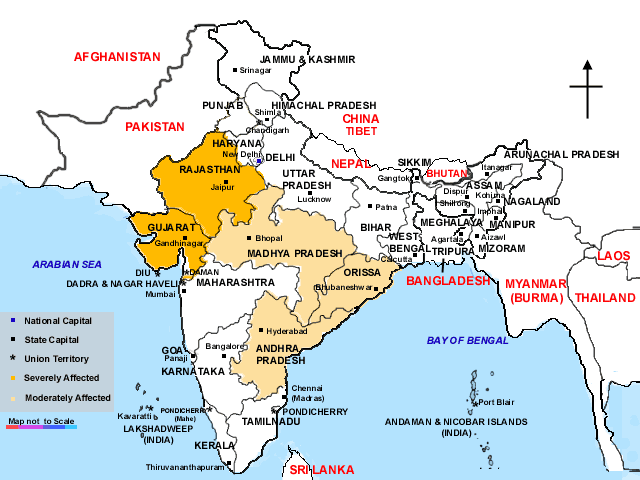
draught

Drought Prone Area Programmee:-

The basic objective of the programme is to minimise the adverse effects of drought on production of crops and livestock and productivity of land, water and human resources ultimately leading to drought proofing of the affected areas. The programme also aims to promote overall economic development and improving the socio-economic conditions of the resource poor and disadvantaged sections inhabiting the programme areas.

How to Fight Drought :-

Drougth is a climatic phenomenon, hence it can only be fought as a long term strategy.

Short-term:- The short-term drought fighting mechanism is to reduce the socio-economic impact of drought. This is essentially bringing the vulnerable from out of imminent danger .

Long – Term:-The long term requires a integrated approach :-

  • Integrated watershed development
  • Ground water recharge programmes
  • Afforestation to contain loss of moisture
  • Desert development programmee- Fighting the aridity and restricting new regions getting decertified.
  • River valley Projects
Share is Caring, Choose Your Platform!

Receive Daily Updates

Stay updated with current events, tests, material and UPSC related news

Recent Posts

  • Context:-

    At the recently concluded Leaders’ Summit on Climate in April 2021, Lowering Emissions by Accelerating Forest Finance (LEAF) Coalition, a collective of the United States, United Kingdom and Norway governments, came up with a $1 billion fund plan that shall be offered to countries committed to arrest the decline of their tropical forests by 2030.

    [wptelegram-join-channel link=”https://t.me/s/upsctree” text=”Join @upsctree on Telegram”]

    What is LEAF Coalition?

    • Lowering Emissions by Accelerating Forest Finance (LEAF) Coalition, a collective of the United States, United Kingdom and Norway governments, came up with a $1 billion fund.
    • LEAF is supported by transnational corporations (TNCs) like Unilever plc, Amazon.com, Inc, Nestle, Airbnb, Inc as well as Emergent, a US-based non-profit.

    Why LEAF Coalition?

    • The world lost more than 10 million hectares of primary tropical forest cover last year, an area roughly the size of Switzerland.
    • Ending tropical and subtropical forest loss by 2030 is a crucial part of meeting global climate, biodiversity and sustainable development goals. Protecting tropical forests offers one of the biggest opportunities for climate action in the coming decade.
    • Tropical forests are massive carbon sinks and by investing in their protection, public and private players are likely to stock up on their carbon credits.
    • The LEAF coalition initiative is a step towards concretising the aims and objectives of the Reducing Emissions from Deforestation and Forest Degradation (REDD+) mechanism.
    • REDD+ was created by the United Nations Framework Convention on Climate Change (UNFCCC). It monetised the value of carbon locked up in the tropical forests of most developing countries, thereby propelling these countries to help mitigate climate change.
    • It is a unique initiative as it seeks to help developing countries in battling the double-edged sword of development versus ecological commitment. 
    • The initiative comes at a crucial time. The tropics have lost close to 12.2 million hectares (mha) of tree cover last year according to global estimates released by Global Forest Watch.
    • Of this, a loss of 4.2 mha occurred within humid tropical primary forests alone. It should come as no surprise that most of these lost forests were located in the developing countries of Latin America, Africa and South Asia.
    • Brazil has fared dismally on the parameter of ‘annual primary forest loss’ among all countries. It has lost 1.7 mha of primary forests that are rich storehouse of carbon. India’s estimated loss in 2020 stands at 20.8 kilo hectares.

    Brazil & India 

    • Between 2002-2020, Brazil’s total area of humid primary forest reduced by 7.7 per cent while India’s reduced by 3.4 per cent.
    • Although the loss in India is not as drastic as in Brazil, its position is nevertheless precarious. For India, this loss is equivalent to 951 metric tonnes worth carbon dioxide emissions released in the atmosphere.
    • It is important to draw comparisons between Brazil and India as both countries have adopted a rather lackadaisical attitude towards deforestation-induced climate change. The Brazilian government hardly did anything to control the massive fires that gutted the Amazon rainforest in 2019.
    • It is mostly around May that forest fires peak in India. However, this year India, witnessed massive forest fires in early March in states like Odisha, Uttarakhand, Madhya Pradesh and Mizoram among others.
    • The European Union’s Copernicus Atmospheric Monitoring Service claimed that 0.2 metric tonnes of carbon was emitted in the Uttarakhand forest fires.

    According to the UN-REDD programme, after the energy sector, deforestation accounts for massive carbon emissions — close to 11 per cent — in the atmosphere. Rapid urbanisation and commercialisation of forest produce are the main causes behind rampant deforestation across tropical forests.

    Tribes, Forests and Government

    Disregarding climate change as a valid excuse for the fires, Indian government officials were quick to lay the blame for deforestation on activities of forest dwellers and even labelled them “mischievous elements” and “unwanted elements”.

    Policy makers around the world have emphasised the role of indigenous tribes and local communities in checking deforestation. These communities depend on forests for their survival as well as livelihood. Hence, they understand the need to protect forests. However, by posing legitimate environmental concerns as obstacles to real development, governments of developing countries swiftly avoid protection of forests and rights of forest dwellers.

    For instance, the Government of India has not been forthcoming in recognising the socio-economic, civil, political or even cultural rights of forest dwellers. According to data from the Union Ministry of Tribal Affairs in December, 2020 over 55 per cent of this population has still not been granted either individual or community ownership of their lands.  

    To make matters worse, the government has undertaken systematic and sustained measures to render the landmark Scheduled Tribes and Other Traditional Forest Dwellers (Recognition of Forest Rights) Act, 2006 ineffective in its implementation. The Act had sought to legitimise claims of forest dwellers on occupied forest land.

    Various government decisions have seriously undermined the position of indigenous people within India. These include proposing amendments to the obsolete Indian Forest Act, 1927 that give forest officials the power to take away forest dwellers’ rights and to even use firearms with impunity.

    There is also the Supreme Court’s order of February, 2019 directing state governments to evict illegal encroachers of forest land or millions of forest dwellers inhabiting forests since generations as a measure to conserve wildlife. Finally, there is the lack of data on novel coronavirus disease (COVID-19) deaths among the forest dwelling population;

    Tardy administration, insufficient supervision, apathetic attitude and a lack of political intent defeat the cause of forest dwelling populations in India, thereby directly affecting efforts at arresting deforestation.

    Way Forward

    • Implementation of the LEAF Coalition plan will help pump in fresh rigour among developing countries like India, that are reluctant to recognise the contributions of their forest dwelling populations in mitigating climate change.
    • With the deadline for proposal submission fast approaching, India needs to act swiftly on a revised strategy.
    • Although India has pledged to carry out its REDD+ commitments, it is impossible to do so without seeking knowledge from its forest dwelling population.

    Tuntiak Katan, a global indigenous leader from Ecuador and general coordinator of the Global Alliance of Territorial Communities, aptly indicated the next steps at the Climate Summit:

    “The first step is recognition of land rights. The second step is the recognition of the contributions of local communities and indigenous communities, meaning the contributions of indigenous peoples.We also need recognition of traditional knowledge practices in order to fight climate change”

    Perhaps India can begin by taking the first step.