


e-KRANTI
Background:-
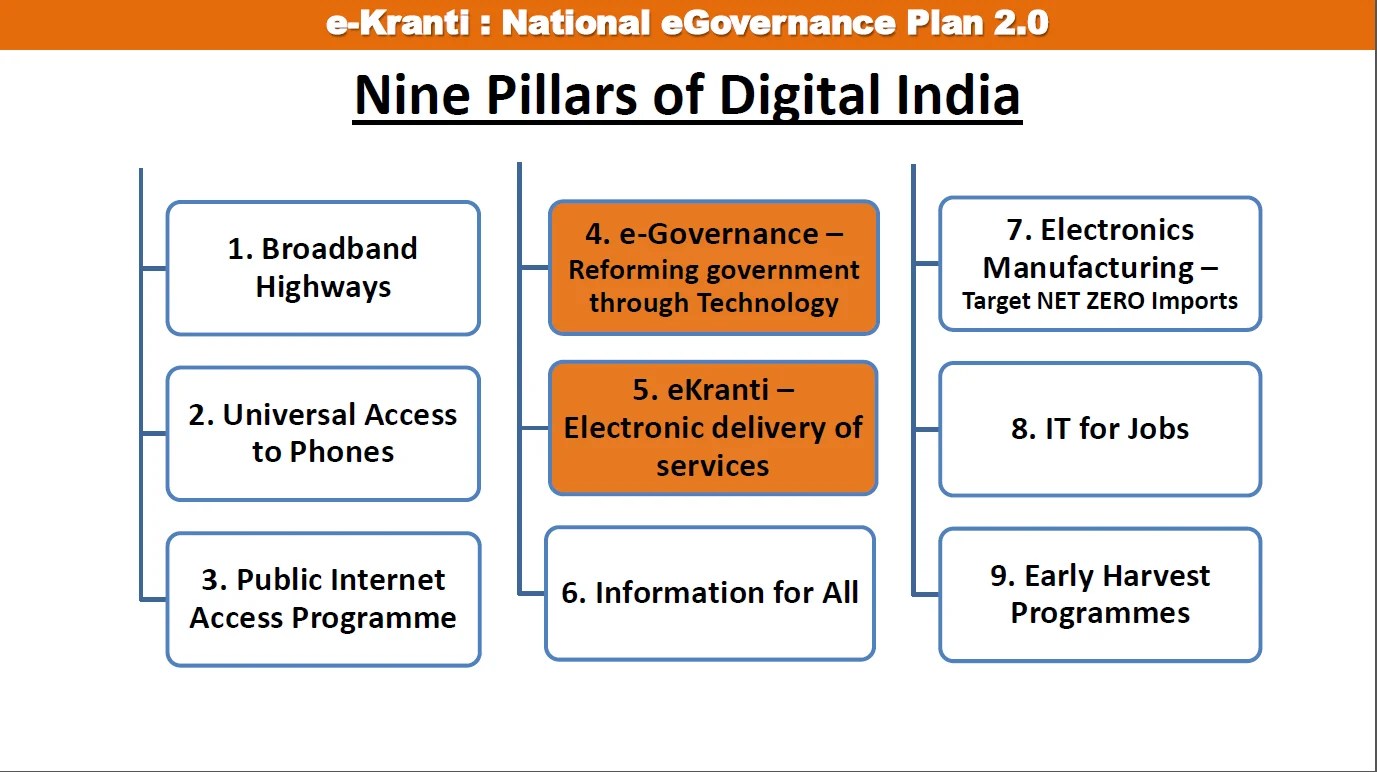
Government of India accords highest priority to the Digital India programme that is an umbrella programme for transforming India into a digitally empowered society and knowledge economy. The pillars of Digital India programme, namely ‘e-Governance: Reforming Government through Technology’ and ‘e-Kranti – Electronic Delivery of Services’ respectively are directly linked to the e-Kranti: National e-Governance Plan (NeGP) 2.0. The implementation of e-Kranti is vital for Digital India and for the delivery of e-governance, easy governance and good governance in the country.
Vision and Mission:-
- “Transforming e-Governance for Transforming Governance”
- “To ensure a Government-wide transformation by delivering Government services electronically to the citizens through integrated and interoperable systems via multiple modes, while ensuring efficiency, transparency and reliability of such services at affordable costs”
Principles of e-Kranti:-
- Transformation and not Translation :- This principle emphasizes that , the programs must not merely translate itself from document or Pen and Paper service to Digital service, it must transform itself, so that the end-user(Public) could get hassle free access to government services.
- Integrated Services and not Individual Services:- More often than not ,we have come across issues where various departments of Governments work in silos and there is rarely any co-ordination among them, instead the coordination part rests upon the individual who wants certain services.This give the space for corruption and bribery is paid to move a file from one department to another. But this principle is trying to change that by integrating the departments , making file movement digital , hence coordination part rests upon the departments and not on the beneficiary.
- Government Process Re-engineering :-Elimination of Non-Value-Adds,process optimization,Standardization, Automation and Self service
- Cloud by Default :-Government Cloud as default cloud for services and no requirement of separate infrastructure set up for any service.Government cloud service known as – Meghraj
- Mobile First :- Making services available via Mobile phones
- Mandating Standards and Protocols
- Language Localization
- Security and Electronic Data Preservation
E-Kranti as Part of Digital India :-
National e-Governance Plan:-
Make all Government services accessible to the COMMON MAN IN HIS LOCALITY, through Common Service Delivery Outlets and ensure EFFICIENCY, TRANSPARENCY & RELIABILITY of such services at AFFORDABLE COSTS to realise the BASIC NEEDS of the common man.
Key Components of NeGP:-
- Integrated Service Delivery Platform
- Mission Mode Projects (MMPS)
- Core ICT Infrastructure
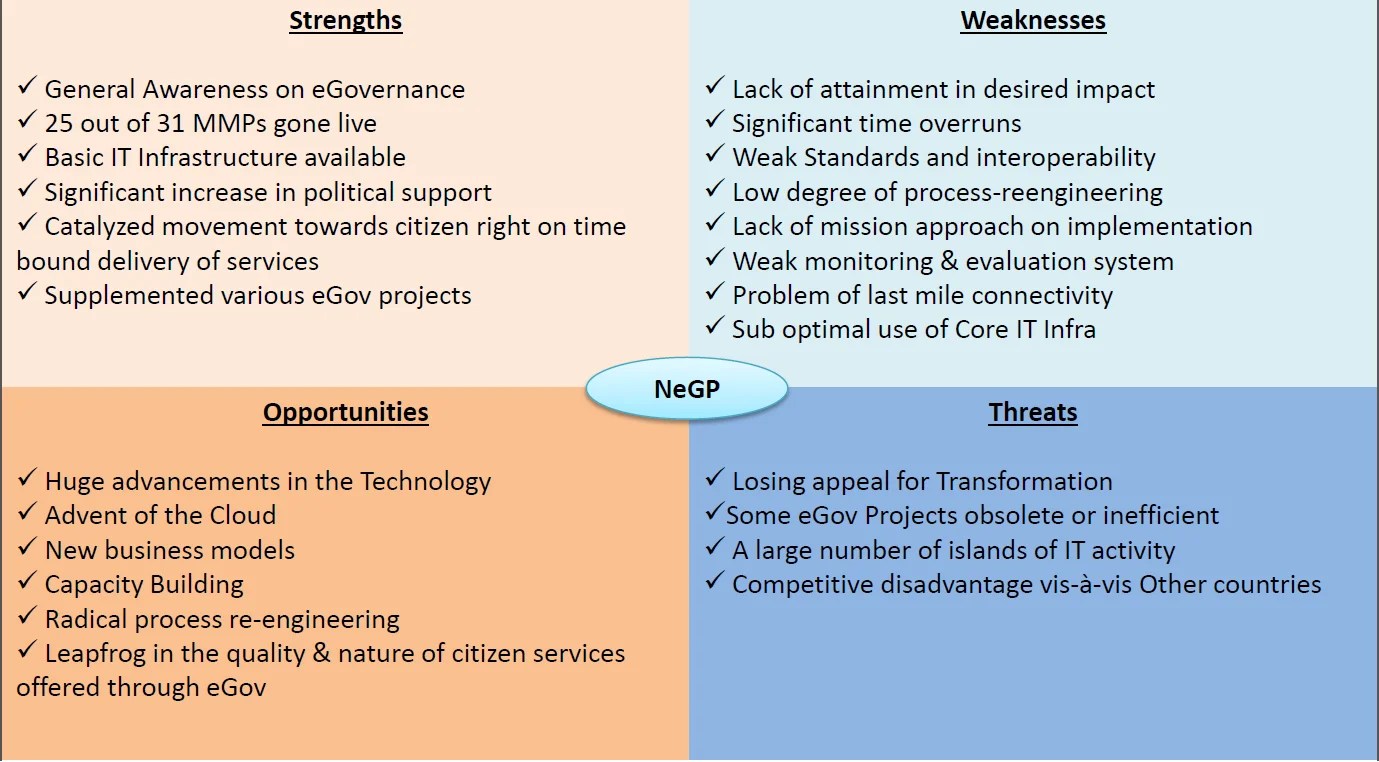
Strength, Weaknesses, Opportunities, Threats:-
NeGP vs e-Kranti :-
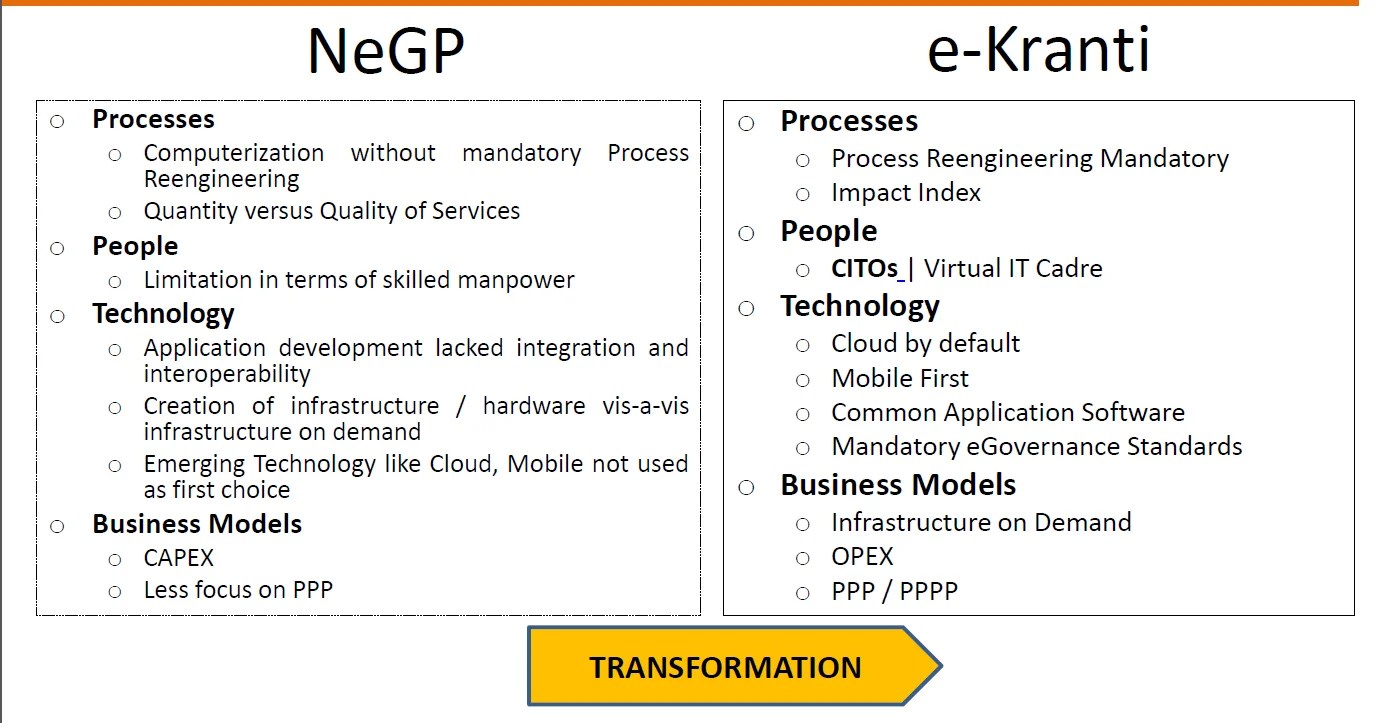
CAPEX-Capital Expense , OPEX-Operating Expense
Why e-Kranti :-
- Need to exploit Emerging Technologies
- Cloud
- Mobile Platform- Smart phones, Tablets
- Geo-Spatial Information System
- Big Data Analytics
- Avoid risk of obsolescence
- Need for introducing more agile implementation models
Institutes and Instruments :-
- National e-Governance Academy
- e-Governance Knowledge Portal
- Create e-Governance Impact Index
- Effective use of Social Media
Few Projects related to e-Kranti:-
- e-Sansad
- e-Vidhaan
- Roads and Highways Information System (RAHI)
- Agriculture 2.0
- Common IT Roadmap for Para Military Forces
- e-Bhasha
- Urban Governance
and Many More.
Analysis:-
- Indian IT sector growth is a result of capitalist market forces combined with abundant and cost-effective human resource availability.
- India over decades built the strengthen in IT sector and it is high time that the Government of India utilizes it to deliver the services.In this regard the e-Kranti is an welcome step.
- However , the major concern is the state of our education and dismal literacy rate which hampers the adoption of technology by masses. More so, IT is a sophisticated platform where many a time even the literate ones unable to transact properly.That means, majority of Indians does not have “digital literacy” , hence there is a social resistance to adopt this services.
- In the absence of digital literacy , many take the help of so called “Middle Man” to get the job done.This in turn , hampers the whole idea of e-governance, because one of its primary focus is self-service and eliminate middle man . Instead, it gave rise to a different kind of middle man altogether in India.
- Frauds are rampant and innocents are getting caught in the trap. The trap also engulfs the literate too.
- Hence, it is high time , literacy and digital literacy should be separated.
- The good part is , digital literacy only demands few protocols to be followed and once it is communicated and demonstrated properly , it may serve the purpose.
- Another revolutionizing idea is the localization of language, thus letting people transact with their own language. This gives fillip to the e-Kranti altogether.
- Thought , there may be an initial hesitance for adoption of technology , however with time, this will vanish and with it the middle man also will vanish.
- The next trouble is the Infrastructure part.Digital infrastructure is a costly affair and requires huge investment. Moreover , given the status quo of many services and rampant call-drops , dismal network services across India, this still seems like a dream.
- The call cost of India may be then lowest, but the data charges are one of the highest.Often one hears the consumer complain on awful data services.Network should search the phone and connect , instead People are searching for networks (sometime on the roof and sometime on the mountain)
- Hence , e-Kranti to succeed , the digital infrastructure should be accessible and affordable , else we will be left will high-end applications but no end-users.
On the conclusion, though, digital infrastructure is a competitive market and given the market capitalization and presence of healthy competition , right push and policies can troubleshoot these problems , there by making e-Kranti a grand success.