


UPSC/STATE PSC
Curated by Experts For Civil Service Aspirants
The Hindu & Indian Express
News 1: Central Bureau of Investigation
- Central Government shall appoint the Director of CBI on the recommendation of a three-member committee consisting of the Prime Minister as Chairperson, the Leader of Opposition in the Lok Sabha and the Chief Justice of India or Judge of the Supreme Court nominated by him. (where there is no recognized leader of opposition in the Lok Sabha, then the leader of the single largest opposition party in the Lok Sabha would be a member of that committee)
4) The CBI is a multidisciplinary investigation agency of the Government of India and undertakes investigation of corruption related cases, economic offences and cases of conventional crime. It normally confines its activities in the anti-corruption field to offences committed by the employees of the Central Government and Union Territories and their public sector undertakings.
5) It takes up investigation of conventional crimes like murder, kidnapping, rape etc., on reference from the state governments or when directed by the Supreme Court/High Courts
News 2: Martand Sun Temple in Kashmir
Background: ASI had objected to the ‘Navgrah Ashtamangalam Puja’ on the premises of Martand Temple as it is a heritage site.
About Martand Sun Temple :
1) Built by the Karkota dynasty king Lalitaditya Muktapida, who ruled Kashmir from 725 AD to 753 AD. Kalhana in Rajatarangini mentions that the Martand Sun Temple was commissioned by Lalitaditya Muktapida in the eighth century AD.
2) According to Jonaraja, the temple was destroyed by Sikandar Shah Miri who is also known as Sikandar Butshikhan ( Butshikan is a title meant for ‘temple Destroyer’)
3) It is located near the city of Anantnag in the Kashmir Valley of Jammu and Kashmir.
4) It is the earliest known Sun temple in India.
Jonaraja:-He was a Kashmiri historian and Sanskrit poet. His Dvitīyā Rājataraṅginī is a continuation of Kalhana’s Rājataraṅginī and brings the chronicle of the kings of Kashmir down to the time of the author’s patron Zain-ul-Abidin (r. 1418-1419 and 1420-1470). Jonaraja, however, could not complete the history of the patron as he died in the 35th regnal year. His pupil, Śrīvara continued the history and his work, the Tritīyā Rājataraṅginī, covers the period 1459–86
News 3: India, Bangladesh ink first water sharing pact in 25 years
Background: India and Bangladesh recently signed an interim water sharing agreement for the Kushiyara river, the first such pact since the signing of the Ganga water treaty in 1996.
Details :
1) India and Bangladesh share 54 rivers.
2) Bangladesh Prime Minister Sheikh Hasina sought for an early conclusion of the Teesta water sharing agreement, which has been hanging for more than a decade due to opposition from West Bengal Chief Minister Mamata Banerjee.
3) Both leaders unveiled Unit-I of the Maitree Super Thermal Power Project. Being constructed under India’s concessional financing scheme, the Project will add 1320 MW to Bangladesh’s National Grid.
4) In total both the countries have signed 7 MoUs
Teesta River :

1) Initially it was part of Ganges system but after a flood, it has changed its course and joined the Brahmaputra river.
2) Tributaries
- Left bank:- Rangpo River, Lachung River, Ranikhola, Relli River, Talung River, Dik Chhu, Lang Lang Chu
- Right bank:- Rangeet River, Ringyong Chhu, Ranghap Chhu
Kushiyara River:
1) It is a distributary river in Bangladesh and Assam, India.
2) It forms on the India-Bangladesh border as a branch of the Barak River, when the Barak separates into the Kushiyara and Surma.
Barak River :-The Barak is the second largest river system in the North East India as well as in Assam. The Barak rises on the southern slope of the lofty Barail Range in Manipur and forms a part of the northern boundary of the Manipur State with Nagaland where it is known as Kirong. Near Karimganj, it bifurcates into the northern branh of Surma and the southern branch of Kushiyara

News 4: Shanghai Cooperation Organisation (SCO) summit in Uzbekistan
Background: China’s President Xi Jinping is likely to travel to Kazakhstan on September 14 and subsequently attend the Shanghai Cooperation Organisation (SCO) summit in Uzbekistan on September 15 16.
About SCO :
1) It is an intergovernmental organization which operates in Eurasian political, economic and military arena aiming to maintain peace, security and stability in the region.
2) Prior to the creation of SCO in 2001, Kazakhstan, China, Kyrgyzstan, Russia and Tajikistan were members of the Shanghai Five.
3) Following the accession of Uzbekistan to the organization in 2001, the Shanghai Five was renamed the SCO.
4) India and Pakistan became members in 2017.
5) Head Quarter:- Beijing
6) India, which would take over the SCO Presidency next year, would give the fullest support for the success of the Samarkand Summit in Uzbekistan in September 2022.
News 5: Purchasing Managers’ Index

1) The PMI is based on a monthly survey of supply chain managers across 19 industries, covering both upstream and downstream activity.
2) The questions are related to 5 key variables. The variables with their weights in the index are — new orders (30%), output (25%), employment (20%), suppliers’ delivery times (15%) and stock of items purchased (10%). The surveys are conducted on a monthly basis.
3) IHS Markit produces the PMI for India. The IHS Markit India Manufacturing Purchasing Managers’ Index measures the performance of India’s manufacturing sector.
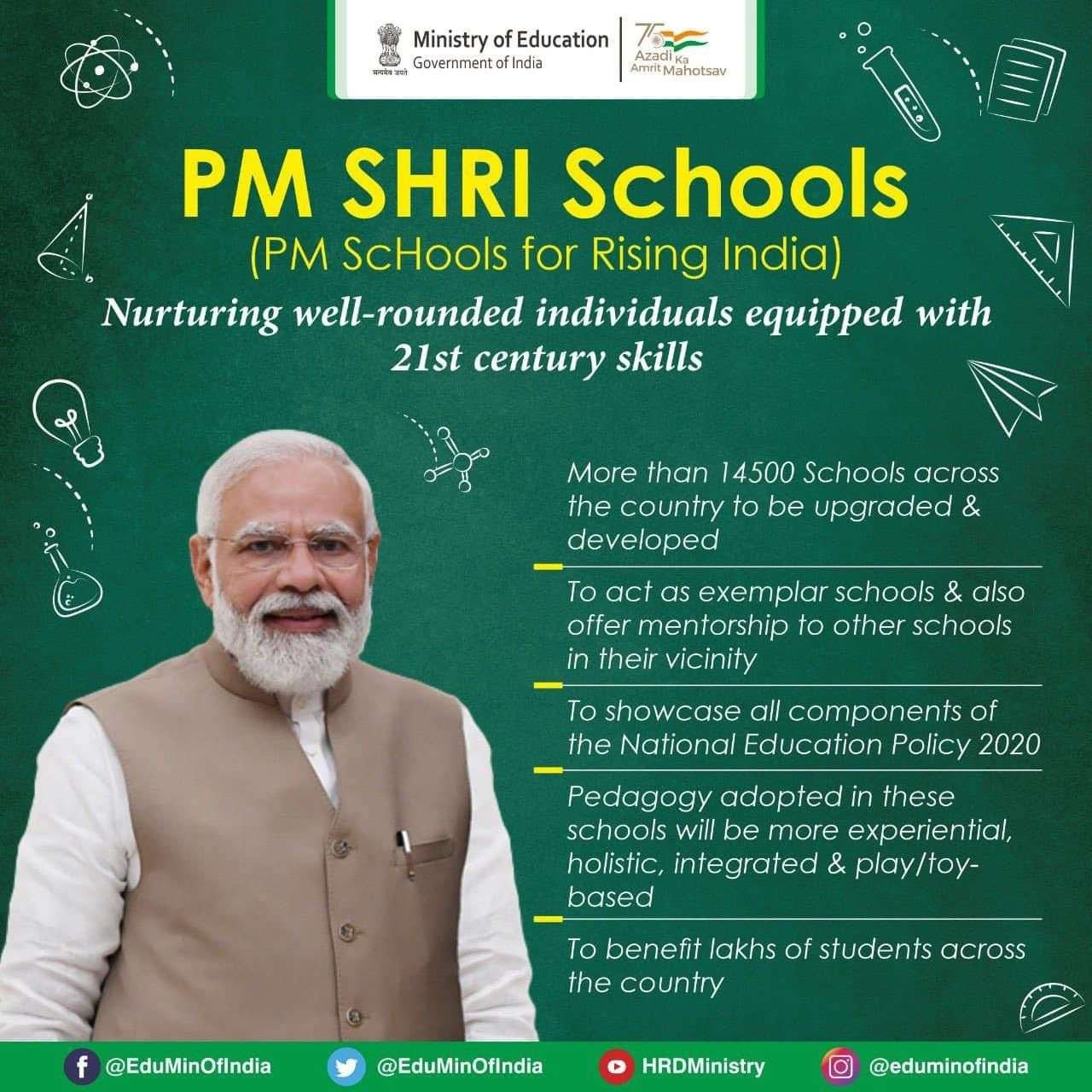
News 5: PM SHRI (PMSchools for Rising India)
1) Under it, as many as 14,500 schools across states and Union Territories will be redeveloped to reflect the key features of the NEP, 2020.
2) Kendriya Vidyalayas or Jawahar Navodaya Vidyalayas come entirely under the Centre’s Ministry of Education. They are fully-funded by the Union government under Central Sector Schemes.
3) While KVs largely cater to children of Union government employees posted in states and UTs, JNVs were set up to nurture talented students in rural parts of the country.
4) In contrast, PM SHRI schools will be an upgrade of existing schools run by the Centre, states, UTs and local bodies. This essentially means that PM SHRI schools can either be KVs, JNVs, state government schools or even those run by municipal corporations.
One Liners:-
1.

2.THE ICONIC Rajpath from RashtrapatiBhavan to IndiaGate is all set to be renamed as Kartavya Path (Path of Duty)
Receive Daily Updates
Recent Posts
- In the Large States category (overall), Chhattisgarh ranks 1st, followed by Odisha and Telangana, whereas, towards the bottom are Maharashtra at 16th, Assam at 17th and Gujarat at 18th. Gujarat is one State that has seen startling performance ranking 5th in the PAI 2021 Index outperforming traditionally good performing States like Andhra Pradesh and Karnataka, but ranks last in terms of Delta
- In the Small States category (overall), Nagaland tops, followed by Mizoram and Tripura. Towards the tail end of the overall Delta ranking is Uttarakhand (9th), Arunachal Pradesh (10th) and Meghalaya (11th). Nagaland despite being a poor performer in the PAI 2021 Index has come out to be the top performer in Delta, similarly, Mizoram’s performance in Delta is also reflected in it’s ranking in the PAI 2021 Index
- In terms of Equity, in the Large States category, Chhattisgarh has the best Delta rate on Equity indicators, this is also reflected in the performance of Chhattisgarh in the Equity Pillar where it ranks 4th. Following Chhattisgarh is Odisha ranking 2nd in Delta-Equity ranking, but ranks 17th in the Equity Pillar of PAI 2021. Telangana ranks 3rd in Delta-Equity ranking even though it is not a top performer in this Pillar in the overall PAI 2021 Index. Jharkhand (16th), Uttar Pradesh (17th) and Assam (18th) rank at the bottom with Uttar Pradesh’s performance in line with the PAI 2021 Index
- Odisha and Nagaland have shown the best year-on-year improvement under 12 Key Development indicators.
- In the 60:40 division States, the top three performers are Kerala, Goa and Tamil Nadu and, the bottom three performers are Uttar Pradesh, Jharkhand and Bihar.
- In the 90:10 division States, the top three performers were Himachal Pradesh, Sikkim and Mizoram; and, the bottom three performers are Manipur, Assam and Meghalaya.
- Among the 60:40 division States, Orissa, Chhattisgarh and Madhya Pradesh are the top three performers and Tamil Nadu, Telangana and Delhi appear as the bottom three performers.
- Among the 90:10 division States, the top three performers are Manipur, Arunachal Pradesh and Nagaland; and, the bottom three performers are Jammu and Kashmir, Uttarakhand and Himachal Pradesh
- Among the 60:40 division States, Goa, West Bengal and Delhi appear as the top three performers and Andhra Pradesh, Telangana and Bihar appear as the bottom three performers.
- Among the 90:10 division States, Mizoram, Himachal Pradesh and Tripura were the top three performers and Jammu & Kashmir, Nagaland and Arunachal Pradesh were the bottom three performers
- West Bengal, Bihar and Tamil Nadu were the top three States amongst the 60:40 division States; while Haryana, Punjab and Rajasthan appeared as the bottom three performers
- In the case of 90:10 division States, Mizoram, Assam and Tripura were the top three performers and Nagaland, Jammu & Kashmir and Uttarakhand featured as the bottom three
- Among the 60:40 division States, the top three performers are Kerala, Andhra Pradesh and Orissa and the bottom three performers are Madhya Pradesh, Jharkhand and Goa
- In the 90:10 division States, the top three performers are Mizoram, Sikkim and Nagaland and the bottom three performers are Manipur and Assam
In a diverse country like India, where each State is socially, culturally, economically, and politically distinct, measuring Governance becomes increasingly tricky. The Public Affairs Index (PAI 2021) is a scientifically rigorous, data-based framework that measures the quality of governance at the Sub-national level and ranks the States and Union Territories (UTs) of India on a Composite Index (CI).
States are classified into two categories – Large and Small – using population as the criteria.
In PAI 2021, PAC defined three significant pillars that embody Governance – Growth, Equity, and Sustainability. Each of the three Pillars is circumscribed by five governance praxis Themes.
The themes include – Voice and Accountability, Government Effectiveness, Rule of Law, Regulatory Quality and Control of Corruption.
At the bottom of the pyramid, 43 component indicators are mapped to 14 Sustainable Development Goals (SDGs) that are relevant to the States and UTs.
This forms the foundation of the conceptual framework of PAI 2021. The choice of the 43 indicators that go into the calculation of the CI were dictated by the objective of uncovering the complexity and multidimensional character of development governance

The Equity Principle
The Equity Pillar of the PAI 2021 Index analyses the inclusiveness impact at the Sub-national level in the country; inclusiveness in terms of the welfare of a society that depends primarily on establishing that all people feel that they have a say in the governance and are not excluded from the mainstream policy framework.
This requires all individuals and communities, but particularly the most vulnerable, to have an opportunity to improve or maintain their wellbeing. This chapter of PAI 2021 reflects the performance of States and UTs during the pandemic and questions the governance infrastructure in the country, analysing the effectiveness of schemes and the general livelihood of the people in terms of Equity.


Growth and its Discontents
Growth in its multidimensional form encompasses the essence of access to and the availability and optimal utilisation of resources. By resources, PAI 2021 refer to human resources, infrastructure and the budgetary allocations. Capacity building of an economy cannot take place if all the key players of growth do not drive development. The multiplier effects of better health care, improved educational outcomes, increased capital accumulation and lower unemployment levels contribute magnificently in the growth and development of the States.


The Pursuit Of Sustainability
The Sustainability Pillar analyses the access to and usage of resources that has an impact on environment, economy and humankind. The Pillar subsumes two themes and uses seven indicators to measure the effectiveness of government efforts with regards to Sustainability.


The Curious Case Of The Delta
The Delta Analysis presents the results on the State performance on year-on-year improvement. The rankings are measured as the Delta value over the last five to 10 years of data available for 12 Key Development Indicators (KDI). In PAI 2021, 12 indicators across the three Pillars of Equity (five indicators), Growth (five indicators) and Sustainability (two indicators). These KDIs are the outcome indicators crucial to assess Human Development. The Performance in the Delta Analysis is then compared to the Overall PAI 2021 Index.
Key Findings:-
In the Scheme of Things
The Scheme Analysis adds an additional dimension to ranking of the States on their governance. It attempts to complement the Governance Model by trying to understand the developmental activities undertaken by State Governments in the form of schemes. It also tries to understand whether better performance of States in schemes reflect in better governance.
The Centrally Sponsored schemes that were analysed are National Health Mission (NHM), Umbrella Integrated Child Development Services scheme (ICDS), Mahatma Gandh National Rural Employment Guarantee Scheme (MGNREGS), Samagra Shiksha Abhiyan (SmSA) and MidDay Meal Scheme (MDMS).
National Health Mission (NHM)
INTEGRATED CHILD DEVELOPMENT SERVICES (ICDS)
MID- DAY MEAL SCHEME (MDMS)
SAMAGRA SHIKSHA ABHIYAN (SMSA)
MAHATMA GANDHI NATIONAL RURAL EMPLOYMENT GUARANTEE SCHEME (MGNREGS)