


Indian researchers exploring the Arctic
From metering the precipitation in the Arctic region to drawing up a baseline data on microbial biodiversity in Kongsfjorden sediments and carrying out a biochemical evaluation and biomarker characterisation of Arctic fjord sediments, Indian researchers are into a series of scientific investigations in the icy terrains of Arctic.
Working from Himadri, country’s Arctic research station at Spitsbergen, Norway, the scientists are looking into the various aspects of life that thrives there to gain a better understanding about the climatological factors that influence the Arctic weather and its impact on climate changes elsewhere.
The researchers of the National Centre for Antarctic and Ocean Research, Goa, specializing in atmospheric sciences, will look into the variability of precipitation over Arctic and the precipitation will be measured using Micro Rain Radar. The temperature and humidity profiles of the region will be created using a microwave radiometer profiler.
They hope to “fill the gaps in the observational data on Arctic clouds, especially during the dark winter season, by recording measurements using a ceilometer to measure the vertical profiles of multiple cloud layers,” according to a research document. The long-term monitoring of Kongsfjorden system of Arctic region for climate change studies has also been the mandate of the Centre during the current assignment.
An environmental specialist from the Mahatma Gandhi University, Kerala, will pay attention to the long term environmental monitoring of fjord ecosystems, especially the ecosystem of Kongsfjorden and Krossfjorden. The water and sediment chemistry with respect to climate change in the fjords will be the focus area of research. Different teams will be carrying several studies. For instance, the biochemical evaluation and biomarker characterization from Arctic fjord sediments is the task assigned to the chemical oceanographer from the Kerala University for Fisheries and Ocean Studies.
The zooplankton ecology and planktonic food web dynamics in Kongsfjorden will be studied using in-situ and satellite oceanography techniques by another team. The impact of glacial runoff and associated arctic freshening on microbial community structure will also be assessed. A case study will be carried out in Kongsfjorden.
While trying to understand the macro-benthic faunal composition at selected locations in the Kongsjorden Fjord covering a length of 15 Km from the oceanic end to the glacial end of the Fjord, another scientist from the Cochin University of Science will look into the impact of glacial run-off and associated Arctic freshening of microbial community structure of Kongsfjorden.
Kongsfjorden
Kongsfjorden, an icy archipelago having a length of about 40 km and width ranging from 5 to 10 km, is a glacial fjord(a long, narrow, deep inlet of the sea between high cliffs, as in Norway and Iceland, typically formed by submergence of a glaciated valley) in the Arctic (Svalbard).
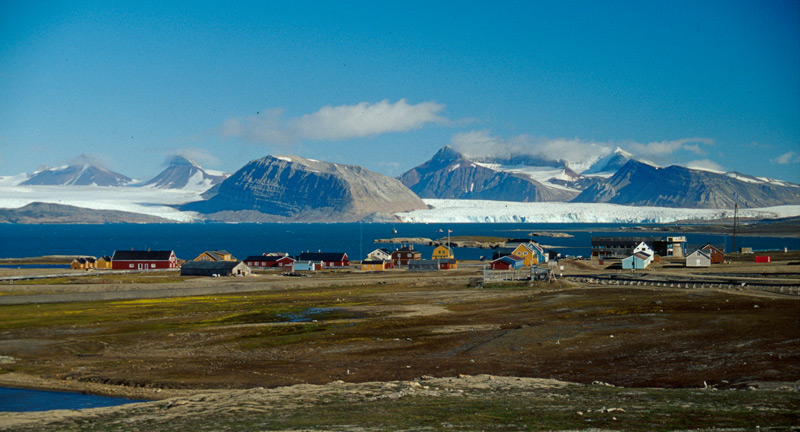
It lies in the northwest coast of Spitsbergen, the main island of Svalbard, and is a site where warmer waters of the Atlantic meet the colder waters of the Arctic.
Ever since India commenced her scientific activities in the Arctic realm, one of the major locales of study has been the Kongsfjorden system. Considering the scope of scientific research the locale afforded and the fact that an integrated study of the fjord has been has been identified as a flagship program of the Svalbard Research Program (SSF), NCAOR in consultation with the Norwegian Polar Institute (NPI) began exploring the feasibility of initiating a major long-term program on the fjord during 2009-10.
Objectives:
The overall objective of the studies planned is to establish a long-term comprehensive physical, chemical, biological and atmospheric measurement programme aimed at understanding:
- The variability in the Arctic/Atlantic climate signal by understanding the interaction between the freshwater from the glacial run-off and Atlantic water from the west Spitsbergen current.
- The effect of interaction between the warm Atlantic water and the cold glacial-melt fresh water on the biological productivity and phytoplankton species composition and diversity within the fjord.
- The winter convection and its role in the biogeochemical cycling.
- The trigger mechanism of spring bloom and its temporal variability and biomass production.
- The production and export of organic carbon in the fjord with a view to quantify the CO2 flux.
Cabinet approves India’s Membership of the International Continental Scientific Drilling Program
The Union Cabinet recently gave its approval for Indian membership of the International Continental Scientific Drilling Program (ICDP) consortium by signing an MoU with the Helmholtz Centre Potsdam GFZ German Research Centre for geosciences. This is a government-funded, Public Law Foundation of the State of Brandenburg, Germany.
Details:
- After signing the MoU on the membership for a period of five years with ICDP, India would enable engaging internationally renowned experts with profound expertise in different aspects of scientific drilling in order to accomplish deep drilling and associated investigations in Koyna region.
- India will get a seat on two ICDP panels – Executive Committee (EC) and Assembly of Governors (AOG). Also, ICDP will provide technical / operational support, facilitate capacity building in terms of manpower training in key scientific areas, sample and data management and support workshops for the Koyna scientific deep drilling project undertaken by Ministry of Earth Sciences.
- As a member of ICDP, scientists/engineers from India would have right to submit proposals, to participate in all ICDP co-funded workshops and drilling projects and have access to all data results from ICDP projects. This will shed new light on the genesis of seismicity and better understanding of earthquake processes.
International Continental Scientific Drilling Program:
It is a multinational program to further and fund geosciences in the field of Continental Scientific Drilling. It was founded in February 1996 in the German Embassy in Tokyo as a result of the German Continental Deep Drilling Program.
Swadesh Darshan Scheme
The Ministry of Tourism has launched the Swadesh Darshan Scheme in 2014-15 with an aim to develop theme based tourist circuits in the country on the principles of high tourist value, competitiveness and sustainability in an integrated manner by synergizing efforts to focus on needs and concerns of all stakeholders to enrich tourist experience and enhance employment opportunities.
Under the Swadesh Darshan scheme, thirteen thematic circuits have been identified, for development namely:
- North-East India Circuit,
- Buddhist Circuit,
- Himalayan Circuit,
- Coastal Circuit,
- Krishna Circuit,
- Desert Circuit,
- Tribal Circuit,
- Eco Circuit,
- Wildlife Circuit,
- Rural Circuit,
- Spiritual Circuit,
- Ramayana Circuit
- Heritage Circuit.
Receive Daily Updates
Recent Posts
- In the Large States category (overall), Chhattisgarh ranks 1st, followed by Odisha and Telangana, whereas, towards the bottom are Maharashtra at 16th, Assam at 17th and Gujarat at 18th. Gujarat is one State that has seen startling performance ranking 5th in the PAI 2021 Index outperforming traditionally good performing States like Andhra Pradesh and Karnataka, but ranks last in terms of Delta
- In the Small States category (overall), Nagaland tops, followed by Mizoram and Tripura. Towards the tail end of the overall Delta ranking is Uttarakhand (9th), Arunachal Pradesh (10th) and Meghalaya (11th). Nagaland despite being a poor performer in the PAI 2021 Index has come out to be the top performer in Delta, similarly, Mizoram’s performance in Delta is also reflected in it’s ranking in the PAI 2021 Index
- In terms of Equity, in the Large States category, Chhattisgarh has the best Delta rate on Equity indicators, this is also reflected in the performance of Chhattisgarh in the Equity Pillar where it ranks 4th. Following Chhattisgarh is Odisha ranking 2nd in Delta-Equity ranking, but ranks 17th in the Equity Pillar of PAI 2021. Telangana ranks 3rd in Delta-Equity ranking even though it is not a top performer in this Pillar in the overall PAI 2021 Index. Jharkhand (16th), Uttar Pradesh (17th) and Assam (18th) rank at the bottom with Uttar Pradesh’s performance in line with the PAI 2021 Index
- Odisha and Nagaland have shown the best year-on-year improvement under 12 Key Development indicators.
- In the 60:40 division States, the top three performers are Kerala, Goa and Tamil Nadu and, the bottom three performers are Uttar Pradesh, Jharkhand and Bihar.
- In the 90:10 division States, the top three performers were Himachal Pradesh, Sikkim and Mizoram; and, the bottom three performers are Manipur, Assam and Meghalaya.
- Among the 60:40 division States, Orissa, Chhattisgarh and Madhya Pradesh are the top three performers and Tamil Nadu, Telangana and Delhi appear as the bottom three performers.
- Among the 90:10 division States, the top three performers are Manipur, Arunachal Pradesh and Nagaland; and, the bottom three performers are Jammu and Kashmir, Uttarakhand and Himachal Pradesh
- Among the 60:40 division States, Goa, West Bengal and Delhi appear as the top three performers and Andhra Pradesh, Telangana and Bihar appear as the bottom three performers.
- Among the 90:10 division States, Mizoram, Himachal Pradesh and Tripura were the top three performers and Jammu & Kashmir, Nagaland and Arunachal Pradesh were the bottom three performers
- West Bengal, Bihar and Tamil Nadu were the top three States amongst the 60:40 division States; while Haryana, Punjab and Rajasthan appeared as the bottom three performers
- In the case of 90:10 division States, Mizoram, Assam and Tripura were the top three performers and Nagaland, Jammu & Kashmir and Uttarakhand featured as the bottom three
- Among the 60:40 division States, the top three performers are Kerala, Andhra Pradesh and Orissa and the bottom three performers are Madhya Pradesh, Jharkhand and Goa
- In the 90:10 division States, the top three performers are Mizoram, Sikkim and Nagaland and the bottom three performers are Manipur and Assam
In a diverse country like India, where each State is socially, culturally, economically, and politically distinct, measuring Governance becomes increasingly tricky. The Public Affairs Index (PAI 2021) is a scientifically rigorous, data-based framework that measures the quality of governance at the Sub-national level and ranks the States and Union Territories (UTs) of India on a Composite Index (CI).
States are classified into two categories – Large and Small – using population as the criteria.
In PAI 2021, PAC defined three significant pillars that embody Governance – Growth, Equity, and Sustainability. Each of the three Pillars is circumscribed by five governance praxis Themes.
The themes include – Voice and Accountability, Government Effectiveness, Rule of Law, Regulatory Quality and Control of Corruption.
At the bottom of the pyramid, 43 component indicators are mapped to 14 Sustainable Development Goals (SDGs) that are relevant to the States and UTs.
This forms the foundation of the conceptual framework of PAI 2021. The choice of the 43 indicators that go into the calculation of the CI were dictated by the objective of uncovering the complexity and multidimensional character of development governance

The Equity Principle
The Equity Pillar of the PAI 2021 Index analyses the inclusiveness impact at the Sub-national level in the country; inclusiveness in terms of the welfare of a society that depends primarily on establishing that all people feel that they have a say in the governance and are not excluded from the mainstream policy framework.
This requires all individuals and communities, but particularly the most vulnerable, to have an opportunity to improve or maintain their wellbeing. This chapter of PAI 2021 reflects the performance of States and UTs during the pandemic and questions the governance infrastructure in the country, analysing the effectiveness of schemes and the general livelihood of the people in terms of Equity.


Growth and its Discontents
Growth in its multidimensional form encompasses the essence of access to and the availability and optimal utilisation of resources. By resources, PAI 2021 refer to human resources, infrastructure and the budgetary allocations. Capacity building of an economy cannot take place if all the key players of growth do not drive development. The multiplier effects of better health care, improved educational outcomes, increased capital accumulation and lower unemployment levels contribute magnificently in the growth and development of the States.


The Pursuit Of Sustainability
The Sustainability Pillar analyses the access to and usage of resources that has an impact on environment, economy and humankind. The Pillar subsumes two themes and uses seven indicators to measure the effectiveness of government efforts with regards to Sustainability.


The Curious Case Of The Delta
The Delta Analysis presents the results on the State performance on year-on-year improvement. The rankings are measured as the Delta value over the last five to 10 years of data available for 12 Key Development Indicators (KDI). In PAI 2021, 12 indicators across the three Pillars of Equity (five indicators), Growth (five indicators) and Sustainability (two indicators). These KDIs are the outcome indicators crucial to assess Human Development. The Performance in the Delta Analysis is then compared to the Overall PAI 2021 Index.
Key Findings:-
In the Scheme of Things
The Scheme Analysis adds an additional dimension to ranking of the States on their governance. It attempts to complement the Governance Model by trying to understand the developmental activities undertaken by State Governments in the form of schemes. It also tries to understand whether better performance of States in schemes reflect in better governance.
The Centrally Sponsored schemes that were analysed are National Health Mission (NHM), Umbrella Integrated Child Development Services scheme (ICDS), Mahatma Gandh National Rural Employment Guarantee Scheme (MGNREGS), Samagra Shiksha Abhiyan (SmSA) and MidDay Meal Scheme (MDMS).
National Health Mission (NHM)
INTEGRATED CHILD DEVELOPMENT SERVICES (ICDS)
MID- DAY MEAL SCHEME (MDMS)
SAMAGRA SHIKSHA ABHIYAN (SMSA)
MAHATMA GANDHI NATIONAL RURAL EMPLOYMENT GUARANTEE SCHEME (MGNREGS)