


When the world runs out of Ideas, it looks at India and then “Steals it”!!! The Prada-Kolhapuri incident is just another example of this. Let me walk you through a number of incidents from “Chapal Chor” to “Rice Chor” to “Haldi Chor” to “Kurti Chor”
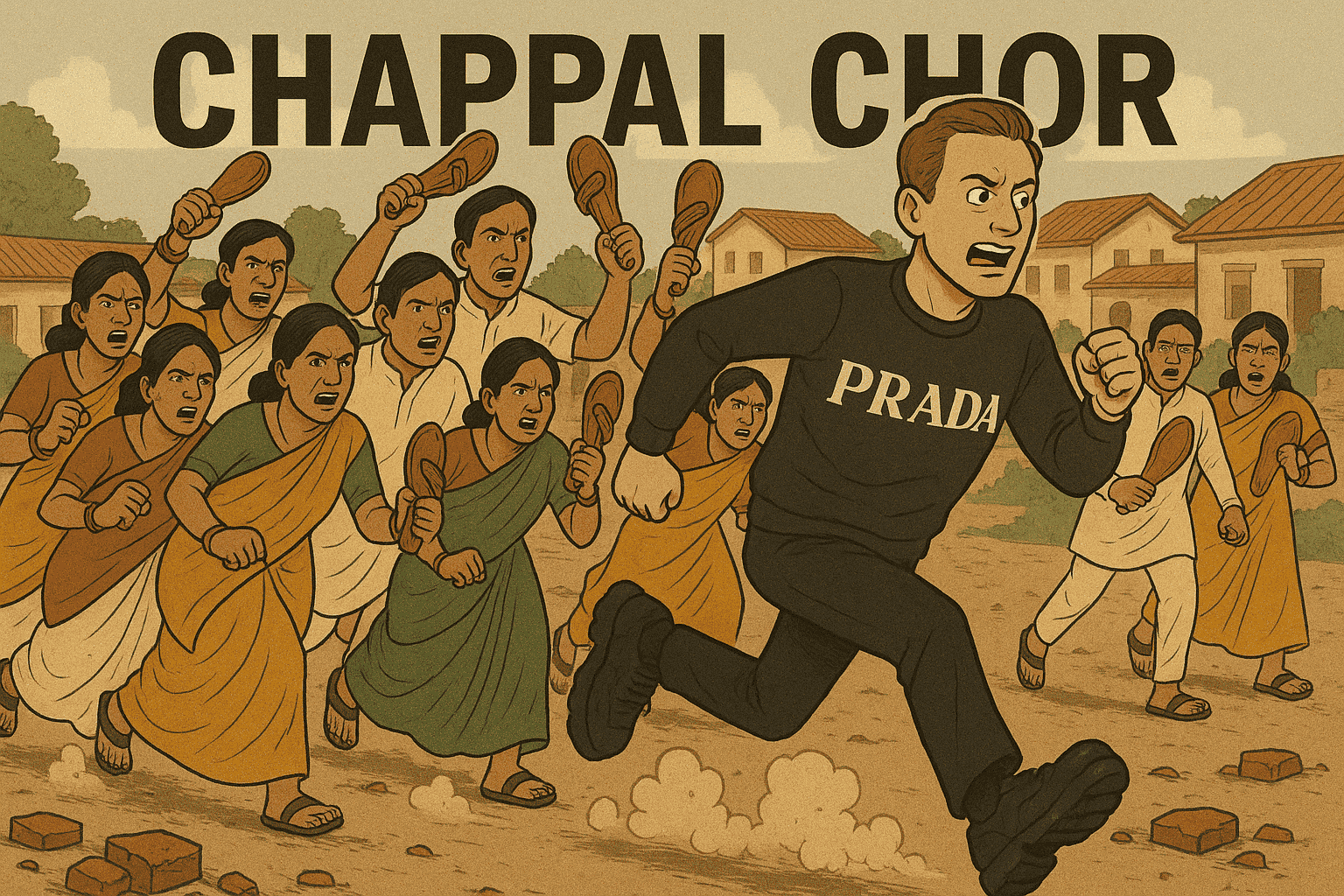
1. Prada–Kolhapuri Chappal Controversy (2025)
- Background: In June 2025, Italian luxury brand Prada unveiled a men’s sandal in its Spring/Summer 2026 collection at Milan Fashion Week that closely resembled the traditional Indian Kolhapuri chappal—a centuries-old handcrafted leather sandal from Maharashtra and Karnataka, protected by a Geographical Indication (GI) tag since 2019.
-
Issue: Prada initially marketed the sandals as their own “leather sandals,” with no mention of India, Kolhapur, or the craft’s legacy, and priced them at over ₹1 lakh (about $1,200), while genuine Kolhapuris sell for around ₹1,000–₹12,000 in India. This omission led to widespread outrage on social media and among Indian artisans, who saw it as cultural appropriation and a violation of the GI tag.
-
Response: After intense backlash, Prada officially acknowledged the Indian inspiration behind the design and expressed willingness to engage with artisan groups. The incident reignited debates about power imbalances in global fashion, the invisibility of original creators, and the need for stronger protection of traditional crafts.
2. Basmati Rice Patent (Ricetec, USA, 1997)
-
Background: In 1997, US company Ricetec Inc. was granted a patent by the US Patent and Trademark Office for certain lines of Basmati rice and its method of cooking. Basmati rice is a premium variety grown in India and Pakistan, known for its unique aroma and long grains.
-
Issue: The patent was seen as an attempt to monopolize the name and qualities of Basmati rice, which has been cultivated in the Indian subcontinent for centuries. The move threatened the livelihoods of Indian farmers and the authenticity of Basmati as a GI product.
-
Response: The Indian government and farmer groups mounted a legal and diplomatic challenge, resulting in the US authorities revoking most of Ricetec’s claims and barring the use of the term “Basmati” for rice grown outside the Indian subcontinent.
3. Turmeric Patent (US Researchers, 1995)
-
Background: In 1995, two US-based researchers were granted a patent for the use of turmeric powder in wound healing—a practice that has been part of Indian traditional medicine (Ayurveda) for centuries.
-
Issue: The patent was widely criticized as an example of “biopiracy,” where traditional knowledge is patented by outsiders without acknowledgment or benefit to the communities that developed it.
-
Response: India’s Council of Scientific and Industrial Research (CSIR) provided evidence of prior traditional use, leading to the patent being revoked in 1997.
4. Neem Patent (USDA/W.R. Grace, USA, 2000)
-
Background: The US Department of Agriculture and chemical company W.R. Grace were granted a European patent for a method of extracting neem oil for use as a fungicide. Neem has been used in Indian agriculture and medicine for centuries.
-
Issue: The patent was seen as an appropriation of traditional Indian knowledge.
-
Response: Indian environmentalists, farmers, and the government challenged the patent, and in 2000, the European Patent Office revoked it on the grounds of “prior art”—proof that the use was already known in India
These incidents highlight a recurring pattern: traditional Indian crafts, agricultural products, and medicinal knowledge being commercialized or patented by foreign companies without proper credit or compensation to Indian creators or communities.
5. Gucci’s Floral Kaftan/Kurta Controversy
- Background:
In 2021, Gucci launched a “floral embroidery organic linen kaftan” priced at $3,500 (approx. ₹2.5 lakh). The garment bore a striking resemblance to the traditional Indian kurta, widely worn across South Asia. The design, embroidery, and silhouette were so familiar that many Indians noted they could find similar pieces in local markets for just a few hundred rupees. - Public Reaction:
The launch sparked widespread backlash on Indian social media, with a wave of criticism, memes, and satire. Many users accused Gucci of cultural appropriation and “fashion colonialism”—profiting from a deeply rooted cultural garment while ignoring its origins. - Cultural Significance:
The kurta is more than just clothing; it’s a cultural staple in India with rich historical and social significance. By labeling it a “kaftan” and failing to acknowledge its South Asian roots, Gucci was widely seen as erasing the garment’s cultural identity.
What is Cultural Misappropriation:
Cultural misappropriation refers to the inappropriate or harmful use of elements from one culture by members of another—often more dominant—culture, typically without understanding, respect, or permission.
It involves the adoption or commercialization of cultural expressions such as traditional dress, music, cuisine, knowledge systems, art, or religious symbols by outsiders. This often reduces meaningful cultural practices to mere fashion trends or marketable commodities, stripping them of their original significance and context.
🌍 What is a Geographical Indication (GI)?
A Geographical Indication (GI) is a type of intellectual property that shows a product comes from a specific place—like a country, region, or town—and has special qualities, reputation, or features because of that location.
For example, famous GI-tagged products in India include:
-
Darjeeling Tea (West Bengal)
-
Pashmina Shawls (Jammu & Kashmir)
-
Madhubani Paintings (Bihar)
-
Kancheepuram Silk (Tamil Nadu)
-
Chanderi Sarees (Madhya Pradesh)
Currently, India has over 650 registered GI products.
Why Are GIs Important?
-
Help local artisans, farmers, and communities
-
Boost exports and rural development
-
Preserve traditional knowledge and heritage
-
Build consumer trust in the product’s authenticity
🏛️ Legal Protection of GIs
-
GIs are collective rights, not owned by any one company.
-
They are protected by laws to stop misuse or fake versions.
-
GIs are legally backed by international rules like the TRIPS Agreement (1995).
-
In India, the Geographical Indications of Goods (Registration and Protection) Act, 1999 governs GIs and came into effect in 2003.
🥿 Can the makers of Kolhapuri chappals claim GI tag violation against Prada?
Not quite, say experts.
According to legal expers, a GI (Geographical Indication) infringement case may not hold up strongly in this situation.
“The affected party can file a case, but it would likely be limited to seeking acknowledgment or credit, not monetary compensation,”
Since Prada did not explicitly use the term ‘Kolhapuri’ or claim to follow its traditional methods, it can legally argue that no violation occurred.
🧵 Why is protecting traditional crafts so difficult?
Protecting traditional crafts under current Intellectual Property (IP) laws is a major challenge, primarily because:
-
IP laws are made for individual innovation, not community knowledge.
-
Traditional crafts are often collective, ancient, and orally transmitted, making them hard to document.
-
Most IP systems require a known creator and novelty, while traditional crafts are already in the public domain.
-
IP protections (except trademarks) have limited durations, whereas traditional heritage needs ongoing protection.
“These crafts fail the ‘novelty’ test and lack formal records, which makes them incompatible with modern IP laws,”
🛡️ So how can we protect against cultural misappropriation?
While the GI tag helps to some extent, more targeted legal tools are needed.
-
Some countries are working on new laws to protect traditional knowledge and cultural expressions.
-
Communities should document and register their crafts at local or national levels to assert moral and economic rights.
-
Ethical and Fair-Trade labels can raise consumer awareness and support fair pay for artisans.
International bodies like the World Intellectual Property Organization (WIPO) are also working on a global legal framework to protect traditional knowledge and cultural heritage.
Receive Daily Updates
Recent Posts
Steve Ovett, the famous British middle-distance athlete, won the 800-metres gold medal at the Moscow Olympics of 1980. Just a few days later, he was about to win a 5,000-metres race at London’s Crystal Palace. Known for his burst of acceleration on the home stretch, he had supreme confidence in his ability to out-sprint rivals. With the final 100 metres remaining,
[wptelegram-join-channel link=”https://t.me/s/upsctree” text=”Join @upsctree on Telegram”]Ovett waved to the crowd and raised a hand in triumph. But he had celebrated a bit too early. At the finishing line, Ireland’s John Treacy edged past Ovett. For those few moments, Ovett had lost his sense of reality and ignored the possibility of a negative event.
This analogy works well for the India story and our policy failures , including during the ongoing covid pandemic. While we have never been as well prepared or had significant successes in terms of growth stability as Ovett did in his illustrious running career, we tend to celebrate too early. Indeed, we have done so many times before.
It is as if we’re convinced that India is destined for greater heights, come what may, and so we never run through the finish line. Do we and our policymakers suffer from a collective optimism bias, which, as the Nobel Prize winner Daniel Kahneman once wrote, “may well be the most significant of the cognitive biases”? The optimism bias arises from mistaken beliefs which form expectations that are better than the reality. It makes us underestimate chances of a negative outcome and ignore warnings repeatedly.
The Indian economy had a dream run for five years from 2003-04 to 2007-08, with an average annual growth rate of around 9%. Many believed that India was on its way to clocking consistent double-digit growth and comparisons with China were rife. It was conveniently overlooked that this output expansion had come mainly came from a few sectors: automobiles, telecom and business services.
Indians were made to believe that we could sprint without high-quality education, healthcare, infrastructure or banking sectors, which form the backbone of any stable economy. The plan was to build them as we went along, but then in the euphoria of short-term success, it got lost.
India’s exports of goods grew from $20 billion in 1990-91 to over $310 billion in 2019-20. Looking at these absolute figures it would seem as if India has arrived on the world stage. However, India’s share of global trade has moved up only marginally. Even now, the country accounts for less than 2% of the world’s goods exports.
More importantly, hidden behind this performance was the role played by one sector that should have never made it to India’s list of exports—refined petroleum. The share of refined petroleum exports in India’s goods exports increased from 1.4% in 1996-97 to over 18% in 2011-12.
An import-intensive sector with low labour intensity, exports of refined petroleum zoomed because of the then policy regime of a retail price ceiling on petroleum products in the domestic market. While we have done well in the export of services, our share is still less than 4% of world exports.
India seemed to emerge from the 2008 global financial crisis relatively unscathed. But, a temporary demand push had played a role in the revival—the incomes of many households, both rural and urban, had shot up. Fiscal stimulus to the rural economy and implementation of the Sixth Pay Commission scales had led to the salaries of around 20% of organized-sector employees jumping up. We celebrated, but once again, neither did we resolve the crisis brewing elsewhere in India’s banking sector, nor did we improve our capacity for healthcare or quality education.
Employment saw little economy-wide growth in our boom years. Manufacturing jobs, if anything, shrank. But we continued to celebrate. Youth flocked to low-productivity service-sector jobs, such as those in hotels and restaurants, security and other services. The dependence on such jobs on one hand and high-skilled services on the other was bound to make Indian society more unequal.
And then, there is agriculture, an elephant in the room. If and when farm-sector reforms get implemented, celebrations would once again be premature. The vast majority of India’s farmers have small plots of land, and though these farms are at least as productive as larger ones, net absolute incomes from small plots can only be meagre.
A further rise in farm productivity and consequent increase in supply, if not matched by a demand rise, especially with access to export markets, would result in downward pressure on market prices for farm produce and a further decline in the net incomes of small farmers.
We should learn from what John Treacy did right. He didn’t give up, and pushed for the finish line like it was his only chance at winning. Treacy had years of long-distance practice. The same goes for our economy. A long grind is required to build up its base before we can win and celebrate. And Ovett did not blame anyone for his loss. We play the blame game. Everyone else, right from China and the US to ‘greedy corporates’, seems to be responsible for our failures.
We have lowered absolute poverty levels and had technology-based successes like Aadhaar and digital access to public services. But there are no short cuts to good quality and adequate healthcare and education services. We must remain optimistic but stay firmly away from the optimism bias.
In the end, it is not about how we start, but how we finish. The disastrous second wave of covid and our inability to manage it is a ghastly reminder of this fact.