By Categories: Environment

Why in News: Odisha has begun the process to declare the Rushikulya rookery in Ganjam district as a Biodiversity Heritage Site, recognising its global importance as a major nesting ground for Olive Ridley sea turtles and a lifeline for local communities.

Rushikulya rookery: a unique coastal ecosystem

The Rushikulya rookery stretches for about 10 km from New Podampeta to Agasti Nuagaon along the river mouth and adjoining sea beach in Ganjam district. It is recognised as one of the world’s major mass nesting, or Arribada, sites where thousands of Olive Ridley sea turtles come ashore to lay eggs every year. This fragile coastal belt also supports migratory and resident birds, diverse plant species and a rich estuarine environment.

The surrounding Prayagi reserve forest, spread over nearly 415 hectares near the sea mouth, further enhances the ecological value of the landscape. This forest harbouring many native and medicinal plants links the marine and terrestrial habitats, creating a mosaic of biodiversity that is rare along India’s eastern coast​.

Why biodiversity heritage status matters

The Odisha government, through the Odisha Biodiversity Board, has initiated the process to confer Biodiversity Heritage Site status on around 747 hectares in and around the rookery under Section 37 of the Biological Diversity Act, 2002. Scientists and researchers have already conducted a preliminary survey along the river mouth and sea beach after the Berhampur forest division submitted a formal proposal. This move signals a policy-level commitment to long-term protection of the rookery’s ecology and its associated cultural landscape.

Confluence of nature, culture and faith

Rushikulya is not only an ecological asset but also a cultural and spiritual space. The river is closely associated with local rituals, festivals and traditional practices that have evolved around its seasonal rhythms and natural cycles. Near the river mouth stands the Bateswar Temple, which embodies a convergence of sacred ecology and cultural heritage amid a biodiverse landscape.

What are Biodiversity Heritage Sites ?

Biodiversity Heritage Sites (BHS) are unique, ecologically fragile, and biodiversity-rich areas—terrestrial, coastal, or inland waters—designated under Section 37 of India’s Biological Diversity Act, 2002. They harbor rare, threatened species and high endemism, emphasizing conservation without restricting local community usage

Key Features of Biodiversity Heritage Sites:

  • Designation: Declared by State Governments in consultation with local bodies (Panchayats/BMCs).
  • Significance: These sites often contain high species richness, wild ancestors of cultivated plants, and significant cultural/aesthetic values.
  • Purpose: To enhance the quality of life of local communities and preserve unique ecosystems.
  • Notable Examples in India:
    • Nallur Tamarind Grove (Karnataka): India’s first BHS (2007), known for ancient tamarind trees.
    • Majuli Island (Assam): Largest river island with unique aquatic/terrestrial biodiversity.
    • Aravalli Biodiversity Park (Haryana): Urban green space.
    • Chilika Lake (Odisha): Major habitat for migratory birds.
    • Gupteswar Forest (Odisha): Rich in biodiversity and sacred groves.
    • Ambaragudda (Karnataka): Features rare Shola vegetation.

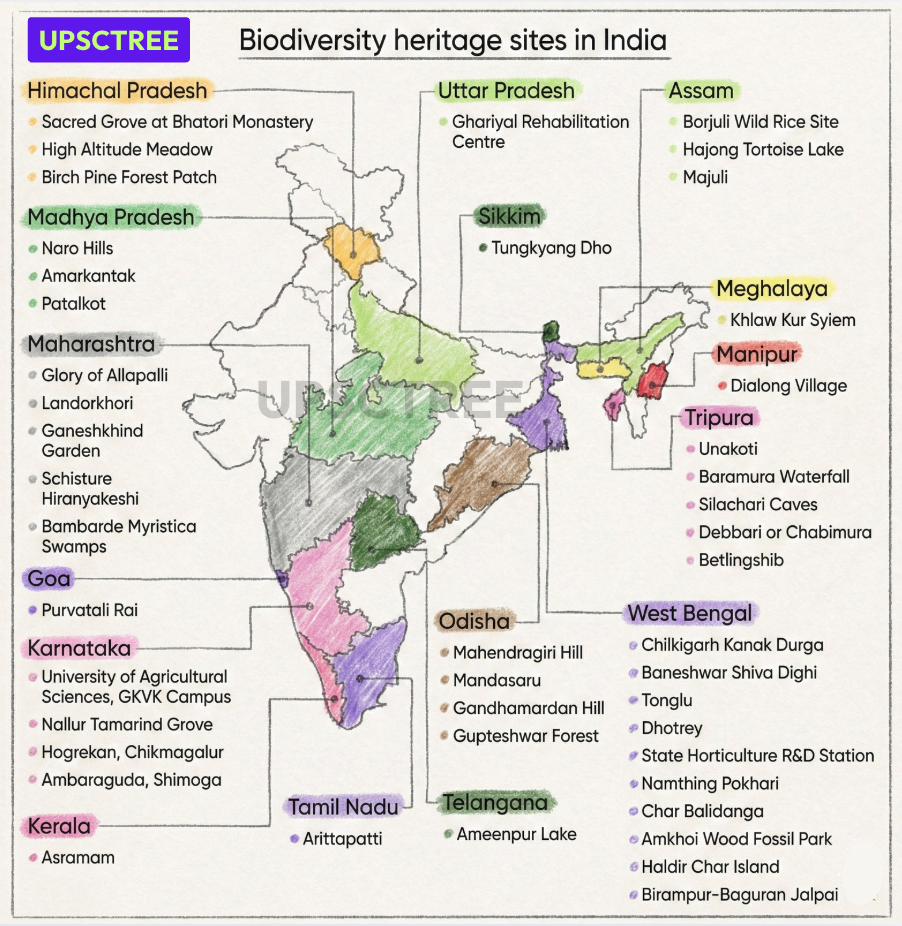
Biodiversity Heritage Sites of India:
Q1. Consider the following statements regarding the Rushikulya Rookery:

  1. It is located in the Ganjam district of Odisha and is globally recognized as an Arribada site for Olive Ridley sea turtles.

  2. The rookery is situated at the mouth of the Mahanadi River, supporting a rich estuarine environment.

  3. The ecosystem’s ecological value is further enhanced by the adjoining Prayagi reserve forest, which connects marine and terrestrial habitats.

Which of the statements given above are correct?
(a) 1 and 2 only

(b) 1 and 3 only

(c) 2 and 3 only

(d) 1, 2, and 3

Q2. With reference to ‘Biodiversity Heritage Sites (BHS)’ in India, consider the following statements:

  1. They are notified by the Central Government under the Environment (Protection) Act, 1986.

  2. The designation of a BHS restricts all traditional resource usage by local communities to ensure absolute conservation of threatened species.

  3. India’s first Biodiversity Heritage Site was declared in Karnataka.

Which of the statements given above is/are correct?

(a) 1 and 2 only

(b) 3 only

(c) 1 and 3 only

(d) None

Q3. Consider the following pairs of Biodiversity Heritage Sites and their key features/locations:

  1. Ambaragudda : Rare Shola vegetation

  2. Majuli Island : Largest river island located in West Bengal

  3. Nallur Tamarind Grove : Ancient trees and India’s first BHS

How many of the above pairs are correctly matched?

(a) Only one pair

(b) Only two pairs

(c) All three pairs

(d) None of the pairs

Q4. Consider the following statements:

  • Statement-I: State Governments have the authority to unilaterally declare any ecologically fragile area as a Biodiversity Heritage Site (BHS) for immediate conservation.

  • Statement-II: The Biological Diversity Act, 2002 mandates consultation with local bodies, such as Panchayats or Biodiversity Management Committees (BMCs), before designating a BHS.

Which one of the following is correct in respect of the above statements?

(a) Both Statement-I and Statement-II are correct and Statement-II is the correct explanation for Statement-I.

(b) Both Statement-I and Statement-II are correct but Statement-II is not the correct explanation for Statement-I.

(c) Statement-I is correct but Statement-II is incorrect.

(d) Statement-I is incorrect but Statement-II is correct.


Answer Key and Explanations

Ans 1. (b) 1 and 3 only

  • Statement 1 is correct: The passage states the Rushikulya rookery is in the Ganjam district and is a major mass nesting (Arribada) site for Olive Ridley turtles.

  • Statement 2 is incorrect: It is located along the Rushikulya river mouth, not the Mahanadi river.

  • Statement 3 is correct: The text mentions the surrounding Prayagi reserve forest links the marine and terrestrial habitats.

Ans 2. (b) 3 only

  • Statement 1 is incorrect: BHS are designated under Section 37 of India’s Biological Diversity Act, 2002 (not the EPA, 1986) by State Governments (not the Central Government).

  • Statement 2 is incorrect: The passage explicitly notes that BHS designation emphasizes conservation without restricting local community usage.

  • Statement 3 is correct: Nallur Tamarind Grove in Karnataka was India’s first BHS, declared in 2007.

Ans 3. (b) Only two pairs

  • Pair 1 is correctly matched: Ambaragudda (Karnataka) features rare Shola vegetation.

  • Pair 2 is incorrectly matched: Majuli Island is the largest river island, but it is located in Assam, not West Bengal.

  • Pair 3 is correctly matched: Nallur Tamarind Grove is known for its ancient tamarind trees and was the first BHS.

Ans 4. (d) Statement-I is incorrect but Statement-II is correct.

  • Statement-I is incorrect: State Governments cannot declare these sites “unilaterally.” They must do so in consultation with local bodies.

  • Statement-II is correct: Section 37 of the Biological Diversity Act, 2002 requires the State Government to consult with local bodies like Panchayats/BMCs before making the declaration.

Share is Caring, Choose Your Platform!

Recent Posts


  • In a diverse country like India, where each State is socially, culturally, economically, and politically distinct, measuring Governance becomes increasingly tricky. The Public Affairs Index (PAI 2021) is a scientifically rigorous, data-based framework that measures the quality of governance at the Sub-national level and ranks the States and Union Territories (UTs) of India on a Composite Index (CI).


    States are classified into two categories – Large and Small – using population as the criteria.

    In PAI 2021, PAC defined three significant pillars that embody GovernanceGrowth, Equity, and Sustainability. Each of the three Pillars is circumscribed by five governance praxis Themes.

    The themes include – Voice and Accountability, Government Effectiveness, Rule of Law, Regulatory Quality and Control of Corruption.

    At the bottom of the pyramid, 43 component indicators are mapped to 14 Sustainable Development Goals (SDGs) that are relevant to the States and UTs.

    This forms the foundation of the conceptual framework of PAI 2021. The choice of the 43 indicators that go into the calculation of the CI were dictated by the objective of uncovering the complexity and multidimensional character of development governance

    The Equity Principle

    The Equity Pillar of the PAI 2021 Index analyses the inclusiveness impact at the Sub-national level in the country; inclusiveness in terms of the welfare of a society that depends primarily on establishing that all people feel that they have a say in the governance and are not excluded from the mainstream policy framework.

    This requires all individuals and communities, but particularly the most vulnerable, to have an opportunity to improve or maintain their wellbeing. This chapter of PAI 2021 reflects the performance of States and UTs during the pandemic and questions the governance infrastructure in the country, analysing the effectiveness of schemes and the general livelihood of the people in terms of Equity.

    Growth and its Discontents

    Growth in its multidimensional form encompasses the essence of access to and the availability and optimal utilisation of resources. By resources, PAI 2021 refer to human resources, infrastructure and the budgetary allocations. Capacity building of an economy cannot take place if all the key players of growth do not drive development. The multiplier effects of better health care, improved educational outcomes, increased capital accumulation and lower unemployment levels contribute magnificently in the growth and development of the States.

    The Pursuit Of Sustainability

    The Sustainability Pillar analyses the access to and usage of resources that has an impact on environment, economy and humankind. The Pillar subsumes two themes and uses seven indicators to measure the effectiveness of government efforts with regards to Sustainability.


    The Curious Case Of The Delta

    The Delta Analysis presents the results on the State performance on year-on-year improvement. The rankings are measured as the Delta value over the last five to 10 years of data available for 12 Key Development Indicators (KDI). In PAI 2021, 12 indicators across the three Pillars of Equity (five indicators), Growth (five indicators) and Sustainability (two indicators). These KDIs are the outcome indicators crucial to assess Human Development. The Performance in the Delta Analysis is then compared to the Overall PAI 2021 Index.

    Key Findings:-

    1. In the Large States category (overall), Chhattisgarh ranks 1st, followed by Odisha and Telangana, whereas, towards the bottom are Maharashtra at 16th, Assam at 17th and Gujarat at 18th. Gujarat is one State that has seen startling performance ranking 5th in the PAI 2021 Index outperforming traditionally good performing States like Andhra Pradesh and Karnataka, but ranks last in terms of Delta
    2. In the Small States category (overall), Nagaland tops, followed by Mizoram and Tripura. Towards the tail end of the overall Delta ranking is Uttarakhand (9th), Arunachal Pradesh (10th) and Meghalaya (11th). Nagaland despite being a poor performer in the PAI 2021 Index has come out to be the top performer in Delta, similarly, Mizoram’s performance in Delta is also reflected in it’s ranking in the PAI 2021 Index
    3. In terms of Equity, in the Large States category, Chhattisgarh has the best Delta rate on Equity indicators, this is also reflected in the performance of Chhattisgarh in the Equity Pillar where it ranks 4th. Following Chhattisgarh is Odisha ranking 2nd in Delta-Equity ranking, but ranks 17th in the Equity Pillar of PAI 2021. Telangana ranks 3rd in Delta-Equity ranking even though it is not a top performer in this Pillar in the overall PAI 2021 Index. Jharkhand (16th), Uttar Pradesh (17th) and Assam (18th) rank at the bottom with Uttar Pradesh’s performance in line with the PAI 2021 Index
    4. Odisha and Nagaland have shown the best year-on-year improvement under 12 Key Development indicators.

    In the Scheme of Things

    The Scheme Analysis adds an additional dimension to ranking of the States on their governance. It attempts to complement the Governance Model by trying to understand the developmental activities undertaken by State Governments in the form of schemes. It also tries to understand whether better performance of States in schemes reflect in better governance.

    The Centrally Sponsored schemes that were analysed are National Health Mission (NHM), Umbrella Integrated Child Development Services scheme (ICDS), Mahatma Gandh National Rural Employment Guarantee Scheme (MGNREGS), Samagra Shiksha Abhiyan (SmSA) and MidDay Meal Scheme (MDMS).

    National Health Mission (NHM)

    • In the 60:40 division States, the top three performers are Kerala, Goa and Tamil Nadu and, the bottom three performers are Uttar Pradesh, Jharkhand and Bihar.
    • In the 90:10 division States, the top three performers were Himachal Pradesh, Sikkim and Mizoram; and, the bottom three performers are Manipur, Assam and Meghalaya.


    INTEGRATED CHILD DEVELOPMENT SERVICES (ICDS)

    • Among the 60:40 division States, Orissa, Chhattisgarh and Madhya Pradesh are the top three performers and Tamil Nadu, Telangana and Delhi appear as the bottom three performers.
    • Among the 90:10 division States, the top three performers are Manipur, Arunachal Pradesh and Nagaland; and, the bottom three performers are Jammu and Kashmir, Uttarakhand and Himachal Pradesh


    MID- DAY MEAL SCHEME (MDMS)

    • Among the 60:40 division States, Goa, West Bengal and Delhi appear as the top three performers and Andhra Pradesh, Telangana and Bihar appear as the bottom three performers.
    • Among the 90:10 division States, Mizoram, Himachal Pradesh and Tripura were the top three performers and Jammu & Kashmir, Nagaland and Arunachal Pradesh were the bottom three performers


    SAMAGRA SHIKSHA ABHIYAN (SMSA)

    • West Bengal, Bihar and Tamil Nadu were the top three States amongst the 60:40 division States; while Haryana, Punjab and Rajasthan appeared as the bottom three performers
    • In the case of 90:10 division States, Mizoram, Assam and Tripura were the top three performers and Nagaland, Jammu & Kashmir and Uttarakhand featured as the bottom three


    MAHATMA GANDHI NATIONAL RURAL EMPLOYMENT GUARANTEE SCHEME (MGNREGS)

    • Among the 60:40 division States, the top three performers are Kerala, Andhra Pradesh and Orissa and the bottom three performers are Madhya Pradesh, Jharkhand and Goa
    • In the 90:10 division States, the top three performers are Mizoram, Sikkim and Nagaland and the bottom three performers are Manipur and Assam