1) The President of India has promulgated ordinance for constitution of commercial courts.
Commercial Courts Bill, 2015
- The Commercial Courts, Commercial Division and Commercial Appellate Division of High Courts Bill, 2015 was introduced in Rajya Sabha on April 29, 2015 by the Minister of Finance, Mr. Arun Jaitley.
- The Bill enables the creation of commercial divisions in high courts, and commercial courts at the district level.
- Commercial dispute: A commercial dispute is defined to include any dispute related to transactions between merchants, bankers, financiers, traders, etc. Such transactions deal with mercantile documents, partnership agreements, intellectual property rights, insurance, etc.
- Commercial courts: Commercial courts, equivalent to district courts, may be set up in all states and union territories, by the state governments after consulting with their respective high courts
- Valuation of dispute: Such commercial divisions in high courts and commercial courts will deal with all matters relating to commercial disputes involving an amount of Rs one crore or more.
- Commercial appellate divisions: Commercial appellate divisions may be set up in all high courts to hear appeals against: (i) orders of commercial divisions of high courts; (ii) orders of commercial courts; and (iii) appeals arising from arbitration matters that are filed before the high courts.
- Any appeal filed in a high court against the orders of certain tribunals like: (i) Competition Appellate Tribunal; (ii) Debt Recovery Appellate Tribunal; (iii) Intellectual Property Appellate Board; (iv) Company Law Board or the National Company Law Tribunal; (v) Securities Appellate Tribunal; and (vi) Telecom Dispute Settlement and Appellate tribunal may be heard by the commercial appellate division of the high court if it relates to a commercial dispute.
- Transfer of pending suits: All suits, that are yet to reach judgement, of a value of Rs one crore or more that are pending in the high court or district court shall be transferred to the commercial division, after it is constituted.
2) Third Indo-African Summit to be held in New Delhi.
Indo-African Summit
- The India–Africa Forum Summit is the official platform for the Inida-Africa relations. It was first held New Delhi, India. It was the first such meeting between the heads of state and government of India and 14 countries of Africa chosen by the African Union.
- Topics
agricultural sector
trade
industry and investment
peace and security
promotion of good governance and civil society
information and communication technology
3) Unakoti – Rock Cut Carving , Tales of a lost Civilization
- Unakoti , situated in North Tripura , hosts finest of rock-cut architecture and stone- images.
- Unakoti pantheons are of two types namely rock-carved and stone images. Central to these rock cut carvings are the Shiva and Ganesha. The colossal image of Shiva head, of 30 ft height, carved in a vertical rock is known as ‘Unakotiswara Kal Bhairava’
- Near by, there is a rock cut image of goddess Durga standing on a lion, while on the other there is an image of goddess Ganga sitting on a Capricorn. There are also images of Nandi Bull lying half buried in the ground
- At the bottom of Unakoti, a beautiful spring descending the hill terraces fills up a cavern, called “Sita Kunda”, having a dip into which is regarded as sacred.
- Unakoti is believed to have had the influence of the Shiva cult originating from the Pala-era of the mediaeval period of Indian history. At the same time, the influences of several other cults like Tantric, Shakti, and Hatha yogis are also found to be present around this archaeological wonder. According to the Archaeological Survey of India (ASI),Unakoti dates back to the 8th or 9th century AD. Yet, many others differ with the opinion, conceding that it dates back longer further holding that those images were carved out in different spell of time.

4) Deprtment of Atomic Energy, Mandates and Achievements
- Mandate:-
- Research Innovation Education
- National Security
- Advanced technology and water resources
- Food, Agriculture and Industrial Applications
- Healthcare
- Nuclear Power and Fuel Cycle
- Highlights:-
- Tummalapalle (A.P) uranium mine: Processing plant to be commissioned in 2015-16.
- India will host the International Thorium Energy Conference (ThEC) in Mumbai in October 2015
- DAE Units supply over 23,000 consignments of radiopharmaceuticals to over 150 nuclear medicine centres and hospitals all over India.
- Vitrified Cesium-137 pencil, First-of-a-kind in the world, developed by BARC by recovery from High Level Waste. First set of 10 pencils delivered for use in Blood Irradiator units produced by BRIT-DAE.
- High yielding pigeon-pea variety Trombay Akola Red Arhar released for commercial cultivation
- Radiation processing plants set up with DAE technology at Unnao, Lucknow and Bavla, Ahmedabad
- Low-cost wound dressing (BaNOcol) developed at BARC – very effective against a broad spectrum of infection-causing microbes
- Strengthened collaborative involvement with LHC- CERN; process to become an Associate Member of CERN initiated.
5) Mission IndraDhanush :-
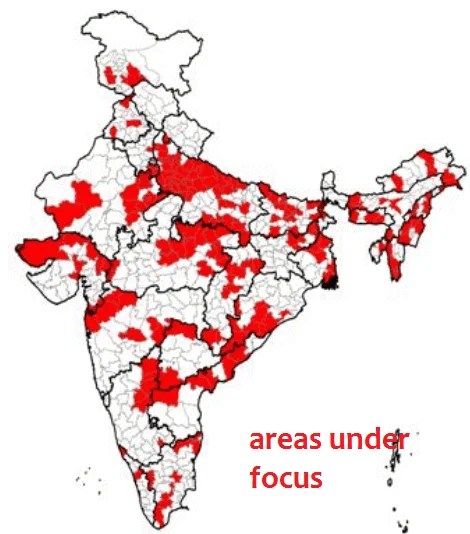
- The Ministry of Health and Family Welfare, Government of India has launched Mission Indradhanush on 25 December, 2014 as a special nationwide initiative to vaccinate all unvaccinated and partially vaccinated children under the Universal Immunization Programme and sustain it by health system strengthening by 2020
- The Mission focuses on interventions to expand full immunization coverage in India from 65% in 2014 to at least 90% children in the next five years
- The programme provides immunization against seven life-threatening diseases (diphtheria, whooping cough, tetanus, polio, tuberculosis, measles and hepatitis B) in the entire country. In addition, vaccination against Heamophilus influenza type B and Japanese Encephalitis is provided in select districts/states.

6) International Tourism Mart:-
- The Ministry of Tourism, Government of India, in association with the North Eastern States and West Bengal has been successfully organising the International Tourism Mart over the last three years in various North Eastern States with the objective of highlighting the tourism potential of the region in the domestic and international markets. This Mart also brings together the tourism business fraternity and entrepreneurs from the eight North Eastern States and West Bengal.
Sorces- PIB and Various relevant newspapers
Receive Daily Updates
Recent Posts
Petrol in India is cheaper than in countries like Hong Kong, Germany and the UK but costlier than in China, Brazil, Japan, the US, Russia, Pakistan and Sri Lanka, a Bank of Baroda Economics Research report showed.
Rising fuel prices in India have led to considerable debate on which government, state or central, should be lowering their taxes to keep prices under control.
The rise in fuel prices is mainly due to the global price of crude oil (raw material for making petrol and diesel) going up. Further, a stronger dollar has added to the cost of crude oil.
Amongst comparable countries (per capita wise), prices in India are higher than those in Vietnam, Kenya, Ukraine, Bangladesh, Nepal, Pakistan, Sri Lanka, and Venezuela. Countries that are major oil producers have much lower prices.
In the report, the Philippines has a comparable petrol price but has a per capita income higher than India by over 50 per cent.
Countries which have a lower per capita income like Kenya, Bangladesh, Nepal, Pakistan, and Venezuela have much lower prices of petrol and hence are impacted less than India.
“Therefore there is still a strong case for the government to consider lowering the taxes on fuel to protect the interest of the people,” the report argued.
India is the world’s third-biggest oil consuming and importing nation. It imports 85 per cent of its oil needs and so prices retail fuel at import parity rates.
With the global surge in energy prices, the cost of producing petrol, diesel and other petroleum products also went up for oil companies in India.
They raised petrol and diesel prices by Rs 10 a litre in just over a fortnight beginning March 22 but hit a pause button soon after as the move faced criticism and the opposition parties asked the government to cut taxes instead.
India imports most of its oil from a group of countries called the ‘OPEC +’ (i.e, Iran, Iraq, Saudi Arabia, Venezuela, Kuwait, United Arab Emirates, Russia, etc), which produces 40% of the world’s crude oil.
As they have the power to dictate fuel supply and prices, their decision of limiting the global supply reduces supply in India, thus raising prices
The government charges about 167% tax (excise) on petrol and 129% on diesel as compared to US (20%), UK (62%), Italy and Germany (65%).
The abominable excise duty is 2/3rd of the cost, and the base price, dealer commission and freight form the rest.
Here is an approximate break-up (in Rs):
a)Base Price | 39 |
b)Freight | 0.34 |
c) Price Charged to Dealers = (a+b) | 39.34 |
d) Excise Duty | 40.17 |
e) Dealer Commission | 4.68 |
f) VAT | 25.35 |
g) Retail Selling Price | 109.54 |
Looked closely, much of the cost of petrol and diesel is due to higher tax rate by govt, specifically excise duty.
So the question is why government is not reducing the prices ?
India, being a developing country, it does require gigantic amount of funding for its infrastructure projects as well as welfare schemes.
However, we as a society is yet to be tax-compliant. Many people evade the direct tax and that’s the reason why govt’s hands are tied. Govt. needs the money to fund various programs and at the same time it is not generating enough revenue from direct taxes.
That’s the reason why, govt is bumping up its revenue through higher indirect taxes such as GST or excise duty as in the case of petrol and diesel.
Direct taxes are progressive as it taxes according to an individuals’ income however indirect tax such as excise duty or GST are regressive in the sense that the poorest of the poor and richest of the rich have to pay the same amount.
Does not matter, if you are an auto-driver or owner of a Mercedes, end of the day both pay the same price for petrol/diesel-that’s why it is regressive in nature.
But unlike direct tax where tax evasion is rampant, indirect tax can not be evaded due to their very nature and as long as huge no of Indians keep evading direct taxes, indirect tax such as excise duty will be difficult for the govt to reduce, because it may reduce the revenue and hamper may programs of the govt.
Globally, around 80% of wastewater flows back into the ecosystem without being treated or reused, according to the United Nations.
This can pose a significant environmental and health threat.
In the absence of cost-effective, sustainable, disruptive water management solutions, about 70% of sewage is discharged untreated into India’s water bodies.
A staggering 21% of diseases are caused by contaminated water in India, according to the World Bank, and one in five children die before their fifth birthday because of poor sanitation and hygiene conditions, according to Startup India.
As we confront these public health challenges emerging out of environmental concerns, expanding the scope of public health/environmental engineering science becomes pivotal.
For India to achieve its sustainable development goals of clean water and sanitation and to address the growing demands for water consumption and preservation of both surface water bodies and groundwater resources, it is essential to find and implement innovative ways of treating wastewater.
It is in this context why the specialised cadre of public health engineers, also known as sanitation engineers or environmental engineers, is best suited to provide the growing urban and rural water supply and to manage solid waste and wastewater.
Traditionally, engineering and public health have been understood as different fields.
Currently in India, civil engineering incorporates a course or two on environmental engineering for students to learn about wastewater management as a part of their pre-service and in-service training.
Most often, civil engineers do not have adequate skills to address public health problems. And public health professionals do not have adequate engineering skills.
India aims to supply 55 litres of water per person per day by 2024 under its Jal Jeevan Mission to install functional household tap connections.
The goal of reaching every rural household with functional tap water can be achieved in a sustainable and resilient manner only if the cadre of public health engineers is expanded and strengthened.
In India, public health engineering is executed by the Public Works Department or by health officials.
This differs from international trends. To manage a wastewater treatment plant in Europe, for example, a candidate must specialise in wastewater engineering.
Furthermore, public health engineering should be developed as an interdisciplinary field. Engineers can significantly contribute to public health in defining what is possible, identifying limitations, and shaping workable solutions with a problem-solving approach.
Similarly, public health professionals can contribute to engineering through well-researched understanding of health issues, measured risks and how course correction can be initiated.
Once both meet, a public health engineer can identify a health risk, work on developing concrete solutions such as new health and safety practices or specialised equipment, in order to correct the safety concern..
There is no doubt that the majority of diseases are water-related, transmitted through consumption of contaminated water, vectors breeding in stagnated water, or lack of adequate quantity of good quality water for proper personal hygiene.
Diseases cannot be contained unless we provide good quality and adequate quantity of water. Most of the world’s diseases can be prevented by considering this.
Training our young minds towards creating sustainable water management systems would be the first step.
Currently, institutions like the Indian Institute of Technology, Madras (IIT-M) are considering initiating public health engineering as a separate discipline.
To leverage this opportunity even further, India needs to scale up in the same direction.
Consider this hypothetical situation: Rajalakshmi, from a remote Karnataka village spots a business opportunity.
She knows that flowers, discarded in the thousands by temples can be handcrafted into incense sticks.
She wants to find a market for the product and hopefully, employ some people to help her. Soon enough though, she discovers that starting a business is a herculean task for a person like her.
There is a laborious process of rules and regulations to go through, bribes to pay on the way and no actual means to transport her product to its market.
After making her first batch of agarbathis and taking it to Bengaluru by bus, she decides the venture is not easy and gives up.
On the flipside of this is a young entrepreneur in Bengaluru. Let’s call him Deepak. He wants to start an internet-based business selling sustainably made agarbathis.
He has no trouble getting investors and to mobilise supply chains. His paperwork is over in a matter of days and his business is set up quickly and ready to grow.
Never mind that the business is built on aggregation of small sellers who will not see half the profit .
Is this scenario really all that hypothetical or emblematic of how we think about entrepreneurship in India?
Between our national obsession with unicorns on one side and glorifying the person running a pakora stall for survival as an example of viable entrepreneurship on the other, is the middle ground in entrepreneurship—a space that should have seen millions of thriving small and medium businesses, but remains so sparsely occupied that you could almost miss it.
If we are to achieve meaningful economic growth in our country, we need to incorporate, in our national conversation on entrepreneurship, ways of addressing the missing middle.
Spread out across India’s small towns and cities, this is a class of entrepreneurs that have been hit by a triple wave over the last five years, buffeted first by the inadvertent fallout of demonetization, being unprepared for GST, and then by the endless pain of the covid-19 pandemic.
As we finally appear to be reaching some level of normality, now is the opportune time to identify the kind of industries that make up this layer, the opportunities they should be afforded, and the best ways to scale up their functioning in the shortest time frame.
But, why pay so much attention to these industries when we should be celebrating, as we do, our booming startup space?
It is indeed true that India has the third largest number of unicorns in the world now, adding 42 in 2021 alone. Braving all the disruptions of the pandemic, it was a year in which Indian startups raised $24.1 billion in equity investments, according to a NASSCOM-Zinnov report last year.
However, this is a story of lopsided growth.
The cities of Bengaluru, Delhi/NCR, and Mumbai together claim three-fourths of these startup deals while emerging hubs like Ahmedabad, Coimbatore, and Jaipur account for the rest.
This leap in the startup space has created 6.6 lakh direct jobs and a few million indirect jobs. Is that good enough for a country that sends 12 million fresh graduates to its workforce every year?
It doesn’t even make a dent on arguably our biggest unemployment in recent history—in April 2020 when the country shutdown to battle covid-19.
Technology-intensive start-ups are constrained in their ability to create jobs—and hybrid work models and artificial intelligence (AI) have further accelerated unemployment.
What we need to focus on, therefore, is the labour-intensive micro, small and medium enterprise (MSME). Here, we begin to get to a definitional notion of what we called the mundane middle and the problems it currently faces.
India has an estimated 63 million enterprises. But, out of 100 companies, 95 are micro enterprises—employing less than five people, four are small to medium and barely one is large.
The questions to ask are: why are Indian MSMEs failing to grow from micro to small and medium and then be spurred on to make the leap into large companies?
At the Global Alliance for Mass Entrepreneurship (GAME), we have advocated for a National Mission for Mass Entrepreneurship, the need for which is more pronounced now than ever before.
Whenever India has worked to achieve a significant economic milestone in a limited span of time, it has worked best in mission mode. Think of the Green Revolution or Operation Flood.
From across various states, there are enough examples of approaches that work to catalyse mass entrepreneurship.
The introduction of entrepreneurship mindset curriculum (EMC) in schools through alliance mode of working by a number of agencies has shown significant improvement in academic and life outcomes.
Through creative teaching methods, students are encouraged to inculcate 21st century skills like creativity, problem solving, critical thinking and leadership which are not only foundational for entrepreneurship but essential to thrive in our complex world.
Udhyam Learning Foundation has been involved with the Government of Delhi since 2018 to help young people across over 1,000 schools to develop an entrepreneurial mindset.
One pilot programme introduced the concept of ‘seed money’ and saw 41 students turn their ideas into profit-making ventures. Other programmes teach qualities like grit and resourcefulness.
If you think these are isolated examples, consider some larger data trends.
The Observer Research Foundation and The World Economic Forum released the Young India and Work: A Survey of Youth Aspirations in 2018.
When asked which type of work arrangement they prefer, 49% of the youth surveyed said they prefer a job in the public sector.
However, 38% selected self-employment as an entrepreneur as their ideal type of job. The spirit of entrepreneurship is latent and waiting to be unleashed.
The same can be said for building networks of successful women entrepreneurs—so crucial when the participation of women in the Indian economy has declined to an abysmal 20%.
The majority of India’s 63 million firms are informal —fewer than 20% are registered for GST.
Research shows that companies that start out as formal enterprises become two-three times more productive than a similar informal business.
So why do firms prefer to be informal? In most cases, it’s because of the sheer cost and difficulty of complying with the different regulations.
We have academia and non-profits working as ecosystem enablers providing insights and evidence-based models for growth. We have large private corporations and philanthropic and funding agencies ready to invest.
It should be in the scope of a National Mass Entrepreneurship Mission to bring all of them together to work in mission mode so that the gap between thought leadership and action can finally be bridged.