


Prelude – Kindly note that today is a Roll-on-News-Day ( Old news published in a new avatar by the newspapers), hence we are publishing this article instead. Any news that may have been left over will be covered in upcoming daily current events post.
1)South China Sea – The geopolitics and it’s impact on India :-
Background :- South China Sea (hereafter referred as SCS) , has been in news for past few years, but the confrontation has never grown out of context or become large enough to be a major flash point in international geopolitics until now. The SCS confrontation has now taken a global dimension which led to rather self restrained president such as Barack Obama to take bold steps such as sending US naval vessel to enter into the water of SCS. How the SCS conflict unfolds is a case to watch out for, but to understand the future , it is necessary to understand the past and present conditions of confrontation.
Introduction:-
- The South China Sea area comprising of islands, rocks and reefs are considered strategic, economic and political assets for the littoral states in the South China Sea because, they can serve as legal base points for states to project their claims of exclusive jurisdiction over waters and resources in the SCS.
- The sea is believed to be harboring large reserves of oil and natural gas and is in demand for its rich fishing. With the rise in demand for energy resources, the disputes in the area have been further exacerbated. It is a critical navigational waterway in this region which is used from the west of the Indian Ocean to East Asia.
- The island groups and the security of the sea lanes (marine terrorism, piracy, marine ecosystems) have been perceived as important since it is an important shipping lane and ASEAN, India, Taiwan, China, Japan and South Korea are all heavily dependent upon international and extra regional trade-most of which is shipped through the area.
- As economies develop, the SCS is fast becoming the focus of tension. The straits that separate these islands are important not only because restrictions upon passage would seriously disrupt international commerce but also because control over the islands would permit dominance over those routes.
- China’s Involvement:-
- Although the assertions of sovereignty, rivalry over maritime resources, nationalism and attempts to consolidate jurisdictional and legal claims have been long standing issues where actions by one claimant or another has drawn reaction from others, it is China’s assertive actions backed by modern maritime enforcement capabilities that are proving to be a cause of concern. As such, China receives the greatest attention because it is by far the most powerful claimant and has the record of using force to pursue its territorial claims.
- China’s economic engine is becoming more dependent on imported energy, and recent Chinese moves suggest safeguarding its energy sources
near and far has become an unstated “core issue”. - As defined by the Chinese officially, core issues are those that must be protected and secured by any means including military measures. China has been relentlessly increasing its capacity to exercise control over the Sea by strengthening its capacity and capability to establish its increasing maritime domain area (MDA) and its emergence as Asia’s pre-eminent naval power.
- These moves taken by Beijing also indicate its growing aggressiveness and unilateralism, which clearly go against the spirit of the 2002 DOC (Declaration of Conduct of parties), a multilateral political document agreed upon by the ASEAN and China that calls for resolution of ‘territorial and jurisdictional disputes by peaceful means, without resorting to the threat of force.
Focus of Confrontation:-
- It is a dispute over territory and sovereignty over ocean areas, and the Paracels and the Spratlys – two island chains claimed in whole or in part by a number of countries.Alongside the fully fledged islands, there are dozens of rocky outcrops, atolls, sandbanks and reefs, such as the Scarborough Shoal.
- Although largely uninhabited, the Paracels and the Spratlys may have reserves of natural resources around them. There has been little detailed exploration of the area, so estimates are largely extrapolated from the mineral wealth of neighbouring areas.
- The sea is also a major shipping route and home to fishing grounds that supply the livelihoods of people across the region.
- The below map can help in understanding the claims:-

- More over China has been flexing its military muscle and building naval bases by reclamation of islands in the sea, as illustrated in the below map:-

- Apart from the reclamation and building artificial islands, China also claims that , historically it has sovereignty over the territory what it call as Nine Dash Line :-

- Beijing says its right to the area goes back to centuries, when the Paracel and Spratly island chains were regarded as integral parts of the Chinese nation, and in 1947 it issued a map detailing its claims. It showed the two island groups falling entirely within its territory. Those claims are mirrored by Taiwan
- Vietnam hotly disputes China’s historical account, saying China had never claimed sovereignty over the islands before the 1940s. Vietnam says it has actively ruled over both the Paracels and the Spratlys since the 17th Century – and has the documents to prove it.
- The other major claimant in the area is the Philippines, which invokes its geographical proximity to the Spratly Islands as the main basis of its claim for part of the grouping.
- Both the Philippines and China lay claim to the Scarborough Shoal (known as Huangyan Island in China) – a little more than 100 miles (160km) from the Philippines and 500 miles from China.
- Malaysia and Brunei also lay claim to territory in the South China Sea that they say falls within their economic exclusion zones, as defined by UNCLOS – the United Nations Convention on the Law of the Sea.

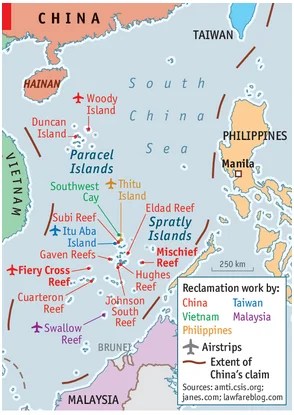
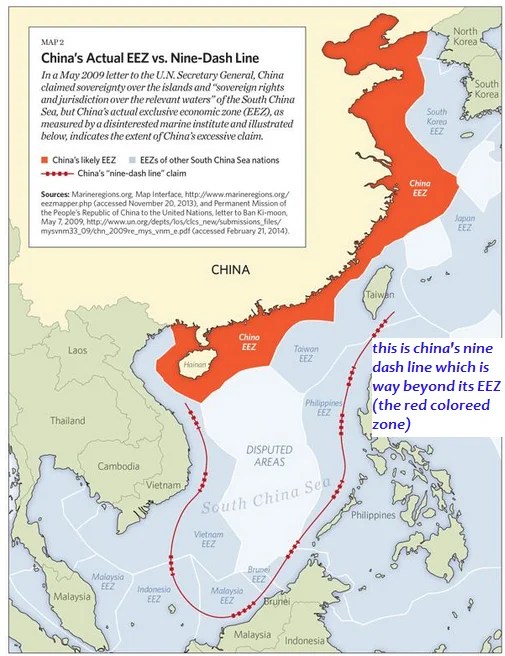
To sum up the confrontations are around two major islands :- Paracel and Spratly island ; and Scarborough Shoal.
Implications for INDIA :-
- Although India is a non claimant to the SCS Island it is concerned with the developments in the SCS. Even though the SCS area may seem far from the Indian mainland but in actual terms it is not so when one considers the Andaman and Nicobar Islands. It is also important to note that India’s trade with Japan and South Korea has
been growing and hence, it is crucial that freedom of navigation is maintained in the South China Sea through which the trading routes between India and these East Asian countries pass. India’s sea bound trade that passes through Indian Ocean constitutes 92-95 per cent of its total trade and, there are estimates that nearly 25 per cent (and growing) of this sea bound trade passes through South China Sea. - India like China is also energy deficit country and is stretching its resources all over the world to access hydrocarbons in what ever form and quantity available. India’s oil and gas exploration and extractions in Myanmar and Vietnam need to be understood in this respect. Therefore, there is no way that India would retreat from South China Sea just because China or any other country has taken an exception to its economic and naval activities in this region.
- Meanwhile, India-ASEAN trade has reached US$ 57.89 billion in 2010-11. Any major conflict in the South China Sea region is bound to impact Indian economic interests.
- Besides, India is worried that if China controls this sea space it will dictate maritime traffic, both civilian and military. Therefore, its priority is to maintain freedom of navigation in the sea both merchant and naval ships. India is of the opinion that the SCS region was a key to its energy security, and that the conflict must be resolved peacefully as per international laws.
- China has objected Indian Naval presence and oil exploration projects in and across Vietnam (INS Airavaat in 2011 , ONGC Videsh project in Vietnam in 2011 )
- This has a geopolitical significance as well. India has an advantage in Indian Ocean , to counter it China has been building chain of ports encircling India, which is otherwise known as “String of Pearls” . By being assertive in SCS , China hopes to claim a dominant position in the SCS and use this as a bargain chip in case of a conflict breaks out.String of pearls can be understood from the below map :-

- The activities of China in SCS, puts India in a disadvantageous position , it is also meddling in the Indian Neighborhood states such as Nepal, Srilanka and Pakistan.Thus it is a greater concern for national security of India. The way forward is a complex architecture of diplomatic re-balancing , which is yet to be fully realized by India, the Indian counter being Project Mausam which is still in incessant phase.

P.S. – Kindly note down the ports in String of Pearls map and other important areas , as UPSC is known to ask the question related to it – both subjective and objective.
Receive Daily Updates
Recent Posts
[wptelegram-join-channel link=”https://t.me/s/upsctree” text=”Join @upsctree on Telegram”]2021 WEF Global Gender Gap report, which confirmed its 2016 finding of a decline in worldwide progress towards gender parity.
Over 2.8 billion women are legally restricted from having the same choice of jobs as men. As many as 104 countries still have laws preventing women from working in specific jobs, 59 countries have no laws on sexual harassment in the workplace, and it is astonishing that a handful of countries still allow husbands to legally stop their wives from working.
Globally, women’s participation in the labour force is estimated at 63% (as against 94% of men who participate), but India’s is at a dismal 25% or so currently. Most women are in informal and vulnerable employment—domestic help, agriculture, etc—and are always paid less than men.
Recent reports from Assam suggest that women workers in plantations are paid much less than men and never promoted to supervisory roles. The gender wage gap is about 24% globally, and women have lost far more jobs than men during lockdowns.
The problem of gender disparity is compounded by hurdles put up by governments, society and businesses: unequal access to social security schemes, banking services, education, digital services and so on, even as a glass ceiling has kept leadership roles out of women’s reach.
Yes, many governments and businesses had been working on parity before the pandemic struck. But the global gender gap, defined by differences reflected in the social, political, intellectual, cultural and economic attainments or attitudes of men and women, will not narrow in the near future without all major stakeholders working together on a clear agenda—that of economic growth by inclusion.
The WEF report estimates 135 years to close the gap at our current rate of progress based on four pillars: educational attainment, health, economic participation and political empowerment.
India has slipped from rank 112 to 140 in a single year, confirming how hard women were hit by the pandemic. Pakistan and Afghanistan are the only two Asian countries that fared worse.
Here are a few things we must do:
One, frame policies for equal-opportunity employment. Use technology and artificial intelligence to eliminate biases of gender, caste, etc, and select candidates at all levels on merit. Numerous surveys indicate that women in general have a better chance of landing jobs if their gender is not known to recruiters.
Two, foster a culture of gender sensitivity. Take a review of current policies and move from gender-neutral to gender-sensitive. Encourage and insist on diversity and inclusion at all levels, and promote more women internally to leadership roles. Demolish silos to let women grab potential opportunities in hitherto male-dominant roles. Work-from-home has taught us how efficiently women can manage flex-timings and productivity.
Three, deploy corporate social responsibility (CSR) funds for the education and skilling of women and girls at the bottom of the pyramid. CSR allocations to toilet building, the PM-Cares fund and firms’ own trusts could be re-channelled for this.
Four, get more women into research and development (R&D) roles. A study of over 4,000 companies found that more women in R&D jobs resulted in radical innovation. It appears women score far higher than men in championing change. If you seek growth from affordable products and services for low-income groups, women often have the best ideas.
Five, break barriers to allow progress. Cultural and structural issues must be fixed. Unconscious biases and discrimination are rampant even in highly-esteemed organizations. Establish fair and transparent human resource policies.
Six, get involved in local communities to engage them. As Michael Porter said, it is not possible for businesses to sustain long-term shareholder value without ensuring the welfare of the communities they exist in. It is in the best interest of enterprises to engage with local communities to understand and work towards lowering cultural and other barriers in society. It will also help connect with potential customers, employees and special interest groups driving the gender-equity agenda and achieve better diversity.