


India’s quiet reaction to Ayatollah Khamenei’s death can be explained in simple language using ideas from realism in International Relations, which says countries mainly act to protect their national interest and power.
A leader who often criticised India
Ayatollah Khamenei was important for Iran, but his words on India were often negative.
-
In 2017, he asked the Muslim world to support “oppressed Muslims of Kashmir,” echoing Pakistan’s stand on a very sensitive issue for India.
-
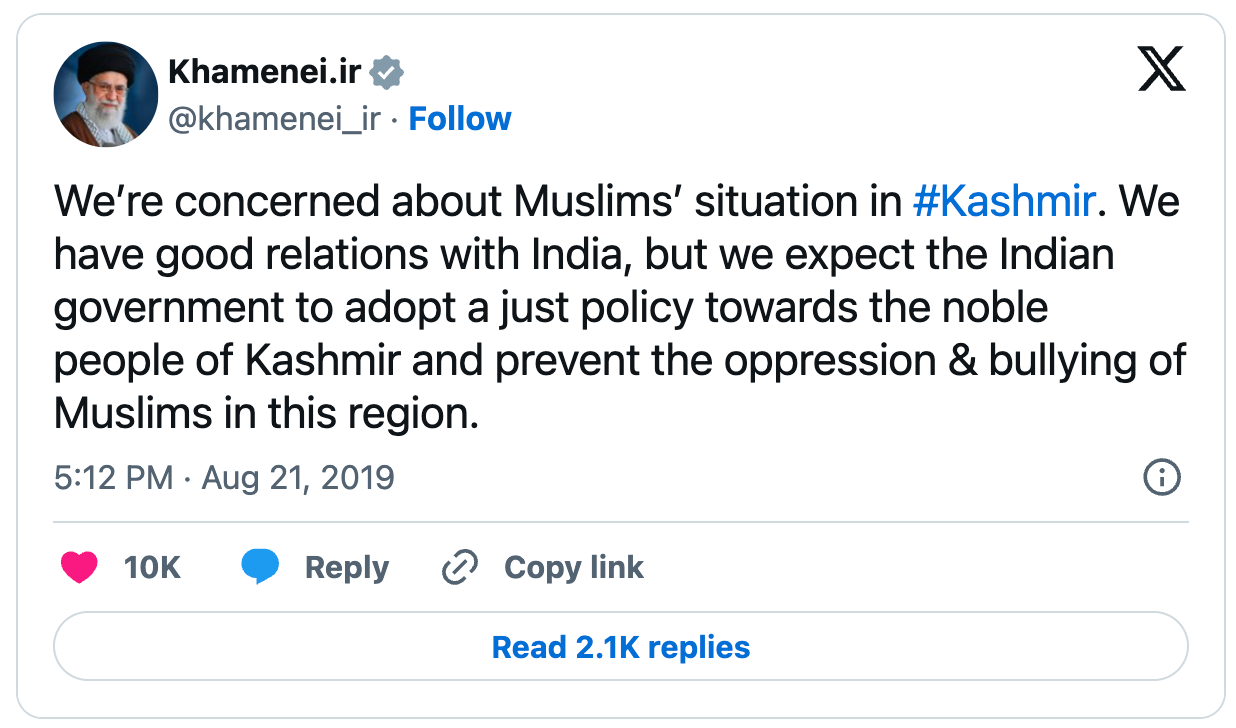
After Article 370 was removed in 2019, he again spoke about Kashmir and demanded a “just policy,” which India saw as interference.
-
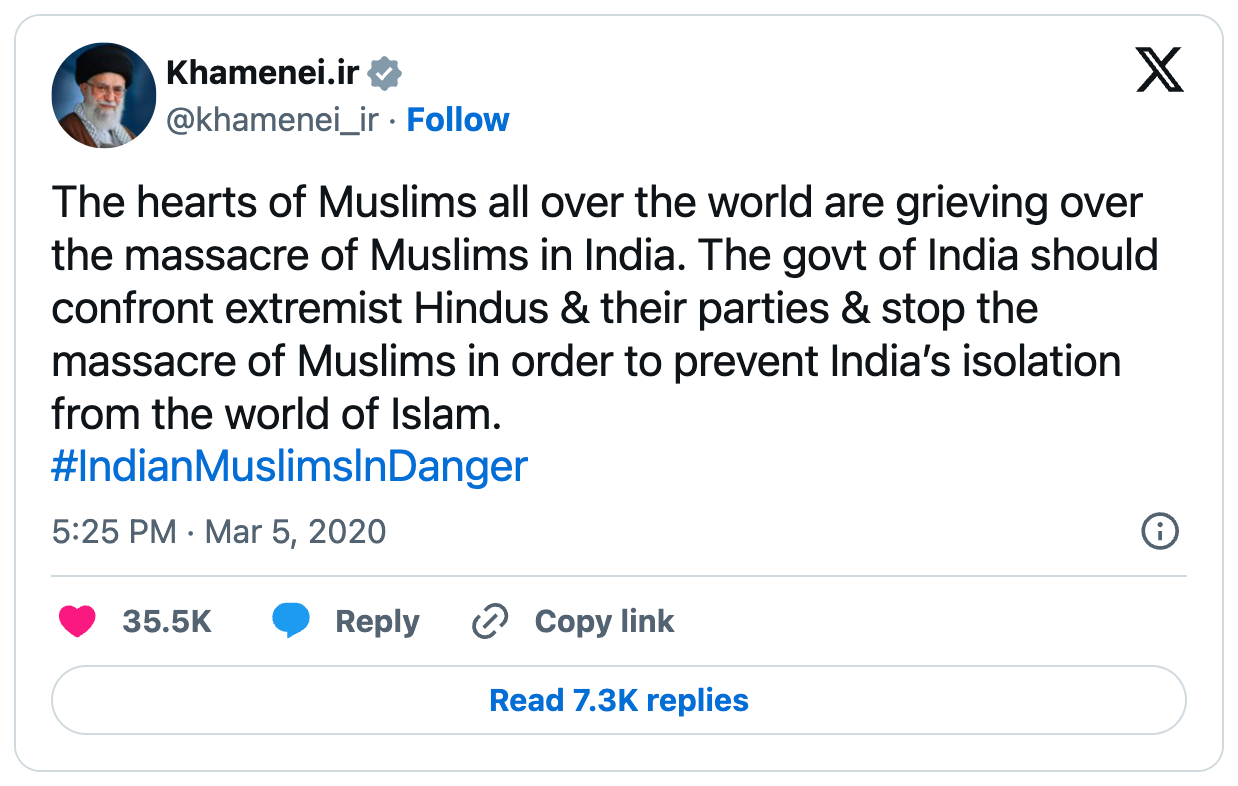
During the CAA protests and Delhi riots in 2020, he accused India of a “massacre” of Muslims and attacked “extremist Hindus.”
So, even though India and Iran had ties based on culture, energy, and geography, Khamenei’s repeated public criticism made him a controversial figure inside India.
How India balanced protest and cooperation
Each time Khamenei commented on Kashmir or CAA, India called in the Iranian ambassador and clearly said that Kashmir and citizenship laws are internal matters. At the same time, India did not break ties with Iran. It continued to work on:
-
Oil trade when sanctions allowed.
-
The Chabahar port, which gives India access to Afghanistan and Central Asia without going through Pakistan.
This is a classic example of realism: India defended its sovereignty in public, but kept cooperation where it served national interest. Realist theory says states can disagree on values or statements but still work together when interests match.
Silence as a deliberate signal
When Khamenei died, the Indian government did not issue a big public condolence message. Opposition leaders like Sonia Gandhi criticised this as going against India’s tradition of honouring major world leaders. But in realist terms, the government seems to have calculated three things:
-
A warm tribute to a leader who repeatedly criticised India on Kashmir and CAA would look inconsistent and could upset many Indians.
-
Any strong statement—whether very positive or very negative—could be read by the US, Israel, Gulf states, and Iran as India taking sides in a tense West Asia situation.]
-
Silence avoids sending the wrong signal abroad while also avoiding domestic controversy.
Realism helps explain this: states often use silence or very careful words as tools of foreign policy. The goal is to protect security, economic interests, and room for manoeuvre, not to express emotion.
Domestic politics and international image
Inside India, Khamenei’s remarks were used by both sides in domestic politics.
-
Critics of the government cited his words on Muslims and Kashmir as outside “proof” of their concerns.
-
Supporters saw his statements as foreign interference that lined up with Pakistan’s narrative.
The government’s silence fits its broader line that India will not accept “lectures” on internal matters from Western countries or from religious leaders in the Muslim world. Opposition, on the other hand, argues that such silence damages India’s image as a bridge between different regions.
Here, another political science idea appears: two-level games. This theory says governments always juggle two tables at once—global diplomacy and domestic politics. India’s leaders had to think about:
-
How Iran, the US, Gulf countries, and others would read any message.
-
How Indian voters, especially on sensitive issues like Kashmir and CAA, would react.
A realist reset in India–Iran ties
Looking ahead, India and Iran still need each other for energy, regional stability, and connectivity through Chabahar. But India is less willing to overlook public criticism from Tehran’s top leadership. Under realism, states try to separate the state-to-state relationship from the personal legacy of one leader when it suits their interest.
India’s quiet reaction, seen through realist theory, is not just avoidance; it is a calculated reset. India is signalling that:
-
It respects Iran as a state and a people.
-
It will protect its core interests and dignity when leaders speak against it.
-
Future relations will be based more on clear interests than on emotional or ideological language.
Receive Daily Updates
Recent Posts
- Anonymity: Darknet allows users to communicate and transact with each other anonymously. Users can maintain their privacy and avoid being tracked by law enforcement agencies or other entities.
- Access to Information: The darknet provides access to information and resources that may be otherwise unavailable or censored on the regular internet. This can include political or sensitive information that is not allowed to be disseminated through other channels.
- Freedom of Speech: The darknet can be a platform for free speech, as users are able to express their opinions and ideas without fear of censorship or retribution.
- Secure Communication: Darknet sites are encrypted, which means that communication between users is secure and cannot be intercepted by third parties.
- Illegal Activities: Many darknet sites are associated with illegal activities, such as drug trafficking, weapon sales, and hacking services. Such activities can attract criminals and expose users to serious legal risks.
- Scams: The darknet is a hotbed for scams, with many fake vendors and websites that aim to steal users’ personal information and cryptocurrency. The lack of regulation and oversight on the darknet means that users must be cautious when conducting transactions.
- Security Risks: The use of the darknet can expose users to malware and other security risks, as many sites are not properly secured or monitored. Users may also be vulnerable to hacking or phishing attacks.
- Stigma: The association of the darknet with illegal activities has created a stigma that may deter some users from using it for legitimate purposes.
- Virtual assistants: Siri, Alexa, and Google Assistant are examples of virtual assistants that use natural language processing to understand and respond to users’ queries.
- Recommendation systems: Companies like Netflix and Amazon use AI to recommend movies and products to their users based on their browsing and purchase history.
- Efficiency: AI systems can work continuously without getting tired or making errors, which can save time and resources.
- Personalization: AI can help provide personalized recommendations and experiences for users.
- Automation: AI can automate repetitive and tedious tasks, freeing up time for humans to focus on more complex tasks.
- Job loss: AI has the potential to automate jobs previously performed by humans, leading to job loss and economic disruption.
- Bias: AI systems can be biased due to the data they are trained on, leading to unfair or discriminatory outcomes.
- Safety and privacy concerns: AI systems can pose safety risks if they malfunction or are used maliciously, and can also raise privacy concerns if they collect and use personal data without consent.
Darknet
Definition:
Darknet, also known as dark web or darknet market, refers to the part of the internet that is not indexed or accessible through traditional search engines. It is a network of private and encrypted websites that cannot be accessed through regular web browsers and requires special software and configuration to access.
The darknet is often associated with illegal activities such as drug trafficking, weapon sales, and hacking services, although not all sites on the darknet are illegal.
Examples:
Examples of darknet markets include Silk Road, AlphaBay, and Dream Market, which were all shut down by law enforcement agencies in recent years.
These marketplaces operate similarly to e-commerce websites, with vendors selling various illegal goods and services, such as drugs, counterfeit documents, and hacking tools, and buyers paying with cryptocurrency for their purchases.
Pros :
Cons:
Artificial Intelligence
Definition:
AI, or artificial intelligence, refers to the development of computer systems that can perform tasks that would normally require human intelligence, such as recognizing speech, making decisions, and understanding natural language.
Examples:
Pros :
Cons: