


Russian Revolution inspired Indians and panicked the colonial British administration, though Communism was not to be the force that swept the British out of India.
Some weeks after the October Revolution in Russia, which took place a hundred years ago this month, the great Tamil poet Subramania Bharati wrote Pudiya Russia:
The people are master of their lives,
Their welfare advanced by their own laws.
Lo! In a trice has it arisen.
This is the people’s state they proclaimed,
So that the whole world might know
“Gone are the slaves’ shackles, knew ye all,
No more shall men be a slave”, said they.
Like a thunder-riven wall
Collapsed the Iron Age
Arise ye, the Golden Age.
Translations into English seldom do justice to Bharati’s work. Regardless, it is not hard to see what the explosive events in Russia meant to sympathetic viewers from afar. For Bharati, this was the Golden Age after the Iron Age—when the workers of Russia would emerge from servitude in the iron shackles of industry and oppression, to a golden dawn of self-determination and freedom.
This was just one of numerous hopeful interpretations that subject peoples all over the world drew from the events that took place in Russia. All around Russia, from Turkey to Afghanistan to Iran to India, the events in Petrograd became a beacon of hope. With each Bolshevik statement about self-determination and liberty, nationalist movements all over Asia began to look to Lenin for ideological, political, even military inspiration.
What did the revolution mean to India, Indian politics and Indian political leadership? And how did colonial authorities react to these influences and interpretations?
Archives from the erstwhile India Office of the British government, now housed at the British Library in London, tell a story of confusion and chaos. Files once secret but now declassified tell of an imperial government in India stretched to its wit’s end as the looming spectre of Bolshevism seemed to cast its shadow over the Himalayas at the greatest colony in the world.
File 1229/1920 titled “Russia: Bolshevik menace to India; anti-Bolshevik measures” is a remarkable series of secret telegrams, intelligence despatches and translations of Russian documents procured and translated by British spies and agents, dating from the summer of 1919. The series starts with a message from London to the viceroy to confirm that an “Indian propaganda bureau” was now functioning under a Suhrawardy. Presumably this is a reference to Shahid Huseyn Suhrawardy, later to become prime minister of Bengal and then Pakistan. Suhrawardy, a lecturer at the Imperial University of St Petersburg between the fateful years of 1914 and 1920, not only witnessed the events of the Russian Civil War first-hand, but also taught English to Alexander Kerensky who was later overthrown by Lenin’s Bolsheviks. This message ends with a fervent question of the viceroy: “Have you considered whether special precautions are required to prevent Bolshevik agents from entering India either by sea or across land frontiers, and what measures do you contemplate for countering propaganda?”
The rest of the file is a blow-by-blow account of the British government’s frantic efforts to undermine any and all Bolshevik meddling in India. The question was: How were the Indians responding to these titanic events?
The Russian Revolution was arguably the last in a series of three “Asian” events that energized nationalist leaders in India in the years just before and after World War I. The Meiji Restoration in 1868 and then, to a far greater extent, Japan’s success in the Russo-Japanese War of 1905 had become a source of great “Asiatic” pride for Indian leaders such as Bal Gangadhar Tilak. In the Marathi newspaper Kesari, Tilak wrote that Japan’s victory had given a rude shock to the prevailing belief in Europe that “Asiatics lacked the sentiment of nationality and were therefore, unable to hold their own…”
The partition of Bengal added the fuel of outrage to the lambent flame of native self-belief. In India and overseas, a clutch of Indian leaders began to militate against the British government. Tilak was the foremost of those in India. In the early years of the 20th century, Jawaharlal Nehru mentions in his memoirs, “Almost without an exception we were Tilakites or Extremists.” Violent anti-British revolutionaries increasingly became a thorn in the imperial side. So much so that in July 1908, Tilak was sent to prison in Burma on sedition charges.
Far away in Russia, these efforts did not go unnoticed. In an article published in 1908, Lenin wrote in his typical style of “The infamous sentence pronounced by the British jackals on the Indian democrat Tilak—he was sentenced to a long term of exile… this revenge against a democrat by the lackeys of the money-bag evoked street demonstrations and a strike in Bombay.
“There can be no doubt that the age-old plunder of India by the British, and the contemporary struggle of all these “advanced” Europeans against Persian and Indian democracy, will steel millions, tens of millions of proletarians in Asia to wage a struggle against their oppressors which will be just as victorious as that of the Japanese. The class-conscious European worker now has comrades in Asia, and their number will grow by leaps and bounds.”
The British, then, were quite right in keeping an eye on Bolshevik plans for India. As late as 1921, a full two years after that first alarmed telegram, British intelligence reports still considered India the main objective of Bolshevik foreign policy.
Communism would indeed gain a foothold in India, inspiring numerous leaders, establishing communist and socialist political parties, and leading to trade union movements and labour mobilization.
The uprising of million of proletarians, however, was not to be. Communism was not to be the force that swept the British out of India. The Russian Revolution was ultimately not to inspire a revolution of the oppressed in India. Why was this so? A number of theories have been put forward by historians and other scholars writing in the years after Indian independence.
One suggestion is that Bolshevism simply became yet another political movement co-opted by the “big tent” that was the Indian National Congress. Writing in International Socialism in 1977, Barry Pavier cites the example of the Ahmedabad textile workers’ strike of 1918 to highlight how establishment nationalist leaders co-opted workers’ movements and smothered them.
Following the withdrawal of a plague bonus that had been paid out to mill workers in order to keep them in the city after an outbreak, workers in Ahmedabad went on strike. M.K. Gandhi intervened and acted as an intermediary between the mill owners, one of whom was Ambalal Sarabhai, and the workers whose representatives included Anasuya Sarabhai, Ambalal’s sister. Indian politics, thus, appeared far too much like a cosy club.
“The workers’ movement,” Pavier writes, “was totally dominated by the bourgeois nationalists of the Congress… The revolutionary aspect—the overthrow of capitalism and the establishment of a workers state—appealed to them not at all.”
Another suggestion is that there was quite widespread disagreement among Indian leaders about how to deal with Bolshevik interest in India. Should Indian revolutionaries seek to replicate the Russian Revolution, merely find inspiration in Lenin’s success, or find some in-between route to freedom. As the memoirs of M.N. Roy, previously excerpted in Mint On Sunday, and many early histories of the Communist Party in India show, early Indian communists themselves disagreed on a Communist Indian response to British imperialism.
Third, and perhaps simplest of all, is the explanation that many Indians simply had no idea what was really going on in India. As M.A. Persits has written in his widely quoted Revolutionaries Of India In Soviet Russia, the Indians who perhaps best understood the theory and practice of Leninist revolution in the early years all tended to live outside India. It would be many years before communism in India stepped out of the shadows of the establishment nationalist parties and became a movement with coherence and strength.
Still, that is not to say that at least some Indians didn’t find a way of putting the Bolsheviks to some use. The somewhat amusing story of Awadht Ahmed Hadrami, an Indian agent for seamen in Aden, can be pieced together from a 1923 intelligence file at the British Library. British authorities received a tip-off that Hadrami was a globetrotting agent meeting communist leaders in Europe, Indian revolutionaries in North America, and then sailing to India to transfer funds and information to his local operatives. Instructions were sent to the postmaster in Aden to open every single letter that reached Hadrami’s address. Empire is nothing if not bureaucratic, and the Hadrami file is full of page after page of handwritten notes pertaining to each and every letter Hadrami received. At one point, Hadrami caught wind of the order and asked why his mail was being censored. He had nothing to hide, he said. So he was happy to have his mail opened, but could he at least be present at the post office when it was? The authorities seemed to agree.
Eventually, authorities realized that Hadrami had absolutely nothing to do with communists or Bolsheviks. His travels to Europe and America mostly had to do with business and with the purely humanitarian aim of checking on poor Indian sailors. It later turned out that Hadrami was a frequent target of harassment by competing manpower agents in Aden.
Sensing the red paranoia of the British someone had decided to get Hadrami into some trouble. They decided to spread a rumour that he was a leftist anti-national.
Receive Daily Updates
Recent Posts
The United Nations has shaped so much of global co-operation and regulation that we wouldn’t recognise our world today without the UN’s pervasive role in it. So many small details of our lives – such as postage and copyright laws – are subject to international co-operation nurtured by the UN.
In its 75th year, however, the UN is in a difficult moment as the world faces climate crisis, a global pandemic, great power competition, trade wars, economic depression and a wider breakdown in international co-operation.
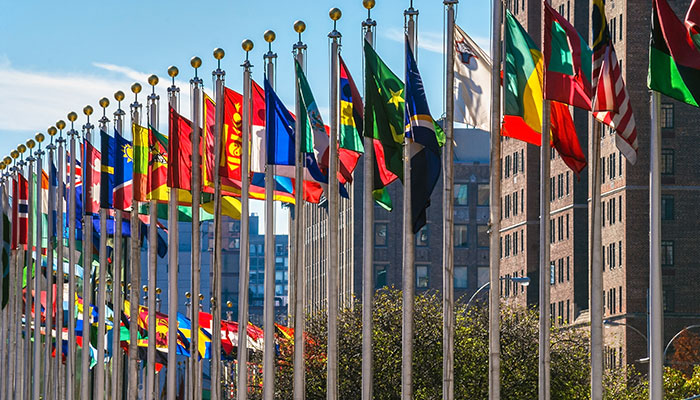
Still, the UN has faced tough times before – over many decades during the Cold War, the Security Council was crippled by deep tensions between the US and the Soviet Union. The UN is not as sidelined or divided today as it was then. However, as the relationship between China and the US sours, the achievements of global co-operation are being eroded.
The way in which people speak about the UN often implies a level of coherence and bureaucratic independence that the UN rarely possesses. A failure of the UN is normally better understood as a failure of international co-operation.
We see this recently in the UN’s inability to deal with crises from the ethnic cleansing of the Rohingya Muslims in Myanmar, to civil conflict in Syria, and the failure of the Security Council to adopt a COVID-19 resolution calling for ceasefires in conflict zones and a co-operative international response to the pandemic.
The UN administration is not primarily to blame for these failures; rather, the problem is the great powers – in the case of COVID-19, China and the US – refusing to co-operate.
Where states fail to agree, the UN is powerless to act.
Marking the 75th anniversary of the official formation of the UN, when 50 founding nations signed the UN Charter on June 26, 1945, we look at some of its key triumphs and resounding failures.
Five successes
1. Peacekeeping
The United Nations was created with the goal of being a collective security organisation. The UN Charter establishes that the use of force is only lawful either in self-defence or if authorised by the UN Security Council. The Security Council’s five permanent members, being China, US, UK, Russia and France, can veto any such resolution.
The UN’s consistent role in seeking to manage conflict is one of its greatest successes.
A key component of this role is peacekeeping. The UN under its second secretary-general, the Swedish statesman Dag Hammarskjöld – who was posthumously awarded the Nobel Peace prize after he died in a suspicious plane crash – created the concept of peacekeeping. Hammarskjöld was responding to the 1956 Suez Crisis, in which the US opposed the invasion of Egypt by its allies Israel, France and the UK.
UN peacekeeping missions involve the use of impartial and armed UN forces, drawn from member states, to stabilise fragile situations. “The essence of peacekeeping is the use of soldiers as a catalyst for peace rather than as the instruments of war,” said then UN Secretary-General Javier Pérez de Cuéllar, when the forces won the 1988 Nobel Peace Prize following missions in conflict zones in the Middle East, Africa, Asia, Central America and Europe.
However, peacekeeping also counts among the UN’s major failures.
2. Law of the Sea
Negotiated between 1973 and 1982, the UN Convention on the Law of the Sea (UNCLOS) set up the current international law of the seas. It defines states’ rights and creates concepts such as exclusive economic zones, as well as procedures for the settling of disputes, new arrangements for governing deep sea bed mining, and importantly, new provisions for the protection of marine resources and ocean conservation.
Mostly, countries have abided by the convention. There are various disputes that China has over the East and South China Seas which present a conflict between power and law, in that although UNCLOS creates mechanisms for resolving disputes, a powerful state isn’t necessarily going to submit to those mechanisms.
Secondly, on the conservation front, although UNCLOS is a huge step forward, it has failed to adequately protect oceans that are outside any state’s control. Ocean ecosystems have been dramatically transformed through overfishing. This is an ecological catastrophe that UNCLOS has slowed, but failed to address comprehensively.
3. Decolonisation
The idea of racial equality and of a people’s right to self-determination was discussed in the wake of World War I and rejected. After World War II, however, those principles were endorsed within the UN system, and the Trusteeship Council, which monitored the process of decolonisation, was one of the initial bodies of the UN.
Although many national independence movements only won liberation through bloody conflicts, the UN has overseen a process of decolonisation that has transformed international politics. In 1945, around one third of the world’s population lived under colonial rule. Today, there are less than 2 million people living in colonies.
When it comes to the world’s First Nations, however, the UN generally has done little to address their concerns, aside from the non-binding UN Declaration on the Rights of Indigenous Peoples of 2007.
4. Human rights
The Human Rights Declaration of 1948 for the first time set out fundamental human rights to be universally protected, recognising that the “inherent dignity and of the equal and inalienable rights of all members of the human family is the foundation of freedom, justice and peace in the world”.
Since 1948, 10 human rights treaties have been adopted – including conventions on the rights of children and migrant workers, and against torture and discrimination based on gender and race – each monitored by its own committee of independent experts.
The language of human rights has created a new framework for thinking about the relationship between the individual, the state and the international system. Although some people would prefer that political movements focus on ‘liberation’ rather than ‘rights’, the idea of human rights has made the individual person a focus of national and international attention.
5. Free trade
Depending on your politics, you might view the World Trade Organisation as a huge success, or a huge failure.
The WTO creates a near-binding system of international trade law with a clear and efficient dispute resolution process.
The majority Australian consensus is that the WTO is a success because it has been good for Australian famers especially, through its winding back of subsidies and tariffs.
However, the WTO enabled an era of globalisation which is now politically controversial.
Recently, the US has sought to disrupt the system. In addition to the trade war with China, the Trump Administration has also refused to appoint tribunal members to the WTO’s Appellate Body, so it has crippled the dispute resolution process. Of course, the Trump Administration is not the first to take issue with China’s trade strategies, which include subsidises for ‘State Owned Enterprises’ and demands that foreign firms transfer intellectual property in exchange for market access.
The existence of the UN has created a forum where nations can discuss new problems, and climate change is one of them. The Intergovernmental Panel on Climate Change (IPCC) was set up in 1988 to assess climate science and provide policymakers with assessments and options. In 1992, the UN Framework Convention on Climate Change created a permanent forum for negotiations.
However, despite an international scientific body in the IPCC, and 165 signatory nations to the climate treaty, global greenhouse gas emissions have continued to increase.
Under the Paris Agreement, even if every country meets its greenhouse gas emission targets we are still on track for ‘dangerous warming’. Yet, no major country is even on track to meet its targets; while emissions will probably decline this year as a result of COVID-19, atmospheric concentrations of greenhouse gases will still increase.
This illustrates a core conundrum of the UN in that it opens the possibility of global cooperation, but is unable to constrain states from pursuing their narrowly conceived self-interests. Deep co-operation remains challenging.
Five failures of the UN
1. Peacekeeping
During the Bosnian War, Dutch peacekeeping forces stationed in the town of Srebrenica, declared a ‘safe area’ by the UN in 1993, failed in 1995 to stop the massacre of more than 8000 Muslim men and boys by Bosnian Serb forces. This is one of the most widely discussed examples of the failures of international peacekeeping operations.
On the massacre’s 10th anniversary, then UN Secretary General Kofi Annan wrote that the UN had “made serious errors of judgement, rooted in a philosophy of impartiality”, contributing to a mass murder that would “haunt our history forever”.
If you look at some of the other infamous failures of peacekeeping missions – in places such as Rwanda, Somalia and Angola – it is the limited powers given to peacekeeping operations that have resulted in those failures.
2. The invasion of Iraq
The invasion of Iraq by the US in 2003, which was unlawful and without Security Council authorisation, reflects the fact that the UN is has very limited capacity to constrain the actions of great powers.
The Security Council designers created the veto power so that any of the five permanent members could reject a Council resolution, so in that way it is programmed to fail when a great power really wants to do something that the international community generally condemns.
In the case of the Iraq invasion, the US didn’t veto a resolution, but rather sought authorisation that it did not get. The UN, if you go by the idea of collective security, should have responded by defending Iraq against this unlawful use of force.
The invasion proved a humanitarian disaster with the loss of more than 400,000 lives, and many believe that it led to the emergence of the terrorist Islamic State.
3. Refugee crises
The UN brokered the 1951 Refugee Convention to address the plight of people displaced in Europe due to World War II; years later, the 1967 Protocol removed time and geographical restrictions so that the Convention can now apply universally (although many countries in Asia have refused to sign it, owing in part to its Eurocentric origins).
Despite these treaties, and the work of the UN High Commission for Refugees, there is somewhere between 30 and 40 million refugees, many of them, such as many Palestinians, living for decades outside their homelands. This is in addition to more than 40 million people displaced within their own countries.
While for a long time refugee numbers were reducing, in recent years, particularly driven by the Syrian conflict, there have been increases in the number of people being displaced.
During the COVID-19 crisis, boatloads of Rohingya refugees were turned away by port after port. This tragedy has echoes of pre-World War II when ships of Jewish refugees fleeing Nazi Germany were refused entry by multiple countries.
And as a catastrophe of a different kind looms, there is no international framework in place for responding to people who will be displaced by rising seas and other effects of climate change.
4. Conflicts without end
Across the world, there is a shopping list of unresolved civil conflicts and disputed territories.
Palestine and Kashmir are two of the longest-running failures of the UN to resolve disputed lands. More recent, ongoing conflicts include the civil wars in Syria and Yemen.
The common denominator of unresolved conflicts is either division among the great powers, or a lack of international interest due to the geopolitical stakes not being sufficiently high. For instance, the inaction during the Rwandan civil war in the 1990s was not due to a division among great powers, but rather a lack of political will to engage.
In Syria, by contrast, Russia and the US have opposing interests and back opposing sides: Russia backs the government of the Syrian dictator Bashar al-Assad, whereas the US does not.
5. Acting like it’s 1945
The UN is increasingly out of step with the reality of geopolitics today.
The permanent members of the Security Council reflect the division of power internationally at the end of World War II. The continuing exclusion of Germany, Japan, and rising powers such as India and Indonesia, reflects the failure to reflect the changing balance of power.
Also, bodies such as the IMF and the World Bank, which are part of the UN system, continue to be dominated by the West. In response, China has created potential rival institutions such as the Asian Infrastructure Investment Bank.
Western domination of UN institutions undermines their credibility. However, a more fundamental problem is that institutions designed in 1945 are a poor fit with the systemic global challenges – of which climate change is foremost – that we face today.