


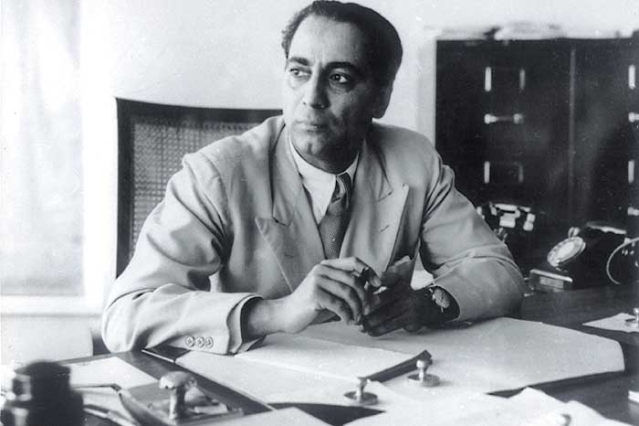
 What Benjamin Franklin said long ago “If you would be famous after you are dead either write things worth reading or do things worth writing about” – is true both ways of one of India’s renowned scientists who happened to be a passenger on the ill-fated Air India plane which crashed on the icy Alps on January 24, 1966 – Dr. Homi Jehangir Bhabha. The simplest and perhaps the most appropriate homage that can be paid to him is to recollect his ideals and philosophy for the promotion of science and technology for the good of the common man.
Honours Galore
After early education in India, Bhabha worked at Cambridge for some years. His original contribution on cosmic rays and related fundamental studies in physics won him wide recognition. He was made a Fellow of the Royal Society and doctoral degrees (honoris causa) were conferred on him by several universities of the West. By returning to his homeland he sacrificed a scientific career at Cambridge; as a true patriot, he worked with phenomenal patience and zeal under not too comfortable an environment but with a strong belief expressed in his own words: “that if proper appreciation and financial support are forthcoming it is the duty of people like us to study in our country and build on it outstanding schools of research such as some other countries are fortunate to possess.” To many of the younger generation, who are prone to criticise the Indian scene, his answer was: “For thousands of scientists who can do good work in a good environment there is perhaps only one who like Rutherford can create his own environment wherever he may be.”
A Queer Blend of Many virtues
Bhabha was a queer blend of many virtues difficult to enumerate. His love of Nature and his exquisite artistic tastes were imprinted on everyone of the institutions he founded. His character baffles analysis. Perhaps where analysis fails there genius begins, as Dr. John Holland Rose of Cambridge said of Napoleon.
The development of the atomic energy programme in India has all along been the exploitation of the atom for peaceful purposes only and in this he endeavoured with a strong faith that the essential difference between developed and underdeveloped countries is the lack of modern science and an economy based on modern technology without establishing science as a live force. A true symbol of this faith is the Tarapur nuclear energy station generating cheap electric power. Similar ones at Kalpakkam (Tamil Nadu) and Rana Pratapsagar (Raiasthan) will considerably add to our power resources.
Building from within
Bhabha struck a new path in bringing up new institutions, though at the outset, it appeared unconventional and even hazardous. First, research scientists were found and the subjects were allowed to grow consistent with the expansion of the scientific base. He had always advocated and followed the policy of “building from within” and the emphasis had been on developing knowhow indigenously.
In a brilliant talk, hardly a few days before his death on “Science and Problems of Development” at the International Council of Scientific Unions attended by scientists from 35 countries, Bhabha said: “There are many factors which hamper progress in science but in general, the absence of the proper administrative set-up for science is greater than the paucity of scientists and technologists. A majority of scientists are made less effective through lack of the right type of administrative support.”
The administration of scientific research and development is an even more subtle matter than the administration of industrial enterprises and Bhabha was convinced that it could not be done on the basis of borrowed knowledge. It must necessarily be done as in the technologically advanced countries by scientists and technologists themselves.
Atom for Peace
Indeed, no one was more aware of the limitation of our fuel resources, fossil as well as nuclear, than Bhabha. As he said in his Presidential address to the Geneva Conference on “The Peaceful Uses of Atomic Energy” in 1965: “For the full industrialisation of the underdeveloped areas, for the continuation of civilisation and its further development, atomic energy is not merely an aid; it is an absolute necessity.”
His philosophy of life expressed in his words should be an example to all scientists of the day: “The scientist must be free to think and put forward whatever ideas he considers right. Ideas are some of the most important things in life and men are prepared to suffer and die for them. Good ideas cannot be suppressed even by violence. Nothing is irreversible except death,”
The formula for the success of a scientist is PAML (Patience, ability, money and luck) and Bhabha had all of them one by one in the course of his career, but alas, when he had all in plenty and interacting favourably the country was unlucky to lose him in tragic circumstances.
Receive Daily Updates
Recent Posts
Steve Ovett, the famous British middle-distance athlete, won the 800-metres gold medal at the Moscow Olympics of 1980. Just a few days later, he was about to win a 5,000-metres race at London’s Crystal Palace. Known for his burst of acceleration on the home stretch, he had supreme confidence in his ability to out-sprint rivals. With the final 100 metres remaining,
[wptelegram-join-channel link=”https://t.me/s/upsctree” text=”Join @upsctree on Telegram”]Ovett waved to the crowd and raised a hand in triumph. But he had celebrated a bit too early. At the finishing line, Ireland’s John Treacy edged past Ovett. For those few moments, Ovett had lost his sense of reality and ignored the possibility of a negative event.
This analogy works well for the India story and our policy failures , including during the ongoing covid pandemic. While we have never been as well prepared or had significant successes in terms of growth stability as Ovett did in his illustrious running career, we tend to celebrate too early. Indeed, we have done so many times before.
It is as if we’re convinced that India is destined for greater heights, come what may, and so we never run through the finish line. Do we and our policymakers suffer from a collective optimism bias, which, as the Nobel Prize winner Daniel Kahneman once wrote, “may well be the most significant of the cognitive biases”? The optimism bias arises from mistaken beliefs which form expectations that are better than the reality. It makes us underestimate chances of a negative outcome and ignore warnings repeatedly.
The Indian economy had a dream run for five years from 2003-04 to 2007-08, with an average annual growth rate of around 9%. Many believed that India was on its way to clocking consistent double-digit growth and comparisons with China were rife. It was conveniently overlooked that this output expansion had come mainly came from a few sectors: automobiles, telecom and business services.
Indians were made to believe that we could sprint without high-quality education, healthcare, infrastructure or banking sectors, which form the backbone of any stable economy. The plan was to build them as we went along, but then in the euphoria of short-term success, it got lost.
India’s exports of goods grew from $20 billion in 1990-91 to over $310 billion in 2019-20. Looking at these absolute figures it would seem as if India has arrived on the world stage. However, India’s share of global trade has moved up only marginally. Even now, the country accounts for less than 2% of the world’s goods exports.
More importantly, hidden behind this performance was the role played by one sector that should have never made it to India’s list of exports—refined petroleum. The share of refined petroleum exports in India’s goods exports increased from 1.4% in 1996-97 to over 18% in 2011-12.
An import-intensive sector with low labour intensity, exports of refined petroleum zoomed because of the then policy regime of a retail price ceiling on petroleum products in the domestic market. While we have done well in the export of services, our share is still less than 4% of world exports.
India seemed to emerge from the 2008 global financial crisis relatively unscathed. But, a temporary demand push had played a role in the revival—the incomes of many households, both rural and urban, had shot up. Fiscal stimulus to the rural economy and implementation of the Sixth Pay Commission scales had led to the salaries of around 20% of organized-sector employees jumping up. We celebrated, but once again, neither did we resolve the crisis brewing elsewhere in India’s banking sector, nor did we improve our capacity for healthcare or quality education.
Employment saw little economy-wide growth in our boom years. Manufacturing jobs, if anything, shrank. But we continued to celebrate. Youth flocked to low-productivity service-sector jobs, such as those in hotels and restaurants, security and other services. The dependence on such jobs on one hand and high-skilled services on the other was bound to make Indian society more unequal.
And then, there is agriculture, an elephant in the room. If and when farm-sector reforms get implemented, celebrations would once again be premature. The vast majority of India’s farmers have small plots of land, and though these farms are at least as productive as larger ones, net absolute incomes from small plots can only be meagre.
A further rise in farm productivity and consequent increase in supply, if not matched by a demand rise, especially with access to export markets, would result in downward pressure on market prices for farm produce and a further decline in the net incomes of small farmers.
We should learn from what John Treacy did right. He didn’t give up, and pushed for the finish line like it was his only chance at winning. Treacy had years of long-distance practice. The same goes for our economy. A long grind is required to build up its base before we can win and celebrate. And Ovett did not blame anyone for his loss. We play the blame game. Everyone else, right from China and the US to ‘greedy corporates’, seems to be responsible for our failures.
We have lowered absolute poverty levels and had technology-based successes like Aadhaar and digital access to public services. But there are no short cuts to good quality and adequate healthcare and education services. We must remain optimistic but stay firmly away from the optimism bias.
In the end, it is not about how we start, but how we finish. The disastrous second wave of covid and our inability to manage it is a ghastly reminder of this fact.