


Introduction:-
The world needs to produce at least 50% more food to feed 9 billion people by 2050. But climate change could cut crop yields by more than 25%.
The land, biodiversity, oceans, forests, and other forms of natural capital are being depleted at unprecedented rates. Unless we change how we grow our food and manage our natural capital, food security—especially for the world’s poorest—will be at risk. (World Bank, 2016)
The status-quo:-
For two decades, leading up to the millennium, global demand for food increased steadily, along with growth in the world’s population, record harvests, improvements in incomes, and the diversification of diets. As a result, food prices continued to decline through 2000. But beginning in 2004, prices for most grains began to rise. Although there was an increase in production, the increase in demand was greater.
Food stocks became depleted. And then, in 2005, food production was dramatically affected by extreme weather incidents in major food-producing countries. By 2006, world cereal production had fallen by 2.1 percent. In 2007, rapid increases in oil prices increased fertilizer and other food production costs.
As international food prices reached unprecedented levels, countries sought ways to insulate themselves from potential food shortages and price shocks. Several food-exporting countries imposed export restrictions. Certain key importers began purchasing grains at any price to maintain domestic supplies.
High Level Task Force on Global Food and Nutrition Security
The dramatic rise of global food prices and the crisis led the United Nations (UN) Chief Executives Board in April 2008 to establish a High-Level Task Force on the Global Food Security Crisis. Composed of 23 key members of the UN system, it is chaired by Secretary-General Ban Ki-moon. The primary aim of the Task Force is to promote a comprehensive and unified response of the international community to the challenge of achieving global food and nutrition security.
Progress continues in the fight against hunger, yet an unacceptably large number of people still lack the food they need for an active and healthy life.
Hunger in numbers
The latest available estimates indicate that about 795 million people in the world – just over one in nine – were undernourished in 2014–16. That means one in nine people do not get enough food to be healthy and lead an active life. Hunger and malnutrition are in fact the number one risk to health worldwide — greater than AIDS, malaria and tuberculosis combined.
Measuring global progress against targets
The year 2015 marked the end of the monitoring period for the two internationally agreed targets for hunger reduction:
- The first was the World Food Summit (WFS) goal. At the WFS, held in Rome in 1996, representatives of 182 governments pledged “… to eradicate hunger in all countries, with an immediate view to reducing the number of undernourished people to half their present level no later than 2015”.
- The second was the formulation of the First Millennium Development Goal (MDG 1), which includes among its targets “cutting by half the proportion of people who suffer from hunger by 2015”.
The Millennium Development Goals and food
In 2000, world leaders gathered at the UN to shape a broad vision to fight poverty, which was translated into eight Millennium Development Goals (MDGs) and remained, until 2015, the overarching development framework for the world. At the end of the MDG period in 2015, there was a final assessment of progress made during the MDG period.
The global mobilization behind the Millennium Development Goals has produced the most successful anti-poverty movement in history. The MDG target of reducing by half the proportion of people living in extreme poverty was achieved in 2010, well ahead of the 2015 deadline.
-
The proportion of undernourished people in the developing regions has fallen by almost half.
-
One in in seven children worldwide are underweight, down from one in four in 1990.
As can be seen from the above results of the MDGs, there was much progress in relation to food and hunger between 2000 and 2015. However, a lot more work needs to be done. That work will now be the focus of the Sustainable Development Goals.
Zero Hunger challenge
The United Nations Secretary-General launched the Zero Hunger Challenge in 2012 during the Rio+20 World Conference on Sustainable Development. The Zero Hunger Challenge was launched to inspire a global movement towards a world free from hunger within a generation. It calls for:
-
Zero stunted children under the age of two
-
100% access to adequate food all year round
-
All food systems are sustainable
-
100% increase in smallholder productivity and income
-
Zero loss or waste of food
Food and the SDGs
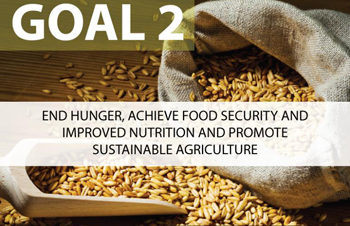
Food is also at the core of the Sustainable Development Goals (SDGs), the UN’s development agenda for the 21st century. The second of the UN’s 17 SDGs is to “End hunger, achieve food security and improved nutrition and promote sustainable agriculture”. Achieving this goal by the target date of 2030 will require a profound change of the global food and agriculture system. Some of the components of this goal are:
-
Ending hunger, and ensuring access by all people to safe, nutritious food;
-
Ending all forms of malnutrition;
-
Doubling the agricultural productivity and incomes of small-scale food producers;
-
Ensuring sustainable food production systems;
-
Increasing investment in agriculture;
-
Correcting and preventing trade restrictions and distortions in world agricultural markets;
-
Adopting measures to ensure the proper functioning of food commodity markets.
UN agencies working for food security
World Food Programme (WFP)
The World Food Programme (WFP), aims to bring food assistance to more than 80 million people in 80 countries and is continually responding to emergencies. But WFP also works to help prevent hunger in the future. They do this through programmes that use food as a means to build assets, spread knowledge and nurture stronger, more dynamic communities. This helps communities become more food secure.
World Bank
Investment in agriculture and rural development to boost food production and nutrition is a priority for the World Bank Group. The Bank Group works with partners to improve food security and build a food system that can feed everyone, everywhere, every day. Activities include encouraging climate-smart farming techniques and restoring degraded farmland, breeding more resilient and nutritious crops and improving storage and supply chains for reducing food losses
The Food and Agriculture Organization of the United Nations (FAO)
Achieving food security for all is at the heart of the efforts of the UN Food and Agriculture Organization (FAO) – to make sure people have regular access to enough high-quality food to lead active, healthy lives. Its three main goals: the eradication of hunger, food insecurity and malnutrition; the elimination of poverty and the driving forward of economic and social progress for all; and, the sustainable management and utilization of natural resources, including land, water, air, climate and genetic resources for the benefit of present and future generations. FAO also issues the food price index, which is a measure of the monthly change in international prices of a basket of food commodities
International Fund for Agricultural Development (IFAD)
The International Fund for Agricultural Development (IFAD) has focused exclusively on rural poverty reduction, working with poor rural populations in developing countries to eliminate poverty, hunger and malnutrition; raise their productivity and incomes; and improve the quality of their lives.
The International Fund for Agricultural Development (IFAD) has focused exclusively on rural poverty reduction, working with poor rural populations in developing countries to eliminate poverty, hunger and malnutrition; raise their productivity and incomes; and improve the quality of their lives. All IFAD-funded programmes and projects address food and nutrition security in some way. IFAD has supported about 400 million poor rural women and men over the past three decades.
Receive Daily Updates
Recent Posts
- In the Large States category (overall), Chhattisgarh ranks 1st, followed by Odisha and Telangana, whereas, towards the bottom are Maharashtra at 16th, Assam at 17th and Gujarat at 18th. Gujarat is one State that has seen startling performance ranking 5th in the PAI 2021 Index outperforming traditionally good performing States like Andhra Pradesh and Karnataka, but ranks last in terms of Delta
- In the Small States category (overall), Nagaland tops, followed by Mizoram and Tripura. Towards the tail end of the overall Delta ranking is Uttarakhand (9th), Arunachal Pradesh (10th) and Meghalaya (11th). Nagaland despite being a poor performer in the PAI 2021 Index has come out to be the top performer in Delta, similarly, Mizoram’s performance in Delta is also reflected in it’s ranking in the PAI 2021 Index
- In terms of Equity, in the Large States category, Chhattisgarh has the best Delta rate on Equity indicators, this is also reflected in the performance of Chhattisgarh in the Equity Pillar where it ranks 4th. Following Chhattisgarh is Odisha ranking 2nd in Delta-Equity ranking, but ranks 17th in the Equity Pillar of PAI 2021. Telangana ranks 3rd in Delta-Equity ranking even though it is not a top performer in this Pillar in the overall PAI 2021 Index. Jharkhand (16th), Uttar Pradesh (17th) and Assam (18th) rank at the bottom with Uttar Pradesh’s performance in line with the PAI 2021 Index
- Odisha and Nagaland have shown the best year-on-year improvement under 12 Key Development indicators.
- In the 60:40 division States, the top three performers are Kerala, Goa and Tamil Nadu and, the bottom three performers are Uttar Pradesh, Jharkhand and Bihar.
- In the 90:10 division States, the top three performers were Himachal Pradesh, Sikkim and Mizoram; and, the bottom three performers are Manipur, Assam and Meghalaya.
- Among the 60:40 division States, Orissa, Chhattisgarh and Madhya Pradesh are the top three performers and Tamil Nadu, Telangana and Delhi appear as the bottom three performers.
- Among the 90:10 division States, the top three performers are Manipur, Arunachal Pradesh and Nagaland; and, the bottom three performers are Jammu and Kashmir, Uttarakhand and Himachal Pradesh
- Among the 60:40 division States, Goa, West Bengal and Delhi appear as the top three performers and Andhra Pradesh, Telangana and Bihar appear as the bottom three performers.
- Among the 90:10 division States, Mizoram, Himachal Pradesh and Tripura were the top three performers and Jammu & Kashmir, Nagaland and Arunachal Pradesh were the bottom three performers
- West Bengal, Bihar and Tamil Nadu were the top three States amongst the 60:40 division States; while Haryana, Punjab and Rajasthan appeared as the bottom three performers
- In the case of 90:10 division States, Mizoram, Assam and Tripura were the top three performers and Nagaland, Jammu & Kashmir and Uttarakhand featured as the bottom three
- Among the 60:40 division States, the top three performers are Kerala, Andhra Pradesh and Orissa and the bottom three performers are Madhya Pradesh, Jharkhand and Goa
- In the 90:10 division States, the top three performers are Mizoram, Sikkim and Nagaland and the bottom three performers are Manipur and Assam
In a diverse country like India, where each State is socially, culturally, economically, and politically distinct, measuring Governance becomes increasingly tricky. The Public Affairs Index (PAI 2021) is a scientifically rigorous, data-based framework that measures the quality of governance at the Sub-national level and ranks the States and Union Territories (UTs) of India on a Composite Index (CI).
States are classified into two categories – Large and Small – using population as the criteria.
In PAI 2021, PAC defined three significant pillars that embody Governance – Growth, Equity, and Sustainability. Each of the three Pillars is circumscribed by five governance praxis Themes.
The themes include – Voice and Accountability, Government Effectiveness, Rule of Law, Regulatory Quality and Control of Corruption.
At the bottom of the pyramid, 43 component indicators are mapped to 14 Sustainable Development Goals (SDGs) that are relevant to the States and UTs.
This forms the foundation of the conceptual framework of PAI 2021. The choice of the 43 indicators that go into the calculation of the CI were dictated by the objective of uncovering the complexity and multidimensional character of development governance

The Equity Principle
The Equity Pillar of the PAI 2021 Index analyses the inclusiveness impact at the Sub-national level in the country; inclusiveness in terms of the welfare of a society that depends primarily on establishing that all people feel that they have a say in the governance and are not excluded from the mainstream policy framework.
This requires all individuals and communities, but particularly the most vulnerable, to have an opportunity to improve or maintain their wellbeing. This chapter of PAI 2021 reflects the performance of States and UTs during the pandemic and questions the governance infrastructure in the country, analysing the effectiveness of schemes and the general livelihood of the people in terms of Equity.


Growth and its Discontents
Growth in its multidimensional form encompasses the essence of access to and the availability and optimal utilisation of resources. By resources, PAI 2021 refer to human resources, infrastructure and the budgetary allocations. Capacity building of an economy cannot take place if all the key players of growth do not drive development. The multiplier effects of better health care, improved educational outcomes, increased capital accumulation and lower unemployment levels contribute magnificently in the growth and development of the States.


The Pursuit Of Sustainability
The Sustainability Pillar analyses the access to and usage of resources that has an impact on environment, economy and humankind. The Pillar subsumes two themes and uses seven indicators to measure the effectiveness of government efforts with regards to Sustainability.


The Curious Case Of The Delta
The Delta Analysis presents the results on the State performance on year-on-year improvement. The rankings are measured as the Delta value over the last five to 10 years of data available for 12 Key Development Indicators (KDI). In PAI 2021, 12 indicators across the three Pillars of Equity (five indicators), Growth (five indicators) and Sustainability (two indicators). These KDIs are the outcome indicators crucial to assess Human Development. The Performance in the Delta Analysis is then compared to the Overall PAI 2021 Index.
Key Findings:-
In the Scheme of Things
The Scheme Analysis adds an additional dimension to ranking of the States on their governance. It attempts to complement the Governance Model by trying to understand the developmental activities undertaken by State Governments in the form of schemes. It also tries to understand whether better performance of States in schemes reflect in better governance.
The Centrally Sponsored schemes that were analysed are National Health Mission (NHM), Umbrella Integrated Child Development Services scheme (ICDS), Mahatma Gandh National Rural Employment Guarantee Scheme (MGNREGS), Samagra Shiksha Abhiyan (SmSA) and MidDay Meal Scheme (MDMS).
National Health Mission (NHM)
INTEGRATED CHILD DEVELOPMENT SERVICES (ICDS)
MID- DAY MEAL SCHEME (MDMS)
SAMAGRA SHIKSHA ABHIYAN (SMSA)
MAHATMA GANDHI NATIONAL RURAL EMPLOYMENT GUARANTEE SCHEME (MGNREGS)