


Health & Society
No Road, No Map, But No Child Left Behind: The Five-Hour River Journey to Deliver Healthcare in Tripura
Deep inside Tripura’s Atharamura mountains, a tiny hamlet called Kalicharan Para has no road connecting it to the world. Getting there means a five-hour boat ride through rough waters and thick jungle. For the health teams who made the journey, that was exactly the point.
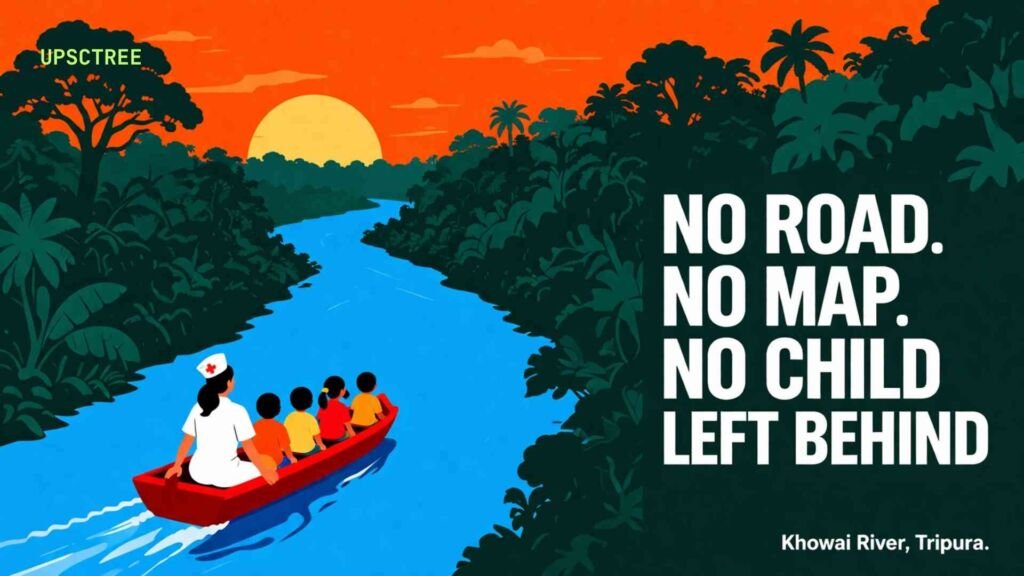 At dawn, the Khowai River runs quiet through dense forest and steep hills in Tripura. The water catches the early light. There are no roads here. No highway signs. No last-mile connectivity in any sense that a planner in a state capital would recognise. There is only the river, and the forest, and somewhere deep inside the Atharamura mountain range, a small hamlet called Kalicharan Para — home to families for whom this waterway is not a scenic route but the only route.
To reach Kalicharan Para, you must board a boat, navigate rough currents, pass through thick jungle and unforgiving terrain, and arrive — five hours later — at a village that exists, for most practical purposes, beyond the reach of the Indian public health system. No road means no regular ambulance. No routine immunisation visit.
That changed when the district administration and the WHO National Public Health Surveillance Network (WHO-NPSN) identified Kalicharan Para as a priority high-risk area and decided, simply, to go there.
The Team That Made the Journey
What made this outreach mission unusual was not just that it happened — it was who made it happen together. The team that arrived in Kalicharan Para was not a small squad of frontline workers sent alone into the forest. It included the Medical Officer from the Primary Health Centre, the Community Health Officer from the nearest Ayushman Arogya Mandir, the Chief Medical Officer, the Sub-Divisional Magistrate, and Primary Health Centre officials.
Critically, senior leadership made the journey too. Dr Soubhik Debbarma, Member Secretary of the National Health Mission, and Mr Rajat Pant, the District Magistrate and Collector of Khowai, travelled alongside frontline workers. They were joined by the WHO-NPSN team led by Dr Tigran Avagyan.
In public health, this matters more than it might seem. When senior officials travel to a remote village rather than receiving reports from it, the message to both their teams and to the community is unmistakable: this place is worth the effort. These people are worth the journey.
What the Team Brought — and What It Found
The outreach camp brought together multiple health services under one roof — something that is easy to take for granted in a city and extraordinary in a village with no road. Services included:
- Immunisation — scheduled childhood vaccines delivered directly to families
- Screening for non-communicable diseases — hypertension, diabetes, and other conditions that often go undetected in remote areas
- Malaria awareness activities — critical in a forested, river-adjacent region
- Antenatal care — check-ups and guidance for pregnant women
- Village Health and Nutrition Day services
- Deworming
What the team also found, and what no health camp checklist could have prepared them for, was the conversation. Sitting with villagers and listening to their daily realities — the difficulty of accessing even basic communication, the long distances to any government facility, the quiet weight of living beyond reach — transformed what could have been a logistical exercise into something more human. Statistics became people. Data became stories.
A Remarkable Finding: No Home Deliveries
One of the most significant things the team discovered was something that wasn’t a problem. Despite the extreme isolation of Kalicharan Para, the village has recorded no home deliveries. Every expectant mother has gone to a government-run health facility for an institutional delivery.
This is not something that happens automatically in remote communities. It reflects sustained effort, trust built over time between the community and health workers, and a commitment on the part of families to make extraordinarily difficult journeys — the same five-hour river route — for the sake of a safe birth. In public health terms, it is a significant achievement, and one that deserved to be recognised and strengthened rather than simply noted.
What Happens After the Visit
The value of a single outreach camp is real but limited. What makes the Kalicharan Para visit matter beyond the day itself is what was set in motion because of it.
Mr Pant directed the District Health Department to make regular visits to the village — not one-off events, but a sustained schedule of outreach. He also asked the Engineering Department to explore developing an alternative road. A physical connection to the rest of the district would change not just healthcare access but the entire texture of daily life for Kalicharan Para’s families.
The lessons from the visit also travelled back to the State Headquarters. WHO-NPSN convened a high-level meeting with senior officials to discuss building a sustainable, scalable framework for immunisation and primary healthcare delivery in hard-to-reach areas — so that what was done once in Kalicharan Para could become a repeatable system rather than a one-time effort.
What “Last-Mile Healthcare” Actually Means
“Last mile” is a term borrowed from logistics — it describes the final, hardest leg of a delivery, when a package has to get from a regional hub to an individual door. In healthcare, it refers to the challenge of reaching people who are geographically, economically, or socially the furthest from health services.
In India, last-mile healthcare is not a metaphor. It is a five-hour boat ride. It is a forest trail that becomes impassable in monsoon. It is a family that knows a government health facility exists somewhere, but has no practical way to reach it. Solving the last-mile problem requires more than good intentions — it requires systems, transport, trained workers, and the institutional will to keep showing up even when showing up is genuinely hard.
At dawn, the Khowai River is quiet again. The health team has gone back. The children who were vaccinated will not remember the day. The mothers whose blood pressure was checked will carry the results for a while, and then — as all of us do — file the paper somewhere and return to the business of living.
But something has shifted in Kalicharan Para. A place that was, for the purposes of the health system, effectively invisible is now visible. It has been visited by senior officials who will not forget having made the journey.
It has been entered into plans and directives and meeting agendas in Khowai and Agartala. The five-hour river route has been travelled once — which means it can be travelled again, and eventually, perhaps, it will not need to be travelled at all.
No child should be left behind, no matter how distant the destination. That sentence, spoken into the forested silence of the Atharamura hills, is the entire point. And in Kalicharan Para, someone finally came far enough to say it in person.
Receive Daily Updates
Recent Posts
Petrol in India is cheaper than in countries like Hong Kong, Germany and the UK but costlier than in China, Brazil, Japan, the US, Russia, Pakistan and Sri Lanka, a Bank of Baroda Economics Research report showed.
Rising fuel prices in India have led to considerable debate on which government, state or central, should be lowering their taxes to keep prices under control.
The rise in fuel prices is mainly due to the global price of crude oil (raw material for making petrol and diesel) going up. Further, a stronger dollar has added to the cost of crude oil.
Amongst comparable countries (per capita wise), prices in India are higher than those in Vietnam, Kenya, Ukraine, Bangladesh, Nepal, Pakistan, Sri Lanka, and Venezuela. Countries that are major oil producers have much lower prices.
In the report, the Philippines has a comparable petrol price but has a per capita income higher than India by over 50 per cent.
Countries which have a lower per capita income like Kenya, Bangladesh, Nepal, Pakistan, and Venezuela have much lower prices of petrol and hence are impacted less than India.
“Therefore there is still a strong case for the government to consider lowering the taxes on fuel to protect the interest of the people,” the report argued.
India is the world’s third-biggest oil consuming and importing nation. It imports 85 per cent of its oil needs and so prices retail fuel at import parity rates.
With the global surge in energy prices, the cost of producing petrol, diesel and other petroleum products also went up for oil companies in India.
They raised petrol and diesel prices by Rs 10 a litre in just over a fortnight beginning March 22 but hit a pause button soon after as the move faced criticism and the opposition parties asked the government to cut taxes instead.
India imports most of its oil from a group of countries called the ‘OPEC +’ (i.e, Iran, Iraq, Saudi Arabia, Venezuela, Kuwait, United Arab Emirates, Russia, etc), which produces 40% of the world’s crude oil.
As they have the power to dictate fuel supply and prices, their decision of limiting the global supply reduces supply in India, thus raising prices
The government charges about 167% tax (excise) on petrol and 129% on diesel as compared to US (20%), UK (62%), Italy and Germany (65%).
The abominable excise duty is 2/3rd of the cost, and the base price, dealer commission and freight form the rest.
Here is an approximate break-up (in Rs):
a)Base Price | 39 |
b)Freight | 0.34 |
c) Price Charged to Dealers = (a+b) | 39.34 |
d) Excise Duty | 40.17 |
e) Dealer Commission | 4.68 |
f) VAT | 25.35 |
g) Retail Selling Price | 109.54 |
Looked closely, much of the cost of petrol and diesel is due to higher tax rate by govt, specifically excise duty.
So the question is why government is not reducing the prices ?
India, being a developing country, it does require gigantic amount of funding for its infrastructure projects as well as welfare schemes.
However, we as a society is yet to be tax-compliant. Many people evade the direct tax and that’s the reason why govt’s hands are tied. Govt. needs the money to fund various programs and at the same time it is not generating enough revenue from direct taxes.
That’s the reason why, govt is bumping up its revenue through higher indirect taxes such as GST or excise duty as in the case of petrol and diesel.
Direct taxes are progressive as it taxes according to an individuals’ income however indirect tax such as excise duty or GST are regressive in the sense that the poorest of the poor and richest of the rich have to pay the same amount.
Does not matter, if you are an auto-driver or owner of a Mercedes, end of the day both pay the same price for petrol/diesel-that’s why it is regressive in nature.
But unlike direct tax where tax evasion is rampant, indirect tax can not be evaded due to their very nature and as long as huge no of Indians keep evading direct taxes, indirect tax such as excise duty will be difficult for the govt to reduce, because it may reduce the revenue and hamper may programs of the govt.