


Climate & Food Security · March 2026
India’s unfolding food-insecurity.
A landmark new study ranks India among the most food-insecure large economies in a warming world — and finds that economic growth alone will not be enough to hold the line. The numbers are stark. The window to act is narrowing.
In the wheat fields of Punjab and Haryana, February is normally a forgiving month — cool enough for grain to fill steadily before the spring harvest. February 2025 was India’s hottest February in 124 years. A farmer in the region told researchers he normally harvests 18 quintals of wheat per acre. That year, he got eight. “The heat all but destroyed not just wheat, but crops like potato and mustard, too. Barely anything survived,” he said.
This is not an isolated story. It is a preview. A major new study by the International Institute for Environment and Development (IIED), published in March 2026, has for the first time mapped food security across 162 countries against warming scenarios of 1.5°C, 2°C, and 4°C — and its findings for India are among the most alarming in the world for a large economy.
I. The Index and What It Says
The IIED Food Security Index measures four things: whether enough food is available, whether people can afford it, whether it is nutritious enough to sustain health, and whether the food system is sustainable enough to survive repeated shocks. Together, these four pillars produce a score from 0 to 10. The global average is 6.74.
India scores 5.31 at baseline — already well below the global average, and behind fellow large emerging economies Brazil (6.72), Mexico (6.36), and Indonesia (5.87). But the study is not about where countries stand today. It is about where they are going.
Under 1.5°C of global warming — the aspirational limit of the Paris Agreement — India’s score falls to 4.96.
Under 2°C, it falls further to 4.52. The trajectory is not gradual or gentle. It is a sustained, measurable decline in the ability of a country of 1.4 billion people to feed itself adequately, predictably, and nutritiously.
India on the IIED Food Security Index — By the Numbers
- Baseline score: 5.31 (global average: 6.74)
- At 1.5°C warming: 4.96
- At 2°C warming: 4.52
- Comparators: Brazil 6.72 | Mexico 6.36 | Indonesia 5.87 | China 7.62
- Highest scorers: Iceland (9.26), Denmark (9.17), Austria (9.15)
- At 2°C globally: an additional 291 million people could fall below the average food security threshold
- 59% of humanity already lives in countries below the global average score
China, with a considerably stronger baseline score of 7.62, is also projected to see its food security decline — to 7.06 at 2°C.
Even among G7 countries, none rank in the global top five, and all are expected to see drops under warming scenarios. The study makes clear this is a global problem. But it also makes clear that the problem is distributed very unequally.
This research shows that, yet again, it’s the poorest countries with the least responsibility for climate change which will suffer its worst effects. But crucially this work also provides tools for understanding the possible impacts and potential solutions in detail.
II. What Warming Actually Does to Indian Fields
India’s two great staple crops — wheat and rice — are both acutely temperature-sensitive. The Ministry of Earth Sciences and India Meteorological Department have projected that climate change will reduce rice and wheat production by 6 to 10 percent. That figure is from the government’s own models.
Independent projections go further. A 2025 Nature study by the Climate Impact Lab found that under a high-emissions scenario, wheat yield losses of 40 to 100 percent could occur across northern and central India by 2100.
Researchers at the International Maize and Wheat Improvement Center calculate that a 2.5 to 4.9°C temperature increase could reduce wheat yields by 41 to 52 percent and rice yields by 32 to 40 percent.
These are not tail-risk scenarios. They are central projections from mainstream climate science — and they describe what happens to the food supply of a country where 80 percent of the population depends on government-subsidised grains, and where 1.4 billion people need to be fed every day.
What the Heat Does, Crop by Crop
Wheat: The Grain-Fill Window Is Closing
Wheat is catastrophically sensitive to heat during the grain-filling phase — the two-to-three-week window in spring when the grain forms inside the husk. Temperatures above 35°C during this period can reduce yields by up to 20 percent. Rising temperatures in northwest India are compressing this window, and delayed sowing caused by disrupted monsoons pushes crops directly into the heat. February 2025’s record temperatures — the hottest in 124 years — hit at precisely this moment. India’s 2024–25 wheat procurement came in at 26.6 million tonnes, well below the 34.15 million tonnes target.
Rice: Yield Falls, Emissions Rise, Nutrition Drops
South and eastern India face projected rice yield reductions of 8 to 12 percent due to erratic rainfall, salinity intrusion in delta regions, and submergence risks. The problem is compounded by a cruel paradox: rising CO₂ levels that drive warming also reduce the protein, iron, and zinc content of rice grains, deepening what scientists call “hidden hunger” — where caloric intake is adequate but nutritional quality is insufficient to maintain health.
Pulses, Maize, Sugarcane
Global maize yields are expected to decline by as much as 24 percent by 2030. Chickpea production has already declined by up to 45 percent in certain regions under specific climate scenarios. Sugarcane farmers in Uttar Pradesh — a crop that supports the livelihoods of roughly 50 million farmers — report yield drops of up to 30 percent and reduced sugar content from sudden temperature spikes in March.
What makes India’s situation particularly acute is the combination of scale and fragility. The country has 1.4 billion people to feed. Over 65 percent of its farmland is rain-fed, with no guaranteed irrigation — meaning it is directly and immediately exposed to monsoon disruption. It has warmed by approximately 0.7°C since 1901, and the pace of warming is accelerating. And it ranks 105th out of 127 countries in the Global Hunger Index — a baseline of nutritional vulnerability that climate stress can only deepen.
III. Growth Won’t Save You
One of the most consequential findings in the IIED study — and one that should unsettle Indian policymakers — concerns the limits of economic growth as a buffer against food insecurity.
The conventional assumption has been that as India gets richer, it gets safer. Wealthier countries can import food when domestic production fails, can afford better storage and supply chains, can subsidise vulnerable populations through disruptions. The logic is not wrong. But it is incomplete.
The IIED researchers found that each additional $1,000 in per capita GDP translates, on average, to about 0.2 additional points on the food security scale. Useful — but uneven. The gains are weakest precisely where they are most needed: in the sustainability pillar, which measures whether a food system can withstand repeated shocks over time.
Economic growth improves access to food today, but it does not make the food system itself more resilient to the kind of repeated, compounding climate disruptions that are now locked in regardless of what the world does in the next decade.
This insight matters globally as well as for India specifically. Climate shocks in major food-producing regions create price volatility that propagates across international markets — as seen when the Ukraine war disrupted wheat supplies, or when El Niño-linked crop failures tightened global rice availability. A climate-driven collapse in Indian or Chinese food production would not stay within their borders. It would ripple through every import-dependent economy in Asia and Africa.
IV. The People Who Bear the Most
Climate-driven food insecurity in India does not arrive uniformly. It follows the geography of existing inequality — deepening the disadvantages already faced by those with the fewest resources to adapt.
Smallholder farmers — who make up the vast majority of India’s agricultural workforce — have neither the capital nor the landholding size to shift crops, install drip irrigation, or absorb a bad season. Only 43 percent of Adivasi and 40 percent of Dalit farmers cultivate more than 0.6 hectares. Those with smaller holdings have fewer options, lower incomes, and weaker safety nets when a heat wave or a failed monsoon strikes. Research links repeated climate-driven crop failures directly to rising rates of rural mental distress and farmer suicide.
Women bear a disproportionate share of the burden. Their roles in food production, household food allocation, and family nutrition — combined with higher nutritional needs during menstruation, pregnancy, and breastfeeding — make them structurally more exposed to food insecurity when supply contracts or prices rise. When grains lose nutritional quality under elevated CO₂, women and children are typically the first to experience the consequences.
Case Study
Hidden Hunger: The Nutrition Crisis Inside the Calorie Count
When scientists talk about food insecurity in a warming world, they often focus on calories — whether enough food exists to prevent starvation. But the IIED index, and much of the underlying research, points to a second, less visible crisis: declining nutritional quality in the food that does exist.
Elevated atmospheric CO₂ — the same gas driving global warming — interferes directly with plant protein synthesis. Experiments in the US, Japan, and Australia have shown that concentrations of iron, zinc, and protein decrease in wheat, rice, maize, peas, and soybeans when exposed to elevated CO₂ levels. For India, where iron-deficiency anaemia already affects roughly half of all women and children, a further decline in the nutritional quality of the grains that form the backbone of the national diet is not a future risk. It is a present emergency being made measurably worse by every fraction of a degree of additional warming.
The IIED study scores India particularly low on the “utilisation” pillar — the measure of whether the food people eat actually nourishes them adequately. This is not a supply problem that can be solved by growing more grain. It requires a fundamental rethinking of what India grows, and for whom.
V. The Migration Pressure That No One Is Planning For
Food insecurity does not sit still. When farming becomes untenable — when the rains fail three years in a row, when the wheat harvest halves, when the family’s savings drain into failed seasons — people move. Central, northern, and eastern India are projected to lose more agricultural jobs to climate shocks than other regions, and the pressure of rural-to-urban migration is already building.
The problem is that the cities migrants move to are themselves under climate pressure — from urban heat islands, flooding, and water stress. The migration is real, it is already happening, and it is heading toward infrastructure that was not designed to absorb the volumes that warming will produce. Unplanned settlements grow. Social services strain. And the new urban poor are often more food-insecure, not less, than the farming communities they left — because they have traded subsistence agriculture for wage work that vanishes when a city’s economy stumbles.
VI. What Would Actually Help
The IIED study is deliberately not a counsel of despair. Its authors are explicit that catastrophic declines are not inevitable — that the difference between a 1.5°C world and a 2°C world is real and significant, and that adaptation investments made now can reduce the severity of what is coming. What would those investments look like for India?
What Adaptation Looks Like — Practical Priorities
- Heat-tolerant crop varieties. Developing wheat and rice varieties with shorter growth cycles to avoid peak heat windows during flowering and grain-fill. IRRI’s Rice Crop Manager already helps farmers calibrate fertiliser precisely, reducing emissions while maintaining yields.
- Crop diversification. Reducing over-reliance on rice and wheat monocultures in favour of climate-resilient millets, sorghum, and legumes — crops that require less water, tolerate heat better, and carry stronger nutritional profiles.
- Irrigation investment. Expanding access to affordable irrigation for the 65 percent of farmland currently rain-fed — particularly through solar-powered micro-irrigation, which reduces both water demand and energy cost.
- Strategic food reserves. Building and maintaining grain buffer stocks sufficient to absorb one to two failed harvests without immediate market price spikes that hit the poor hardest.
- Strengthening the PDS. Expanding the Public Distribution System to cover nutritionally diverse foods — not just rice and wheat — so that when the climate shrinks one crop, the safety net doesn’t fail with it.
- Soil health. Decades of intensive cultivation have depleted soil fertility across large areas. Restoring soil organic matter improves drought resilience, water retention, and yield stability at minimal cost.
None of these are new ideas. Many have been in policy documents for years. The gap is not between knowing what to do and not knowing. It is between knowing and doing — at the scale, and with the urgency, that the trajectory of warming now demands.
At 2°C of warming — a scenario that is not worst-case but is, by current global emissions trajectories, close to likely — an additional 291 million people worldwide could fall below the food security threshold.
India has achieved remarkable things in agriculture over the past half-century: the Green Revolution, successive record harvests, the feeding of a population that has nearly tripled since independence. But those achievements were built for a stable climate. The next half-century will not have one.
The Punjab farmer who harvested eight quintals of wheat where he expected eighteen is not an outlier in a data set. He is an early signal in a series. The question is whether India’s food system, and the policy architecture around it, is being rebuilt fast enough to receive what comes next.
Receive Daily Updates
Recent Posts
The United Nations has shaped so much of global co-operation and regulation that we wouldn’t recognise our world today without the UN’s pervasive role in it. So many small details of our lives – such as postage and copyright laws – are subject to international co-operation nurtured by the UN.
In its 75th year, however, the UN is in a difficult moment as the world faces climate crisis, a global pandemic, great power competition, trade wars, economic depression and a wider breakdown in international co-operation.
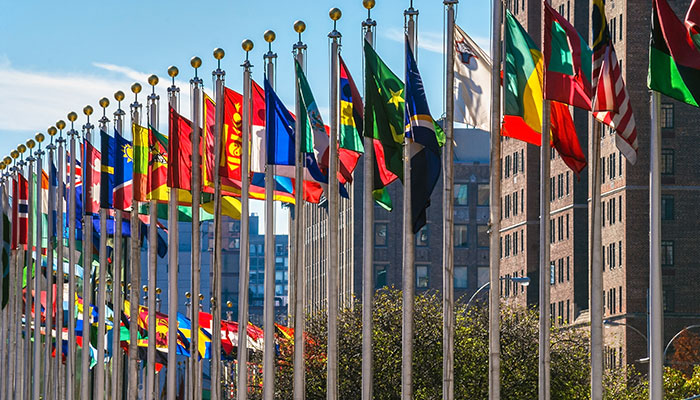
Still, the UN has faced tough times before – over many decades during the Cold War, the Security Council was crippled by deep tensions between the US and the Soviet Union. The UN is not as sidelined or divided today as it was then. However, as the relationship between China and the US sours, the achievements of global co-operation are being eroded.
The way in which people speak about the UN often implies a level of coherence and bureaucratic independence that the UN rarely possesses. A failure of the UN is normally better understood as a failure of international co-operation.
We see this recently in the UN’s inability to deal with crises from the ethnic cleansing of the Rohingya Muslims in Myanmar, to civil conflict in Syria, and the failure of the Security Council to adopt a COVID-19 resolution calling for ceasefires in conflict zones and a co-operative international response to the pandemic.
The UN administration is not primarily to blame for these failures; rather, the problem is the great powers – in the case of COVID-19, China and the US – refusing to co-operate.
Where states fail to agree, the UN is powerless to act.
Marking the 75th anniversary of the official formation of the UN, when 50 founding nations signed the UN Charter on June 26, 1945, we look at some of its key triumphs and resounding failures.
Five successes
1. Peacekeeping
The United Nations was created with the goal of being a collective security organisation. The UN Charter establishes that the use of force is only lawful either in self-defence or if authorised by the UN Security Council. The Security Council’s five permanent members, being China, US, UK, Russia and France, can veto any such resolution.
The UN’s consistent role in seeking to manage conflict is one of its greatest successes.
A key component of this role is peacekeeping. The UN under its second secretary-general, the Swedish statesman Dag Hammarskjöld – who was posthumously awarded the Nobel Peace prize after he died in a suspicious plane crash – created the concept of peacekeeping. Hammarskjöld was responding to the 1956 Suez Crisis, in which the US opposed the invasion of Egypt by its allies Israel, France and the UK.
UN peacekeeping missions involve the use of impartial and armed UN forces, drawn from member states, to stabilise fragile situations. “The essence of peacekeeping is the use of soldiers as a catalyst for peace rather than as the instruments of war,” said then UN Secretary-General Javier Pérez de Cuéllar, when the forces won the 1988 Nobel Peace Prize following missions in conflict zones in the Middle East, Africa, Asia, Central America and Europe.
However, peacekeeping also counts among the UN’s major failures.
2. Law of the Sea
Negotiated between 1973 and 1982, the UN Convention on the Law of the Sea (UNCLOS) set up the current international law of the seas. It defines states’ rights and creates concepts such as exclusive economic zones, as well as procedures for the settling of disputes, new arrangements for governing deep sea bed mining, and importantly, new provisions for the protection of marine resources and ocean conservation.
Mostly, countries have abided by the convention. There are various disputes that China has over the East and South China Seas which present a conflict between power and law, in that although UNCLOS creates mechanisms for resolving disputes, a powerful state isn’t necessarily going to submit to those mechanisms.
Secondly, on the conservation front, although UNCLOS is a huge step forward, it has failed to adequately protect oceans that are outside any state’s control. Ocean ecosystems have been dramatically transformed through overfishing. This is an ecological catastrophe that UNCLOS has slowed, but failed to address comprehensively.
3. Decolonisation
The idea of racial equality and of a people’s right to self-determination was discussed in the wake of World War I and rejected. After World War II, however, those principles were endorsed within the UN system, and the Trusteeship Council, which monitored the process of decolonisation, was one of the initial bodies of the UN.
Although many national independence movements only won liberation through bloody conflicts, the UN has overseen a process of decolonisation that has transformed international politics. In 1945, around one third of the world’s population lived under colonial rule. Today, there are less than 2 million people living in colonies.
When it comes to the world’s First Nations, however, the UN generally has done little to address their concerns, aside from the non-binding UN Declaration on the Rights of Indigenous Peoples of 2007.
4. Human rights
The Human Rights Declaration of 1948 for the first time set out fundamental human rights to be universally protected, recognising that the “inherent dignity and of the equal and inalienable rights of all members of the human family is the foundation of freedom, justice and peace in the world”.
Since 1948, 10 human rights treaties have been adopted – including conventions on the rights of children and migrant workers, and against torture and discrimination based on gender and race – each monitored by its own committee of independent experts.
The language of human rights has created a new framework for thinking about the relationship between the individual, the state and the international system. Although some people would prefer that political movements focus on ‘liberation’ rather than ‘rights’, the idea of human rights has made the individual person a focus of national and international attention.
5. Free trade
Depending on your politics, you might view the World Trade Organisation as a huge success, or a huge failure.
The WTO creates a near-binding system of international trade law with a clear and efficient dispute resolution process.
The majority Australian consensus is that the WTO is a success because it has been good for Australian famers especially, through its winding back of subsidies and tariffs.
However, the WTO enabled an era of globalisation which is now politically controversial.
Recently, the US has sought to disrupt the system. In addition to the trade war with China, the Trump Administration has also refused to appoint tribunal members to the WTO’s Appellate Body, so it has crippled the dispute resolution process. Of course, the Trump Administration is not the first to take issue with China’s trade strategies, which include subsidises for ‘State Owned Enterprises’ and demands that foreign firms transfer intellectual property in exchange for market access.
The existence of the UN has created a forum where nations can discuss new problems, and climate change is one of them. The Intergovernmental Panel on Climate Change (IPCC) was set up in 1988 to assess climate science and provide policymakers with assessments and options. In 1992, the UN Framework Convention on Climate Change created a permanent forum for negotiations.
However, despite an international scientific body in the IPCC, and 165 signatory nations to the climate treaty, global greenhouse gas emissions have continued to increase.
Under the Paris Agreement, even if every country meets its greenhouse gas emission targets we are still on track for ‘dangerous warming’. Yet, no major country is even on track to meet its targets; while emissions will probably decline this year as a result of COVID-19, atmospheric concentrations of greenhouse gases will still increase.
This illustrates a core conundrum of the UN in that it opens the possibility of global cooperation, but is unable to constrain states from pursuing their narrowly conceived self-interests. Deep co-operation remains challenging.
Five failures of the UN
1. Peacekeeping
During the Bosnian War, Dutch peacekeeping forces stationed in the town of Srebrenica, declared a ‘safe area’ by the UN in 1993, failed in 1995 to stop the massacre of more than 8000 Muslim men and boys by Bosnian Serb forces. This is one of the most widely discussed examples of the failures of international peacekeeping operations.
On the massacre’s 10th anniversary, then UN Secretary General Kofi Annan wrote that the UN had “made serious errors of judgement, rooted in a philosophy of impartiality”, contributing to a mass murder that would “haunt our history forever”.
If you look at some of the other infamous failures of peacekeeping missions – in places such as Rwanda, Somalia and Angola – it is the limited powers given to peacekeeping operations that have resulted in those failures.
2. The invasion of Iraq
The invasion of Iraq by the US in 2003, which was unlawful and without Security Council authorisation, reflects the fact that the UN is has very limited capacity to constrain the actions of great powers.
The Security Council designers created the veto power so that any of the five permanent members could reject a Council resolution, so in that way it is programmed to fail when a great power really wants to do something that the international community generally condemns.
In the case of the Iraq invasion, the US didn’t veto a resolution, but rather sought authorisation that it did not get. The UN, if you go by the idea of collective security, should have responded by defending Iraq against this unlawful use of force.
The invasion proved a humanitarian disaster with the loss of more than 400,000 lives, and many believe that it led to the emergence of the terrorist Islamic State.
3. Refugee crises
The UN brokered the 1951 Refugee Convention to address the plight of people displaced in Europe due to World War II; years later, the 1967 Protocol removed time and geographical restrictions so that the Convention can now apply universally (although many countries in Asia have refused to sign it, owing in part to its Eurocentric origins).
Despite these treaties, and the work of the UN High Commission for Refugees, there is somewhere between 30 and 40 million refugees, many of them, such as many Palestinians, living for decades outside their homelands. This is in addition to more than 40 million people displaced within their own countries.
While for a long time refugee numbers were reducing, in recent years, particularly driven by the Syrian conflict, there have been increases in the number of people being displaced.
During the COVID-19 crisis, boatloads of Rohingya refugees were turned away by port after port. This tragedy has echoes of pre-World War II when ships of Jewish refugees fleeing Nazi Germany were refused entry by multiple countries.
And as a catastrophe of a different kind looms, there is no international framework in place for responding to people who will be displaced by rising seas and other effects of climate change.
4. Conflicts without end
Across the world, there is a shopping list of unresolved civil conflicts and disputed territories.
Palestine and Kashmir are two of the longest-running failures of the UN to resolve disputed lands. More recent, ongoing conflicts include the civil wars in Syria and Yemen.
The common denominator of unresolved conflicts is either division among the great powers, or a lack of international interest due to the geopolitical stakes not being sufficiently high. For instance, the inaction during the Rwandan civil war in the 1990s was not due to a division among great powers, but rather a lack of political will to engage.
In Syria, by contrast, Russia and the US have opposing interests and back opposing sides: Russia backs the government of the Syrian dictator Bashar al-Assad, whereas the US does not.
5. Acting like it’s 1945
The UN is increasingly out of step with the reality of geopolitics today.
The permanent members of the Security Council reflect the division of power internationally at the end of World War II. The continuing exclusion of Germany, Japan, and rising powers such as India and Indonesia, reflects the failure to reflect the changing balance of power.
Also, bodies such as the IMF and the World Bank, which are part of the UN system, continue to be dominated by the West. In response, China has created potential rival institutions such as the Asian Infrastructure Investment Bank.
Western domination of UN institutions undermines their credibility. However, a more fundamental problem is that institutions designed in 1945 are a poor fit with the systemic global challenges – of which climate change is foremost – that we face today.