


The global order today is in flux, caught between the collapse of the post–World War II liberal framework and the absence of a coherent replacement. As conflict spreads across continents and ideologies crumble, the world appears to be returning to an older, harsher logic of geopolitics—rooted not in shared values, but in raison d’état (national interest) and balance of power.
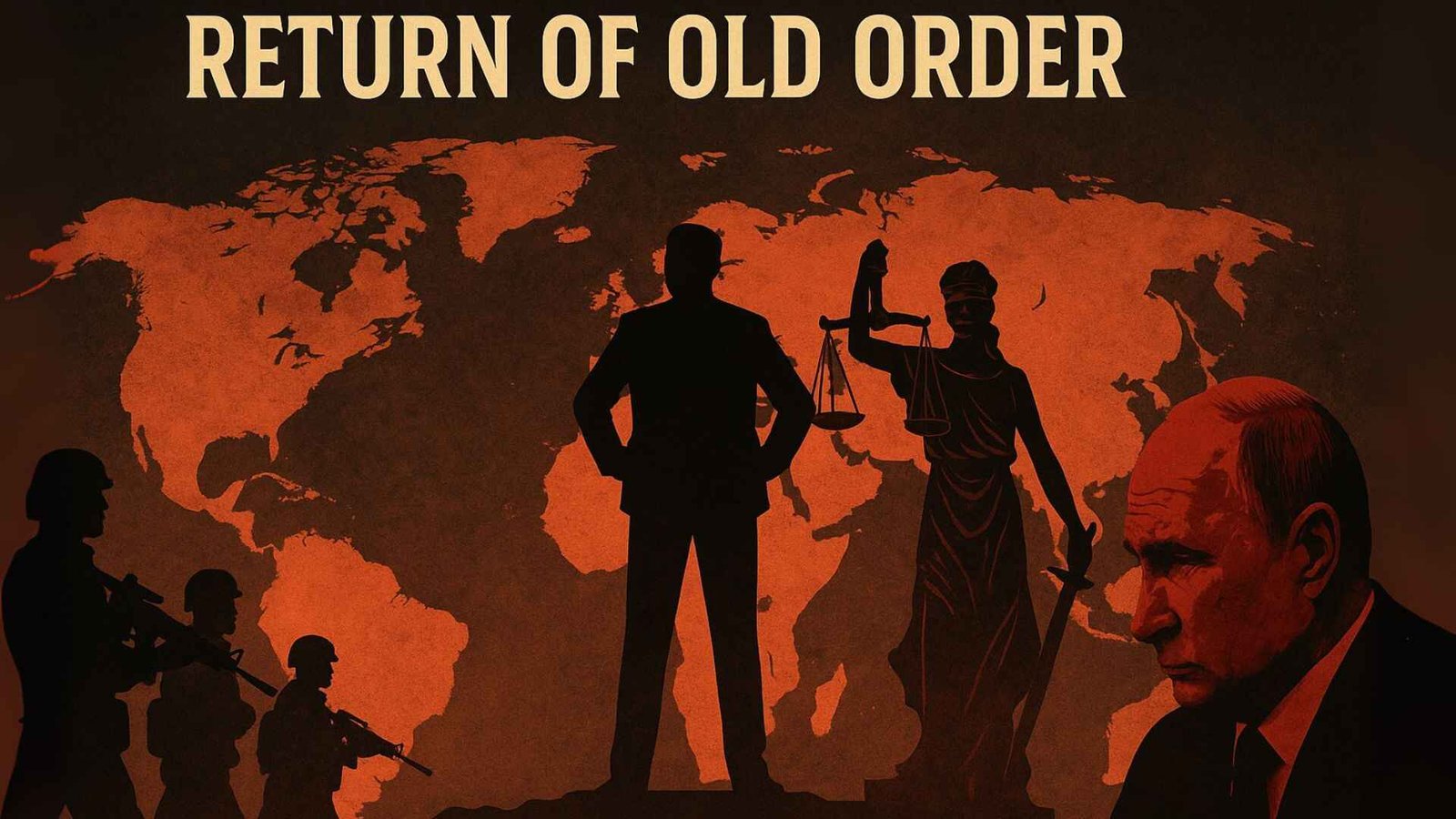 🧭 A Return to the Old Order?
Despite hopes of liberal democracy’s dominance after the Cold War—most famously asserted by Francis Fukuyama’s “End of History”—the world has veered in a different direction. Samuel Huntington’s prediction of civilizational clashes seemed more accurate as wars and tensions grew along cultural, religious, and national lines.
Today, the globe is embroiled in multi-front crises:
- Russia’s war in Ukraine
- Escalating Middle East tensions (Israel vs Hamas, Hezbollah, Houthis, Iran)
- US-Iran conflict and a renewed India–Pakistan standoff
- China’s strategic rise
- Fallout from America’s withdrawal from Afghanistan and past interventions in Iraq and Libya
These flashpoints echo 17th–20th century templates—where national interest, first strikes, and alliance systems shaped global conflict.
🏛 Origins of Modern Geopolitics
The 1648 Peace of Westphalia established the idea of sovereign nation-states. France’s Cardinal Richelieu introduced raison d’état, while Hugo Grotius and William of Orange developed balance-of-power systems. These principles—tested through events like the Concert of Vienna (1815) and two World Wars—still influence international relations today.
By the 20th century, technological change (mobilization speed, nuclear weapons) further complicated traditional strategies. The Cold War saw the emergence of MAD (mutually assured destruction), cementing power structures built on fear and alliances.
🚨 The Illusion of Liberal Victory
The post-1991 unipolar world, led by the US, seemed like the dawn of liberal democracy—but 9/11 shattered that illusion. The war on terror, interventions in Afghanistan, Iraq, and Libya failed to establish democracies or peace, exposing the limits of idealism.
Instead, actions were consistently driven by national interest, even when cloaked in moral language like “democracy promotion” or the Right to Protect.
🔁 The Cycle Repeats
China’s rise isn’t ideological—it’s a pursuit of its perceived historical destiny. The return of the Taliban wasn’t a civilizational clash—it was a strategic calculation. In every case, realpolitik has trumped idealism.
Thus, despite modern technology and economic integration, global politics continues to be ruled by centuries-old doctrines:
- Raison d’état – Nations act to protect and advance their own interests.
- Balance of power – Alliances shift to maintain strategic equilibrium.
These principles, forged in Europe’s age of empires, still dominate. And as we look ahead, they are likely to define the new global order—not something radically different, but rather a revival of an old order in modern clothes.
Receive Daily Updates
Recent Posts
Petrol in India is cheaper than in countries like Hong Kong, Germany and the UK but costlier than in China, Brazil, Japan, the US, Russia, Pakistan and Sri Lanka, a Bank of Baroda Economics Research report showed.
Rising fuel prices in India have led to considerable debate on which government, state or central, should be lowering their taxes to keep prices under control.
The rise in fuel prices is mainly due to the global price of crude oil (raw material for making petrol and diesel) going up. Further, a stronger dollar has added to the cost of crude oil.
Amongst comparable countries (per capita wise), prices in India are higher than those in Vietnam, Kenya, Ukraine, Bangladesh, Nepal, Pakistan, Sri Lanka, and Venezuela. Countries that are major oil producers have much lower prices.
In the report, the Philippines has a comparable petrol price but has a per capita income higher than India by over 50 per cent.
Countries which have a lower per capita income like Kenya, Bangladesh, Nepal, Pakistan, and Venezuela have much lower prices of petrol and hence are impacted less than India.
“Therefore there is still a strong case for the government to consider lowering the taxes on fuel to protect the interest of the people,” the report argued.
India is the world’s third-biggest oil consuming and importing nation. It imports 85 per cent of its oil needs and so prices retail fuel at import parity rates.
With the global surge in energy prices, the cost of producing petrol, diesel and other petroleum products also went up for oil companies in India.
They raised petrol and diesel prices by Rs 10 a litre in just over a fortnight beginning March 22 but hit a pause button soon after as the move faced criticism and the opposition parties asked the government to cut taxes instead.
India imports most of its oil from a group of countries called the ‘OPEC +’ (i.e, Iran, Iraq, Saudi Arabia, Venezuela, Kuwait, United Arab Emirates, Russia, etc), which produces 40% of the world’s crude oil.
As they have the power to dictate fuel supply and prices, their decision of limiting the global supply reduces supply in India, thus raising prices
The government charges about 167% tax (excise) on petrol and 129% on diesel as compared to US (20%), UK (62%), Italy and Germany (65%).
The abominable excise duty is 2/3rd of the cost, and the base price, dealer commission and freight form the rest.
Here is an approximate break-up (in Rs):
a)Base Price | 39 |
b)Freight | 0.34 |
c) Price Charged to Dealers = (a+b) | 39.34 |
d) Excise Duty | 40.17 |
e) Dealer Commission | 4.68 |
f) VAT | 25.35 |
g) Retail Selling Price | 109.54 |
Looked closely, much of the cost of petrol and diesel is due to higher tax rate by govt, specifically excise duty.
So the question is why government is not reducing the prices ?
India, being a developing country, it does require gigantic amount of funding for its infrastructure projects as well as welfare schemes.
However, we as a society is yet to be tax-compliant. Many people evade the direct tax and that’s the reason why govt’s hands are tied. Govt. needs the money to fund various programs and at the same time it is not generating enough revenue from direct taxes.
That’s the reason why, govt is bumping up its revenue through higher indirect taxes such as GST or excise duty as in the case of petrol and diesel.
Direct taxes are progressive as it taxes according to an individuals’ income however indirect tax such as excise duty or GST are regressive in the sense that the poorest of the poor and richest of the rich have to pay the same amount.
Does not matter, if you are an auto-driver or owner of a Mercedes, end of the day both pay the same price for petrol/diesel-that’s why it is regressive in nature.
But unlike direct tax where tax evasion is rampant, indirect tax can not be evaded due to their very nature and as long as huge no of Indians keep evading direct taxes, indirect tax such as excise duty will be difficult for the govt to reduce, because it may reduce the revenue and hamper may programs of the govt.