


Background
- A heatwave is a period of unusually hot weather with above normal temperatures that typically last three or more days. In India, heatwaves are generally experienced during March-June.
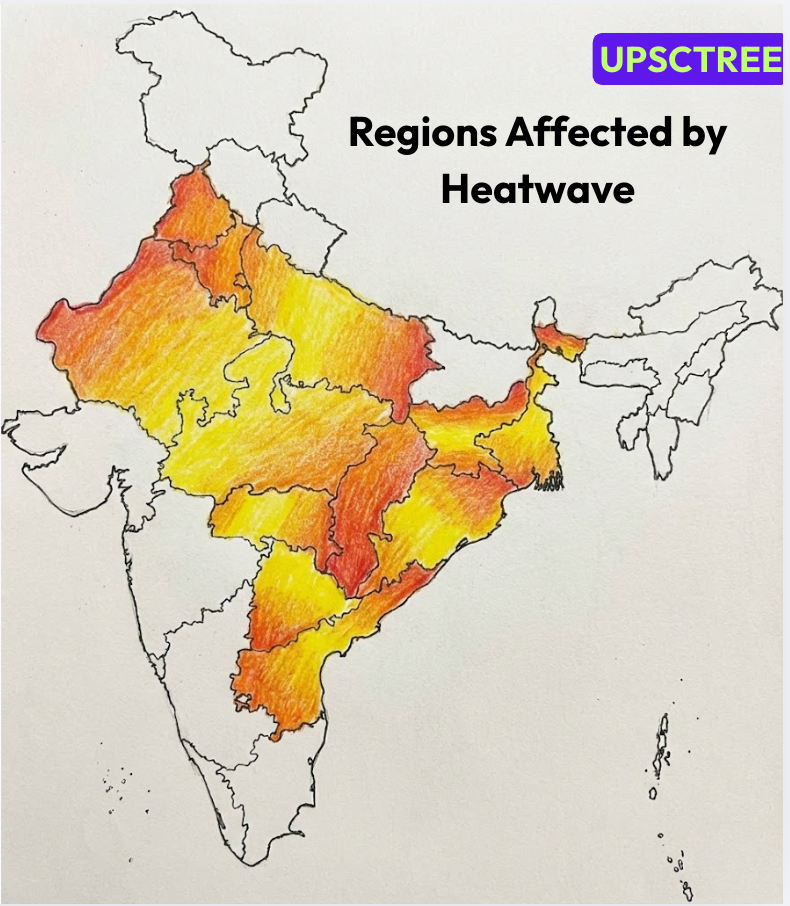
- On an average, two-three heatwave events are expected every season. Heatwaves are predominantly observed over two areas, central and northwest India and another over coastal Andhra Pradesh and Odisha, supported by favourable atmospheric conditions.
- Total duration of heatwaves has increased by about three days during the last 30 years and a further increase of 12-18 days is expected by 2060. In future climate, heatwaves will be spread to new areas including southern parts of India. Climate change is causing heatwaves more frequently, and they are much stronger and can last for more days.

Caused fatalities
- Heatwaves have multiple and cascading impact on human health, ecosystems, agriculture, energy, water and economy.
- The recent 2022 heatwave in India and Pakistan in March-April made devastating impacts.
- It is estimated to have led at least 90 deaths across India and Pakistan. It also triggered an extreme Glacial Lake Outburst Flood in northern Pakistan.
How are heatwaves caused?
- Heatwaves are caused by large scale atmospheric circulation anomalies like high pressure areas, upper-tropospheric, jet streams, etc.
- The global forcing like the El Nino/Southern Oscillation (ENSO) and the Indian Ocean modulate the frequency and duration of Indian
- heatwaves. Heatwave can be further accentuated by local effects like depleted soil moisture and enhanced sensible heat flux.
Major regions affected by Heatwave in India
How good is our early warning system for heatwaves?
- Research helped us to improve our understanding on the underlying mechanism of its genesis and intensity
- Under the National Monsoon Mission, the Ministry of Earth Sciences (MoES) had established an advanced prediction system for early warnings of heatwaves.
- IMD has the capability to predict the genesis, duration and intensity of heatwave events with reasonable accuracy up to four-five days in advance.
- Adaptation to heatwaves can be effective to minimize the negative impacts, by developing a comprehensive heat response plan that includes early warnings, awareness rising and technology intervention.
- India has now a strong national framework for heat action plans involving the India Meteorological Department (IMD), the National and State disaster management authorities, and local bodies.
- Early warning systems are an integral part of this heat action plan.
Can we then predict heatwaves two weeks in advance and what about a season in advance?
- A recent study published in the Scientific Reports by the scientists at the Indian Institute of Tropical Meteorology (IITM), Pune, has shown that heatwave genesis and duration in India can be predicted with good skill up to two weeks in advance.
- They have used the hindcasts from the MoES Extended Range Prediction System (ERPS) that uses ensemble method combining four atmospheric general circulation models.
Improved prediction
- The model could reproduce the spatial distribution of heatwave frequency and duration very well. The model also showed useful skill in predicting the characteristics of heatwaves for different months (April to June) separately.
- The model skill in predicting heatwaves arises due to its fidelity in reproducing the impacts of ENSO and the Indian Ocean on atmospheric circulation anomalies over the Indian region.
- Thus, we have an end-to-end seamless prediction system to predict heatwaves in all time scales, from short-range to seasonal. The seasonal forecast will provide an outlook or probability of frequency and duration of heatwaves, one season in advance.
- This early outlook can be further strengthened using the extended range (two weeks) and short range (four-five days) forecasts for more focused region-wise response strategies.
- Seasonal forecasts should use a multi-model ensemble (MME) forecasting strategy. Short- range ensemble forecasts should use higher resolution global models, initialized with observed soil moisture data, which are available from microwave satellites and IMD’s soil moisture network. We should then expect more advanced forecasting system for heatwaves in the near future.
Receive Daily Updates
Recent Posts
Petrol in India is cheaper than in countries like Hong Kong, Germany and the UK but costlier than in China, Brazil, Japan, the US, Russia, Pakistan and Sri Lanka, a Bank of Baroda Economics Research report showed.
Rising fuel prices in India have led to considerable debate on which government, state or central, should be lowering their taxes to keep prices under control.
The rise in fuel prices is mainly due to the global price of crude oil (raw material for making petrol and diesel) going up. Further, a stronger dollar has added to the cost of crude oil.
Amongst comparable countries (per capita wise), prices in India are higher than those in Vietnam, Kenya, Ukraine, Bangladesh, Nepal, Pakistan, Sri Lanka, and Venezuela. Countries that are major oil producers have much lower prices.
In the report, the Philippines has a comparable petrol price but has a per capita income higher than India by over 50 per cent.
Countries which have a lower per capita income like Kenya, Bangladesh, Nepal, Pakistan, and Venezuela have much lower prices of petrol and hence are impacted less than India.
“Therefore there is still a strong case for the government to consider lowering the taxes on fuel to protect the interest of the people,” the report argued.
India is the world’s third-biggest oil consuming and importing nation. It imports 85 per cent of its oil needs and so prices retail fuel at import parity rates.
With the global surge in energy prices, the cost of producing petrol, diesel and other petroleum products also went up for oil companies in India.
They raised petrol and diesel prices by Rs 10 a litre in just over a fortnight beginning March 22 but hit a pause button soon after as the move faced criticism and the opposition parties asked the government to cut taxes instead.
India imports most of its oil from a group of countries called the ‘OPEC +’ (i.e, Iran, Iraq, Saudi Arabia, Venezuela, Kuwait, United Arab Emirates, Russia, etc), which produces 40% of the world’s crude oil.
As they have the power to dictate fuel supply and prices, their decision of limiting the global supply reduces supply in India, thus raising prices
The government charges about 167% tax (excise) on petrol and 129% on diesel as compared to US (20%), UK (62%), Italy and Germany (65%).
The abominable excise duty is 2/3rd of the cost, and the base price, dealer commission and freight form the rest.
Here is an approximate break-up (in Rs):
a)Base Price | 39 |
b)Freight | 0.34 |
c) Price Charged to Dealers = (a+b) | 39.34 |
d) Excise Duty | 40.17 |
e) Dealer Commission | 4.68 |
f) VAT | 25.35 |
g) Retail Selling Price | 109.54 |
Looked closely, much of the cost of petrol and diesel is due to higher tax rate by govt, specifically excise duty.
So the question is why government is not reducing the prices ?
India, being a developing country, it does require gigantic amount of funding for its infrastructure projects as well as welfare schemes.
However, we as a society is yet to be tax-compliant. Many people evade the direct tax and that’s the reason why govt’s hands are tied. Govt. needs the money to fund various programs and at the same time it is not generating enough revenue from direct taxes.
That’s the reason why, govt is bumping up its revenue through higher indirect taxes such as GST or excise duty as in the case of petrol and diesel.
Direct taxes are progressive as it taxes according to an individuals’ income however indirect tax such as excise duty or GST are regressive in the sense that the poorest of the poor and richest of the rich have to pay the same amount.
Does not matter, if you are an auto-driver or owner of a Mercedes, end of the day both pay the same price for petrol/diesel-that’s why it is regressive in nature.
But unlike direct tax where tax evasion is rampant, indirect tax can not be evaded due to their very nature and as long as huge no of Indians keep evading direct taxes, indirect tax such as excise duty will be difficult for the govt to reduce, because it may reduce the revenue and hamper may programs of the govt.